
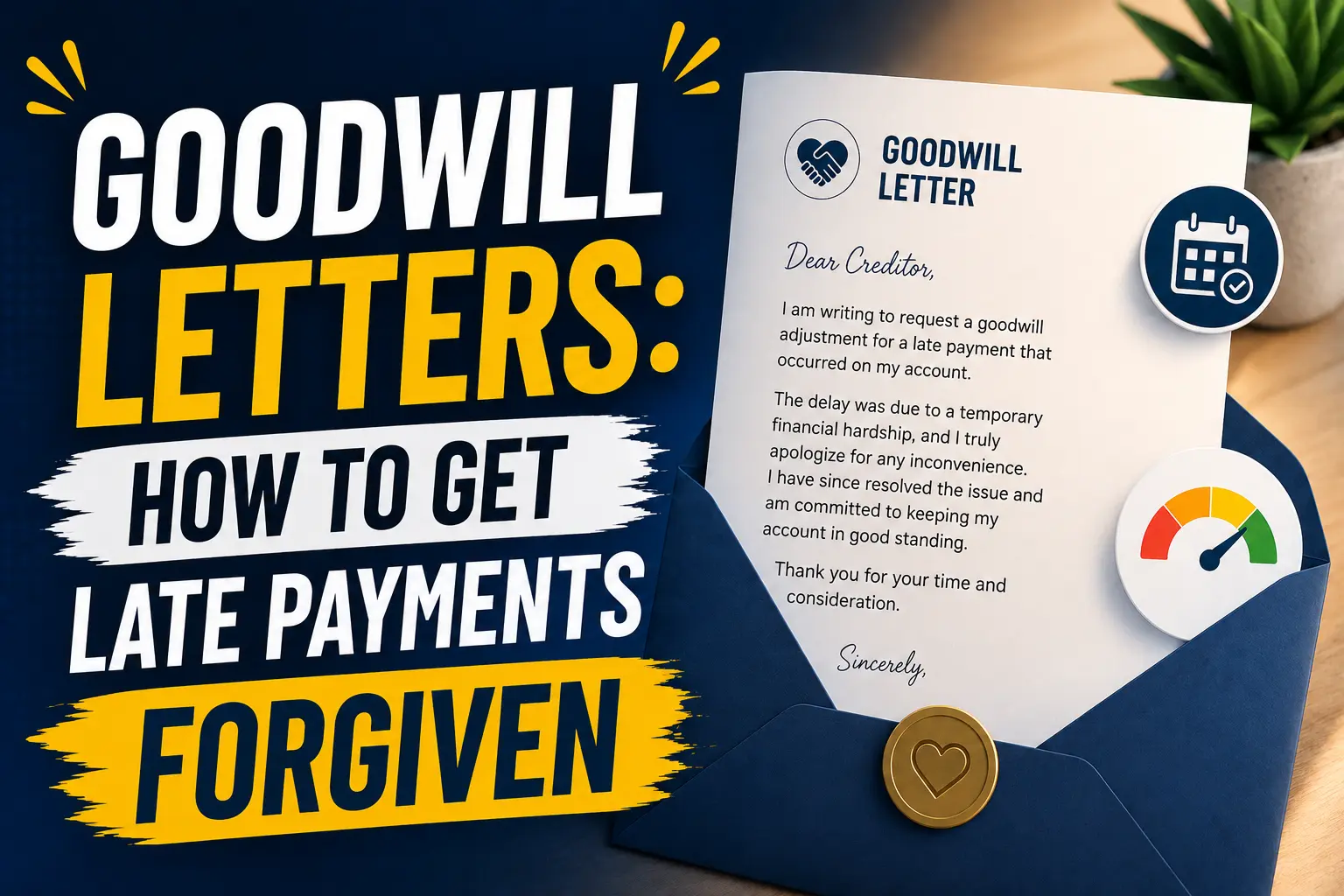
A late payment can leave a mark on your credit report, even if it was a one-time mistake. But, there is a way, if the payment was accurate, you can still ask the creditor to remove it by sending a goodwill letter.
A goodwill letter can help you here. But goodwill requests are different from credit repair dispute letters, which are used to challenge inaccurate or incomplete information. Knowing the difference can help you choose the right approach for your situation.
What Is a Goodwill Letter?
A goodwill letter is a written request to a creditor or lender asking them to remove a negative item, such as a late payment, from your credit report as a courtesy.
The key point is that you are not claiming the information is wrong. You are acknowledging that the late payment happened and asking the creditor to consider removing it based on your circumstances.
For example, you might explain that:
- You experienced a temporary financial hardship.
- You were dealing with an unexpected personal or financial event.
- You accidentally missed a payment despite normally paying on time.
- You misunderstood a payment due date.
- You have since brought the account current and maintained a good payment history.
A creditor is generally not required to approve a goodwill request. The decision is voluntary and depends on the creditor’s policies and your individual situation.
How Does a Goodwill Letter Work?
Basically it means you contact the company that reported the late payment and make a reasonable, personal request for help. A strong goodwill letter usually has four parts:
- Identify the account: Provide enough information for the creditor to locate your account.
- Explain what happened: Give a short and honest explanation for the missed payment.
- Show what has changed: Explain how you resolved the situation and why the late payment was an isolated event.
- Make a specific request: Ask the creditor to consider removing the late payment from your credit reports as a goodwill adjustment.
The goal is not to argue with the creditor. It is to show that the late payment does not represent your normal financial behavior and respectfully ask for a second chance.
For example, someone who has made dozens of payments on time but missed one payment during a temporary hardship may have a stronger goodwill request than someone with a long history of repeated late payments.
Goodwill Letter vs. Credit Repair Dispute Letter
This is one of the most important distinctions to understand before sending a letter. A goodwill letter is used when the negative information is accurate but you want the creditor to voluntarily remove it.
A credit repair dispute letter is used when you believe information on your credit report is inaccurate, incomplete, duplicated, outdated, or otherwise incorrectly reported.
| Goodwill Letter | Credit Repair Dispute Letter |
| Requests a voluntary courtesy adjustment | Challenges inaccurate or incomplete information |
| Usually sent to the creditor or lender | Can be sent to the credit bureau and/or information furnisher |
| Does not claim the information is inaccurate | Explains why the information is inaccurate or incomplete |
| Removal is generally at the creditor’s discretion | The dispute must be investigated under applicable credit reporting rules |
| Often used for accurate late payments | Used for legitimate credit report errors |
Federal consumer guidance says accurate negative information generally cannot simply be removed because it is unfavorable. However, inaccurate or incomplete information can be disputed with the credit reporting company and the business that supplied the information.
When Should You Send a Goodwill Letter?
A goodwill request may make sense when the late payment is accurate but there is a reasonable explanation behind it.
It can be particularly worth considering when the late payment is an isolated incident and your account otherwise shows a strong payment history.
For example, imagine you had a credit card for several years and consistently paid on time. You then missed one payment after an unexpected financial problem, caught up shortly afterward, and have made every payment on time since. You could explain that history in your goodwill letter and ask the creditor to consider removing the late payment as a courtesy.
Your request may be less persuasive if the account has numerous recent late payments or a continuing history of missed payments. Still, you can make a respectful request. Just avoid presenting a goodwill letter as a guaranteed solution.
What Should You Include in a Goodwill Letter?
A good goodwill letter does not need to be several pages long. In most cases, clear and personal writing is more useful than a long explanation. Include the following:
1. Your Account Information
Give the creditor enough information to identify your account. Depending on the company’s requirements, this may include your name, address, account number, and other identifying information. Avoid putting unnecessary sensitive information into a letter.
2. A Clear Explanation
Briefly explain why you missed the payment. But you do not need to provide an extremely detailed personal story. Focus on the relevant facts and explain why the missed payment was unusual.
3. Your Payment History
If you have generally paid the account on time, mention it. A creditor may be more receptive when you can show that the late payment was an isolated mistake rather than part of an ongoing pattern.
4. What You Have Done Since
Explain how you corrected the situation. For example, you might mention that you paid the overdue amount, brought the account current, set up automatic payments, or changed your payment system to prevent another missed payment.
5. A Specific Request
Do not leave the creditor guessing about what you want. Ask them to consider removing the late payment from your credit reports as a goodwill adjustment.
Remember, keep the tone respectful. You are asking for a courtesy, not demanding that the creditor change accurate information.
Goodwill Letter Template for a Late Payment
Here is a simple example you can customize:
Subject: Goodwill Request for Removal of Late Payment
Dear [Creditor Name],
I am writing regarding my [account type] account ending in [last four digits].
I understand that a late payment was reported on my account for [month/year]. I take responsibility for the missed payment and understand that the information reported reflects what occurred.
The late payment happened because [brief explanation]. This was an unusual situation for me, and I took steps to resolve it. Since then, I have [explain what you did to prevent another missed payment], and I have worked to maintain a consistent payment history.
I value my relationship with [creditor name] and would be grateful if you would consider removing the late payment from my credit reports as a goodwill adjustment.
I understand that this request is being made as a courtesy and that the decision is at your discretion. Thank you for taking the time to review my request.
Sincerely,
[Your Name]
[Contact Information]
[Account Information]
The strongest version of this letter is usually the one that accurately reflects your situation. Avoid copying a generic story that does not apply to you.
How to Send a Goodwill Letter
You have to start by identifying the company that reported the late payment. You can usually find the creditor or furnisher listed on your credit report. Then check the company’s website or account information for the appropriate correspondence address. Some companies have specific departments or addresses for credit reporting matters.
Keep a copy of everything you send, including the letter and supporting documents. You can also consider sending the request in a way that gives you proof of delivery. For formal credit report disputes, the CFPB and FTC recommend keeping documentation and provide guidance on written disputes.
If the creditor says no, you can decide whether to make another reasonable request later, but avoid sending the exact same letter repeatedly without adding anything useful.
What If the Creditor Says No?
A rejected goodwill request does not mean you have no other options. First, review the late payment and make sure the information is accurate. If you actually paid on time, notice an incorrect date, or find another reporting error, you may have a legitimate reason to challenge it.
That is where dispute letters for credit repair can help. Instead of asking for a favor, you are asking the creditor or credit bureau to investigate information you believe is inaccurate or incomplete.
Can Credit Repair Dispute Letters Help Instead?
Yes, but only when there is a genuine error on your credit report. Unlike a goodwill letter, credit repair dispute letters are used to challenge information you believe is inaccurate or incomplete.
For example, if you paid a credit card bill on time but it was reported as 30 days late, you can explain the error and provide proof of payment. The credit bureau or creditor can then review the information and make corrections if the dispute is valid.
Goodwill Request or Formal Dispute?
Use the goodwill approach when the late payment is accurate and you are asking for a voluntary courtesy adjustment.
Use a formal dispute when you have a legitimate reason to believe the information is inaccurate or incomplete.
Do not turn an accurate late payment into a false dispute just because you want it removed. Accurate negative information can generally remain on your credit report for up to seven years, while some types of information have different reporting periods.
Final Thoughts: Start With the Right Letter
A goodwill letter can be worth trying when an accurate late payment was a one-time mistake. If the information is inaccurate, credit repair dispute letters may be the better option.
The key is choosing the right approach for your situation. Need help reviewing your credit report and identifying what you can dispute? Start your credit repair journey today.
FAQ
Can a goodwill letter remove a late payment?
It can, but there is no guarantee. A goodwill letter asks the creditor to voluntarily remove or adjust an accurate late payment as a courtesy. The creditor decides whether to approve the request.
How successful are goodwill letters?
Success depends on factors such as the creditor’s policies, your payment history, the reason for the missed payment, and your overall relationship with the company. A strong history of on-time payments and an isolated late payment may make your request more persuasive, but approval is never guaranteed.
Can I write my own goodwill letter?
Yes. You can write a goodwill letter yourself. Keep it concise, honest, personal, and specific about what you are asking the creditor to do.
What is the difference between a goodwill letter and a dispute letter?
A goodwill letter asks a creditor to voluntarily remove an accurate negative item. A dispute letter challenges information that you believe is inaccurate or incomplete. You should not dispute accurate information simply because it is negative.
How many goodwill letters can I send?
There is no universal number that guarantees success. If your first request is rejected, you may choose to make another reasonable request, especially if you have new relevant information. Avoid flooding the creditor with repetitive requests.
Can a creditor remove an accurate late payment?
A creditor may choose to make a voluntary adjustment, but it is not required to remove accurate information simply because you ask. Accurate negative information can generally remain on a credit report for the applicable reporting period.