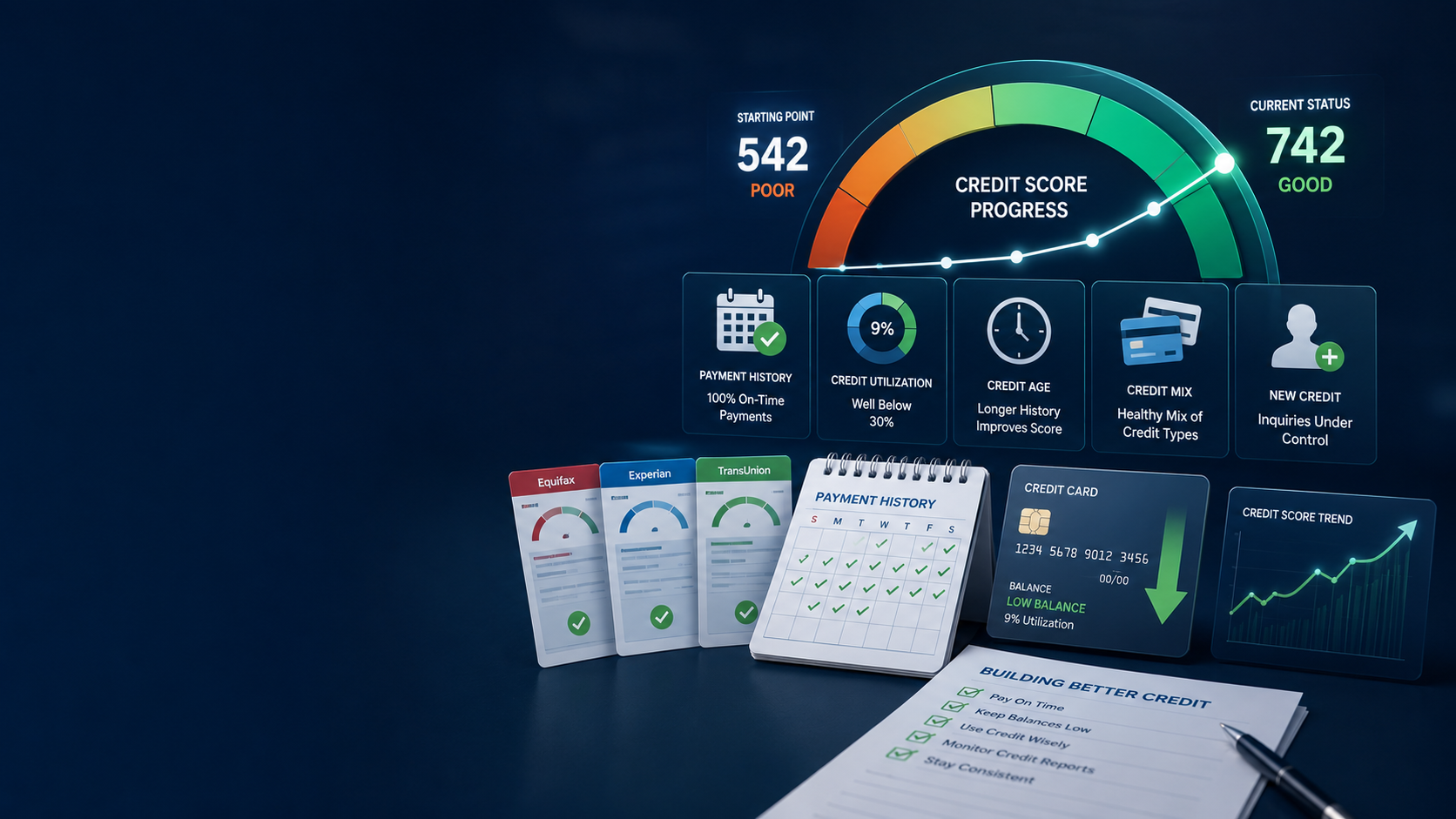
This guide walks through seven steps that genuinely move the needle. No “secret loopholes,” no overnight promises, no gimmicks that sound too good to be true (because they are). What you’ll find instead is a clear, plain-English explanation of how credit scores work, what hurts them most, what you can fix in 30 days versus what takes patience, and the realistic habits that keep your score climbing for the long haul. By the end, you’ll have a roadmap you can start on today — even if that first step is just pulling your reports and seeing where you stand.
If you’d rather have a professional walk through your reports with you, that’s where we come in. At , we offer a free credit audit across all three major bureaus, and we’ll tell you straight — no pressure, no hype — what we see and what, if anything, is worth disputing. But whether you work with us or go it alone, the steps below are yours to use.
How Your Credit Score Is Actually Calculated
Before you can fix something, it helps to understand how it’s built. Most lenders in the United States use the FICO Score, and the newer VantageScore follows a very similar logic. Both range from 300 to 850, and both are calculated from the information in your credit reports at the three major bureaus — Equifax, Experian, and TransUnion. (It’s worth noting that you actually have a separate score at each bureau, because each bureau has its own copy of your file, and they don’t always match.)
FICO breaks your score down into five weighted factors. Knowing these percentages tells you exactly where to focus your energy:
The Five Factors and Their Weights
- Payment history — 35%. This is the single biggest piece of your score. It asks one question: have you paid your credit accounts on time? Late payments, collections, charge-offs, repossessions, and bankruptcies all live here. Because it’s the heaviest weight, it’s also where the biggest gains (and the biggest drops) come from.
- Amounts owed — 30%. This is mostly about credit utilization — how much of your available credit you’re using at any given moment. If you have a card with a $5,000 limit and you carry a $2,500 balance, your utilization on that card is 50%. High utilization signals to lenders that you might be stretched thin, even if you’ve never missed a payment.
- Length of credit history — 15%. This factor considers the age of your oldest account, the age of your newest account, and the average age of all your accounts. Older is better, because a longer track record gives lenders more to judge you on.
- Credit mix — 10%. Lenders like to see that you can handle different types of credit — a revolving account (like a credit card) alongside an installment loan (like a car loan, mortgage, or personal loan). You don’t need one of everything, but a reasonable mix helps.
- New credit — 10%. Every time you apply for new credit, a hard inquiry is recorded on your report. One or two is fine. A sudden burst of applications in a short window looks risky and can temporarily ding your score.
Why This Breakdown Matters for Your Strategy
Notice that payment history and amounts owed together account for 65% of your score. That’s almost two-thirds of the entire calculation. If you only had the bandwidth to work on two things, those two would give you by far the biggest return. The other three factors — length of history, credit mix, and new credit — matter, and we’ll cover them, but they’re smaller levers and some of them (like the age of your oldest account) can only improve with time.
This is also why “quick-fix” schemes that promise to erase legitimate negative marks overnight are misleading. The scoring model is designed to reward consistent, verifiable behavior over time. There’s no back door that lets you skip the 35% payment-history weight. But there is a legal, structured process for removing errors and outdated information — and that’s where a lot of real score gains come from.
The Score Ranges, in Plain Terms
For context, here’s how FICO generally categorizes scores:
- 800–850: Exceptional. You’ll qualify for the best rates lenders offer.
- 740–799: Very good. You’re a strong candidate for most credit at favorable terms.
- 670–739: Good. This is roughly the average range for U.S. consumers; most lenders will approve you, though not always at the lowest rates.
- 580–669: Fair. You may be approved, but you’ll likely pay higher interest and have fewer options.
- 300–579: Poor. Approval is difficult, and you may need secured products or a co-signer to rebuild.
If you’re sitting in the fair or poor range right now, don’t read that as a verdict — read it as a starting line. People move from the 500s to the 700s more often than you’d think, and the steps in this guide are exactly how they do it.
What Hurts Your Score the Most
Knowing what drags a score down is just as important as knowing what lifts it. Here are the most common culprits, roughly in order of impact, with a note on how recoverable each one is.
Late Payments
A single 30-day-late mark can drop a good score by 70 to 90 points or more, and it stays on your report for seven years. The good news: the older a late payment gets, the less it hurts. A late from five years ago barely moves the needle, while one from last month stings. And if the late payment is incorrect — say, you actually paid on time but the lender reported it wrong — it can be disputed and removed. We’ll cover that process in Step 2.
Collections and Charge-Offs
When an account goes unpaid long enough, the creditor may “charge it off” (write it off as a loss) or hand it to a collection agency. Both are serious negatives. Collections can sometimes be negotiated — a “pay-for-delete” arrangement where the collector agrees to remove the entry in exchange for payment — though not all collectors will agree, and the practice sits in a gray area. Charge-offs are tougher; even if paid, the mark can remain for seven years unless you successfully dispute it as inaccurate or outdated.
High Credit Utilization
This one is stealthy because it doesn’t feel like a problem — you’re making your payments, after all. But if you’re carrying balances close to your limits, your score is being held down every month that the high balance gets reported. The fix is often faster than people expect, which is why Step 4 is dedicated to it.
Maxed-Out or Over-Limit Cards
Going over your credit limit, or sitting right at it, is an extreme version of high utilization. Some card issuers will let you exceed your limit (often for a fee), but doing so can trigger a penalty rate and a noticeable score drop.
Bankruptcy
A Chapter 7 bankruptcy stays on your report for 10 years; a Chapter 13 stays for 7 years. It’s the most damaging single entry, but it’s also not the end of the road — many people begin rebuilding within months of discharge and reach the 700s within a few years by following exactly the kind of disciplined process in this guide.
Foreclosure and Repossession
Both are severe negatives that remain for seven years. Like bankruptcy, they’re recoverable with time and consistent positive behavior.
Hard Inquiries in a Short Window
One hard inquiry typically drops a score by fewer than five points and fades in 12 months (it stops affecting the score entirely after 24 months and falls off the report after two years). But six inquiries in a month signals distress and can compound the damage.
Settled-for-Less-Than-Full-Balance
If you negotiate with a creditor to pay less than you owe, the account may be reported as “settled,” which is less damaging than an unpaid charge-off but still a negative mark. It’s often worth pursuing when the alternative is a continued collection, but it’s not score-neutral.
Closed Accounts in Good Standing (Mostly a Myth)
A common worry is that closing an old card will tank your score. The reality is more nuanced. Closing a card doesn’t immediately shorten your length of credit history — closed accounts in good standing typically stay on your report for up to 10 years and continue contributing to your average age of accounts. The real risk is utilization: closing a card removes its credit limit from your total available credit, which can push your utilization up even if your balances don’t change. We’ll walk through that in Step 6.
Step 1: Pull All Three Reports and Know Exactly Where You Stand
You cannot fix what you have not seen. The very first step — before disputes, before strategy, before anything — is pulling your full credit reports from all three bureaus.
Where to Get Them (Free, by Law)
Under the Fair Credit Reporting Act (FCRA), you’re entitled to a free copy of your credit report from each of the three major bureaus every 12 months. Since 2023, you can actually access them weekly for free through the official site:
AnnualCreditReport.com — this is the only federally authorized site. Beware of look-alike services that charge you after a trial.
You do not need to buy a subscription or hand over a card to get your reports from AnnualCreditReport.com. If a site asks for payment information to “get your free report,” you’re on the wrong site.
What to Look For on Each Report
Pull all three. Don’t just grab one and assume the others are identical — they often aren’t. Lenders don’t always report to all three bureaus, so an account on your Experian file might not appear on your TransUnion file, and vice versa.
Go through each report methodically and check:
- Personal information — your name (and any aliases), current and past addresses, employer listings, date of birth, Social Security number. Errors here can be a sign of mixed files or, more seriously, identity theft.
- Account list — every account, with its open date, credit limit or original loan amount, current balance, payment status, and payment history. Confirm each one is actually yours.
- Negative items — late payments, collections, charge-offs, repossessions, foreclosures, public records like bankruptcies or judgments. Check the dates carefully, because most of these have expiration dates.
- Inquiries — both hard (from applications you made) and soft (from pre-approval checks or your own pulls). Only hard inquiries affect your score.
- Public records — bankruptcies, civil judgments, tax liens. (Note: as of recent years, most tax liens and civil judgments have been removed from credit reports due to reporting standard changes, but it’s still worth verifying.)
Keep a Written Inventory
As you review, make a simple list — a notebook, a spreadsheet, whatever works for you — with one row per item you’re unsure about. Columns: Bureau, Account Name, Issue, Date Reported, Date of Last Activity, Why It Looks Wrong. This inventory becomes your dispute roadmap in Step 2.
Actionable Takeaway
Set aside 30 to 45 minutes this week. Go to AnnualCreditReport.com, download all three reports, and read every line. You’re not trying to fix anything yet — you’re just seeing the full picture. Knowing exactly what’s on your file is the foundation everything else is built on.
Step 2: Dispute Every Inaccuracy You Find
This is where some of the fastest, most satisfying score improvements happen. The FCRA gives you the right to dispute any information on your credit report that you believe is inaccurate, incomplete, or unverifiable — and the bureaus are legally required to investigate, generally within 30 days.
What Counts as “Inaccurate, Incomplete, or Unverifiable”
More than you might think. Common, legitimate grounds for dispute include:
- Accounts that aren’t yours — either identity theft or a mixed file where someone else’s information was merged into your report.
- Late payments that were actually on time — lenders misreport more often than you’d expect, especially around payment-plan changes or auto-pay setup dates.
- Duplicate entries — the same debt listed twice, sometimes once by the original creditor and once by a collection agency, or appearing on two bureaus as if they’re separate debts.
- Outdated negative items — most negatives must be removed after seven years (bankruptcies after 7 or 10). If an old collection is still showing, it’s eligible for removal.
- Incorrect account details — wrong credit limit (which can hurt your utilization calculation), wrong open date (which can hurt your length-of-history calculation), wrong balance, wrong account status.
- Re-aged debts — a collector updates the “date of last activity” to make an old debt look newer than it is. This is illegal under the FCRA and a strong dispute ground.
- Accounts from a former spouse that were assigned to them in a divorce but still appear on your file (these can be more complex and may require documentation).
- Public records with errors — a bankruptcy filed by someone with a similar name, a judgment that was vacated but not updated, etc.
How to File a Dispute
You can dispute with the credit bureaus, with the furnisher (the lender or collector that reported the information), or both. Doing both is often the most thorough approach.
Disputing with the bureaus: All three allow online disputes through their websites (Equifax, Experian, TransUnion), and you can also dispute by mail. Online is faster and easier to track; mail creates a paper trail, which matters if you need to escalate later. If you dispute by mail, send it certified with return receipt so you have proof of delivery, and include:
- A copy (not the original) of the report with the disputed item circled
- A clear, factual statement of why the information is wrong
- Any supporting documents (bank statements showing on-time payment, a letter from the lender confirming an account was closed in good standing, a police report for identity theft)
- Your full name, address, date of birth, and Social Security number (for identification)
Disputing with the furnisher: Send the same information directly to the lender or collection agency at the address listed on your report. Under the FCRA, they must investigate and stop reporting the information if they can’t verify it.
What Happens After You Dispute
The bureau generally has 30 days to investigate (45 days if you dispute after receiving your free annual report). They contact the furnisher, who must verify the information. If the furnisher can’t verify it — or doesn’t respond in time — the bureau must remove or correct the item. You’ll get the results in writing, and if anything was changed, you’ll get a free updated copy of your report.
If the item is verified as accurate, it stays. But you still have options: you can add a 100-word statement of explanation to your report (less useful for scoring, but helpful context for a human reviewer), you can dispute again if you have new evidence, or you can work with a professional who can push harder on procedural and legal grounds.
When to Get Professional Help
Simple, clear-cut errors — a wrong address, an account that’s obviously not yours, a late payment you can prove was on time — are well within reach of a determined individual. But the territory gets complicated fast when you’re dealing with:
- Multiple disputed items across all three bureaus
- Collections that keep getting re-reported after removal
- Debts where the original creditor and multiple collectors all show up
- Identity theft with extensive fraudulent accounts
- Public records errors
- Furnishers who verify information you know is wrong
This is where an attorney-backed credit repair firm earns its keep. At , we work alongside experienced attorneys, we know the FCRA inside out, and we can escalate disputes — including legal action when a furnisher or bureau continues reporting information they legally cannot verify. If your case is simple, you can absolutely handle it yourself. If it’s tangled, that’s what we’re here for.
Actionable Takeaway
From your Step 1 inventory, pick every item you believe is wrong, outdated, or unverified. File disputes with the relevant bureau(s) and furnishers. Keep copies of everything. Mark your calendar for 35 days out — if you haven’t heard back by then, follow up. The FCRA gives you the right to an answer, and silence is not an acceptable one.
Step 3: Never Miss Another Payment — and Fix the Ones You’ve Missed
Since payment history is 35% of your score — the single largest factor — no other habit will protect and build your score as powerfully as paying every account on time, every month. And if you’ve already missed payments, there are a few ways to soften the damage.
Set Up the System So You Don’t Have to Remember
The goal is to make on-time payment automatic, not willpower-dependent. A few practical moves:
- Auto-pay at least the minimum on every credit card and loan. Even if you prefer to pay in full manually each month, auto-pay ensures a slip-up never turns into a 30-day-late report. You can always make an additional payment for the full balance.
- Set payment alerts — a calendar reminder three days before each due date, plus a reminder the day before, as a backup to auto-pay.
- Move due dates if they cluster badly. Many card issuers let you change your due date. If four cards all come due the same week and that’s when cash is tight, spreading them across the month can make coverage easier.
- Build a small buffer — over time, aim to keep one month’s worth of minimum payments sitting in the account your auto-pay pulls from, so a timing mismatch (a deposit clearing a day late, a weekend delay) doesn’t trigger a bounce.
What to Do About Past Misses
A late payment that already happened can’t be undone — but its impact fades, and there are a few things you can try:
- goodwill letters. If you have an otherwise solid history with a lender and a single late payment due to a documented hardship (a medical emergency, a job loss, a natural disaster), a goodwill letter asking them to remove the late mark as a courtesy sometimes works. It’s not a right, and it’s not guaranteed, but it costs nothing to ask.
- Pay-for-delete on collections. As mentioned earlier, some collection agencies will agree in writing to remove a collection from your report in exchange for payment. Get the agreement in writing before you pay — verbal promises are worthless.
- Dispute if the late is inaccurate. If the late payment is genuinely wrong — you have proof of on-time payment — dispute it under the FCRA as described in Step 2.
- Let time do its work. A 30-day late hurts most in the first two years. By year five, its impact is small. At seven years, it falls off entirely. If a late is legitimate and recent, the best strategy is simply to never miss again and let the clock run.
The One Habit That Matters Above All Others
If you take only one thing from this entire guide, let it be this: every single on-time payment is a vote in favor of your score, and every missed payment is a vote against it. The scoring model is, at its core, a long-running tally of those votes. You don’t need a perfect past to build a strong score — you need a strong recent pattern and a clean going-forward record. Start that pattern this month.
Actionable Takeaway
Today, log into every credit account you have. Turn on auto-pay for at least the minimum due. Set a monthly calendar alert for three days before each due date. If you have a recent legitimate late payment, draft a goodwill letter this week and send it. None of this requires perfect credit to start — it just requires starting.
Step 4: Bring Your Credit Utilization Under 30 Percent — Ideally Under 10
After payment history, credit utilization is the second most powerful lever in your score, and it’s one of the fastest to move. Utilization is simply the percentage of your available revolving credit that you’re using. If you have $10,000 in total credit limits across your cards and you’re carrying $3,000 in balances, your overall utilization is 30%.
The Thresholds That Matter
The general guidance, supported by years of scoring data:
- Under 30%: the broad “safe” zone. You’re not being heavily penalized, but you’re not maxing out the factor either.
- Under 10%: the “optimal” zone. People in this range tend to see the best scores. The scoring model treats very low utilization as evidence that you use credit responsibly without relying on it.
- 0%: interestingly, not ideal. A small reported balance — even just a few dollars — shows activity, which is slightly better than a completely dormant file. The sweet spot is a small balance that you pay off each month.
These thresholds apply both to your overall utilization (total balances ÷ total limits) and to per-card utilization (each card’s balance ÷ its limit). A high balance on a single card can hurt even if your overall utilization is low.
How to Lower Utilization — Several Approaches
- Pay down balances. The most straightforward approach. Every dollar you pay down lowers your utilization. If you can pay cards down to under 10% of their limits, you’ll often see a score bump within a billing cycle or two, because utilization is recalculated every time a new balance is reported (typically once a month, on your statement closing date).
- Ask for credit limit increases. If your accounts are in good standing and you’ve been with the issuer a while, a limit increase raises your denominator, which lowers your utilization even if your balances stay the same. Important: ask whether the increase will trigger a hard inquiry. Many issuers will grant a “soft” increase with no inquiry; others will hard-pull. A hard pull costs a few points short-term, which may be worth it if it meaningfully lowers your utilization long-term.
- Open a new card — cautiously. A new card adds to your total available credit, which lowers utilization. But it also adds a hard inquiry, lowers your average account age, and creates the temptation to spend. This is a reasonable move only if you trust yourself not to carry a balance on the new card. If you’re rebuilding, a secured card can serve the same purpose with lower risk.
- Make mid-cycle payments. If your statement closes on the 20th and you typically pay on the 1st, the balance reported to the bureaus is whatever you owed on the 20th — which might be high even though you pay in full. Making a payment before the statement closes means a lower balance gets reported. This is a powerful, underused technique for people who pay in full but still show high utilization.
- Keep cards open even if you don’t use them. A card with a $5,000 limit and a $0 balance contributes $5,000 to your total available credit and helps your utilization. Closing it removes that limit and can push your utilization up. If a card has no annual fee, consider keeping it open with a small recurring charge (a streaming subscription, say) and auto-pay, so it stays active and reports positively.
A Quick Example
Say you have two cards:
- Card A: $3,000 limit, $1,500 balance (50% utilization on the card)
- Card B: $2,000 limit, $0 balance (0% utilization)
Your overall utilization is $1,500 ÷ $5,000 = 30%. That’s at the threshold. But Card A’s per-card utilization is 50%, which is hurting you. Two options:
- Pay Card A down to $300 (10% of its limit). Overall drops to 6%, and Card A is in the optimal zone.
- Move $1,000 of Card A’s balance to Card B (via a balance transfer or simply by spending on Card B and paying down Card A). Now Card A is at $500/$3,000 (17%) and Card B is at $1,000/$2,000 (50%). Overall is the same, but per-card is more balanced. Still not great on Card B, though — paying down is usually the better move.
Actionable Takeaway
Find out your total credit limits and total balances across all revolving accounts. Calculate your overall utilization. If you’re above 30%, pick one of the approaches above and apply it this month. If you’re above 50%, treat it as urgent — pay down as much as you can, and consider a limit-increase request. Check your utilization again at the next statement cycle.
Step 5: Be Strategic About New Credit and Hard Inquiries
New credit is only 10% of your score, but it’s the factor most people mishandle — either by applying too often, or by being so afraid of inquiries that they never build the credit they need. The goal is intentionality.
Hard vs. Soft Inquiries — Know the Difference
- Hard inquiry: triggered when you apply for credit — a card, a loan, a mortgage, an apartment application, sometimes a new utility or cell-phone account. It appears on your report and can lower your score by a few points. It stays on your report for two years and affects your score for one.
- Soft inquiry: triggered when you check your own credit, when a lender pre-approves you, or when a current lender monitors your account. It does not affect your score.
Checking your own reports (Step 1) is a soft inquiry. It will never hurt your score, no matter how often you do it.
Rate Shopping: The Exception to the Rule
When you’re shopping for a specific type of loan — a mortgage, an auto loan, a student loan — multiple inquiries within a short window are usually treated as a single inquiry for scoring purposes. FICO uses a 45-day shopping window (older versions used 14); VantageScore uses 14. This means you can apply with five different mortgage lenders within a few weeks and take only one inquiry’s worth of damage, rather than five.
The catch: this applies only to the same type of loan. Five mortgage inquiries in a month = one inquiry. But a mortgage inquiry, two card applications, and a personal loan in the same month = four separate inquiries.
Rules of Thumb for Applying
- Don’t apply for new credit while you’re actively disputing or rebuilding. Every hard inquiry adds a small drag, and a new account lowers your average age. If your focus is dispute resolution and payment-history recovery, hold off on new applications until your score is steadier.
- Space out card applications by at least six months. Card issuers get nervous about rapid applications (some have explicit rules — Chase’s “5/24” is the most famous), and the scoring model does too.
- Only apply for credit you actually need. A store card you’ll use once for a discount, then never again, is usually not worth the inquiry and the new account. A card with rewards that match your spending, that you’ll pay in full each month, can be worth it.
- Use pre-qualification tools before formally applying. Many issuers offer a pre-qualification check that uses a soft pull and gives you a sense of your approval odds without a hard inquiry. Pre-qualification isn’t a guarantee, but it helps you avoid wasted hard pulls.
What About Secured Cards and Credit-Builder Loans?
If you’re starting from a thin file or rebuilding after a major negative, secured cards and credit-builder loans are two of the best tools available:
- Secured card: you put down a refundable deposit (often $200–$500), which becomes your credit limit. You use the card like any other, and the issuer reports your activity to the bureaus. After 6–12 months of on-time payments, many issuers will return your deposit and upgrade you to an unsecured card.
- credit-builder loan: instead of receiving money upfront, you “borrow” a small amount (say, $1,000) that’s held in a savings account. You make monthly payments — which are reported to the bureaus — and when the loan is paid off, you get the money. It builds payment history and credit mix simultaneously.
Both are low-risk, FCRA-compliant ways to add positive history to your file. They’re not shortcuts, but they work.
Actionable Takeaway
For the next six months, adopt a no-new-hard-inquiries rule unless a specific, necessary opportunity arises (a car you need to finance, a mortgage you’re ready for). Focus your energy on the bigger levers — payment history and utilization. When you do apply, use pre-qualification first, shop within the rate-shopping window, and choose products that build the kind of history you want.
Step 6: Lengthen Your Credit History and Diversify Your Credit Mix
These two factors — length of history (15%) and credit mix (10%) — are smaller levers, and much of what affects them is simply time. But there are decisions you can make now to set yourself up well.
Length of Credit History
The scoring model looks at:
- The age of your oldest account
- The age of your newest account
- The average age of all your accounts
Older is better across the board. This is why closing your oldest card can be a mistake — even though closed accounts in good standing stay on your report for up to 10 years, eventually they fall off, and at that point your length of history takes a hit. If your oldest card has an annual fee that’s no longer worth it, see if the issuer will product-change it to a no-fee card in the same family, rather than closing it outright. That preserves the account’s age and its contribution to your history.
Credit Mix
The model rewards a reasonable variety — not a perfect portfolio. Having a credit card and an installment loan (auto, personal, mortgage, student) demonstrates that you can handle both revolving and fixed-payment credit. If you only have cards, adding a small credit-builder loan can help. If you only have an installment loan, adding a secured card can help. But don’t take on debt you don’t need just to improve your mix — 10% isn’t worth paying interest you’d otherwise avoid.
When to Close a Card
Closing a card isn’t always wrong. Good reasons to close:
- The card has a high annual fee that you’re not offsetting with benefits, and a product change isn’t available.
- The issuer is dropping your limit or making the account unmanageable.
- You’re being added as an authorized user on a stronger account elsewhere and the closed card’s limit won’t hurt your overall utilization.
- The card is a temptation you genuinely can’t manage — if having it means you’ll carry a balance, the scoring math doesn’t matter as much as the behavioral reality.
Before closing, do the utilization math. Calculate what your overall utilization will be without that card’s limit. If it pushes you above 30%, either pay down balances first, or ask for a limit increase on another card to compensate.
Authorized User Strategy
Being added as an authorized user on someone else’s long-standing, low-utilization card can give your score a meaningful boost. The card’s history (often including its age and payment record) shows up on your report. This is most commonly done within families — a parent adding a young adult child, for example. Choose wisely: if the primary holder has late payments or high utilization on that card, those negatives can come along too. And make sure the issuer reports authorized-user activity to all three bureaus (most major issuers do).
Actionable Takeaway
Audit your open accounts. Identify your oldest card — make a plan to keep it open and active (a small recurring charge, auto-paid). If you have only revolving or only installment credit, consider adding one account of the missing type in the next year, when your score is steady enough to absorb the inquiry. Avoid closing cards unless there’s a clear reason, and always calculate the utilization impact first.
Step 7: Build the Long-Term Habits That Keep Your Score Climbing
The first six steps are about fixing, optimizing, and positioning. Step 7 is about sustaining. Credit scores reward consistent positive behavior over years, not weeks. The people who reach and stay in the 700s and 800s aren’t doing anything exotic — they’ve built a handful of habits and stuck with them.
Habit 1: Check Your Reports Every Year (at Least)
Set a recurring annual reminder. Pull all three reports. Skim for anything new, anything unexpected, anything that shouldn’t be there. Early detection of errors — or identity theft — saves you from finding out about a problem when a lender pulls your score and denies you.
You can also use free monitoring services (many card issuers now offer free FICO or VantageScore access) to keep an eye on your score month to month. Just remember that your score is a lagging indicator — it moves after the underlying report information changes. The report is the source; the score is the echo.
Habit 2: Treat Credit Cards Like Debit Cards
If you can’t pay for it from money you already have, don’t put it on a card. Pay the full statement balance every month. This single habit keeps utilization low, costs you zero interest, and builds a flawless payment history. Rewards cards become genuinely rewarding only when you never carry a balance — otherwise the interest eats the rewards and then some.
Habit 3: Keep an Emergency Fund
A modest emergency fund — even one month’s expenses — prevents the scenario where an unexpected cost forces you to carry a credit card balance, which spikes your utilization, which dips your score, which limits your options right when you need them most. The fund and the score protect each other.
Habit 4: Never Co-Sign Without Understanding the Risk
When you co-sign, you’re fully liable for the debt, and it appears on your report. If the primary borrower pays late, your score takes the hit. If you’re asked to co-sign, consider whether you’re willing and able to take over the payments yourself if needed — because that’s the scenario you’re insuring against.
Habit 5: Communicate With Lenders Early
If you’re going to miss a payment — job loss, medical bill, emergency expense — call the lender before the due date. Many have hardship programs, payment deferral options, or goodwill arrangements that can keep a late mark off your report. Lenders would rather work with you than send you to collections. The call is uncomfortable; a 90-day-late mark is worse.
Habit 6: Keep Your Utilization Low, Forever
This isn’t a one-time fix — it’s an ongoing practice. Even after you’ve paid your balances down, life happens. A big purchase, a temporary income dip, a holiday season can push utilization back up. Watch it. The mid-cycle payment technique from Step 4 is a habit you can use indefinitely.
Habit 7: Educate Yourself
You don’t need to become a credit expert, but a basic, ongoing familiarity with the FCRA, your rights, and how the scoring model works puts you in control. The more you understand, the less intimidating the whole system feels — and the harder it is for anyone (a shady “credit repair” operation, a collector using illegal tactics, a lender reporting incorrectly) to take advantage of you.
This is part of our philosophy at . We don’t just fix your credit; we want you to leave the process knowing more than you did when you started, so you can keep your credit strong for life. We’re a long-term partner, not a one-time service.
Actionable Takeaway
Pick one habit from the list above and commit to it for the next 90 days. Just one. Maybe it’s checking your reports annually. Maybe it’s paying your statement balance in full. Maybe it’s building a one-month emergency fund. Small, sustained habits compound — in savings, in scores, and in peace of mind.
A Realistic Timeline: What Takes 30 Days, 6 Months, and 1+ Years
One of the most frustrating things about credit repair is that it doesn’t move on your schedule. Understanding what’s realistic at each horizon helps you stay motivated and avoid falling for “overnight” promises.
Within 30 Days
- Dispute resolutions. Many FCRA disputes are resolved within the 30-day investigation window. If an item is removed, you may see a score bump within a billing cycle or two, once the updated report is reflected.
- Utilization drops. If you pay down a high balance and the new, lower balance is reported at your next statement closing date, you can see a meaningful score increase within 30 days.
- Credit limit increases. If you request and receive a soft-pull limit increase, your utilization improves immediately.
- New reporting. A new on-time payment is added to your history each month. One on-time payment won’t transform a score, but it contributes to the pattern.
Realistic expectation: a 10–40 point gain is achievable in 30 days for some people, particularly those whose score was being held down by a single removable error or by high utilization that they’ve now addressed. Not everyone will see this — if your score is suppressed by legitimate recent negatives, 30 days won’t move it much.
Within 6 Months
- A clean payment streak. Six consecutive on-time payments establishes a clear recent pattern of positive behavior, which starts to offset older negatives.
- Secured card / credit-builder loan history. Six months of reported activity on a new rebuilding account gives the scoring model something current to work with.
- Disputes on more complex items. Items that required multiple rounds, furnisher disputes, or re-disputes often resolve within a few months.
- Average age stabilization. If you’ve avoided new applications, your average account age has held steady or ticked up slightly.
Realistic expectation: a 30–80 point gain over six months is realistic for someone starting in the fair range who is diligently disputing errors, paying on time, and lowering utilization. Outcomes vary widely based on the starting point and what’s on the report.
Within 1+ Years
- Fading of recent lates. A late payment that’s now 12–18 months old has meaningfully less impact than one that’s 3 months old.
- Strong rebuilding history. 12+ months of flawless payments, low utilization, and a reasonable credit mix can move a score from fair to good, or good to very good.
- Collections aging out. Collections that are approaching the seven-year mark fall off entirely.
- Average account age growth. With no new accounts, your average age keeps climbing.
Realistic expectation: 50–150+ point gains over a year or more are achievable for people who started with significant but fixable issues — errors, high utilization, and a recent pattern of misses that they’ve now corrected. People recovering from bankruptcy or foreclosure can see substantial improvement within 2–3 years post-discharge, even though the public record remains.
The Honest Caveat
No two credit profiles are identical, and no reputable firm or individual can guarantee a specific point increase by a specific date. What we can say — because we’ve seen it across thousands of cases — is that consistent application of these steps moves scores in the right direction. The speed depends on your starting point, the specifics of your report, and how disciplined you are. If anyone promises you a guaranteed 100-point jump in 30 days, walk away. That’s not how the system works, and it’s not how we operate.
Common Mistakes to Avoid
Even well-intentioned credit builders make missteps that set them back. Here are the most common ones, and how to sidestep them.
Mistake 1: Falling for “Guaranteed Removal” Schemes
Any company that promises to remove accurate, verified negative information from your report is either lying or planning to do something illegal. The FCRA gives you the right to dispute inaccurate information — not to erase accurate history. Some shady operators use tactics like filing fake identity-theft reports or bombarding bureaus with frivolous disputes, which can get your disputes flagged as fraudulent and make legitimate future disputes harder. Stick with FCRA-compliant processes and attorney-backed firms that follow the law.
Mistake 2: Closing Old Cards to “Clean Up”
As we covered, closing your oldest card can eventually shorten your length of history, and it immediately reduces your total available credit (raising utilization). Unless there’s a compelling reason — a fee you can’t justify, a card you can’t manage — keep older accounts open and lightly active.
Mistake 3: Ignoring Small Balances on Cards You Don’t Use
A card with a $25 balance you forgot about can still report a balance, and if that card has a low limit, the utilization on it might be high. Worse, if you forget it long enough, it can go past due. Keep a list of every card and check each monthly statement, even for cards you rarely use.
Mistake 4: Applying for Multiple Cards to “Build Fast”
A burst of applications in a short window looks desperate to both the scoring model and to lenders’ own internal review. It adds multiple hard inquiries, lowers your average account age, and can trigger denial patterns that make future approvals harder. Build deliberately, one account at a time.
Mistake 5: Disputing Everything Indiscriminately
Some “credit repair” advice tells you to dispute every negative item, hoping something sticks. Bureaus can flag your disputes as frivolous, especially if you dispute items you’ve previously confirmed or if you provide no basis for the dispute. Dispute the items you genuinely believe are wrong, incomplete, or unverifiable — and provide a reason each time.
Mistake 6: Settling a Debt Without Negotiating the Reporting
If you’re paying or settling a collection, negotiate the reporting before you pay. “Paid” is better than “unpaid,” but “deleted” is best. A pay-for-delete agreement (in writing) removes the collection entirely, which is far better for your score than a “paid collection” mark that lingers for seven years.
Mistake 7: Not Checking All Three Bureaus
Because the three bureaus don’t always have the same information, fixing an error on your Experian report doesn’t fix it on Equifax or TransUnion. A lender might pull from any one of the three — or all three. Always check and dispute across all bureaus where the error appears.
Mistake 8: Giving Up Because Progress Feels Slow
Credit building is a marathon. The people who succeed aren’t the ones who found a secret — they’re the ones who kept going when it felt like nothing was changing. The work compounds. A year of consistent habits, even with setbacks, almost always produces a meaningfully better score than the year before. Don’t quit in month three.
Frequently Asked Questions
1. How fast can I improve my credit score?
It depends on what’s holding it down. If your score is suppressed by a removable error or by high utilization, you can see improvement within 30 days. If it’s suppressed by legitimate recent late payments, collections, or a bankruptcy, the timeline is longer — meaningful improvement over months, substantial improvement over a year or more. Anyone who guarantees a specific speed is not being honest with you.
2. Can I repair my credit myself, or do I need a company?
You can absolutely repair your credit yourself. The FCRA gives you the same dispute rights whether you’re represented by a firm or acting on your own. The question is whether your case is simple enough to handle alone or complex enough that professional help saves you time, stress, and missed opportunities. If you have one or two clear errors, DIY is reasonable. If you have multiple disputed items across all three bureaus, re-reported collections, identity theft, or public records issues, a reputable attorney-backed firm like can make a real difference.
3. Does checking my own credit hurt my score?
No. Checking your own credit is a soft inquiry and has zero impact on your score, no matter how often you do it. You can pull your reports weekly through AnnualCreditReport.com without any penalty.
4. Will paying off a collection remove it from my report?
Not automatically. Paying or settling a collection typically updates the status to “paid” or “settled,” but the collection can remain on your report for up to seven years from the date of first delinquency. To have it removed entirely, you’d need a pay-for-delete agreement (negotiated in writing before payment) or a successful dispute if the collection is inaccurate or unverifiable.
5. How does being an authorized user affect my credit?
If the primary cardholder has a strong history — on-time payments, low utilization, long account age — being added as an authorized user can give your score a boost, because that account’s positive history may be reported on your file. But if the primary holder has late payments or high utilization on the card, those negatives can also appear on your report. Choose carefully, and make sure the issuer reports authorized-user activity to all three bureaus.
6. What’s the difference between FICO and VantageScore?
Both are credit scoring models, both range from 300 to 850, and both draw from the same bureau data. FICO is older and more widely used by lenders, especially for mortgages. VantageScore is newer and uses a slightly different factor weighting. For most consumers, the two scores are reasonably close, and the same habits (on-time payments, low utilization, long history) improve both. Don’t get too hung up on the difference — focus on the underlying report.
7. Can I get a mortgage with a credit score in the 600s?
Yes, potentially. FHA loans typically require a minimum FICO of 580 (with 3.5% down) or 500 (with 10% down). Conventional loans generally want 620 or higher. The higher your score, the better your rate and the lower your required down payment, so even if you qualify at a lower score, improving it first can save you thousands over the life of the loan. If you’re planning to buy, a credit audit and a focused improvement period beforehand is often well worth it.
8. Is credit repair legal?
Yes. The FCRA explicitly gives you the right to dispute inaccurate, incomplete, or unverifiable information on your credit report, and the Credit Repair Organizations Act (CROA) sets the legal framework for credit repair companies — including prohibiting them from charging upfront fees before services are rendered, and requiring them to provide a written contract and a three-day cancellation right. Reputable, attorney-backed firms operate fully within these laws. Steer clear of anyone who asks for full payment upfront or who suggests illegal tactics.
Take One Small Step Today
If you’ve read this far, you already have more understanding of how credit scores work than most people ever bother to acquire. That’s not a small thing — knowledge is the foundation everything else is built on, and you’ve laid it.
Now pick one step. Just one. Maybe it’s pulling your three reports this week and reading them end to end. Maybe it’s turning on auto-pay for every card you have. Maybe it’s sitting down with a calculator and figuring out your current utilization. Maybe it’s calling a lender you’re worried about missing a payment with, before the due date. The specific step matters less than the fact that you take it — because credit building, like so many things, is mostly about not letting another month pass without forward motion.
If you’d like a partner for this — someone to look at your three reports with you, tell you honestly what’s worth disputing and what’s not, handle the dispute process correctly the first time, and help you build a plan that fits your specific situation — we’d be glad to help. At , we offer a free credit audit across all three major bureaus. No pressure, no hype, no guarantees we can’t back up. Just a clear look at where you stand and what your options are.
You don’t need perfect credit to start. You just need to start. And today is as good a day as any.
This article is for educational purposes and is not legal or financial advice. Your individual credit situation is unique. For specific guidance about your reports and rights under the FCRA, consider a free consultation with an attorney-backed credit repair professional.
Leave a Reply