CROA is the primary federal law governing the credit repair industry, and understanding exactly what it does — and doesn’t — cover is genuinely useful, both for evaluating any credit repair company you’re considering and for knowing your rights if something goes wrong.
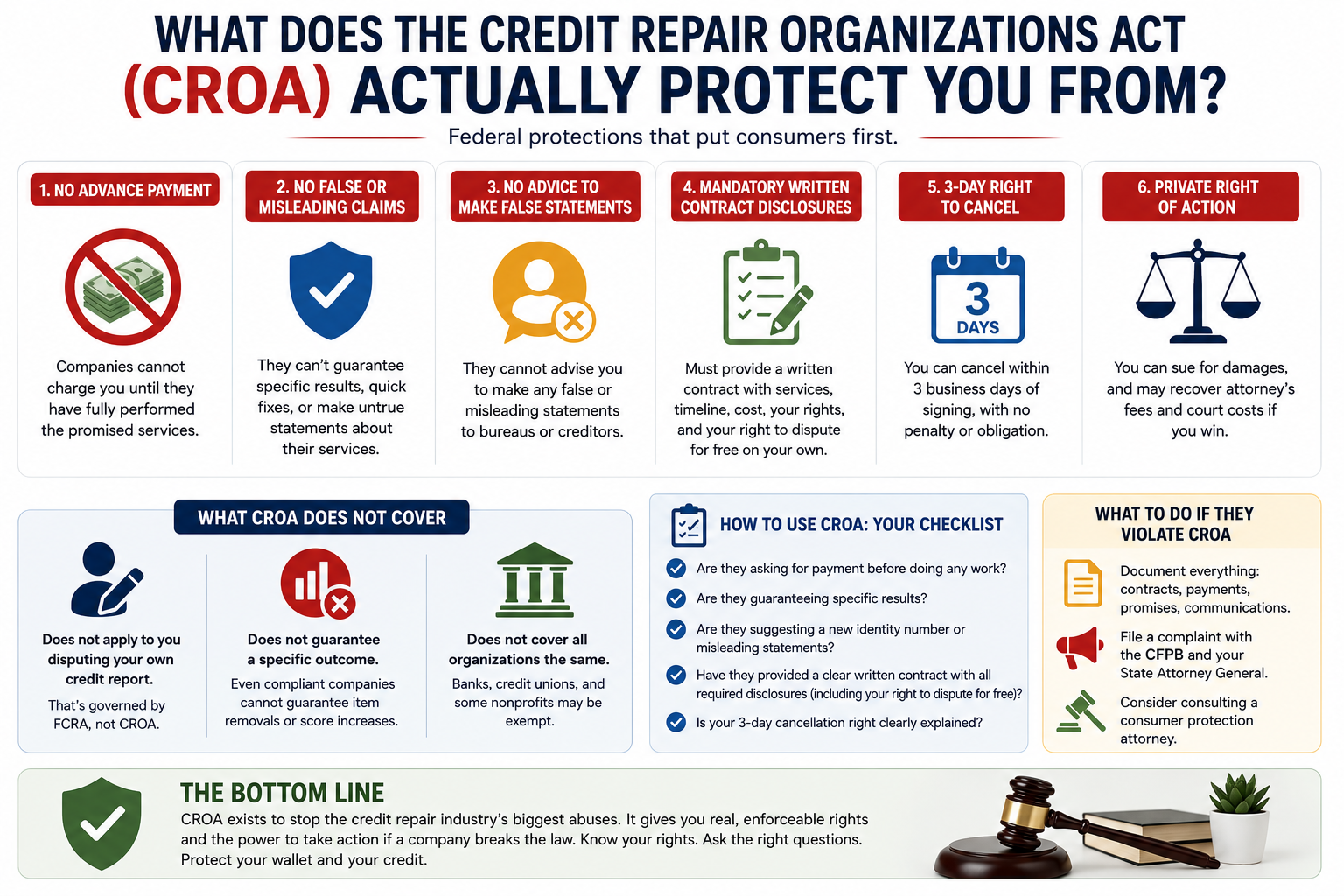
The Credit Repair Organizations Act (CROA), passed in 1996, is a federal law designed to protect consumers from widespread abuse in the credit repair industry. CROA's most significant protection prohibits credit repair companies from charging any fee until they have fully performed the promised services. Additionally, the Act prevents companies from making false or misleading claims and grants consumers a mandatory 3-day right to cancel their contract. These provisions aim to safeguard consumers from scams involving upfront fees and unfulfilled promises.
What CROA Is and Why It Exists
The Credit Repair Organizations Act was passed in 1996, specifically in response to widespread abuse in the then-largely-unregulated credit repair industry — companies charging large upfront fees, making false guarantees, and delivering little to no actual value. CROA created specific, enforceable federal protections for anyone who engages a “credit repair organization,” defined broadly as any person or company that offers, for payment, to improve your credit record, history, or rating, or to provide advice or assistance in doing so.
Protection 1: No Advance Payment
This is CROA’s most significant, practically important protection: credit repair companies **cannot legally charge you any fee until they have fully performed the services they promised**. This directly targets the classic scam pattern of collecting large upfront fees and then providing minimal or no actual work.
This means legitimate companies charge only after completing agreed-upon work, often structured as ongoing monthly fees tied to services actually rendered during that period, not a lump sum collected before anything happens.
Protection 2: No False or Misleading Claims
CROA prohibits credit repair companies from making any untrue or misleading statement about their services, including:
– Claims about specific results they can guarantee.
– Claims about how quickly they can produce results.
– Misrepresenting the legal effect of any actions they’ll take on your behalf.
This is why legitimate companies avoid guaranteeing specific score increases or specific item removals — not just as good practice, but because doing so is a direct CROA violation.
Protection 3: No Advice to Make False Statements
CROA specifically prohibits credit repair companies from advising you to make any statement that’s untrue or misleading to a credit bureau or creditor with intent to alter your creditworthiness. This directly covers the CPN/file segregation schemes and false identity theft claims covered in our credit repair scam guide — these aren’t just bad practice, they’re specifically the type of conduct CROA (along with separate fraud statutes) was designed to prohibit.
Protection 4: Mandatory Written Contract Disclosures
Before you sign anything or pay anything, CROA requires credit repair companies to provide a written contract disclosing:
– The specific services to be performed.
– The estimated timeline for those services.
– The total cost.
– Your specific cancellation rights.
– A required, specific disclosure statement about your legal rights, including your right to dispute inaccurate information on your own for free.
This last point is worth emphasizing: CROA actually requires companies to disclose, in writing, that you have the legal right to dispute credit report information yourself without paying anyone — a direct, mandated acknowledgment that their services aren’t providing access to something otherwise unavailable to you.
Protection 5: A 3-Day Right to Cancel
CROA gives you the right to cancel any contract with a credit repair organization within **3 business days** of signing, without any penalty or obligation, similar to cooling-off periods required for various other consumer contracts. This applies regardless of what the company’s own contract terms might otherwise suggest, and any contract provision attempting to waive this right is unenforceable.
Protection 6: A Private Right of Action
If a credit repair company violates CROA, you’re not limited to filing a regulatory complaint and hoping for enforcement — CROA specifically gives consumers the right to sue in federal court, and includes provisions for:
– Actual damages you suffered.
– In some cases, punitive damages if the violation involved willful or reckless disregard of the law.
– Attorney’s fees and court costs if you prevail, which makes pursuing a claim more accessible even for relatively modest actual damages, since you’re not necessarily on the hook for your own legal costs if you win.
This is a meaningful protection, since it means CROA violations aren’t purely a matter of hoping a regulator takes action — you have direct legal recourse.
What CROA Does NOT Cover
It’s worth understanding the limits, too:
– **CROA doesn’t apply to you disputing your own credit report** — it specifically governs third-party credit repair organizations, not your own DIY efforts, which are instead governed by FCRA’s separate dispute provisions.
– **CROA doesn’t guarantee any specific outcome from a legitimate company’s efforts** — it prohibits companies from promising guarantees, but it doesn’t create a right to a successful result; a company can follow every CROA requirement and still not succeed in getting a specific item removed, since removal depends on the underlying accuracy of the information, not the company’s compliance with CROA.
– **CROA doesn’t cover banks, credit unions, or nonprofit organizations** in the same way it covers for-profit credit repair companies — there are some specific exemptions in the statute, so not every entity offering credit-related assistance is necessarily bound by CROA’s full requirements in the same way.
How to Use CROA Knowledge Practically
When evaluating a credit repair company, walk through CROA’s requirements as a checklist:
1. **Are they asking for payment before doing any work?** — Violation.
2. **Are they guaranteeing specific results?** — Violation.
3. **Are they suggesting anything involving a new identity number or misleading statements to bureaus?** — Violation (and separately, fraud).
4. **Have they provided a clear written contract with all required disclosures, including your right to dispute for free yourself?** — Should be yes, if compliant.
5. **Is your 3-day cancellation right clearly explained?** — Should be yes, if compliant.
Any failure on points 1-3 is a serious, actionable violation. A failure on points 4-5 is also a violation, though perhaps a somewhat less alarming one if everything else about the company otherwise seems legitimate — though it’s still worth pushing back on before proceeding.
What to Do If a Company Violates CROA
1. **Document everything** — the contract (or lack of one), payment records, any promises or guarantees made (in writing or, if verbal, noted with dates and details as best you can).
2. **File a complaint with the CFPB and your state Attorney General.**
3. **Consider consulting a consumer protection attorney**, particularly if you’ve suffered financial harm — given CROA’s fee-shifting provision, many consumer attorneys take these cases without requiring large upfront legal fees from you.
The Bottom Line
CROA exists specifically to prevent the credit repair industry’s most common historical abuses — upfront fees without services rendered, false guarantees, and deceptive practices — and it gives you real, enforceable rights, including a private right to sue with fee-shifting provisions that make legal recourse more accessible than you might expect. Understanding these specific protections turns “does this company seem trustworthy” from a vague gut-check into a concrete checklist you can actually verify before handing over any money.