
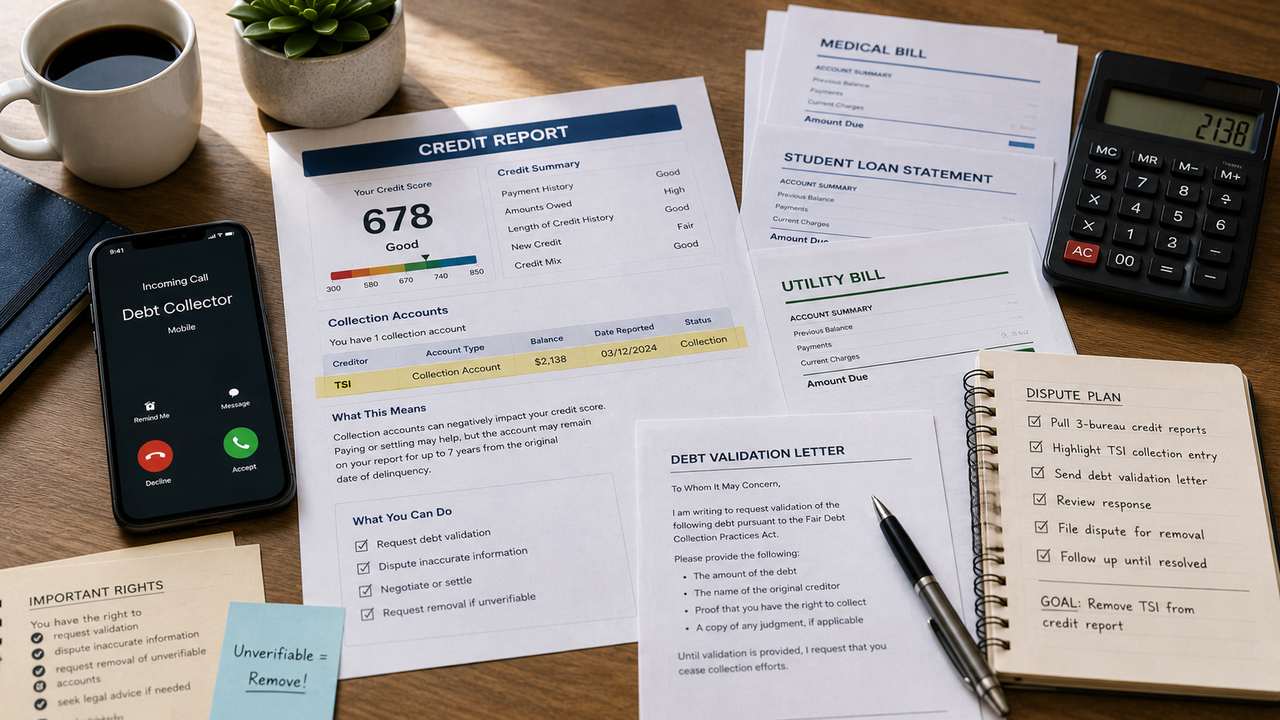
TSI on a credit report stands for Transworld Systems Inc., one of the largest and longest-operating debt collection agencies in the United States. This entry typically appears when TSI is attempting to collect an unpaid debt, either on behalf of an original creditor or after acquiring the debt directly. The presence of a TSI collection account can negatively impact a consumer's credit score, necessitating a clear process to verify its legitimacy and explore options for resolution or removal.
Who Is TSI?
TSI stands for Transworld Systems Inc., one of the largest and longest-operating debt collection and accounts receivable management companies in the United States. The company was founded in 1970, making it one of the more established names in the collections industry, and over its history it has operated under different ownership groups and from different headquarters locations, having at various points been affiliated with NCO Financial/Expert Global Solutions before being acquired by private equity firms (Platinum Equity and later Clearlake Capital have both been reported as major stakeholders at different points).
TSI provides collection and accounts receivable services across a wide range of industries, including healthcare providers, colleges and universities, government agencies, telecommunications and utility companies, and general commercial and financial institution clients. It’s worth noting that TSI sometimes operates or has operated under other business names as well, including North Shore Agency Inc., so if you see that name on a report or in correspondence, it may be connected to the same parent company.
TSI is a legitimate, real company — not a scam. That said, being legitimate doesn’t automatically mean every account attributed to you is accurate, and it doesn’t mean you should simply accept whatever they claim without verifying it first, which is exactly what this guide will walk you through.
Is TSI a Collection Agency or a Debt Buyer?
This distinction matters because it affects who you’re actually negotiating with and who legally owns the underlying debt. Unlike some companies that primarily buy charged-off debt outright (a “debt buyer” model), TSI has historically operated more heavily as a third-party collection agency — meaning in many cases, your original creditor still owns the debt, and TSI has simply been hired to attempt collection on the creditor’s behalf, typically for a contingency fee taken from whatever they successfully recover.
That said, TSI’s business has also included debt purchasing and loan servicing arrangements in some contexts, so it’s not accurate to assume it’s exclusively one model or the other. The practical way to find out which situation applies to you is the same either way: request debt validation (covered in detail below), which should clarify whether TSI is collecting on behalf of your original creditor or claims ownership of the debt itself.
Why Is TSI Contacting You or Appearing on Your Report?
A few common scenarios explain how TSI ends up associated with your credit file:
- A creditor hired TSI to collect an unpaid balance. This is the most common scenario, particularly for smaller-balance accounts like medical bills, gym memberships, or utility final bills, where the original business doesn’t have its own internal collections department and outsources the work to a specialized company like TSI.
- You have an old private student loan connected to certain trusts. TSI became widely known for its role collecting on behalf of the National Collegiate Student Loan Trusts (NCSLT), a group of trusts holding large pools of private student loan debt. If you have an old private student loan (not a federal loan, which is handled by an entirely different system) that went into default, this is a common and specific reason TSI might be involved.
- A medical bill was sent to collections. TSI has a large healthcare-focused collections division, and unpaid medical bills — sometimes for amounts you didn’t even realize you owed, due to insurance processing delays or billing errors — are one of the most frequent reasons people find an unfamiliar TSI account on their report.
- A tuition or education-related balance went unpaid. TSI also works with colleges and universities on unpaid tuition, fee, and related account balances.
- A mistake, mix-up, or identity theft has occurred. As with any collector, it’s possible the account attributed to you isn’t actually yours — due to a data error, a similar name, or fraudulent activity. This is exactly why validation matters before you assume the debt is accurate.
What is TSI's Regulatory History and CFPB Enforcement?
In 2017, the Consumer Financial Protection Bureau (CFPB) took formal enforcement action against Transworld Systems specifically related to its role collecting on private student loans for the National Collegiate Student Loan Trusts. The CFPB’s consent order found that TSI had filed false or misleading affidavits and provided false or misleading testimony in debt collection lawsuits, in some cases pursuing legal claims when the underlying documentation didn’t actually prove the debt was owed as claimed. As part of the resolution, TSI was required to pay a civil penalty and adhere to specific injunctive requirements going forward.
This history is genuinely useful context, not just a scary factoid: it means that if TSI is pursuing an old private student loan debt connected to these particular trusts, there’s a documented history of these specific collection efforts sometimes lacking adequate proof, which makes the debt validation step described below especially important rather than optional in this specific category of debt. This doesn’t mean every TSI account is questionable — the vast majority of medical, utility, and general commercial accounts they handle are routine and accurately documented — but if your situation specifically involves a private student loan and one of these trusts, extra diligence is warranted given this history.
Step One: Pull Your Full Credit Report and Find the Exact Entry
Before doing anything else, get your free credit reports from all three bureaus (Equifax, Experian, and TransUnion) at AnnualCreditReport.com and locate the specific TSI entry. Note the exact details: the reported balance, the original creditor listed (if any), the date the account was opened or reported, and which specific bureau or bureaus show it (since not every creditor reports identically to all three).
Step Two: Request Debt Validation
This is the single most important step, and it applies whether you believe the debt is accurate, aren’t sure, or suspect it isn’t yours at all. Under the Fair Debt Collection Practices Act (FDCPA), you have the right to request that TSI validate the debt — providing written proof of the amount owed, the name of the original creditor, and confirmation of their right to collect it from you. You generally have 30 days from your first contact with them to make this request, and once you do, they’re legally required to pause collection activity until they provide that validation.
How to do this properly: Send a written letter — not just a phone call, which is harder to document and prove later — to the address provided in any TSI correspondence, explicitly requesting debt validation under the FDCPA and requesting they cease collection activity until it’s provided. Send it via certified mail with return receipt requested, so you have documented proof of when it was sent and received.
Step Three: Evaluate the Response
Once TSI responds (or fails to respond, which is also meaningful information), you’re in a position to make an informed decision:
- If they provide clear, accurate validation and the debt is genuinely yours, you can move forward deciding how to resolve it (covered in the next section).
- If they can’t adequately validate the debt — meaning they don’t provide sufficient proof of the amount, the original creditor, or their right to collect — you have strong grounds to dispute it formally with the credit bureaus, and in many cases, this alone leads to the account being removed, since a creditor or collector that can’t validate a debt generally cannot continue reporting it either.
- If the debt genuinely isn’t yours, whether due to a data error or identity theft, formally dispute it as inaccurate with all three credit bureaus, providing whatever documentation supports your position, and if identity theft is involved, file a report at IdentityTheft.gov and consider a fraud alert or credit freeze.
How to Actually Get a TSI Account Removed From Your Credit Report
This is the core question driving most searches about TSI, so let’s break down every realistic path, since “removal” can happen through a few different mechanisms depending on your specific situation.
Path One: Successfully Dispute an Inaccuracy
If the debt is inaccurate in any material way — wrong amount, wrong dates, doesn’t belong to you, already paid, or TSI can’t properly validate it — filing a formal dispute with the credit bureaus is the most direct path to full removal. Under the Fair Credit Reporting Act, the bureau must investigate (typically within 30 days) and remove or correct any information that can’t be verified as accurate. This path results in genuine, complete removal because the information itself was wrong — not because of any payment or negotiation.
Path Two: Attempt a “Pay for Delete” Negotiation
A pay-for-delete arrangement involves paying some or all of the debt in exchange for TSI’s agreement to request removal of the account from your credit report entirely, rather than reporting it as simply “paid.” It’s worth understanding upfront that this isn’t a guaranteed or standard practice — major creditors and many large collection agencies generally avoid this practice due to their data-accuracy commitments with the credit bureaus, and TSI, as a large and long-established company, may be similarly reluctant. That said, it doesn’t hurt to ask, provided you get any agreement explicitly in writing before sending any payment, and you have a solid backup plan if it’s declined (which is a common outcome).
Path Three: Pay or Settle the Debt (Without Deletion) and Let the Status Update
Even without a deletion agreement, resolving the debt — through payment in full or a negotiated settlement — updates your credit report to reflect a “paid” or “settled” status rather than an ongoing unpaid balance. Under most current scoring models, this is viewed meaningfully more favorably than an unresolved account, even though the entry itself typically remains visible on your report for the remainder of its reporting window.
Path Four: Request a Goodwill Removal After Resolving the Debt
Once a debt is paid or settled, you can send a written goodwill request specifically asking TSI (or, if applicable, the original creditor) to consider removing the account as a courtesy, particularly if this was an isolated incident and you have a broader financial history that’s otherwise solid. This is entirely discretionary and not guaranteed, but it costs nothing to request and occasionally succeeds, especially with smaller balances or older accounts.
Path Five: Wait for the Standard Reporting Period to Expire
If none of the above paths succeed, or if you choose not to pursue them, the account will still eventually age off your credit report through the standard federal rule: seven years from the date of the original delinquency on the underlying account, regardless of who currently owns or reports the debt, or how many times it’s changed hands. This is a passive path, but it’s a guaranteed one — no negative item, TSI-related or otherwise, remains on your report indefinitely.
How is the Seven-Year Credit Reporting Clock Calculated for TSI Accounts?
It’s worth being precise about this, since it’s one of the most commonly misunderstood aspects of credit reporting: the seven-year window is measured from the date of your original delinquency on the underlying account — meaning when you first fell behind with the original creditor — not from whenever TSI became involved, started reporting, or a debt was transferred to them. If your original medical bill or student loan first became delinquent five years ago, and TSI only recently started attempting to collect and report it, the clock still runs from that original five-year-old delinquency date, not from TSI’s more recent involvement. This means the account may be closer to aging off your report than you’d assume just from looking at how recently TSI’s activity appears.
Does Making a Payment Reset This Clock?
For credit reporting purposes specifically, no — making a payment does not reset the seven-year credit reporting clock, which is fixed to the original delinquency date under federal law. However, this is a different question from your state’s separate statute of limitations governing how long a creditor can sue you to legally compel payment through the courts, which does vary by state and, in many states, genuinely can be restarted or extended by making a partial payment or otherwise acknowledging the debt in writing. Before making any payment on an old TSI account, especially one that’s several years old, it’s worth understanding your state’s specific statute of limitations for the type of debt involved, since these are two entirely separate legal concepts that are easy to conflate.
What If TSI Is Contacting You About a Debt You’ve Already Paid?
This happens more often than you’d expect, particularly with debt that’s changed hands multiple times or with medical bills where insurance processing delays created confusion about what was actually owed. If you believe you’ve already paid a debt TSI is now pursuing, gather your proof — payment confirmations, bank statements, receipts, or correspondence from the original creditor confirming the account was resolved — and submit this directly to TSI in writing, along with a formal dispute to the credit bureaus if the account is already appearing on your report. This is one of the stronger, more straightforward disputes to win, since you have concrete documentary proof rather than a more abstract disagreement about accuracy.
Handling TSI Calls: What They Can and Can’t Do
Because TSI operates as a debt collector, it’s bound by the same Fair Debt Collection Practices Act protections that apply to any other collector:
- They cannot call before 8 a.m. or after 9 p.m. in your time zone.
- They cannot harass you with repeated calls intended to annoy, or use abusive or threatening language.
- They cannot misrepresent the debt or their identity, including falsely implying legal action is imminent when it isn’t, or misstating the amount owed.
- They must stop calling your workplace once you inform them, verbally or in writing, that you can’t receive calls there.
- They must honor a written cease-and-desist request, though this doesn’t erase the debt and doesn’t prevent other legal remedies like a lawsuit if the debt is still within the enforceable window.
- They cannot discuss your debt with third parties, other than in limited circumstances permitted for locating you.
If TSI violates any of these protections, you have the right to file a complaint with the CFPB and, depending on the severity, may have grounds for legal action under the FDCPA, which includes statutory damages in some cases.
If TSI Sues You
If you’re served with a lawsuit related to a TSI-collected debt, do not ignore it, even if you believe the debt is inaccurate or too old to legally pursue. Failing to respond by the court’s deadline can result in a default judgment against you — meaning you automatically lose without ever presenting a defense, even if you had a legitimate one, such as an expired statute of limitations or inadequate proof of the debt. Consider consulting a consumer law attorney, particularly one experienced in debt defense, many of whom offer free or low-cost initial consultations. Given TSI’s documented history with insufficiently proven student loan collection lawsuits specifically, this is a category of case where a legal consultation is especially worthwhile if you’re facing litigation over an old private student loan.
What is a Step-by-Step Plan to Resolve a TSI Account?
- Pull your full credit reports from all three bureaus and identify the exact TSI entry, including the balance, original creditor, and dates.
- Send a written debt validation request via certified mail, and wait for a response before taking any further action.
- Evaluate what comes back: does it clearly and accurately validate the debt, or is something missing, wrong, or unconvincing?
- If inaccurate or unvalidated, file a formal dispute with the credit bureaus, providing any supporting documentation.
- If accurate, decide your approach: pay in full, negotiate a settlement, or, for very old debt outside your state’s statute of limitations and close to the seven-year reporting mark, consider whether resolving it or simply waiting it out makes more sense for your situation.
- Get everything in writing — validation responses, settlement agreements, payment confirmations — before and after making any payment.
- Once resolved, consider a goodwill removal request, understanding it’s discretionary and not guaranteed.
- If nothing else results in removal, track the seven-year mark from the original delinquency date, since the account will age off automatically at that point regardless of any other outcome.
Frequently Asked Questions
Is TSI the same as Transworld Systems?
Yes, TSI is simply the commonly used abbreviation for Transworld Systems Inc. If you see either name on your credit report or in correspondence, they refer to the same company.
Can TSI legally still collect a debt that’s very old?
It depends on your state’s statute of limitations for the type of debt involved. TSI can generally still attempt to contact you and request payment even on very old debt, but if the debt is past your state’s statute of limitations, they generally cannot successfully sue you over it — though they’re not always required to volunteer that information, so it’s worth knowing your own state’s rules.
Does TSI ever agree to remove accounts for payment (pay for delete)?
This isn’t standard or guaranteed practice, and larger, more established collection agencies are often reluctant to agree to it. It doesn’t hurt to ask, but get any agreement explicitly in writing before paying, and have a backup plan if it’s declined.
What if I don’t recognize the original creditor TSI lists at all?
This is worth taking seriously — request full validation, and if the details genuinely don’t match anything you recognize, formally dispute it and consider whether identity theft or a data-matching error might be involved.
Should I be more cautious if the TSI debt is a private student loan?
Given TSI’s documented 2017 CFPB enforcement history specifically related to insufficiently proven private student loan collection lawsuits, yes — this is a category where verifying documentation carefully, rather than assuming the claimed amount and ownership are accurate, is especially worthwhile.
How long will a TSI collection stay on my report if I do nothing?
Up to seven years from the date of the original delinquency on the underlying account, regardless of when TSI became involved or started reporting it, after which it must be removed regardless of payment status.
What are the Specific Rules for TSI's Healthcare Collections?
Because medical debt is one of the most common reasons people encounter TSI, it’s worth understanding a few specific rules that apply to medical collections differently from other debt types. As of recent, industry-wide changes adopted by all three major credit bureaus, paid medical collections are now generally removed from credit reports entirely rather than simply marked as paid — a more consumer-friendly standard than applies to most other debt types. Additionally, there’s now a required waiting period (commonly one year) before unpaid medical debt can even be reported in the first place, giving insurance claims and billing disputes time to resolve before a bill affects your credit. There’s also generally a minimum dollar threshold below which many medical collections aren’t reported at all under current bureau policy.
This means if your TSI account is specifically a medical bill, you may have more consumer-friendly paths available than for other debt types: if you can show the bill was paid (even after it went to collections), it should be removed entirely rather than simply updated, and if the balance is small or the bill was sent to collections faster than the standard waiting period allows, you may have a straightforward basis for dispute on procedural grounds alone, separate from any question about whether the underlying charge was accurate.
What is TSI's Role in Private Student Loan Collections and Associated Challenges?
Since TSI’s connection to National Collegiate Student Loan Trusts is a common and often confusing scenario, it deserves a more detailed explanation. NCSLT is actually a collection of numerous individual trusts that purchased private student loans (not federal loans) originally issued by various banks, bundled them together, and hold them as investment assets. When a borrower defaults on one of these loans, the specific trust holding it typically hires a servicer or collector — historically, this has often been TSI — to pursue collection, sometimes including litigation.
A significant and well-documented complication in this specific area of debt collection has been proving the actual chain of ownership: because these loans were often bundled, securitized, and transferred multiple times between the original lender and the specific trust now claiming ownership, courts in numerous cases around the country have found that the trusts (and TSI, collecting on their behalf) sometimes couldn’t produce adequate documentation proving they actually owned the specific loan in question, or that the amount claimed was accurate. This was, in fact, the core issue underlying the CFPB’s 2017 enforcement action.
If you have an old private student loan connected to NCSLT and TSI is now involved, it’s genuinely worth requesting complete documentation of the chain of ownership as part of your validation request — not just a claim that you owe the money, but actual proof connecting the original loan, through whatever transfers occurred, to the specific trust and TSI’s authority to collect on its behalf. Given the well-documented history of gaps in this specific documentation trail, this is one of the more promising categories of debt to challenge thoroughly rather than assume is automatically valid.
A Sample Debt Validation Letter for TSI
Having a template ready makes this process considerably less intimidating. Here’s a structure you can adapt:
[Your Name]
[Your Address]
[Date]Transworld Systems Inc.
[Address provided in their correspondence]Re: Account [Reference Number]
To Whom It May Concern:
I am writing in response to your recent contact regarding the above-referenced account. Pursuant to my rights under the Fair Debt Collection Practices Act, I am requesting validation of this debt. Please provide the following:
1. The name and address of the original creditor
2. Documentation showing the amount owed and how it was calculated
3. Proof that your company has the legal right to collect this specific debt from mePlease note that I am requesting you cease all collection activity, including phone calls and further correspondence, until this validation is provided, as is my right under the FDCPA.
Sincerely,
[Your Name]
[Account Reference Number]
Send this via certified mail with return receipt requested, and keep a copy along with the mailing receipt for your records. If TSI responds by phone rather than in writing, ask them to confirm anything discussed in writing as well, since a documented paper trail protects you far more effectively than a verbal exchange.
What are the Different TSI Account Removal Options Compared?
| Method | Requires payment? | Removal guaranteed? | Best used when |
|---|---|---|---|
| Formal dispute (inaccuracy) | No | Yes, if successful | The debt is wrong, unverifiable, or not yours |
| Pay for delete | Yes | No — discretionary | You want to try, with a backup plan ready |
| Pay/settle without deletion | Yes | No (updates status only) | The debt is accurate and you want it resolved |
| Goodwill request after payment | No (after paying) | No — discretionary | You’ve already resolved it and want a courtesy removal |
| Wait for 7-year expiration | No | Yes, eventually | None of the above succeeded, or you prefer to wait |
This table makes clear why disputing a genuine inaccuracy is the strongest path when it applies — it’s the only method on this list that guarantees removal without requiring any payment at all. This is exactly why the validation step is so important as your very first move: it often reveals whether you’re dealing with a debt worth disputing on the merits, rather than one you should simply move toward resolving through payment.
What to Do If TSI Reports the Same Debt Under Multiple Names
Because TSI has operated under related business names, including North Shore Agency Inc., and because debt can sometimes be transferred between related divisions or subsidiaries, it’s possible to see what appears to be the same underlying debt reported more than once under slightly different company names. If this happens, treat it as its own specific issue to dispute — creditors and collectors are generally not permitted to report the same debt multiple times as if they were separate, independent obligations, since this can unfairly compound the negative impact on your score for what is, in reality, a single unpaid account. Point this out explicitly in your dispute, providing the account details from both entries to demonstrate they refer to the same underlying debt.
Why Some People Choose to Settle Even When They Could Fight
Not every situation calls for a prolonged dispute process, even when there might be grounds for one. Some people, when facing an old, accurate TSI debt that’s genuinely theirs, simply prefer to resolve it as efficiently as possible — negotiating a reasonable settlement and moving on, rather than investing significant time and effort into a validation and dispute process for a debt they don’t fundamentally dispute owing. This is a completely reasonable choice, particularly for smaller balances where the time and effort of a thorough dispute process may not be worth it relative to simply settling and closing the chapter. The key principle either way is the same: make an informed choice based on accurate information, rather than either fighting reflexively or paying reflexively without understanding your situation first.
Frequently Asked Questions, Continued
Does TSI report to all three credit bureaus, or just one?
This can vary by account and by which specific creditor or client TSI is collecting for — it’s worth checking all three of your reports individually, since it’s possible an account appears on one or two bureaus’ reports but not the third, depending on TSI’s reporting practices for that particular account.
If I successfully dispute and remove a TSI account, can it come back later?
Generally, no — once a credit bureau removes an item following a dispute because the furnisher (TSI, in this case) couldn’t verify it, they’re not permitted to simply re-report the same unverified information later without new substantiation. If it does reappear, this itself can be grounds for another dispute and, potentially, a complaint to the CFPB regarding a furnisher’s reporting practices.
Can I negotiate with TSI even before receiving their validation response?
It’s generally advisable to wait for validation first, since negotiating or making a payment before confirming the debt is accurate and properly owned by or assigned to TSI could mean resolving something you didn’t actually need to pay, or inadvertently acknowledging a debt that might otherwise have been successfully disputed.
Is there a way to check whether TSI is legitimate before responding to them at all?
Yes — you can independently verify their general legitimacy (as a real, longstanding company) through a basic search, and for your specific account, you can call TSI directly using contact information you find independently (not from a potentially suspicious letter or call) to confirm an account under your name genuinely exists in their system before sending any detailed personal information.
What if TSI’s letter references a debt from a company I’ve never heard of?
This is worth investigating carefully as part of your validation request — ask specifically for documentation connecting that original creditor to an account you actually opened, since it’s possible the original creditor’s name has changed, merged with another company, or that this represents a data error worth disputing.
What is the Key Takeaway for Resolving TSI Accounts?
The key takeaway for resolving TSI accounts is to approach it methodically, starting with requesting written debt validation. TSI, or Transworld Systems Inc., is a legitimate collection company, but you should not accept an unfamiliar entry on your credit report at face value. After reviewing the validation, choose the appropriate path: a formal dispute if inaccurate, payment or settlement if accurate, a goodwill request once resolved, or tracking the seven-year mark if other options fail. Making an informed choice based on accurate information, rather than ignoring or paying reflexively, provides the strongest position for resolution.
Need Help Reviewing Your Credit Report?
If TSI is appearing on your credit report and you’re unsure whether the account is accurate or how to address it, reviewing the account details and your available options can be an important first step.