
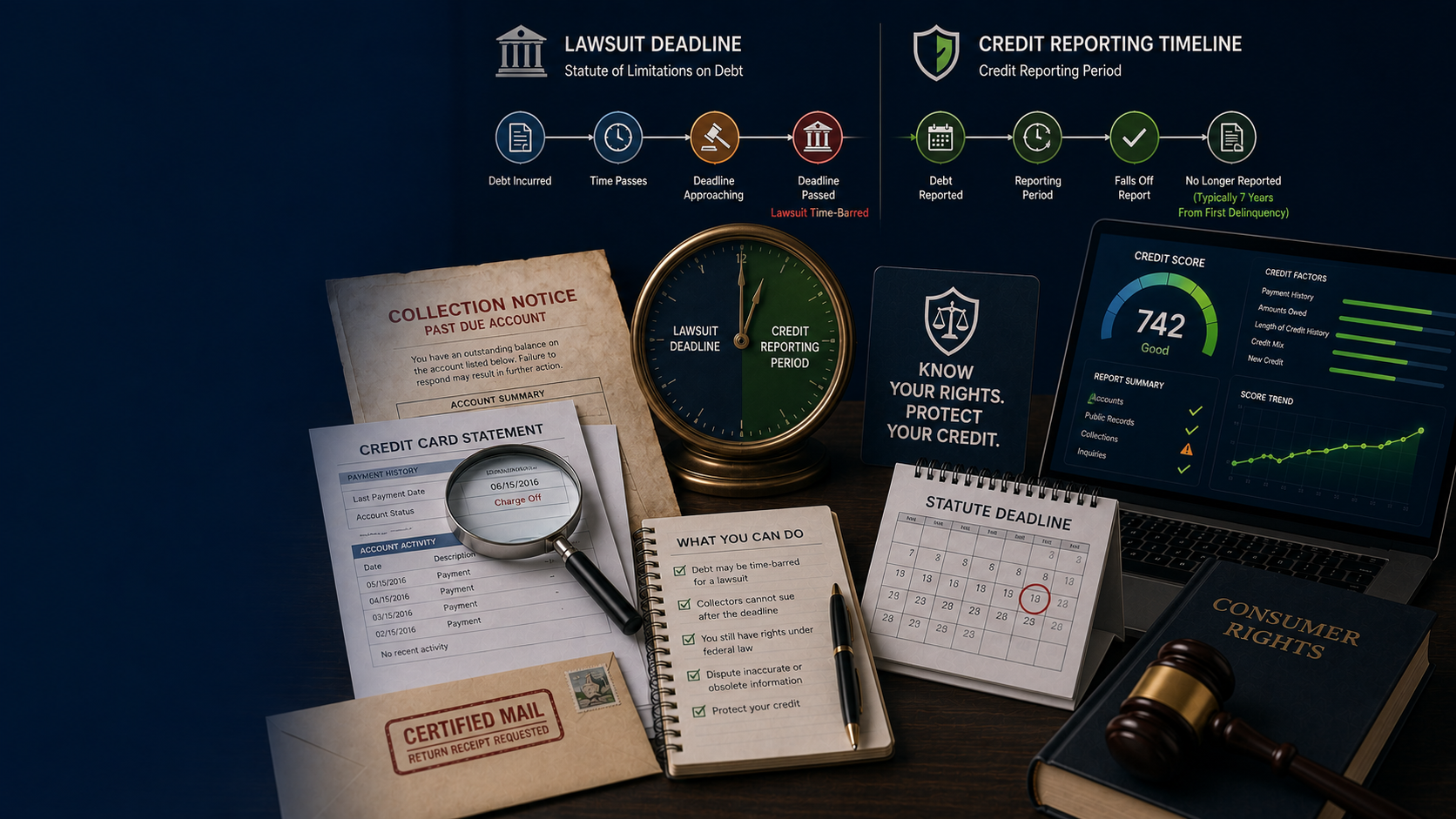
The Statute of Limitations (SOL) on debt is a legal deadline that limits the period during which a creditor or debt collector can sue to collect a debt. Once this period expires, the debt becomes "time-barred," meaning legal action cannot be taken, though the debt itself may still exist. This legal framework prevents creditors from pursuing very old debts indefinitely, providing a definitive end to the legal enforceability of a debt. It is distinct from the 7-year period that most negative information remains on a credit report, as the SOL governs legal action while credit reporting affects your credit score.
Take a breath. Before you agree to anything, read this.
There’s a legal time limit on how long a creditor or debt collector can sue you for an unpaid debt. It’s called the statute of limitations on debt, and once that clock runs out, the debt becomes what the law calls time-barred. That doesn’t mean the debt disappears, and it doesn’t mean it leaves your credit report — but it does mean you have powerful legal rights that most collectors won’t volunteer to tell you about.
This guide walks you through everything you need to know: what the statute of limitations is, how it’s different from the seven-year credit reporting clock (people confuse these constantly, and that confusion costs them), what can restart the clock, what “time-barred” actually means, what to do if a collector calls or sues you on an old debt, and how to protect yourself from “zombie debt” that keeps rising from the grave.
We’re a San Diego-based, attorney-backed credit repair firm, and we’ve spent years helping people across the country understand and exercise their rights under federal credit laws like the Fair Credit Reporting Act (FCRA) and the Fair Debt Collection Practices Act (FDCPA). This article is educational — it is not legal advice. State laws vary significantly, and if you’re dealing with a lawsuit or a particularly aggressive collector, having attorneys in your corner makes a real difference. We’ll explain why throughout.
What Is the Statute of Limitations on Debt?
The statute of limitations on debt (often abbreviated as SOL) is a state law that sets a time limit on how long a creditor or debt collector has to file a lawsuit against you to collect an unpaid debt. Think of it as a legal expiration date on their right to drag you into court over that specific obligation.
Here’s the key idea: the statute of limitations is about suing you — not about whether you still owe the money. A debt doesn’t vanish when the SOL runs out. You may still technically owe it, and a collector may still try to collect it through letters and phone calls (within the limits of the FDCPA). What changes is that they lose their most powerful enforcement tool: the courts. They can’t get a judgment against you, which means they can’t garnish your wages, lien your property, or levy your bank account through that debt — unless you let them.
That last part is critical, and we’ll return to it. Many people accidentally reset the statute of limitations clock by doing something seemingly innocent, like making a small “good faith” payment or even just acknowledging the debt on a recorded call. More on that below.
Why does the SOL exist?
Statutes of limitations exist for a practical reason: evidence disappears, memories fade, and records get lost over time. It’s fundamentally unfair to drag someone into court over a 15-year-old credit card charge when neither side can reliably prove what happened. The SOL forces creditors to act within a reasonable window or lose their judicial remedies. Every state has its own version, and they vary by the type of debt (more on that in the table below).
What key terminology should you know about debt?
You’ll see a few terms in this article that are worth defining up front:
- Statute of limitations (SOL) — the lawsuit deadline, set by state law.
- Time-barred debt — a debt past its statute of limitations. Collectors generally can’t sue you on it.
- Zombie debt — very old, often uncollectible or already-paid debt that gets resold to aggressive collectors who try to revive it.
- Charge-off — when a creditor writes a debt off their books as a loss, typically after ~180 days of non-payment. This is an accounting event, not a legal one, and it’s not the same as the SOL expiring.
With those definitions in hand, let’s tackle the single most common — and most costly — point of confusion around all of this.
Typical Statute of Limitations Ranges by State
The statute of limitations on debt is set by state law, not federal law, which means it varies depending on where you live (or, in some cases, where the creditor is headquartered — read your original contract’s choice-of-law clause). Most states group debts into a few legal categories, each with its own deadline.
What are the different debt types and what do they mean for SOL?
| Debt Type | What It Covers | Typical SOL Range |
|---|---|---|
| Oral contract | A spoken agreement to repay money (no written document) | 3–6 years |
| Written contract | A signed written agreement to repay (e.g., a personal loan, medical debt in some states) | 3–6 years (some states up to 10+) |
| Promissory note | A written promise to pay a specific sum, often with interest (e.g., student loans, some auto loans) | 3–6 years (some states up to 15) |
| Open-ended account | Revolving credit with a balance that changes over time — credit cards, store cards, lines of credit | 3–6 years |
A few important caveats:
- These are general ranges, not exact numbers. State laws change, courts interpret them differently, and some states have quirky rules. Always confirm the current SOL for your specific state and debt type before relying on it. We’ll show you how below.
- Credit cards are the trickiest. Courts disagree on whether a credit card is an “open-ended account” or a “written contract,” and that distinction can change the SOL by years in some states.
- Some debts have much longer SOLs. Federal student loans, for example, generally have no statute of limitations — the government can pursue them indefinitely. Some states have long SOLs for child support, tax debts, and judgments (a court judgment itself can often be renewed for 10–20 years).
- Where you live may not be the only factor. Many credit card agreements include a “choice of law” clause saying which state’s laws apply to disputes. This can sometimes be used to shorten or lengthen the SOL — another reason this gets complicated fast.
What is a general snapshot of SOL ranges by state?
As of recent years, the general landscape looks something like this — but please treat this as a starting point, not legal authority:
- Shorter SOL states (often 3 years for many debt types): States like North Carolina, South Carolina, Maryland, and New Hampshire tend to have shorter windows.
- Middle-range states (4–6 years): The majority of states fall here, including California (typically 4 years for written contracts and open-ended accounts), Texas (4 years), and Florida (typically 4–5 years).
- Longer SOL states (6+ years, some up to 10 or 15): States like New York (typically 6 years), Illinois (typically 5–10 years depending on type), and Ohio (typically 6–15 years depending on type) tend toward longer windows. A handful of states have 10-year or even 15-year SOLs for written contracts.
Again — state laws change, and court interpretations shift. The only way to be confident about your SOL is to check the current statute for your state or, better, work with someone who does this for a living and has attorneys reviewing the details. We’ll cover how to check in a later section.
Why the category matters so much
If you’re being sued on an old credit card debt, whether that debt is treated as an “open-ended account” (shorter SOL) or a “written contract” (sometimes longer SOL) can be the difference between winning and losing the case. This is a genuinely technical legal question, and it’s one of the biggest reasons people benefit from having attorney-backed help — not just a DIY dispute, but someone who knows how your state’s courts have ruled on this exact question.
How the SOL Clock Starts
A question we hear all the time: “When does the clock actually start running?” The answer is more nuanced than you’d expect, and it matters a lot.
What is the general rule for when the SOL clock starts?
In most states, the statute of limitations clock starts running from the date of your last payment — or more precisely, from the date of “last activity” on the account. “Last activity” usually means your most recent payment, but in some states it can also be the date of your last charge, the date of the last written acknowledgment of the debt, or the date the account was charged off.
Here’s a concrete example. Say you made your last payment on a credit card on March 15, 2021, and you never touched the account again. In a state with a 4-year SOL for open-ended accounts, the clock would start on or around March 15, 2021, and the SOL would expire on or around March 15, 2025. After that date, a collector generally cannot sue you on that debt.
What are the variations in how the SOL clock starts by state?
Some states start the clock differently:
- From the date of breach (when you first failed to make a required payment) — this is the most common approach.
- From the date of charge-off — less common, but some states use this.
- From the date of the last payment — also common, and often the same as the breach date if you simply stopped paying.
- From the date the creditor accelerated the debt (declared the full balance immediately due) — in some contract-based debts.
These differences can shift the SOL date by months, which is sometimes the entire ballgame. If the SOL expires in April but the collector sues you in February, the suit is valid; if they wait until May, it’s not. Every month matters.
Why this is a frequent battleground
Collectors sometimes argue that the clock started later than you think — for example, by claiming you made a payment or acknowledged the debt at a date that resets the timeline (more on that next). This is one of the most common ways old-debt lawsuits get fought: not over whether you owe the money, but over when the clock started and whether it has run out.
Good record-keeping on your end matters here. If you can produce bank statements showing your last payment was in March 2021 and nothing since, that’s strong evidence. If you can’t, the collector may try to fill the gap with their own (sometimes shaky) records.
What Can Restart the Statute of Limitations
This is where a lot of people get burned. In many states, certain actions on your part can restart the statute of limitations clock from zero, effectively giving the collector a fresh window to sue you. This is called “reviving” or “tolling” the debt, and the rules vary — you guessed it — by state.
The actions that can restart the SOL typically fall into a few categories:
1. Making a payment
In many states, making any payment on an old debt — even a tiny one — can restart the SOL. A collector calls, pressures you, and you think, “I’ll just send $20 to get them off my back.” That $20 can reset the clock entirely, giving the collector a brand-new multi-year window to sue you. This is one of the most common traps we see.
It doesn’t matter whether the payment was voluntary, coerced, or even a settlement offer. In many jurisdictions, any payment is enough to revive the debt. Some states require the payment to be accompanied by a written acknowledgment, but many don’t.
2. Making a written acknowledgment of the debt
In some states, signing a written acknowledgment that you owe the debt can restart the SOL. This might include:
- Signing a payment agreement or new contract with the collector.
- Sending a letter that says, “I acknowledge I owe this debt and I intend to pay.”
- Signing a settlement offer in writing.
The exact rule varies. Some states require the acknowledgment to be in writing and signed; some require it to be a clear admission of the debt; some are more lenient. But the general principle is the same: if you formally admit the debt is yours and valid, you may reset the clock.
3. Making a settlement offer
In some states, offering to settle the debt — even if the offer is rejected — can be treated as an acknowledgment that revives the SOL. This is less universal than the payment rule, but it’s real in several jurisdictions.
4. A partial payment agreement
Entering into a written payment plan or agreeing to make partial payments can restart the clock in many states, for the same reasons a payment does.
What generally does NOT restart the clock
- Merely discussing the debt on the phone. A verbal acknowledgment usually isn’t enough to revive a debt in most states (though a few are stricter). That said, collectors record these calls and will try to get you to say things they can use — so silence is safer.
- Disputing the debt. Sending a validation dispute letter (which we’ll cover) does not restart the SOL because you’re not acknowledging the debt; you’re challenging it.
- A collector reporting the debt. Their actions don’t restart the clock — only yours do.
What is the safest move when contacted about an old debt?
If a collector contacts you about an old debt, do not make any payment, do not acknowledge the debt in writing, and do not agree to a settlement — until you know whether the debt is time-barred. This is the single most important protective step you can take. A few minutes of caution can save you years of legal exposure.
Here’s the trap collectors often set: they call about a debt that’s two months from being time-barred. They’re friendly, they offer you a “deal,” they say a small payment will show good faith. You send $50. The clock resets. Now they have another 3–6 years to sue you, and you’ve just handed them that power. Don’t do it.
What “Time-Barred” Means and Your Rights
When a debt passes its statute of limitations, it becomes time-barred. That’s a legal term with real teeth. Here’s what it means for you.
What time-barred does NOT mean
Let’s clear up the biggest misconception first. A time-barred debt:
- Does not disappear. You may still technically owe the money.
- Does not automatically come off your credit report. That’s the separate 7-year FCRA clock.
- Does not prevent collectors from contacting you. They can still call and write (within FDCPA limits).
- Does not prevent them from asking you to pay voluntarily. You can choose to pay a time-barred debt if you want to.
What time-barred DOES mean
A time-barred debt gives you strong legal protections:
- Collectors generally cannot sue you. Filing a lawsuit on a time-barred debt is, in most courts, a violation of the Fair Debt Collection Practices Act (FDCPA). The FDCPA prohibits collectors from using false or deceptive means to collect, and courts have repeatedly held that suing on a debt you legally can’t enforce is deceptive and abusive.
- Collectors cannot threaten to sue you on a time-barred debt. Even the threat of a lawsuit on time-barred debt is an FDCPA violation. If a collector says, “We’ll take you to court if you don’t pay,” on a debt that’s past the SOL, that’s illegal — and you may have a claim against them.
- If they do sue you, you have an absolute defense. You can raise the expired SOL as an affirmative defense and ask the court to dismiss the case. But — and this is critical — you have to actually raise the defense. If you ignore the lawsuit, the collector can get a default judgment against you, even on a time-barred debt. More on this in the lawsuit section.
What is the FDCPA's role in protecting consumers from debt collectors?
The Fair Debt Collection Practices Act (FDCPA) is a federal law that governs how third-party debt collectors can operate. (It generally doesn’t apply to original creditors, only to third-party collectors and debt buyers.) Among its many protections, the FDCPA:
- Prohibits collectors from suing or threatening to sue on time-barred debts.
- Requires collectors to send you a validation notice within 5 days of first contact.
- Gives you the right to dispute the debt and demand validation within 30 days.
- Prohibits harassment, false statements, and unfair practices.
- Limits when and how collectors can contact you.
The FDCPA is a powerful tool, but it only works if you know your rights and assert them. Collectors violate it every day, betting that consumers don’t know the rules. Knowing that a time-barred debt is legally unenforceable — and that threatening to sue on one is illegal — flips the power dynamic.
What role do state laws play in debt collection?
Many states have their own debt collection laws that go beyond the FDCPA, sometimes covering original creditors (which the FDCPA doesn’t) or adding additional protections. California’s Rosenthal Act, for example, extends FDCPA-like rules to original creditors. If your state has stronger consumer protection laws, you may have even more leverage than the federal floor provides. This is where attorney-backed guidance really pays off — knowing both the federal framework and your state’s specific overlays.
How to Respond if a Collector Calls on an Old Debt
A collector calls about an old debt. What do you actually do, step by step? Here’s the playbook.
1. Don’t panic, and don’t say much
Your first goal on the call is to gather information without giving any. Collectors record calls. Everything you say can and will be used against you. Do not acknowledge the debt. Do not agree to pay anything. Do not confirm personal details beyond your identity (and even that, cautiously).
2. Ask for the details
Get the basics, writing them down if you can:
- The name of the collection agency and the original creditor.
- The account number and the amount they claim you owe.
- The date of your last payment (ask them what they have on file — this helps you figure out the SOL).
- Their mailing address (you’ll need this for the validation letter).
3. Say as little as possible
A good script: “I’m not discussing any debt today. Please send me the validation notice in writing. I’ll review it and respond.” Then end the call. You are not obligated to talk to them, and silence is your safest position until you know the SOL status.
4. Send a validation letter within 30 days
Under the FDCPA, collectors must send you a validation notice within 5 days of first contacting you. Once you receive it, you have 30 days to dispute the debt and demand validation. If you do, the collector must stop collection activities until they provide proof that you owe the debt and that the amount is correct.
This is one of the most underused consumer protections out there. A validation letter:
- Forces the collector to prove the debt is yours.
- Forces them to prove the amount is correct.
- Stops collection activity while they gather the proof.
- Sometimes causes them to drop the matter entirely (especially if the debt has been sold multiple times and the records are thin).
Your validation letter should be simple and should not acknowledge the debt. Something like: “I am disputing this debt and requesting validation. Please provide the original creditor’s name, the account number, the amount owed, and proof that I am responsible for this debt.” Send it by certified mail with a return receipt so you have proof they received it.
5. Check the SOL
Once you have the details — especially the date of your last payment — figure out whether the debt is past your state’s statute of limitations. If it is, you have much more leverage. You can:
- Send a cease-and-desist letter demanding they stop contacting you (the FDCPA requires them to comply, with limited exceptions).
- Use the time-barred status as leverage if they’re threatening to sue (which would be an FDCPA violation).
- Decide whether to pay, settle, or simply let it age off your report.
6. Don’t pay anything until you’ve done all of the above
The temptation to “just make it go away” with a quick payment is exactly what collectors prey on. Any payment can restart the SOL. Don’t send a dime until you know where you stand and have a clear strategy.
What are the warnings about debt settlement offers?
Collectors love to offer “settlements” on old debts — “Pay 40% and we’ll consider it settled.” These offers can be legitimate, but they can also be traps:
- Paying may restart the SOL on the remaining balance (though settled debts are usually considered closed — read the terms carefully).
- A settlement may be reported as “settled for less than full balance,” which is still a negative mark on your credit report.
- If the debt is time-barred, you may be paying money you’re not legally required to pay.
If you’re considering a settlement, do it strategically, in writing, and ideally with professional guidance.
Zombie Debt: Old Debts Resold and Re-Aged
There’s a special category of old debt that deserves its own discussion: zombie debt. These are debts that should be dead — they’re past the SOL, they’re already been paid, they were discharged in bankruptcy, they were never yours in the first place — but they keep coming back, sold and resold to increasingly aggressive collectors who try to revive them.
How zombie debt happens
When you stop paying a debt, the original creditor may sell it to a debt buyer at pennies on the dollar. That debt buyer may try to collect for a while, then sell it again to another buyer for even less. Each sale adds a layer of separation from the original records. By the time a debt has been sold three or four times, the documentation is often a mess — missing signatures, incomplete account histories, wrong amounts.
Some debt buyers specialize in buying these near-worthless, out-of-statute debts for fractions of a cent on the dollar, then aggressively pursuing consumers who don’t know their rights. Their business model relies on a small percentage of people either paying out of fear or accidentally restarting the SOL.
What is the problem of re-aging debt?
One of the most abusive practices in the zombie debt world is re-aging — when a collector reports an old debt to the credit bureaus with a newer date, making it look fresh. This is illegal under the FCRA. The reporting clock starts from the date of first delinquency with the original creditor, and no amount of reselling or re-reporting can legally reset it.
But it happens. A debt buyer picks up a 2018 charge-off and reports it to the bureaus with a 2024 date of last activity. Suddenly, a debt that should fall off your report in 2025 looks like it’ll stay until 2031. This is a serious violation, and it’s exactly the kind of thing that FCRA disputes and attorney-backed credit repair are designed to catch and correct.
How to fight zombie debt
If you suspect a debt on your report is zombie debt — re-aged, out of statute, or not yours — here’s the approach:
- Dispute it with the credit bureaus. Under the FCRA, you have the right to dispute any inaccurate information on your credit report. The bureau must investigate within 30 days (generally) and remove unverifiable information. Cite the correct date of first delinquency if you know it.
- Send a validation letter to the collector. Force them to prove the debt is yours, the amount is correct, and the dates are accurate. Many zombie debt buyers can’t produce adequate documentation and will drop the claim.
- Document everything. Keep records of when the debt was first delinquent, when it was charged off, and any communications from collectors. This paper trail is your evidence.
- Consider legal action. If a collector is reporting re-aged debt or threatening to sue on a time-barred debt, they may be violating the FDCPA or FCRA — and you may have grounds to sue them. Consumer protection attorneys often take these cases on contingency.
Zombie debt is scary precisely because it exploits people’s lack of knowledge. The moment you understand your rights, the threat shrinks dramatically. A debt that’s past the SOL and misreported on your credit report is not a problem to fear — it’s a problem to fix, and you have the law on your side.
How to Handle a Lawsuit on an Old Debt
If you actually get served with a lawsuit on an old debt, the stakes are higher — but you still have strong defenses. Here’s what to do.
1. Do not ignore it
The worst thing you can do is nothing. If you ignore a lawsuit, the collector can get a default judgment against you — even if the debt is time-barred. A default judgment is what the court enters when you don’t respond. It basically says, “The plaintiff wins by default because the defendant didn’t show up.” At that point, the SOL defense is lost, and the collector can pursue wage garnishment, bank levies, and property liens.
This is the biggest trap with old-debt lawsuits. Collectors file them on time-barred debts hoping you won’t respond. Many people don’t, either out of fear, confusion, or the mistaken belief that the SOL protects them automatically. It doesn’t. You have to raise the SOL defense.
2. Check the SOL immediately
Look at the date of your last payment on the debt and your state’s SOL. If the debt is time-barred, you have an affirmative defense. Calculate the date carefully — this is not the moment to guess.
3. File a response and raise the SOL defense
You typically have a limited window (often 20–30 days, varies by state) to file a written response to the lawsuit. In your response, you raise affirmative defenses, one of which is that the debt is past the statute of limitations. This forces the collector to prove the debt is still within the SOL — and if it’s not, the case should be dismissed.
4. Demand proof of the debt
In addition to the SOL defense, demand that the collector produce documentation proving:
- The debt is actually yours.
- The amount is correct.
- They have the legal right to collect it (chain of assignment if it’s been sold).
- The date of your last payment (which establishes the SOL timeline).
Debt buyers, especially those dealing in old debts, often have thin documentation. If they can’t prove the debt, they can’t win — even if the SOL hasn’t expired.
5. Consider counterclaims
If the collector has violated the FDCPA (by suing or threatening to sue on a time-barred debt, for example), you may have counterclaims. You could potentially recover damages, attorney’s fees, and costs. This is where having an attorney becomes especially valuable — they can evaluate whether the collector’s conduct gives you leverage to flip the case.
6. Get help if you need it
Defending a lawsuit is technical. Deadlines are strict, court procedures are formal, and the consequences of a mistake are serious. If you’re sued on an old debt, this is the moment where professional help earns its keep. An attorney (or an attorney-backed credit repair firm like ours) can:
- Evaluate whether the debt is actually time-barred.
- Prepare and file your response.
- Raise the SOL defense properly.
- Challenge the collector’s documentation.
- Identify FDCPA or FCRA violations that give you leverage.
- Negotiate a settlement or dismissal from a position of strength.
You don’t have to face this alone, and you shouldn’t. The good news is that old-debt lawsuits are very winnable when the SOL defense is properly raised.
What Happens If You Pay an Old Debt
This is one of the most important sections in this article, because well-meaning people sabotage themselves here all the time. Here’s what can happen when you pay an old debt — and why “doing the right thing” can sometimes backfire.
Paying can restart the SOL
As we covered, making a payment on an old debt can restart the statute of limitations in many states. If the debt was three months from being time-barred and you make a payment, you may have just given the collector another 3–6 years to sue you. This is true even if you only paid a small amount, and even if the payment was coerced by collector pressure.
Paying can update the report date
Paying an old debt can also update the date of last activity on your credit report. While the FCRA’s 7-year reporting clock is supposed to run from the original date of first delinquency, a payment can cause the account to be re-reported with a more recent activity date, which may make the negative mark look fresher than it is and potentially extend how long it appears to affect your score. This is a gray area and a source of real consumer harm, and it’s something to be very careful about.
Paying a collection account doesn’t remove it
A common misconception: “If I pay the collection, it’ll come off my credit report.” No. Paying a collection generally updates it to “paid” or “paid, settled” status, but the negative mark remains on your report for the remainder of the 7-year reporting period. A paid collection can still drag down your score, just slightly less than an unpaid one. Newer credit scoring models (FICO 9, VantageScore 3.0+) ignore paid collections, but many lenders still use older models that don’t.
When paying an old debt might make sense
None of this means you should never pay an old debt. There are situations where it’s the right move:
- The debt is recent and within the SOL. If you’re still in the lawsuit window and you can afford to pay or settle, doing so may be smarter than risking a judgment.
- You’re applying for a mortgage. Many mortgage lenders require that collection accounts be paid or settled before closing, regardless of age. Paying may be necessary to get the loan.
- You want peace of mind. Some people simply don’t want old debts hanging over them, and paying — even a time-barred debt — is worth it to them for the mental relief. That’s a valid choice, as long as it’s informed.
- You’ve negotiated a favorable settlement. If a collector will take a small fraction of the balance in exchange for closing the account, and you’ve confirmed in writing that the payment won’t restart the SOL on any remaining balance, it can be a good deal.
What is the key to deciding whether to pay an old debt?
The danger isn’t paying an old debt — it’s paying it reactively, under collector pressure, without understanding the consequences. The right approach is to first understand where the debt stands on both clocks (SOL and reporting), then decide based on your goals and the full picture. That’s exactly what a thoughtful, attorney-backed credit repair process helps you do.
How to Check Your State’s Statute of Limitations
So how do you actually find out your state’s SOL for a specific debt? Here’s the practical approach.
1. Identify the type of debt
First, figure out what kind of debt you’re dealing with — credit card (usually open-ended), personal loan (usually written contract), medical debt (varies), auto loan (varies), etc. The category determines which SOL applies.
2. Find your last payment date
Pull your old bank statements, credit reports, or account records to find the date of your last payment. This is the starting point for the SOL clock in most states. If you’re not sure, the date of first delinquency on your credit report is a good proxy.
3. Look up your state’s SOL
You can find your state’s statute of limitations through:
- Your state’s consumer protection agency or attorney general’s website (many publish SOL summaries).
- Reputable consumer law resources (Nolo, the CFPB, and similar).
- A consumer protection attorney in your state.
- An attorney-backed credit repair firm (like us) that can research and confirm it for you.
4. Calculate carefully
Add your state’s SOL to your last-payment date. If the result is in the past, the debt is likely time-barred. If it’s in the future, you’re still within the SOL window and need to be more careful.
5. Confirm with a professional
SOL calculations have a lot of moving parts — choice-of-law clauses, tolling rules, restart events, debt-type classifications. If the debt is large or you’re facing a lawsuit, confirm your calculation with someone who does this professionally. A small mistake can be expensive.
Common Mistakes to Avoid
We’ve covered a lot of ground. Let’s consolidate the most common mistakes people make with old debts — mistakes that can restart clocks, extend negative reporting, or cost real money.
Mistake 1: Acknowledging the debt on a collector’s call
The collector is recording. You’re not. Anything you say — “I know I owe it but I can’t pay right now,” “I’ll try to send something next month,” “I think I made a payment last year” — can be used to restart the SOL or establish a timeline. Say as little as possible. Dispute in writing.
Mistake 2: Making a “good faith” payment
A $20 payment to get a collector off your back can reset the SOL for years. Never make a payment on an old debt without first confirming the SOL status and understanding the consequences.
Mistake 3: Ignoring a lawsuit
A time-barred debt doesn’t protect you if you don’t show up to court and raise the defense. Always respond to a lawsuit. Default judgments are how collectors win cases they should lose.
Mistake 4: Confusing the SOL with the 7-year reporting clock
They’re separate. A debt can be off your report and still sue-able, or time-barred and still on your report. Know where both clocks stand.
Mistake 5: Assuming paying will fix your credit
Paying an old collection updates it to “paid” but doesn’t remove it from your report. Understand what payment will and won’t do before you send money.
Mistake 6: Trusting a collector’s timeline
Collectors have every incentive to make a debt seem newer than it is. Verify dates independently through your own records and credit reports.
Mistake 7: Not disputing re-aged debts
If an old debt shows up on your report with a newer date, that’s likely an FCRA violation. Dispute it. Don’t let zombie debt sit on your report unchallenged.
Mistake 8: Going it alone on a lawsuit
If you’re sued, the procedural rules are unforgiving. Get professional help. Attorney-backed guidance can be the difference between winning and a default judgment.
Frequently Asked Questions
Can a collector still contact me about a time-barred debt?
Yes. A time-barred debt doesn’t vanish — the collector can still attempt to collect it through calls and letters, as long as they don’t threaten to sue or actually sue (both of which are FDCPA violations on time-barred debt). You can send a cease-and-desist letter demanding they stop contacting you, and under the FDCPA they generally must comply (with limited exceptions, like notifying you of specific actions). If they continue to harass you after receiving the letter, you may have an FDCPA claim.
Does the statute of limitations apply to all types of debt?
No. Most consumer debts (credit cards, personal loans, medical bills, auto loans) have an SOL. But some debts are special cases:
- Federal student loans generally have no SOL — the government can pursue them indefinitely.
- Federal tax debt generally has a 10-year collection statute, but it can be extended in various ways.
- Child support often has no SOL or a very long one.
- Court judgments can often be renewed for 10–20 years depending on the state.
- Some state tax debts have their own long collection windows.
If you’re dealing with one of these special categories, the general SOL rules in this article may not apply — get specific guidance.
Can a debt collector sue me after the SOL has expired?
They can file the lawsuit (courts don’t automatically screen for SOL), but if you raise the SOL as a defense, the case should be dismissed. Suing or threatening to sue on a time-barred debt is an FDCPA violation. The key is that you must respond and raise the defense — ignoring the lawsuit leads to a default judgment that bypasses the SOL entirely.
Will paying an old debt improve my credit score?
Not immediately, and maybe not much. Paying a collection updates it to “paid” status, which is better than “unpaid” but doesn’t remove the negative mark from your report. The collection still shows for the remainder of the 7-year reporting period. Newer scoring models (FICO 9, VantageScore 3.0+) ignore paid collections, but many lenders use older models (FICO 8) that don’t. If your goal is credit score improvement, there are often more effective strategies than simply paying an old collection — which is where a thoughtful credit repair process comes in.
How do I know if a debt has been re-aged illegally?
Re-aging means a collector reports an old debt to the credit bureaus with a newer date than the actual date of first delinquency. Signs of re-aging:
- A debt you recognize as old suddenly shows a recent “date of last activity” on your credit report.
- A debt that should be approaching the 7-year reporting limit appears to have a fresh reporting date.
- A collection account shows up that you’ve never seen before, for a very old debt.
If you see any of these, pull your credit reports from all three bureaus, compare the dates, and dispute the inaccurate information. Re-aging is an FCRA violation, and you have the right to have it corrected.
What’s the difference between the FDCPA and the FCRA?
They’re two separate federal laws that protect consumers in different ways:
- FDCPA (Fair Debt Collection Practices Act) governs how debt collectors can behave — who they can contact, when, what they can say, and what they can’t do (like suing on time-barred debt, harassing you, or making false statements).
- FCRA (Fair Credit Reporting Act) governs how credit bureaus and creditors report and handle your credit information — accuracy, dispute rights, how long items can stay on your report, and your right to see and correct your report.
Both are relevant to old debts: the FDCPA protects you from abusive collection tactics, and the FCRA protects you from inaccurate credit reporting. A good credit repair strategy uses both.
Should I ever pay a time-barred debt?
It depends on your goals. If you’re applying for a mortgage and the lender requires it, yes. If you want peace of mind and can afford it, maybe. If the debt is time-barred, off your credit report soon, and the collector is just fishing — probably not. The key is to decide strategically, in writing, with full knowledge of the consequences — not reactively under collector pressure.
Can a creditor restart the SOL without my action?
Generally no — only your actions (payment, written acknowledgment, settlement offer) restart the clock in most states. A creditor simply reporting the debt, selling it, or contacting you does not restart the SOL. This is an important protection: the clock keeps running regardless of what the creditor does. But be aware that some states have tolling rules that can pause the clock in specific situations (e.g., if you leave the state or file for bankruptcy). These are less common but worth confirming.
