
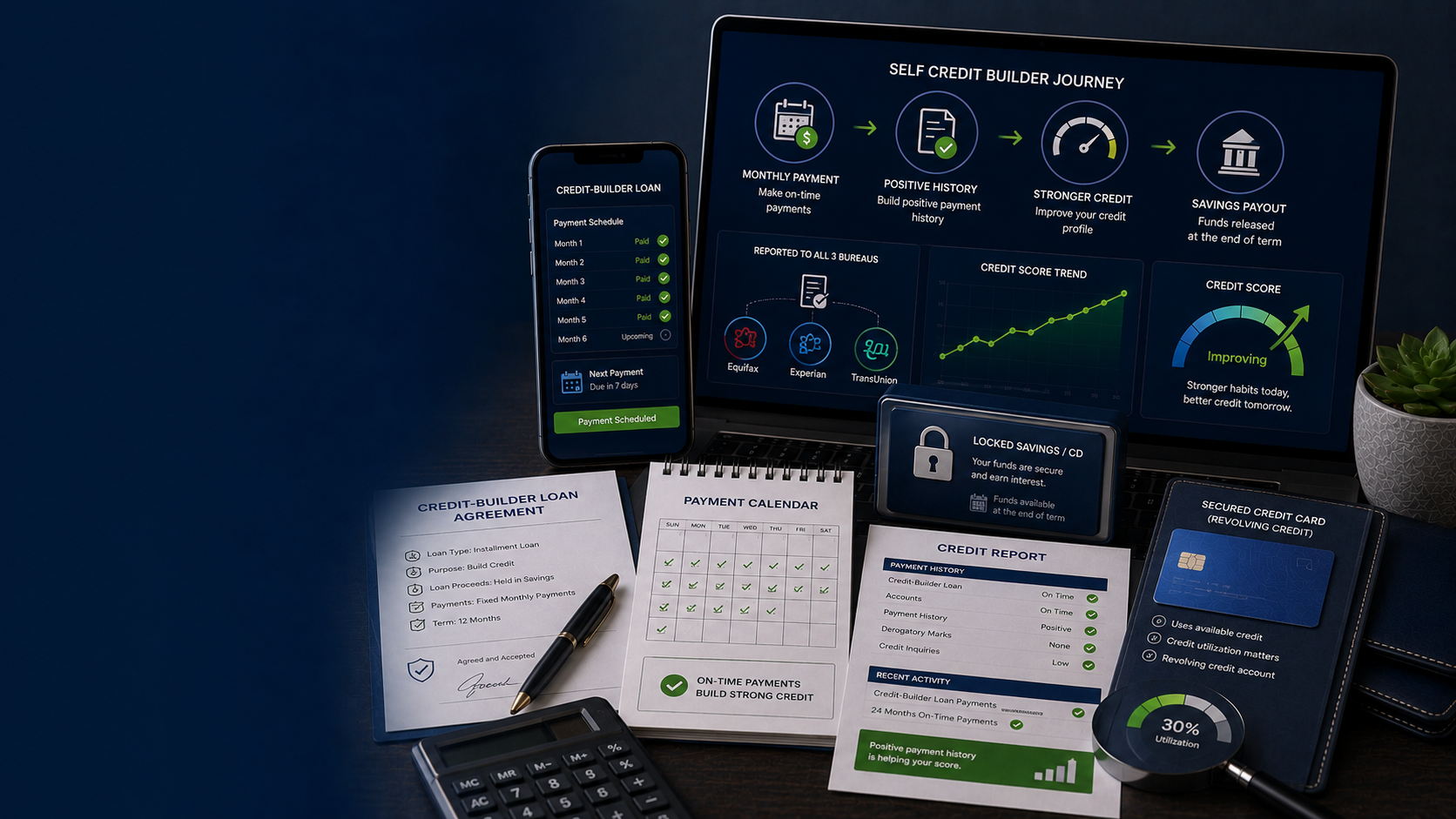
Self Credit Builder, known as Self Lender until 2021, is a fintech product designed to help individuals with thin or damaged credit establish a positive payment history by reporting monthly loan payments to all three major credit bureaus. While it can be a useful tool for building credit and savings, users effectively pay interest to save money, and it does not address existing negative items on a credit report. Credit-repair.com suggests Self is best for those needing a structured savings and credit-building method, but less ideal if a secured credit card with a lower APR is an option or if extensive credit repair is needed first.
What Is Self (and What Happened to Self Lender)?
Self — known until 2021 as Self Lender — is a fintech company that offers a credit-builder product designed to help people with thin credit files, no credit history, or damaged credit establish a positive payment record without requiring a traditional credit card.
The rebrand from “Self Lender” to “Self” was more than cosmetic. The company expanded beyond its original flagship credit-builder loan into a broader suite of tools: a secured credit card (available once you’ve built enough payment history), a rent and utility reporting feature, and a mobile-first Self app that tracks your credit score and progress. But the core idea hasn’t changed — you make small monthly payments that are reported to all three major credit bureaus (Equifax, Experian, and TransUnion), and at the end of the term you receive the money you paid in, minus fees and finance charges.
Here’s the key distinction that matters for this Self credit builder review: Self is not a lender in the traditional sense, and it’s not a savings account. It’s a structured installment product — technically a credit-builder loan — where the “loan” amount is held in a certificate of deposit (CD) until you finish the term. You’re not borrowing money upfront. You’re paying it in over time, and the act of paying is what builds your credit.
This matters because many people come to Self expecting to receive cash up front to pay down other debts or cover expenses. That’s not what this product does. If you need liquidity — actual money in hand today — Self is the wrong tool. If you need a safe, low-risk way to generate positive payment history on your credit report, that’s where it earns its place.
Self is operated alongside partner banks (historically Sunrise Banks, N.A., and Lead Bank, among others), and the product is available in most U.S. states. The Self app is available on iOS and Android and serves as the primary way most customers manage their account today.
Bottom line up front: Self is a legitimate, FCRA-aligned credit-building tool. It works — but “works” means it adds positive payment history to your report, not that it guarantees a score increase or erases existing negatives. The fees are modest but real, the timeline is slow (12–24 months), and whether it’s worth it depends heavily on what else is on your credit report.
How the Self Credit Builder Works, Step by Step
Understanding the mechanics is what separates a useful Self credit builder review from marketing copy. Here’s exactly what happens when you sign up:
Step 1: You choose a monthly payment amount and term
When you open a Self credit builder loan, you select a monthly payment you can comfortably afford — typically $25, $35, $48, or $150 per month. You also choose a term length, usually 12 or 24 months. The total of your monthly payments (minus the one-time admin fee and finance charge) becomes the amount “held” in a CD in your name.
For example, at the $25/month tier over 24 months, you’d pay roughly $600 total. After the non-refundable $9 admin fee and the finance charge (the APR, which we’ll get to), you’d receive somewhere around $520–$545 back at the end. That payout is smaller than what you paid in — and that gap is the cost of the service. You’re paying for the credit-building function, not to grow savings.
Step 2: A CD is opened in your name at a partner bank
Self’s partner bank opens a CD in your name for the total loan amount. You don’t get access to this money. It’s locked. This is the collateral — it’s what makes the “loan” low-risk for the bank, which is why they can offer it to people with poor or no credit.
Step 3: You make monthly payments
Each month, you pay Self your chosen amount. Self reports that payment — on-time or late — to all three credit bureaus. This is the core value: every on-time payment is a positive mark on your payment history, which is the single biggest factor in your credit score (35% under FICO).
If you pay late, Self reports that too. Late payments can actively damage the very score you’re trying to build. This is the double-edged nature of any credit-building product: it helps you if you’re disciplined and hurts you if you’re not.
Step 4: The loan is “paid off” and you receive your payout
Once you complete the full term, the CD unlocks and you receive your money — the total you paid in, minus the admin fee and finance charges. You can take it as a check, direct deposit, or (if you qualify) roll part of it into a Self secured card.
That’s the full cycle. There’s no credit check to open the account (Self uses a soft check or identity verification, not a hard inquiry), no upfront deposit beyond the admin fee, and no risk of running up unsecured debt — because you can’t spend money you don’t have with this product.
The Products Self Offers
Self has grown from a single-product company into a small suite. Here’s what’s actually available:
1. The Self Credit Builder Loan (the flagship)
This is the product described above — the small installment loan held in a CD, with payments reported to all three bureaus. It’s the core of what most people mean when they ask “does Self work?”
Key specs:
- Monthly payments: $25, $35, $48, or $150
- Terms: 12 or 24 months (some plans offer both)
- Admin fee: $9 non-refundable, charged at signup
- APR / finance charge: varies by plan, generally in the mid-teens as an effective rate — but remember, the APR is applied to a loan you’re paying down, not borrowing up
- Payout at end: your total payments minus the admin fee and finance charge
- Credit check: none (soft/identity verification only)
- Bureau reporting: Equifax, Experian, TransUnion
2. The Self Secured Credit Card
Once you’ve made enough on-time payments on the credit-builder loan (typically a few months), Self may invite you to apply for its secured credit card. This is a genuine revolving credit account — it reports to all three bureaus and lets you build credit utilization history, which the loan alone doesn’t address.
Key specs:
- Credit limit: typically $100–$300 initially, based on your savings progress
- Security deposit: drawn from your Self credit-builder savings (the money you’ve already paid in), not a new cash outlay
- Annual fee: yes — usually around $25 (check current terms, as these change)
- APR: variable, on the higher side (as with most cards for credit-building)
- Reporting: all three bureaus
The secured card is where Self becomes more powerful, because it lets you build two of the five FICO factors — payment history (35%) and credit utilization (30%) — instead of just one. More on this in the comparison section below.
3. Free Credit Score Monitoring
The Self app includes free credit score monitoring (typically VantageScore from one bureau, with FICO available in some plans). This is useful for tracking progress but shouldn’t be confused with full report monitoring — you’ll want to pull your actual reports from AnnualCreditReport.com separately to verify what’s being reported and to check for errors.
4. Rent and Utility Reporting
Self also offers a feature to report your rent and utility payments to the credit bureaus, which can add another stream of positive payment history. This is a nice add-on, especially for renters who want credit for payments they’re already making. It’s worth noting that not all bureaus weight rent and utility data equally, and not all scoring models factor it in — but it generally doesn’t hurt.
How Self Reports to the Three Credit Bureaus
One of the strongest features of Self is that it reports to all three major credit bureaus: Equifax, Experian, and TransUnion. This matters because:
- Lenders don’t all pull the same bureau. A credit card issuer might pull Experian, an auto lender might pull Equifax, and a mortgage lender often pulls all three. Positive history on all three means you’re covered regardless of which bureau a future lender checks.
- Some credit-builder products report to only one or two bureaus. Self’s three-bureau reporting is a genuine advantage over partial-reporting alternatives.
What gets reported each month:
- The payment status (on-time, or late by 30/60/90+ days)
- The account type (installment loan, and later revolving for the secured card)
- The balance and original loan amount
- The account open date (which starts your credit history clock)
What does not get reported:
- Your income or employment
- Your bank account details
- Anything about your other credit accounts (Self can’t see them)
Important nuance: Self reports the credit-builder loan as an installment account, not a revolving account. This is great for building payment history and credit mix, but it does not help your credit utilization ratio — which is the second-biggest FICO factor and applies only to revolving (credit card) accounts. That’s why the Self secured card, once you qualify for it, is the piece that rounds out the benefit.
What Score Impact Can You Realistically Expect?
This is the section where most Self credit builder review articles overpromise. We won’t.
What Self can do
For someone with no credit history (a “thin file”) or no open positive accounts, adding a Self installment loan generates a stream of on-time payments where none existed. In that scenario, Self can produce a meaningful score increase over 6–12 months — sometimes enough to move from “no score” to a fair score in the 600s. Self’s own published data and independent user reports support this for the thin-file crowd.
For someone with damaged credit but some open positive accounts, Self adds another positive tradeline, which helps dilute the impact of older negative marks over time. The effect is real but more modest — think incremental points, not a 100-point jump.
What Self cannot do
- It cannot offset active negatives. A recent late payment, a collection, a charge-off, or a maxed-out credit card will drag your score far more than Self’s positive payments can lift it. If you have serious report errors or unresolved negatives, addressing those is almost always the higher-leverage move.
- It cannot improve utilization. Because the loan is an installment account, it has no effect on your revolving utilization. If your score is suffering because your credit cards are near their limits, Self won’t fix that — paying down your card balances will.
- It is not instant. Expect 2–6 months before you see meaningful movement, and the full benefit arrives only after 12–24 months of on-time payments.
- It is not guaranteed. Your score depends on everything on your report, not just this one account. Adding Self while also racking up new late payments elsewhere will still produce a net-negative result.
What are the realistic expectations for credit score improvement with Self?
If you’re starting from nothing and you make every payment on time for the full term, you should end up with a fair-to-good credit score and a solid foundation to build on. If you’re starting from damaged credit, Self is a useful supplementary tradeline, not a standalone solution — pair it with report repair (disputing errors, negotiating pay-for-deletes, settling collections) for the best results.
The Pros of Using Self
Let’s give credit where it’s due. Self does several things genuinely well:
- No credit check to open. You won’t take a hard inquiry hit just to start. For people already worried about their score, this removes a real barrier.
- No large upfront deposit. Unlike a traditional secured card that might require $200–$500 upfront, Self starts at $25/month plus a $9 fee. The barrier to entry is low.
- Reports to all three bureaus. As noted, this is a meaningful advantage over alternatives that report to only one or two.
- Forces a savings habit. Because your payments are locked in a CD, you can’t spend them. For people who struggle to save, this is a built-in commitment device — you end the term with a few hundred dollars you might not have otherwise kept.
- No risk of unsecured debt. You can’t overspend with the credit-builder loan. There’s no credit limit to max out, no temptation to carry a balance you can’t afford. For people rebuilding after debt problems, this safety is valuable.
- Path to a secured card without a new deposit. The Self secured card is funded from the money you’ve already paid into the credit-builder loan — no separate cash outlay. This is a genuinely thoughtful design.
- Mobile-first, easy to manage. The Self app makes payment setup, autopay, and score tracking straightforward. Autopay is critical (more on that below), and Self makes it easy to enable.
- Transparent, legal, FCRA-aligned. Self is a legitimate financial product from a real fintech with partner banks. It’s not a sketchy “credit sweep” or a fake tradeline. Everything it reports is real, verifiable, and compliant with federal credit laws.
- Builds credit mix (eventually). Once you add the secured card, you have both an installment and a revolving account — which is better for your credit mix than either alone.
- Good educational content. Self publishes reasonably honest educational material about credit, which is more than many credit-building services do.
The Cons and Real Costs of Using Self
Here’s where we earn the “honest review” part. Self has real downsides, and ignoring them does you no favors.
1. The fees and finance charge reduce your payout
This is the single most important number to understand. You will get back less money than you put in. The gap is the cost of the service.
On the $25/month, 24-month plan:
- You pay in: ~$600 (plus $9 admin fee)
- Finance charge over the term: roughly $89 (this varies — check current Self disclosures)
- You receive at the end: approximately $520
So you’re paying roughly $80–$90 over two years for the credit-building function. Is that worth it? For someone with no other way to build credit, yes — it’s a reasonable price. For someone who could instead put a $200 deposit on a secured card and pay no finance charge, it’s a worse deal. We’ll compare directly below.
2. The “APR” effectively means you’re paying to save
Self discloses an APR in the mid-teens. Because you don’t receive the loan proceeds upfront, this APR isn’t interest you pay on borrowed money — it’s effectively a fee on your own savings. Framed that way, it’s not a great financial deal in isolation. You’re paying for the credit reporting function, not for a return on your money. If you only think of Self as a savings account, you’ll be disappointed.
3. It’s slow
We’re talking 12–24 months. If you need a credit score this year — to qualify for a mortgage, to refinance a car, to get an apartment — Self alone won’t get you there in time. Report repair, authorized-user positions, and rapid rescores can move faster.
4. No utilization benefit from the loan alone
As covered, the installment loan doesn’t touch your revolving utilization. If utilization is your problem, the loan won’t help until you add the secured card.
5. Late payments hurt you
Miss a payment and it’s reported to all three bureaus — the same bureaus you’re trying to impress. A 30-day late on a credit-builder account is a self-inflicted wound. If your income is irregular and you’re not confident you can make every payment, this risk is real.
6. The payout is locked until the end
You can’t withdraw your money mid-term without closing the account, which typically means forfeiting the credit-building benefit and possibly paying fees. If you have an emergency, the money you’ve paid in is not accessible. Don’t put money in Self that you might need.
What are the consequences of early cancellation of Self?
Closing early can result in a smaller payout, a mark on your credit report (a closed account with a short history), and possibly no refund of the admin fee. We cover this in detail in the cancellation section.
8. Customer service limitations
Self is a fintech, not a full-service bank. Customer support is app- and chat-based, and response times can be slow during high-volume periods. For a product you’re trusting to report accurately to three bureaus, that can be frustrating if something goes wrong.
9. Not available in all states / terms change
Self’s plans, fees, and availability shift over time and by state. The numbers in this review were accurate at writing, but always confirm current terms on Self’s site before signing up.
Pros and Cons at a Glance
| Pros | Cons |
|---|---|
| No credit check to open | You get back less than you put in (fees + finance charge) |
| Low monthly entry ($25+) | Slow — 12–24 months for full benefit |
| Reports to all 3 bureaus | No utilization benefit from loan alone |
| No risk of unsecured debt | Late payments reported and damage your score |
| Builds a forced savings habit | Money is locked until the end of the term |
| Path to secured card with no new deposit | Cancellation can reduce payout and hurt history |
| Easy autopay via the Self app | Customer service can be slow |
| FCRA-compliant, legitimate product | Terms vary by state and can change |
| Good for thin files / credit newbies | Less useful if you already have good credit options |
Self vs. Secured Credit Card vs. Other Credit-Builder Loans
This is the comparison that actually matters. Let’s line up the three main paths to building credit without a traditional unsecured card.
Self Credit Builder Loan vs. a Secured Credit Card
A secured credit card requires a refundable deposit (usually $200–$500) that becomes your credit limit. You use the card for small purchases, pay it off each month, and the issuer reports to the bureaus.
| Self Credit Builder Loan | Secured Credit Card | |
|---|---|---|
| Upfront cost | $9 admin fee + $25/mo | $200–$500 deposit (refundable) |
| Net cost over 2 years | ~$80–$90 (fees + finance charge) | $0 if paid in full (deposit returned) |
| Builds payment history | Yes | Yes |
| Builds utilization | No (installment) | Yes (revolving) |
| Risk of overspending | None | Yes — you can carry a balance |
| Reports to all 3 bureaus | Yes | Yes (most major issuers) |
| Credit check to open | No | Usually a soft check (some hard) |
| Money accessible during term | No | Deposit held, but card is usable |
The verdict: If you have $200–$500 to put down as a deposit and you trust yourself not to carry a balance, a secured card is generally the better financial deal — you get your deposit back in full, you build utilization, and you have a usable card. The catch is the upfront cash and the spending discipline required.
If you don’t have the upfront deposit or you don’t trust yourself with a credit limit, Self is the safer choice. The modest finance charge is the price of that safety.
The best path for many people is both: Use Self to build installment payment history and save up a deposit, then add a secured card (Self’s or another issuer’s) to build revolving history too. Two positive tradelines across two account types is stronger than either alone.
Self vs. Other Credit-Builder Loans
Credit-builder loans aren’t unique to Self. Community banks, credit unions, and CDFIs (Community Development Financial Institutions) have offered them for decades, often at lower cost than Self.
| Self | Credit Union / CDFI Credit-Builder Loan | |
|---|---|---|
| Cost | Higher (finance charge + fees) | Often lower — some pay you interest on the CD |
| Accessibility | App-based, nationwide (most states) | Must be a member / local resident |
| Convenience | High — sign up in minutes | Lower — membership application, branch visit |
| Bureau reporting | All 3 | Varies — some report to all 3, some only 1–2 |
| Customer service | App/chat-based | In-person or phone, often better |
The verdict: If you’re already a member of a credit union or there’s a CDFI in your area, check their credit-builder loan first. It may cost less and offer better service. If you value convenience, no membership requirements, and nationwide availability, Self wins on accessibility.
Self vs. Becoming an Authorized User
Being added as an authorized user on someone else’s well-managed credit card can add positive history to your report at zero cost — assuming you have a trusted family member or friend with a good card.
The verdict: If you have that option, it’s the cheapest and fastest path. But it depends on someone else’s continued good behavior (their late payments would hurt you too), and not everyone has a willing cardholder in their life. Self is the independent option.
Who Self Is Good For
Self shines for a specific set of situations:
- You have no credit history at all — a true thin file. Self is one of the easiest ways to start generating positive payment history from zero.
- You can’t afford a secured card deposit. If $200–$500 upfront is genuinely out of reach, the $25/month entry point makes Self accessible.
- You’ve had problems with credit card debt and need a credit-building tool with no spending temptation. Self’s locked structure keeps you safe from yourself.
- You want a structured, forced-savings component. If you struggle to save, the locked CD doubles as a commitment device.
- You’re rebuilding after a major negative event (bankruptcy, foreclosure, serious delinquencies) and need a clean, positive tradeline to add to your report alongside your repair efforts.
- You’re comfortable managing everything through an app and don’t need branch access.
In all of these cases, Self’s modest cost is a reasonable trade for the structure, safety, and three-bureau reporting it provides.
Who Should Skip Self
Self is not the right tool for:
- People who already have good credit and a couple of open, on-time credit cards. You don’t need it. Adding another installment loan won’t meaningfully help and will cost you money.
- People who can afford a secured card deposit. A secured card is generally a better financial deal and builds utilization too. Skip Self unless you specifically want the installment + savings structure.
- People who need liquidity. If you need cash in hand — to pay down high-interest debt, cover medical bills, or make rent — Self’s locked-CD structure is the opposite of what you need.
- People with serious unresolved report errors. If your credit is suffering because of inaccurate negatives, a collection that shouldn’t be there, or mixed-file errors, fix the report first. A free credit audit at will surface what’s actually dragging your score. Often, removing one inaccurate 60-day late or one erroneous collection moves your score more than a year of Self payments.
- People who can’t commit to monthly payments for 12–24 months. If your income is irregular or you’re one missed paycheck away from a problem, the risk of a reported late payment outweighs the benefit.
- People in a hurry. If you need a score improvement in weeks, not months, Self is too slow on its own.
How to Use Self the Right Way
If you’ve decided Self makes sense for you, here’s how to get the most out of it — and avoid the traps that turn a good tool into a setback.
1. Pick the lowest payment you’ll reliably make
Resist the urge to choose the $150 plan because it “builds credit faster.” It doesn’t build credit faster — the payment amount doesn’t matter to your score, only that you pay on time. A $25/month on-time payment helps your score just as much as a $150 one. Pick the amount you can make every single month without thinking about it.
2. Turn on autopay immediately
This is non-negotiable. Set autopay the day you open the account. The entire value of Self depends on every payment being on time. A single 30-day late can undo months of progress. If your bank account is the issue, fix that first or pick a lower payment tier.
3. Don’t open Self and nothing else
Self is most effective as one part of a broader plan. While it’s building installment history, also:
- Pull your free reports from AnnualCreditReport.com and review them for errors
- Dispute any inaccurate negatives (or work with a reputable credit repair firm to do so)
- Avoid applying for other credit you don’t need (each hard inquiry has a small cost)
- If you have other open accounts, keep them paid on time too
4. Add the Self secured card when you qualify
Once Self offers you the secured card, take it — but use it minimally. Put one small recurring charge on it (a streaming subscription, a single tank of gas) and pay it in full every month. This builds revolving utilization history without spending money you don’t have. Keep your balance under 10% of the limit for the best utilization impact.
5. Keep the account open until the full term
Closing early reduces your payout and shortens your account history. Commit to the full 12 or 24 months. If you need to stop, see the cancellation section first and understand the consequences.
6. Monitor your reports to verify Self is reporting correctly
A few months in, pull your reports (or use the Self app’s score monitoring) and confirm the Self account is showing up on all three bureaus with correct payment status. If it’s missing or misreported, contact Self support promptly. Rare, but it happens — and you’re paying for the reporting, so verify it.
7. Have a plan for the payout
When the term ends and you receive your few hundred dollars, don’t let it evaporate. Use it to open a secured card (if you haven’t already), to fund an emergency savings starter, or to pay down an existing balance. Treat it as a stepping stone, not a windfall.
How to Cancel Self and What to Watch Out For
Life happens. If you need to close your Self account before the term ends, here’s what to expect — and what to watch for.
How to cancel
You can close your account through the Self app (in account settings) or by contacting Self support. Once you initiate closure:
- Your loan is closed and the CD is liquidated.
- You receive your accumulated payments minus the admin fee, any finance charges, and possibly an early-closure fee (check current terms).
- Self reports the account as closed to all three bureaus.
What are the risks and consequences of canceling Self early?
- A closed account with a short history can slightly hurt your score in the short term. If you close after only 3–4 months, you’ve added a brief tradeline that now shows as closed — not as helpful as a full 12–24 month positive history. Try to make it at least 6 months if you can.
- Your payout will be smaller than what you paid in. The admin fee is non-refundable, and finance charges accrued to date are kept. Don’t expect to get all your money back.
- If you had any late payments, they stay on your report. Closing the account doesn’t erase the late marks. They’ll continue to affect your score for up to seven years, though their impact fades.
- The secured card, if you opened one, is a separate account. Closing the credit-builder loan doesn’t automatically close the secured card — but you’ll want to confirm the card’s standing separately, since its deposit may be tied to your Self savings.
- Avoid closing in the first 1–2 months if possible. An account that opens and closes within a couple months can look like a “flash” tradeline and provides almost no benefit. If you’re going to cancel that early, you might be better off not opening it at all.
When cancellation makes sense
- You’ve secured a better credit-building tool (a secured card, an authorized-user slot) and want to stop paying Self’s finance charge.
- Your financial situation changed and you can’t reliably make payments — better to cancel than to stack late payments.
- You’ve finished the term and simply want to move on — that’s not cancellation, that’s completion, and it’s the ideal outcome.
Common Mistakes That Undo the Benefits
Over years of helping clients build and repair credit, we see the same handful of mistakes repeatedly. Avoid these and Self will do what it’s supposed to:
Mistake 1: Picking a payment you can’t sustain
The $48 or $150 plan looks impressive, but if you miss month seven, the late mark outweighs the six on-time payments before it. Pick the payment that’s boringly easy to make.
Mistake 2: Forgetting autopay
A single missed payment — because you were traveling, busy, or forgot — gets reported to all three bureaus and can take months to recover from. Autopay is the single most important setting in the Self app.
Mistake 3: Opening Self and ignoring the rest of your report
Self adds positive history. It does nothing for the inaccurate collection, the erroneous late mark, or the mixed-file error that’s actually causing your score to be low. We see clients spend two years on Self while a single report error that could have been disputed in 30 days was silently capping their score the entire time. Review your reports first. A free credit audit at will tell you exactly what’s on there and what’s worth disputing.
Mistake 4: Closing early when bored or frustrated
The benefit of Self compounds with time. The 24-month mark is where you see the full payoff — both in payout dollars and in credit history length. Closing at month 9 because it “feels slow” wastes the first 9 months of effort.
Mistake 5: Not adding a revolving account
An installment loan alone leaves 30% of your FICO score (utilization) untouched. Once you qualify for the Self secured card or any other revolving account, add one and use it responsibly. Credit mix matters.
Mistake 6: Applying for too much other credit at once
Every hard inquiry costs a few points. If you open Self, then immediately apply for three store cards, a car loan, and an apartment, you’ll tank the score you’re trying to build. Be patient. One new account at a time.
Mistake 7: Expecting Self to fix everything
Self is a building tool, not a repair tool. It adds positives. It does not remove negatives. If your report has significant errors or unresolved derogatory marks, those will continue to suppress your score regardless of how many on-time Self payments you stack. Address both sides — repair and build — for the best results.
Frequently Asked Questions
1. Is Self (formerly Self Lender) legitimate?
Yes. Self is a real fintech company that partners with FDIC-insured banks to offer credit-builder loans and a secured credit card. It reports to all three major credit bureaus and operates in compliance with federal credit laws, including the FCRA. It is not a scam, not a “credit sweep,” and not a fake tradeline — it’s a genuine financial product.
2. Does Self actually build credit?
Yes — but with caveats. Self adds positive payment history to your credit report, which is the biggest single factor in your credit score. For people with thin or no credit files, this can produce a meaningful score increase over 6–24 months. For people with existing credit damage, Self helps incrementally but won’t overcome active negatives or report errors on its own.
3. Does the Self credit builder loan help my credit utilization?
No. The loan is an installment account, and utilization is calculated only from revolving (credit card) accounts. To build utilization, you need a revolving account — either the Self secured card (once you qualify) or a secured card from another issuer.
4. How much does Self cost?
You pay a $9 non-refundable admin fee at signup, plus a monthly payment ($25, $35, $48, or $150) for 12 or 24 months. A finance charge (APR in the mid-teens) is applied over the term. You receive your money back at the end, minus the admin fee and finance charge — typically meaning you pay roughly $80–$90 over two years on the smallest plan. Always check current Self disclosures for exact figures.
5. What happens if I miss a payment?
Self reports the late payment to all three credit bureaus once it’s 30 days late. This can damage the score you’re trying to build. If you think you’ll miss a payment, contact Self support beforehand to explore options. Autopay is the best defense.
6. Can I get my money out early?
Generally no — the money is locked in a CD until the term ends or you close the account. If you close early, you’ll receive your accumulated payments minus fees and finance charges, and the early closure may slightly hurt your credit history length. Don’t put money in Self that you might need to access in an emergency.
7. Is Self better than a secured credit card?
It depends. A secured card is usually a better financial deal (you get the full deposit back) and builds utilization, but it requires a larger upfront deposit and spending discipline. Self is better if you can’t afford a deposit or want a no-temptation structure. Ideally, use both — Self for installment history and savings, a secured card for revolving history.
8. Will Self remove negative items from my credit report?
No. Self only adds positive payment history. It has no ability to dispute, remove, or correct negative items. If your report has errors, collections that shouldn’t be there, or inaccurate late marks, you need credit report repair — either DIY through the FCRA dispute process or with help from a reputable, attorney-backed credit repair firm. That’s where comes in.