
Both tools exist for essentially the same purpose — establishing or repairing credit for people who don’t currently qualify for standard unsecured products — but they work through different mechanisms, build different types of credit history, and have different practical tradeoffs. The honest answer to “which is faster” depends on what specifically you’re optimizing for, but understanding how each actually works will make the choice, or the decision to use both, much clearer.
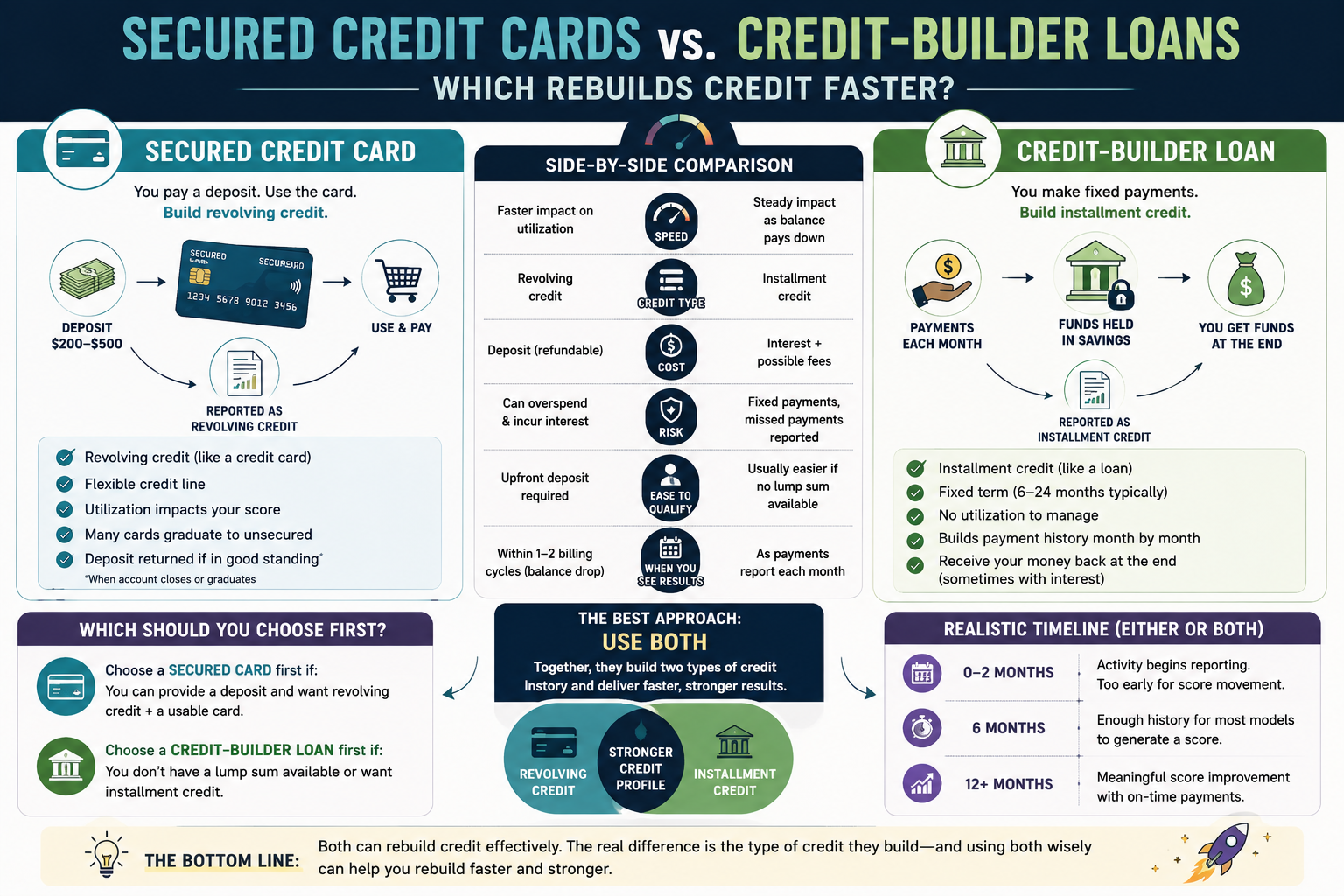
Neither secured credit cards nor credit-builder loans are universally faster for rebuilding credit, as their effectiveness depends on the specific credit factor they address. Secured credit cards can improve credit scores faster regarding utilization-related factors, with benefits potentially visible within a single billing cycle if balances are kept low. Credit-builder loans establish a positive payment history for installment credit, typically requiring about six months of on-time payments to significantly impact a credit score. For comprehensive credit rebuilding, using both a secured credit card and a credit-builder loan can be beneficial, addressing both revolving and installment credit history.
How a Secured Credit Card Works
You provide a cash deposit (typically $200-500, sometimes more), which becomes your credit limit. You use the card like a normal credit card — making purchases, receiving a monthly statement, and making payments — and your activity is reported to the credit bureaus as **revolving credit**, the same category as any standard unsecured credit card.
Key mechanics:
– Your deposit is held as collateral, reducing the issuer’s risk, which is why approval is accessible even with poor or no credit history.
– You can typically use it up to your limit repeatedly, as long as you pay down the balance (hence “revolving”).
– After a period of responsible use (often 6-12 months, varies by issuer), many secured cards either automatically graduate to unsecured status (returning your deposit) or make you eligible to apply for an unsecured card with the same issuer.
How a Credit-Builder Loan Works
Instead of receiving loan funds upfront, the “loan” amount is held in a locked savings account (or sometimes a CD) by the lender, and you make fixed monthly payments over a set term (often 6-24 months). At the end of the term, you receive the accumulated funds, sometimes with a small amount of interest.
Key mechanics:
– Your payments are reported to the credit bureaus as **installment credit** — a fixed monthly payment over a defined term, similar in structure to an auto loan or personal loan.
– You don’t have access to the funds until the term completes (or, with some products, after you’ve paid a certain percentage), which is fundamentally different from a secured card’s revolving access.
– There’s no ongoing utilization ratio to manage — your reported balance simply declines predictably each month as you make payments, following the loan’s amortization schedule.
Speed Comparison: Which Shows Results Faster?
**For utilization-related score factors**: a secured card can show a benefit faster, since utilization is calculated from your most recent reported balance and can improve within a single billing cycle if you keep spending low relative to your limit.
**For payment history establishment**: both report similarly — each on-time monthly payment adds to your track record, and most scoring models need a similar minimum period (roughly 6 months) of reporting history before generating a score at all, regardless of which product type you’re using.
**For credit mix**: a credit-builder loan adds installment credit to your file, which is a different category than the revolving credit a secured card provides. If you already have one type of account, adding the other type is what actually helps your credit mix factor — using two of the same type doesn’t provide this specific benefit.
In practice, neither product is meaningfully “faster” in isolation — the real speed advantage comes from using both together, since this establishes two different credit history types simultaneously, rather than sequentially.
Cost Comparison
**Secured card costs:**
– Upfront deposit, which is returned (assuming good standing) when the account closes or graduates to unsecured status — this isn’t really a “cost” so much as a temporary hold on your own money.
– Some secured cards carry annual fees, which is a genuine cost worth comparing across options.
– Interest charges apply if you carry a balance, though — as with any credit card — paying in full each month avoids this entirely.
**Credit-builder loan costs:**
– Interest is typically charged on the loan amount, similar to a standard personal loan, though credit-builder-specific products sometimes have relatively modest rates given their credit-building purpose.
– Some products charge a modest origination or administrative fee.
– Unlike a secured card, you generally get your money back at the end (plus, in some structures, a small amount of interest earned on the held funds) rather than a return of an unused deposit — the overall cost structure differs, so a direct comparison depends on the specific terms of each product.
Risk Comparison
**Secured card risk**: if you overspend and can’t pay it off, you risk carrying a balance with interest charges, and in more serious cases, if the account goes delinquent, the issuer may use your deposit to cover the unpaid balance — meaning you could lose your deposit and still end up with a damaged account on your credit report.
**Credit-builder loan risk**: since you’re making fixed payments toward funds you don’t yet have access to, missing a payment has the same negative reporting consequence as any other late payment, without the flexibility a credit card offers (like paying only the minimum in a pinch). Some people find this more psychologically challenging, since you’re paying money each month without immediate access to spend it, which can feel less flexible during tight financial periods.
Which Is Easier to Qualify For?
Both are generally accessible with poor or no credit, but there are some differences:
– **Secured cards** usually require the ability to provide the deposit upfront in a single lump sum, which can be a barrier for some applicants.
– **Credit-builder loans** spread the “cost” of the loan amount across monthly payments rather than requiring an upfront lump sum, which can make them more accessible for people who don’t have several hundred dollars available at once, even though the total amount paid over time may be similar or higher once fees/interest are factored in.
Which Should You Choose First?
If you can only start with one:
– **Choose a secured card first** if your priority is establishing revolving credit and you have the deposit available — revolving credit history and demonstrated utilization management are weighted meaningfully in most scoring models, and a secured card also gives you an actual usable card for everyday purchases.
– **Choose a credit-builder loan first** if you don’t have a lump sum available for a deposit, or if you specifically want to add installment credit to complement existing revolving credit (a credit card) you might already have.
The Best Approach: Use Both, If Feasible
Since they build different types of credit history and complement rather than duplicate each other, using both simultaneously — a secured card for revolving history plus a credit-builder loan for installment history — tends to produce faster, more well-rounded credit-building results than relying on either alone. This does mean managing two separate monthly payment obligations, so it’s only worth pursuing if you’re confident you can manage both reliably; missing payments on either defeats the purpose entirely.
Realistic Timeline for Either (or Both)
– **First 1-2 statement cycles**: initial reporting begins; too early to see meaningful score movement yet.
– **6 months**: enough history for most scoring models to generate a score, assuming consistent on-time payments.
– **12 months**: with continued responsible use, meaningful score improvement is typical, often sufficient to start qualifying for unsecured products.
The Bottom Line
Neither a secured credit card nor a credit-builder loan is definitively “faster” in isolation — both need roughly the same minimum reporting period before producing a usable score, and both depend entirely on consistent on-time payments to actually help. The real advantage comes from understanding what each contributes (revolving vs. installment credit history) and, if your budget allows, using both together to build a more diverse, faster-developing credit file than either product could produce alone.