
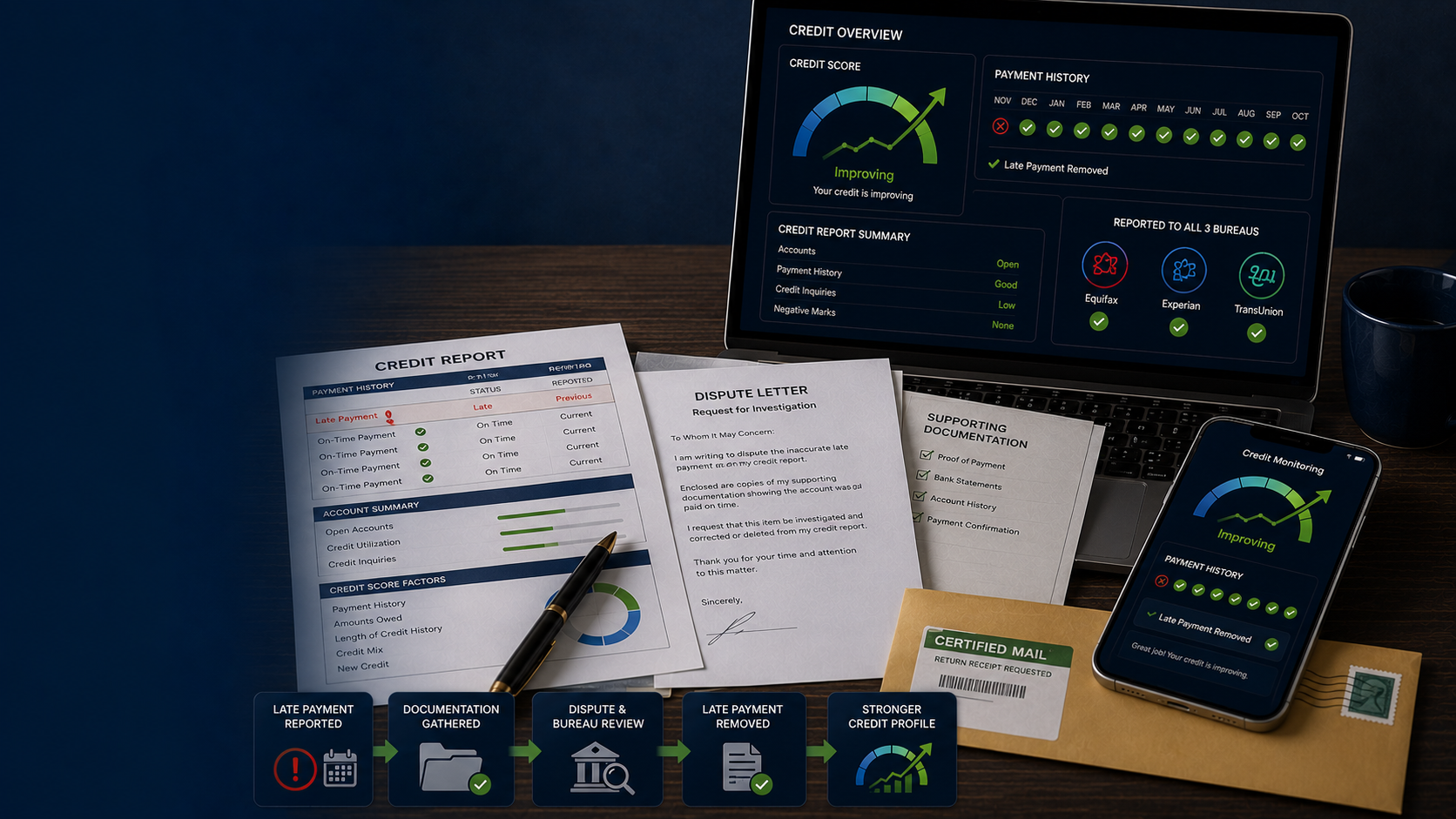
Late payments can severely impact a credit score, potentially reducing it by dozens of points, and typically remain on a credit report for up to seven years. While not all late payments can be removed, especially if accurate and recent, consumers have legitimate, FCRA-compliant options to address them. These options include disputing inaccurate or unverifiable entries, sending goodwill letters for isolated or older legitimate late payments, or negotiating pay-for-delete agreements for associated collections.
In this guide, we walk you through what a late payment actually is, how much it hurts, how long it stays, and the five legitimate paths to getting it off your report. We include step-by-step instructions and sample letters you can adapt and send yourself.
What Is a Late Payment?
A late payment is a payment on a credit account — a credit card, auto loan, mortgage, student loan, personal loan, or other installment account — that was not made by the due date listed in your agreement with the lender. Creditors generally report your payment status to the three major credit bureaus (Equifax, Experian, and TransUnion) every month, and that status becomes part of your credit history.
Not every payment that is a day late shows up on your report. Most creditors have a small grace period (often 10 to 15 days for credit cards, longer for mortgages) before they consider a payment officially delinquent and before they report it. The key threshold is 30 days past due. Once a payment crosses that 30-day mark, the creditor can — and almost always will — report it to the bureaus as a 30-day late payment.
That is the moment a late payment enters your credit file and starts affecting your score. Before 30 days, you may still owe a late fee to the creditor, but the bureaus typically do not know about it. After 30 days, it becomes a matter of public record on your credit report — visible to any lender who pulls your file.
A late payment on your report includes several pieces of information:
- The creditor’s name (the furnisher who reported it)
- The account number (often truncated)
- The date the late payment occurred (the month and year)
- The severity (30, 60, 60, or 90+ days late)
- The current status (whether the account is now current, still delinquent, or charged off)
Understanding each of these fields matters because, when you dispute a late payment, you are asking the bureau to verify the accuracy of these specific details. A wrong date, a wrong severity code, or a furnisher that cannot back up the entry are all openings for removal.
()
30, 60, and 90-Day Late Payments — How Severity Differs
Not all late payments are created equal. The credit reporting system uses a sliding scale of severity, and the further behind you fall, the more damage each mark does.
30-Day Late Payment
A 30-day late payment is the first tier of delinquency. It means a payment was not made within 30 days of the due date. This is the most common type of late payment and the one most people encounter at some point in their lives — a forgotten bill, a payment that got lost in the mail, a temporary cash-flow crunch.
A 30-day late is the least severe of the lates, but it is still a late payment, and it still hurts. On a good credit score, a single 30-day late can drop you 60 to 80 points. On a score that is already mid-range, the hit is smaller but still meaningful.
60-Day Late Payment
A 60-day late payment means the payment is now two billing cycles behind. This is more serious. By the time you reach 60 days, the creditor has usually sent you multiple notices, possibly called you, and may have restricted your account. A 60-day late signals to lenders that this was not a one-off oversight but a sustained inability to keep up.
The score impact of a 60-day late is larger than a 30-day, and it stays a red flag for longer in the eyes of manual underwriters even after the score itself has recovered.
90-Day Late Payment
A 90-day late payment is the most serious of the commonly reported lates, and it is often the threshold at which a creditor considers the account in default. At 90 days, many creditors will charge off the account (write it off as a loss), send it to a collection agency, or, for secured loans, begin repossession or foreclosure proceedings.
A 90-day late is treated by the scoring models as a major delinquency. It can drop a good score by 100 points or more, and its effect lingers. From a lender’s perspective, a 90-day late is a strong signal of financial distress, and it is the hardest type of late payment to explain away.
120, 150, and 180-Day Lates
Some accounts report even higher delinquency tiers — 120, 150, and 180 days — before charge-off. These behave much like 90-day lates in terms of scoring impact: they are major delinquencies, and the damage is severe. If you have lates at this level, they are almost always accompanied by a charge-off or collection, which means the path to resolution usually involves the account itself, not just the late-payment mark.
Why the Distinction Matters for Removal
The severity of the late payment matters for two reasons. First, it tells you how hard the mark will be to remove. A 30-day late on an otherwise perfect account is a candidate for a goodwill letter; a 90-day late on a charged-off account is not. Second, it tells you how much the mark is hurting you right now, which helps you prioritize which items to go after first when you are working through a credit repair plan.
How Much a Late Payment Hurts Your Score
The impact of a late payment depends on three things: how recent it is, how severe it is, and what your score was before it happened. Of the three, recency matters the most.
Recency Is the Biggest Factor
The FICO and VantageScore models weight recent negative information more heavily than old negative information. A late payment from three months ago hurts you far more than an identical late payment from three years ago. This is why people often see their score drop sharply right after a late reports, and then slowly recover over the following years even if the late payment itself never comes off.
This also means that the first year after a late payment is the most painful. If you can get through that first year with on-time payments on everything else, you will have absorbed most of the damage and your score will begin to stabilize.
Severity Amplifies the Hit
As we covered above, a 30-day late is less damaging than a 90-day late. But the scoring models do not treat each additional 30 days as a linear increase — the jump from 30 to 60 is meaningful, and the jump from 60 to 90 is even bigger because 90 crosses into major-delinquency territory.
Your Starting Score Changes Everything
Here is a wrinkle that surprises people: the higher your score was before the late payment, the more points you will lose. Someone with an 800 score who gets a 30-day late might drop to 680 — a 120-point swing. Someone with a 620 score who gets the same 30-day late might only drop to 600 — a 20-point swing.
This feels unfair, but it makes sense in the context of risk modeling. A high score says you have a long, clean history, so a new late payment is a strong signal that something has changed. A lower score already reflects some risk, so a new late is less of a surprise.
A Rough Point-Range Guide
These are estimates, not guarantees — your actual score change depends on your full profile:
- Single 30-day late, previously clean file: 60–110 point drop
- Single 60-day late: 70–130 point drop
- Single 90-day late: 90–150+ point drop
- Multiple late payments on the same account: the impact compounds, and the account can start dragging your score down in a way that does not fully reverse until the account itself is resolved
The takeaway: a late payment is not a minor blemish. It is a significant event, and it is worth fighting to remove if you have a legitimate basis to do so.
How Long Late Payments Stay on Your Report
Under the Fair Credit Reporting Act (FCRA), most negative information — including late payments — can stay on your credit report for up to seven years. The clock starts from the date of the original delinquency — that is, the date the late payment first occurred, not the date the account was closed or the date the late was reported.
The Seven-Year Rule
Seven years is the maximum. The bureaus are required to remove the late payment automatically once that seven-year period ends. You do not have to request it (though it is a good idea to check that it actually comes off — bureaus occasionally miss the deadline).
When the Clock Starts
This is one of the most misunderstood parts of credit reporting. The seven-year clock does not start when you close the account, when you pay off the debt, or when the late payment was reported. It starts on the date of the first delinquency that led to the late being reported.
For a single isolated late payment, this is straightforward: the clock starts the month the payment was due and you missed it. For an account that went delinquent and stayed delinquent (leading to a charge-off), the clock starts on the date of the first missed payment in that delinquent streak — not the date of the charge-off.
State Laws Can Shorten the Window
Some states have laws that require negative information to come off sooner than seven years for certain types of data. California, for example (where we are based), has consumer protection provisions that interact with the FCRA. It is worth knowing your state’s rules, but the FCRA’s seven-year cap is the federal baseline that applies everywhere.
What Does Not Reset the Clock
A common myth is that making a payment, disputing the account, or acknowledging the debt resets the seven-year clock. It does not. The date of original delinquency is fixed. Making a partial payment on an old account does not restart the reporting clock (though it may restart the statute of limitations for being sued — a separate legal concept you should understand before you act on an old debt).
How to Check When a Late Payment Will Fall Off
Your credit report typically includes a “scheduled to remain on report until” date for each negative item. Pull your free reports from all three bureaus at AnnualCreditReport.com and look for that date. If a late payment is older than seven years and is still showing, you have a clear-cut dispute: the bureau is required to remove it.
()
The Five Legitimate Paths to Late Payment Removal
There is no single magic method for removing a late payment. There are five legitimate paths, and the right one depends on whether the late is accurate, how old it is, and whether there is an open collection or charge-off attached to it.
Let’s walk through each.
Path 1: Dispute an Inaccurate or Unverifiable Late Payment
Best for: late payments that are wrong in any detail — wrong date, wrong severity, not yours, or already paid on time.
This is the strongest and most straightforward path. Under the FCRA, you have the right to dispute any information on your credit report that is inaccurate, incomplete, or unverifiable. When you file a dispute, the bureau is required to investigate (usually within 30 days) by going back to the furnisher (the creditor that reported the late) and asking them to verify the details. If the furnisher cannot verify it, or does not respond in time, the bureau must delete the late payment.
Grounds for disputing a late payment include:
- The payment was actually made on time (you have proof)
- The date of the late is wrong
- The severity is wrong (it says 60 days but you were only 30)
- The account is not yours (identity theft or mixed file)
- The account was in deferment or forbearance at the time
- The late was already resolved and should be reporting as current
- The furnisher no longer exists or cannot verify the details
Step-by-Step: How to Dispute an Inaccurate Late Payment
- Pull all three credit reports. Get your reports from Equifax, Experian, and TransUnion. The late may appear on one, two, or all three — and you need to dispute it with each bureau that is reporting it. Use AnnualCreditReport.com for your free copies.
- Gather your evidence. Bank statements, payment confirmations, canceled checks, correspondence with the creditor, deferment letters — anything that proves the late is wrong or supports your version of events. The stronger your documentation, the better your odds.
- File the dispute with each bureau reporting the late. You can dispute online, by phone, or by mail. Mail is slower but creates a paper trail and lets you include copies of your evidence. We recommend mail for anything complicated.
- Send the dispute to the furnisher too. Under the FCRA, you can also dispute directly with the creditor that reported the late. This is often overlooked. Send them the same documentation and ask them to correct or withdraw the reporting.
- Wait for the investigation. The bureau has 30 days (sometimes 45, if you send additional information during the investigation) to complete their review. They will contact the furnisher, who must verify the details.
- Review the results. The bureau sends you the outcome in writing. If the late is deleted, great. If it is verified and remains, you move to the next path.
- If deleted, confirm it across all three bureaus. A deletion at one bureau does not automatically delete at the others. Pull your reports again in 30–60 days to confirm.
What If the Furnisher Does Not Respond?
If the furnisher fails to respond to the bureau’s verification request within the 30-day window, the bureau is required to delete the late payment. This happens more often than you might think, especially with older accounts where the furnisher has archived the records or the original creditor has been acquired or dissolved.
This is why disputing is worth doing even when you are not 100% certain the late is wrong — if the furnisher cannot back it up, the late comes off. But do not dispute items you know are accurate just hoping the furnisher skips the response; that strategy backfires, and bureaus can flag repeat, frivolous disputes.
Path 2: Send a Goodwill Letter for an Isolated or Old Late
Best for: a late payment that is accurate but was a one-time mistake on an otherwise solid account, or a late that is several years old and you have been current ever since.
A goodwill letter is exactly what it sounds like: a polite, honest letter to the creditor asking them, as a matter of goodwill, to remove a late payment from your report. You are not disputing the accuracy — you are acknowledging the mistake and asking for leniency.
This works because creditors have the discretion to remove accurate negative reporting if they choose to. There is no law requiring them to keep it on, and no law preventing them from taking it off. It is entirely up to the human (or algorithm) on the other end.
When Goodwill Letters Work Best
Goodwill letters are most effective when:
- The late was a one-time event on an account with years of on-time payments before and after
- The late is older — at least a year or two in the past
- You are still a customer in good standing (or were for a long time)
- There was a genuine hardship — a job loss, medical emergency, divorce, death in the family — that you can briefly and honestly explain
- Your account is current and has been for a while
When Goodwill Letters Rarely Work
- The late is recent (within the last few months)
- You have multiple late payments on the same account
- The account went to collections or was charged off
- You closed the account angrily or defaulted on a settlement
- The creditor is a large bank with an automated policy against goodwill removals (some are more flexible than others)
Step-by-Step: How to Write and Send a Goodwill Letter
- Identify the right recipient. Send the letter to the creditor’s customer service or executive resolution office, not the general payment address. For larger banks, search for the office of the president or the executive customer relations team.
- Be honest and specific. State the account number, the date of the late payment, and the reason it happened. Do not over-explain or make excuses — a few honest sentences are more effective than a long, dramatic story.
- Emphasize your positive history. Mention how long you have been a customer, how many on-time payments you have made, and any steps you have taken to make sure it does not happen again (autopay, emergency fund, etc.).
- Make a clear, polite ask. Request that they remove the late payment as a goodwill gesture. Do not demand, threaten, or cite laws — this is a favor, not a legal right.
- Send by mail if possible. A physical letter on paper gets more attention than an email or a portal message. Keep a copy and send it with tracking.
- Follow up if you do not hear back. Wait 30–45 days. If no response, send a second letter. If still nothing, try a different contact path (executive office, social media, regulator complaint as a last resort).
- Be patient and realistic. Goodwill removals are not guaranteed. Creditors say no far more often than they say yes. But the cost of trying is a stamp and a few minutes, so it is almost always worth a shot for a late that is genuinely an outlier.
()
Path 3: Pay-for-Delete When a Collection Is Tied to the Late
Best for: situations where the late payment has escalated into a collection account or a charge-off, and you have the ability to pay (or settle) the underlying debt.
Pay-for-delete is an arrangement where you negotiate with a collection agency (or sometimes the original creditor) to have the negative item removed from your credit report in exchange for paying the debt. This is not a dispute and not a goodwill request — it is a negotiated settlement.
The Important Caveat
Pay-for-delete works primarily with collection agencies, not with original creditors reporting late payments directly. If your late payment is simply a 30/60/90-day mark on an open account that is still with the original creditor, pay-for-delete is usually not on the table. It becomes relevant when the account has been sent to collections or charged off, and a collection agency is now reporting a separate collection item.
In those cases, paying the collection (or settling it) in exchange for deletion of the collection entry can indirectly clean up the credit file — and sometimes, with the right negotiation, the original late-payment marks too.
Step-by-Step: How to Negotiate Pay-for-Delete
- Confirm the debt is yours and the amount is correct. Do not negotiate until you have validated the debt. Send a debt validation letter first if you have any doubts.
- Decide what you can pay. Full payment is ideal, but many collection agencies will accept a settlement for less than the full balance (often 40–70%). Decide your ceiling before you start negotiating.
- Get the agreement in writing before you pay. This is the most important step. Never pay on a verbal promise. The agency must send you a written agreement stating that, upon receipt of your payment, they will request deletion of the collection (and any related negative reporting) from all three bureaus.
- Pay only after the written agreement is in hand. Use a method that gives you a receipt — check, money order, or tracked payment. Keep proof forever.
- Follow up to confirm deletion. Give it 30–60 days after payment, then pull your reports. If the collection is still showing, send a dispute to the bureaus with your pay-for-delete agreement and proof of payment attached.
Honest Limitations
Not all collection agencies agree to pay-for-delete. Some have policies against it, and some credit bureaus have pushed back on the practice. But many still do it, especially for full payment. And even if you cannot get a deletion, paying a collection is still better for your credit than leaving it open — paid collections are scored more favorably than unpaid ones under newer FICO and VantageScore models, and many lenders treat a paid collection very differently than an unpaid one in manual underwriting.
Path 4: Wait Out the Seven-Year Clock
Best for: accurate late payments that cannot be removed any other way, especially older ones that are already close to the seven-year mark.
This is the path no one wants to hear, but it is the most reliable one. If a late payment is accurate, has been verified, and the creditor will not grant goodwill removal, it comes off your report automatically after seven years from the date of the original delinquency. No letter, no dispute, no payment required.
Make the Wait Less Painful
While you wait, the late payment’s impact shrinks every year. The scoring models weight recency, so a late that is five years old barely affects your score even though it is still on your report. Here is how to make the waiting period work for you:
- Pay everything on time, every time. The single best thing you can do for your score while waiting out a late is to build a long, unbroken streak of on-time payments. New positive history dilutes the old negative.
- Keep your credit utilization low. Stay under 30% on your credit cards, ideally under 10%. This is the second-biggest scoring factor after payment history.
- Do not close old accounts. Account age helps your score. Closing a long-standing account can shorten your average age of accounts and lower your score.
- Add positive accounts if you need to. A secured credit card or a credit-builder loan, used responsibly, adds new positive history to your file.
- Monitor the deletion date. Set a reminder for the month the late is scheduled to come off. If it does not disappear on its own, dispute it as obsolete.
Disputing as Obsolete
If a late payment is older than seven years and is still on your report, you have an absolute right to have it removed. File a dispute with each bureau stating that the item is obsolete — older than the FCRA’s seven-year reporting period — and must be deleted. Include the date of the original delinquency if you have it. The bureau must remove it. This is one of the easiest disputes to win.
Path 5: Negotiate Directly With the Furnisher
Best for: situations where you have a relationship with the creditor and some leverage — for example, you are current on a modified payment plan, you are settling a charged-off account directly with the original creditor, or you are a long-standing customer with a single blemish.
Sometimes the fastest path is a direct conversation with the creditor that reported the late. This is different from a goodwill letter (which is written) and different from pay-for-delete (which is about a collection). This is picking up the phone or sending a message and asking, person to person, whether they will update the reporting as part of a broader arrangement.
Scenarios Where This Works
- You are settling a charged-off account. As part of the settlement, ask the creditor to report the account as “paid as agreed” or “current” instead of “settled” or “charged off.” Some will do this; many will not, but it is worth asking.
- You are entering a hardship or modification program. Some creditors will agree to suppress negative reporting while you are on a modification plan, or to remove prior lates once you complete the plan successfully.
- You are a long-time customer with a single late. A phone call to the retention or executive customer service line can sometimes accomplish what a goodwill letter cannot, especially if you are considering moving your business elsewhere.
How to Approach the Conversation
- Call the customer service line and ask to be transferred to a supervisor or the retention/executive resolutions team. Front-line reps often do not have the authority to change credit reporting.
- Be calm, clear, and specific. State what you want (removal of a specific late payment, re-reporting as current, suppression of future lates during a plan). Have your account number and the date of the late in front of you.
- Offer something in return if you can. If you are settling, offer a higher settlement percentage in exchange for better reporting. If you are a long-time customer, mention your history and your desire to stay.
- Get any promise in writing. If they agree, ask them to send you a letter or email confirming what they will report. Verbal promises are not enforceable, and front-line reps sometimes misstate what they can actually do.
- Follow up on your reports. Give it 30–60 days and check whether the reporting has actually changed. If it has not, call back with your written confirmation in hand.
Sample Dispute Letter for an Inaccurate Late Payment
Below is a template you can adapt when disputing a late payment you believe is inaccurate or unverifiable. Replace everything in brackets with your own information, and include copies (not originals) of any supporting documents.
[Your Name] [Your Address] [City, State ZIP] [Your Phone Number] [Your Date of Birth] [Your Social Security Number — last 4 only, e.g., XXX-XX-1234] [Date] [Credit Bureau Name — Equifax, Experian, or TransUnion] [Bureau Address] RE: Dispute of Inaccurate Late Payment Reporting To Whom It May Concern: I am writing to dispute a late payment that is appearing on my credit report from [Bureau Name]. I believe this information is inaccurate and should be removed. Account Information: – Creditor: [Creditor Name] – Account Number: [Account Number] – Late Payment Date Reported: [Month/Year] – Severity Reported: [30/60/90 days late] – Reason for Dispute: [Choose one: The payment was made on time / The date is incorrect / The severity is incorrect / This account is not mine / The account was in forbearance at the time / Other — explain briefly] Supporting Facts: [In 2–4 sentences, state plainly what happened and why the reporting is wrong. Example: “My bank records show the payment for the December 2024 billing cycle was initiated on December 18, 2024, and posted to the creditor on December 20, 2024 — four days before the due date. The late payment reporting for January 2025 is therefore incorrect.”] Enclosed are copies of the following documents supporting my dispute: – [List each document, e.g., “Bank statement showing payment initiation on 12/18/2024”] – [Creditor’s payment confirmation email dated 12/20/2024] – [Any other evidence] Under the Fair Credit Reporting Act (15 U.S.C. § 1681i), I am requesting that you investigate this dispute within 30 days, contact the furnisher to verify the accuracy of the reporting, and delete this late payment from my credit file if it cannot be verified or is found to be inaccurate. Please send me the results of your investigation in writing, along with an updated copy of my credit report reflecting the deletion if applicable. Thank you for your prompt attention to this matter. Sincerely, [Your Signature] [Your Printed Name] Enclosures: [Number] pages
A few tips on using this letter:
- Send it by certified mail with return receipt so you have proof of delivery and the date it was received.
- Keep a copy of everything you send.
- Send a separate letter to each bureau that is reporting the late. Do not assume they will share the dispute with each other.
- Send a separate dispute to the furnisher (the creditor) at the same time. The FCRA gives you the right to dispute directly with furnishers, and doing both at once increases your chances.
Sample Goodwill Letter for a Legitimate Late Payment
Below is a template for a goodwill letter — use this when the late payment is accurate but you are asking the creditor to remove it as a courtesy. Be honest, be brief, and be specific about your positive history.
[Your Name] [Your Address] [City, State ZIP] [Your Phone Number] [Date] [Creditor Name] Attn: Customer Service / Executive Resolutions [Creditor Address] RE: Goodwill Request for Removal of Late Payment Account Number: [Account Number] Dear [Creditor Name] Team, I am writing to respectfully request a goodwill adjustment to remove a late payment reported on my account in [Month/Year of the late]. I have been a customer with [Creditor Name] since [Year you opened the account], and I value our relationship. In [Month/Year], I missed a payment due to [brief, honest reason — e.g., “an unexpected medical emergency that kept me out of work for three weeks” / “a job transition that caused a temporary disruption in my income” / “an oversight while traveling for a family emergency”]. I take full responsibility for the missed payment. Since that time, I have brought the account current and have made [number] consecutive on-time payments. I have also enrolled in autopay to ensure this does not happen again. My account is in good standing. This single late payment is the only blemish on an otherwise strong history with your company, and it is currently preventing me from [specific goal — e.g., “qualifying for a mortgage” / “refinancing my auto loan at a better rate” / “securing a business loan for my small business”]. I am hoping you will consider, as a gesture of goodwill, removing this late payment from my credit report. I understand this is a request and not a requirement, and I appreciate your time in considering it. Thank you for being a company I have trusted with my financial business for [number] years. Sincerely, [Your Signature] [Your Printed Name]
Tips for goodwill letters:
- Address it to a real person or office if you can find a name. LinkedIn and executive contact databases can help.
- Keep it to one page. Long letters get skimmed, not read.
- Do not cite the FCRA or threaten legal action. This is a favor, not a fight.
- Send it by mail. Email works sometimes, but a physical letter signals effort and seriousness.
- If you get a no, wait two to three months and try again, perhaps to a different contact within the company.
What to Do If the Late Payment Is Verified
So you disputed the late payment, the bureau investigated, and the furnisher verified it. The late is staying. Now what?
First, do not panic. A verified late payment is not the end of your credit journey. Here is the playbook for living with — and ultimately moving past — a verified late.
1. Request a Method of Verification
Under the FCRA, you have the right to ask the bureau how they verified the item — what process they used, who they contacted, and what evidence the furnisher provided. Send a written request for the method of verification within 15 days of receiving the dispute results. Sometimes the bureau’s “investigation” is nothing more than a database check with the furnisher, and if they cannot produce a meaningful answer, you have grounds to push harder.
2. Dispute Directly With the Furnisher
If the bureau’s investigation was cursory, go directly to the creditor. Send them a dispute letter under FCRA Section 623, which requires furnishers to investigate disputes about information they reported. Include your evidence and ask them to correct or withdraw the reporting. Some furnishers are more responsive to direct disputes than to bureau-forwarded ones.
3. Add a Consumer Statement to Your File
Under the FCRA, you have the right to add a 100-word consumer statement to your credit report explaining the circumstances behind a negative item. This does not change your score, but it can be seen by lenders who manually review your report, and it gives you a chance to tell your side of the story. This is a small, often-overlooked tool.
4. File a Complaint if There Is a Real Error
If you have strong evidence that the late is wrong and the bureau and furnisher are both stonewalling, you can file a complaint with the Consumer Financial Protection Bureau (CFPB) and your state attorney general’s office. The CFPB forwards complaints to the company and requires a response within 60 days. This is not a guarantee of resolution, but it puts pressure on the furnisher and creates a paper trail that can support a future legal claim if one becomes necessary.
5. Talk to an Attorney
If a furnisher is knowingly reporting inaccurate information and refuses to correct it, you may have a claim under the FCRA. The FCRA allows consumers to sue for actual damages, statutory damages, and attorney’s fees. This is where the attorney-backed part of what we do matters — having legal counsel review a stubborn, inaccurate reporting situation can change the furnisher’s calculus quickly. Not every case warrants a lawsuit, but some do, and you should know your options.
6. Focus on What You Can Control
While you work the dispute, keep building positive credit. On-time payments, low utilization, and new positive accounts all help your score recover even while the late payment sits there. Do not let one verified late payment make you give up on the rest of your credit profile.
How Late Payments Age and Hurt Less Over Time
Here is something that often gets lost in the stress of a late payment: the damage shrinks as the late gets older. A late payment does not hurt you the same amount in year one as it does in year six.
The Recency Curve
The scoring models are built to care most about what you have done lately. A late payment from two months ago is a strong signal of current trouble. A late payment from four years ago is a much weaker signal — you have had four years to demonstrate that it was an anomaly, not a pattern.
A rough way to think about the curve:
- Year 1 (0–12 months): Full impact. The late is hurting you as much as it ever will.
- Year 2 (12–24 months): Meaningful but softening. Your score has likely recovered some if the rest of your file is clean.
- Years 3–4: Noticeably less impact. Many people see their scores return to pre-late levels by this point, assuming no new negatives.
- Years 5–6: Minimal impact. The late is still on your report, but it is barely moving your score.
- Year 7: The late falls off entirely, and you get whatever small boost remains.
Why This Matters
This matters because it tells you where to focus. If you have a late payment from five years ago and a high credit card balance from this month, paying down the balance will help your score more than chasing the old late payment. The recency-weighted scoring means your energy is best spent on the most recent factors first.
It also means that time is on your side. Every month that passes with on-time payments, the late payment hurts a little less. This is why we encourage clients not to obsess over a single old late at the expense of building strong current habits. The old late is fading; the new habits compound.
Single 30-Day Late vs. 90-Day Late — The Impact Difference
People often ask: does it matter whether it was a 30-day late or a 90-day late? The answer is yes — a lot.
The 30-Day Late
A single 30-day late on an otherwise clean account is the most survivable negative item on a credit report. It hurts, especially in the first year, but it is the kind of thing lenders see regularly and are willing to overlook with context. A goodwill letter has a real chance of working. A year of on-time payments afterward recovers most of the lost score. Two years out, it is mostly a footnote.
The 90-Day Late
A 90-day late is a different animal. It is classified as a major delinquency, and it tells lenders that the missed payment was not a one-time oversight but a sustained period of nonpayment. The score drop is larger, the recovery is slower, and goodwill removals are far less likely because the creditor has a harder time justifying the deletion internally.
A 90-day late also frequently comes with downstream consequences: the account may be closed by the creditor, the interest rate may be jacked up to a penalty APR, and the account may be charged off and sent to collections. When that happens, you are not dealing with one negative item — you are dealing with a late payment, a charge-off, and a collection, all stemming from the same event.
The Practical Takeaway
If you have a choice about which late to address first — say, you have a 30-day late on one account and a 90-day late on another — go after the 90-day late first if there is any chance of removal or settlement, because it is doing more damage. But also know that the 90-day late is harder to remove and that managing the underlying account (settling it, paying it, negotiating reporting) is usually more productive than disputing the late mark in isolation.
Compound Lates
If a single account has a 30, then a 60, then a 90 — a streak of escalating lates — the scoring impact compounds. The account looks like it slid into delinquency and stayed there. In these cases, the most effective strategy is usually to address the account as a whole (bring it current, settle it, or negotiate a resolution) rather than trying to pluck individual late marks off one at a time.
Common Mistakes That Sabotage Removal Attempts
In our work with clients, we see the same mistakes over and over. Avoiding these will save you time, money, and frustration.
1. Disputing Everything Hoping Something Sticks
Filing disputes on accurate items you know are correct, just hoping the furnisher does not respond, is a bad strategy. Bureaus can flag your disputes as frivolous under the FCRA, which lets them refuse to investigate. Once you are flagged, even legitimate disputes become harder. Dispute only items you have a genuine reason to question.
2. Using Aggressive or Threatening Language
Whether you are writing a dispute, a goodwill letter, or a negotiation, angry, threatening, or legalistic language backfires. The people reading these are humans with discretion, and a hostile tone makes them less inclined to help. Be firm, be clear, and be polite.
3. Not Keeping Records
Every letter you send, every response you receive, every date and every name — keep it all. Disputes and negotiations often come down to who can prove what happened and when. If you cannot show the bureau received your dispute on a specific date, you cannot enforce the 30-day investigation deadline.
4. Sending Originals Instead of Copies
Never send original documents to a bureau or furnisher. Send copies. Documents get lost, and if you send your only proof, you may never see it again.
5. Paying a Collection Without a Written Deletion Agreement
If you are pursuing pay-for-delete, get the agreement in writing before you pay. Paying first and then asking for deletion almost never works — once they have your money, they have no incentive to help you.
6. Closing Accounts After a Late Payment
Closing the account where the late happened does not remove the late from your report, and it can hurt your score by shortening your average account age and reducing your available credit. Keep the account open, keep it current, and let the positive history rebuild.
7. Believing “Guaranteed Removal” Promises
Any company that guarantees they can remove accurate, verified late payments is lying. The FCRA does not allow for guaranteed removal of accurate information, and no legitimate credit repair firm — ours included — will promise that. We can pursue every legitimate path, and we do, but we will not lie to you about the odds.
8. Ignoring the Underlying Debt
If a late payment is tied to an unpaid debt, chasing the late mark without addressing the debt is a losing game. The debt can be sold, re-reported, and turned into a collection that does far more damage than the original late. Deal with the debt first, then deal with the reporting.
9. Disputing Online When You Should Dispute by Mail
Online disputes are fast, but they often ask you to waive certain rights and they limit how much documentation you can attach. For complicated disputes, mail is better — it creates a full paper trail and lets you include everything.
10. Giving Up After One “No”
A no from a bureau or a creditor is not always final. Goodwill letters can be sent again to a different contact. Disputes can be reframed with new evidence. Furnishers can be contacted directly. Persistence — within reason and within the rules — pays off.
Frequently Asked Questions
Can I remove a late payment that is accurate?
It is possible but not guaranteed. The most common path for an accurate late payment is a goodwill letter asking the creditor to remove it as a courtesy. Creditors are not required to say yes, and many do not, but some do — especially for isolated lates on accounts with long, otherwise clean histories. If there is an open collection tied to the late, a pay-for-delete negotiation may also be an option.
How long does a late payment stay on my credit report?
Up to seven years from the date of the original delinquency, under the FCRA. The late payment should be removed automatically once that period ends. If it is still showing after seven years, you can dispute it as obsolete and the bureau must delete it.
Will one late payment ruin my credit?
No. A single 30-day late payment will hurt your score — especially in the first year — but it is not catastrophic, and the impact fades over time. With consistent on-time payments afterward, most people see substantial score recovery within 12 to 24 months. A 90-day late is more serious and takes longer to recover from.
Can I dispute a late payment online?
Yes, all three bureaus offer online dispute portals. However, for complicated disputes or ones that require documentation, we recommend disputing by mail with certified delivery. This creates a stronger paper trail and lets you include copies of all your supporting evidence. Online disputes sometimes limit what you can attach and may include arbitration clauses you do not want to agree to.
Does paying a late payment remove it from my report?
Not automatically. Paying the overdue amount brings your account current and stops new lates from reporting, but the existing late payment mark stays on your report for up to seven years. To try to remove the mark itself, you would need to dispute it (if it is inaccurate), send a goodwill letter, or negotiate pay-for-delete if a collection is involved.
What is a goodwill letter and does it work?
A goodwill letter is a written request to a creditor asking them to remove an accurate late payment from your credit report as a courtesy. It works sometimes — not always. It is most effective for a one-time late on an account with a long, positive history, especially if there was a genuine hardship. Creditors are not obligated to grant goodwill removals, and many have internal policies against it, but the cost of trying is low and the upside is real.
Can a credit repair company remove late payments?
A legitimate credit repair company can help you identify inaccurate or unverifiable late payments, file disputes on your behalf, send goodwill letters, and negotiate with creditors and collectors. What a legitimate company cannot do is guarantee the removal of accurate, verified information. If a company promises guaranteed removals, that is a red flag. We pursue every legitimate path, but we will be honest with you about the odds.
Should I hire a lawyer to remove a late payment?
For most late payments, a lawyer is not necessary — the dispute and goodwill processes are things you can do yourself or with a credit repair firm. However, if a furnisher is knowingly reporting inaccurate information and refuses to correct it, you may have a claim under the FCRA, and an attorney can help you pursue it. The FCRA allows for actual damages, statutory damages, and attorney’s fees, which means legal representation may be available at no out-of-pocket cost to you depending on the case. This is one of the advantages of working with an attorney-backed credit repair firm.
How much does a late payment affect my credit score?
It depends on your starting score, the severity of the late, and how recent it is. A single 30-day late can drop a strong score (780+) by 60 to 110 points. A 90-day late can drop a strong score by 100 to 150 points or more. If your score is already lower, the point drop is smaller. The impact fades each year, and by years 5–6 the late is barely affecting your score even though it is still on your report.
What is the difference between a late payment and a collection?
A late payment is a mark on an existing account showing that a payment was overdue by 30, 60, or 90+ days. The account is still open and being reported by the original creditor. A collection is a separate account that appears when the original creditor gives up on collecting the debt and either sells it to a collection agency or hires one to collect on their behalf. A collection is a more serious negative item and typically appears in addition to, not instead of, the late payments that led up to it.