
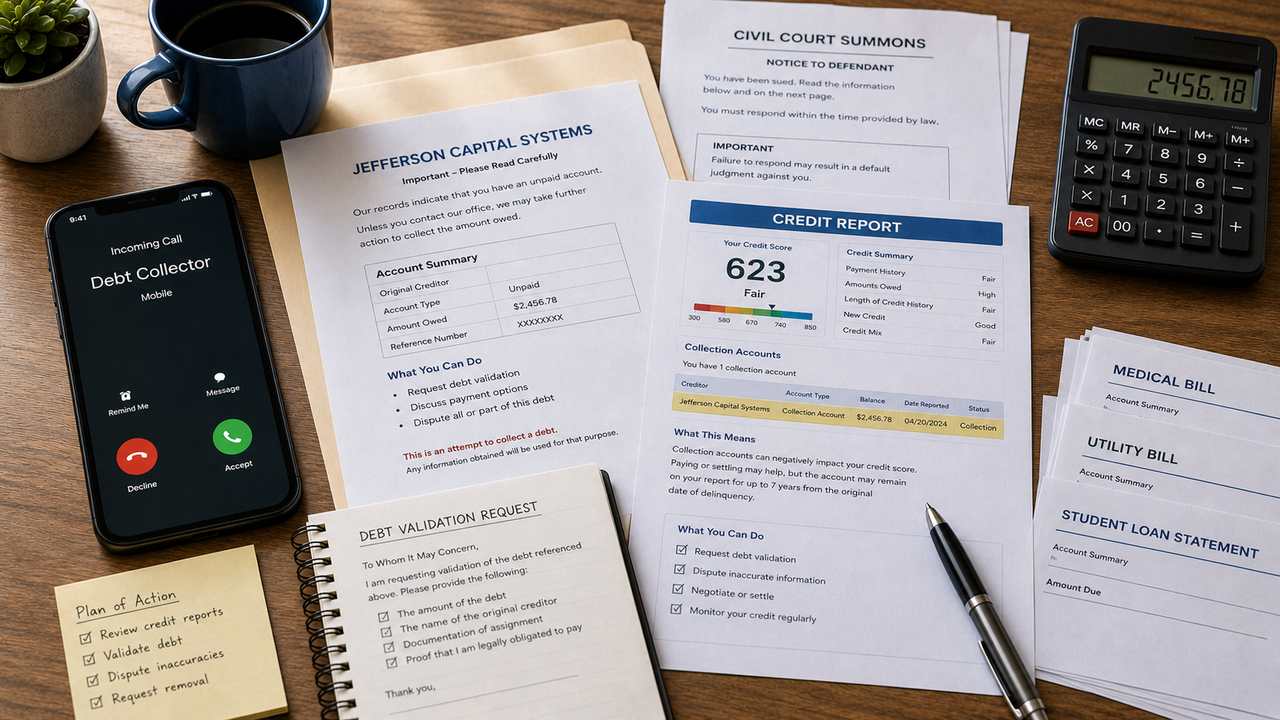
Jefferson Capital Systems is a legitimate debt buyer and collector that acquires old, charged-off debts from original creditors. They contact individuals because they have purchased a debt they believe is owed, and their objective is to collect on it, often for a fraction of the original amount.
Take a breath — you’re not alone in this, and there’s a clear, factual answer to what’s going on. This guide explains exactly who Jefferson Capital Systems is, why they have your contact information, what they can and can’t legally do, and the specific steps to take depending on your situation.
Who Is Jefferson Capital Systems?
Jefferson Capital Systems, LLC (often abbreviated JCAP) is a debt buyer and debt collection company headquartered in St. Cloud, Minnesota. The company was originally founded in 2002 and has grown into one of the larger debt buyers operating in the United States, with additional operations extending into Canada and the United Kingdom. Over the years, Jefferson Capital has operated under different corporate ownership structures, as is common in the debt-buying industry, where companies are periodically acquired, merged, or restructured.
Here’s the most important thing to understand right away: Jefferson Capital Systems is not a scam. It’s a real, legally operating company, registered and regulated as a debt collector under federal law, specifically the Fair Debt Collection Practices Act (FDCPA). That doesn’t mean every interaction with them will feel pleasant, and it doesn’t mean every debt they claim you owe is necessarily accurate or still legally collectible — but the company itself is a legitimate business, not a fraudulent operation preying on consumers with fake debts.
What Does Jefferson Capital Actually Do?
Jefferson Capital’s core business model is being a debt buyer, which is a specific and important distinction from a traditional third-party collection agency. Here’s the difference, and why it matters to you directly:
A traditional collection agency is typically hired by your original creditor (say, a credit card company) to collect a debt on the creditor’s behalf, for a fee or commission. The creditor still legally owns the debt; the agency is just acting on their behalf.
Jefferson Capital, by contrast, buys the debt outright, usually long after it’s been charged off by the original creditor (meaning the original lender has already written it off as a financial loss on their books — a separate accounting concept covered in more detail later in this guide). Debt buyers like Jefferson Capital typically purchase these charged-off accounts in large bundled portfolios, for a small fraction of the original balance — often just pennies on the dollar. Once purchased, Jefferson Capital becomes the new legal owner of the debt, which means any payment, negotiation, or settlement you make going forward would be with Jefferson Capital directly, not your original bank or lender.
This is exactly why so many people are caught off guard: you might have taken out a credit card with one bank, stopped paying it years ago during a difficult financial stretch, largely forgotten about it, and then suddenly get a call from a company you’ve never heard of. The explanation is almost always the same — your original account was sold, once or sometimes multiple times, and Jefferson Capital is now the current owner attempting to collect.
What Types of Debt Does Jefferson Capital Buy?
Jefferson Capital purchases a wide range of charged-off consumer debt, commonly including:
- Credit card debt from major banks and card issuers
- Personal loans
- Private student loans (not federal student loans, which are handled through an entirely separate government system)
- Utility and telecom account balances, including unpaid phone or internet bills
- Bankruptcy-related debt, including servicing certain secured and unsecured accounts tied to bankruptcy proceedings
Because of this broad purchasing activity, Jefferson Capital’s name — or variations of it — can show up on your credit report or in collection correspondence in several different forms, including “Jefferson Capital Systems,” “Jefferson Capital LLC,” “JCAP Funding LLC,” “Jefferson Collection,” or even a name referencing the original creditor, such as “Jefferson Capital Systems Verizon,” if the debt originated with a telecom provider. If you’re trying to search your own credit report or old mail for a match, it’s worth checking for several of these name variations rather than assuming there’s only one exact way it would appear.
Why Are They Calling or Writing to You Specifically?
There are a few common scenarios that explain why you’re hearing from Jefferson Capital:
- You have an old, unpaid account that was eventually charged off and sold. This is by far the most common reason. Somewhere in your financial history, an account went unpaid long enough that the original creditor gave up trying to collect it directly and sold it to a debt buyer — in this case, Jefferson Capital.
- The debt was resold multiple times before reaching Jefferson Capital. It’s common for charged-off debt to be bought and sold more than once as it moves through the debt-buying industry, meaning Jefferson Capital might be the third or fourth company to have owned a particular account since it was originally charged off.
- A mistake or mix-up has occurred. Less commonly, but not rarely, people are contacted about debt that isn’t actually theirs — due to identity theft, a case of mistaken identity (especially common with similar or shared names), or a data error somewhere along the chain of the debt being resold.
- The debt may be outside your state’s legal collection window (statute of limitations), but they’re still permitted to contact you. Even if a debt is past the point where a collector could successfully sue you for it, in most cases collectors can still legally contact you and request payment, as long as they don’t misrepresent the enforceability status of the debt (a specific and important legal boundary covered later in this guide).
What Are Your Rights Under the FDCPA?
Because Jefferson Capital is legally classified as a debt collector, they’re required to follow the Fair Debt Collection Practices Act, a federal law that establishes clear boundaries on what debt collectors can and cannot do. Understanding these rights puts you in a much stronger position, regardless of whether the debt turns out to be legitimate or not.
- They cannot call you at unreasonable hours. Under the FDCPA, debt collectors generally cannot contact you before 8 a.m. or after 9 p.m. in your time zone.
- They cannot harass, threaten, or use abusive language. This includes repeated calls intended to annoy or harass, threats of violence, or the use of obscene language.
- They cannot misrepresent themselves or the debt. This includes falsely claiming to be an attorney or government representative, misstating the amount owed, or falsely implying that failure to pay will result in arrest (a threat that’s simply not legally accurate for consumer debt in the United States).
- They cannot contact you at your workplace if you’ve told them not to. Once you inform a collector, verbally or in writing, that you can’t receive calls at work, they’re legally required to stop contacting you there.
- They must stop contacting you if you send a written cease-and-desist request. You have the right to request in writing that a collector stop all communication, though this doesn’t erase the debt itself, and it doesn’t necessarily prevent them from pursuing other legal remedies, such as a lawsuit, if the debt is still within the legal window to sue.
- They cannot discuss your debt with third parties. This applies other than in very limited circumstances (such as confirming your location information), meaning they generally can’t disclose details of your debt to your family, employer, or neighbors.
What is the First Step When Contacted by Jefferson Capital?
A natural instinct when facing an unfamiliar collector is either to ignore it entirely, hoping it goes away, or to panic and immediately pay whatever is demanded just to make it stop. Neither of these is the ideal first move. The single most important first step is to request debt validation.
What Is Debt Validation, and Why It Matters
Under the FDCPA, you have the right to request that a debt collector validate a debt — meaning they must provide written proof of specific key facts, including the amount owed, the name of the original creditor, and confirmation that they have the legal right to collect this specific debt from you. You generally have 30 days from your first contact with the collector to make this request, and once you do, the collector is legally required to pause collection activity (including further calls) until they provide that validation.
This step is valuable for everyone contacted by a debt collector, regardless of whether you believe the debt is legitimate, for a simple reason: it confirms the basic facts before you commit to anything, and it creates a paper trail. If the debt isn’t actually yours, is inaccurate, or the company can’t properly prove ownership and the amount owed, this process often reveals that clearly, without you having to take their word for it over the phone.
How to request validation: Send a written letter (not just a phone request, which is harder to prove later) to the address provided in Jefferson Capital’s collection letter, clearly stating that you’re requesting debt validation under the FDCPA, and that you’re requesting they cease collection activity until validation is provided. Send it via certified mail with return receipt requested, so you have proof of when it was sent and received.
How Do You Check if the Debt is Actually Yours?
Once you receive validation information, compare it carefully against your own records. A few things worth confirming:
- Does the original creditor’s name match an account you actually had? If you don’t recognize the original creditor at all, this is a strong signal something may be wrong — either a data error or potential identity theft.
- Does the amount claimed make sense relative to what you remember owing, accounting for any interest or fees that may have legitimately accrued?
- Is the account genuinely yours, not a case of a similar name, a family member’s account, or identity theft?
If anything doesn’t check out, this is the point to formally dispute the debt in writing, and if identity theft is suspected, to also file a report with the FTC at IdentityTheft.gov and place a fraud alert or credit freeze with the credit bureaus.
How Do You Check Your State’s Statute of Limitations?
Every state has a statute of limitations — a legal time limit within which a creditor or debt buyer can sue you to collect a debt through the court system. This period varies significantly by state, commonly ranging anywhere from three to ten years, and can also vary depending on the specific type of debt (written contract, credit card, promissory note, and so on).
This is a critically important, and often misunderstood, legal concept, separate from how long a debt can appear on your credit report (governed by an entirely different federal rule under the Fair Credit Reporting Act, generally seven years from the original delinquency date). A debt can be past your state’s statute of limitations for lawsuits, while still legally appearing on your credit report if it’s within that separate seven-year window, and Jefferson Capital, like other debt buyers, is generally still permitted to contact you and ask for payment on a time-barred debt — they just can’t legally sue you over it (and in many states, and under a Consumer Financial Protection Bureau rule, they’re required to disclose to you that the debt is time-barred if they’re aware of it and still choose to attempt collection).
Why this matters enormously before you pay anything: In many states, making even a partial payment, or in some cases simply acknowledging the debt in writing, can restart the statute of limitations clock, making you newly vulnerable to a lawsuit on a debt that was previously too old to be legally enforced in court. If you’re dealing with an old debt and you’re not sure whether your state’s statute of limitations has already expired, it’s worth researching this specifically, or consulting a consumer law attorney, before making any payment.
How Should You Handle Debt from Jefferson Capital?
Once you’ve validated the debt and understand your legal timeline, you have several realistic paths forward, and the right one depends on your specific circumstances.
- Pay the debt in full, if you have the means and confirm it’s accurate and something you want to resolve completely. This closes out the account and, under most current credit scoring models, is viewed more favorably than an unpaid balance.
- Negotiate a settlement for less than the full amount. Since Jefferson Capital purchased the debt for a fraction of its original value, they often have real flexibility to accept a reduced lump-sum payment — sometimes 30-60% of the claimed balance, though this varies. Always get any settlement agreement in writing before sending payment.
- Set up a payment plan, if a lump sum isn’t feasible, structured over time in a way that fits your budget — again, with any agreement documented in writing.
- Dispute the debt formally, if validation reveals it isn’t accurate, isn’t yours, or the company can’t adequately prove their claim.
- Do nothing further and let the reporting period run its course, if the debt is old, you’ve confirmed your state’s statute of limitations has already expired (making a lawsuit unlikely to succeed even if filed), and you’re not concerned about the remaining time it will stay on your credit report. This is a legitimate, if passive, strategy some people choose for very old debt, though it does mean the account may continue showing as unpaid on your credit report until it ages off.
What If Jefferson Capital Sues You?
If Jefferson Capital or a law firm representing them files a lawsuit against you, do not ignore it. This is one of the most consequential mistakes people make when dealing with any debt collector or debt buyer. If you don’t respond to a lawsuit by the deadline specified in the court papers, the court can enter a default judgment against you — meaning you automatically lose the case without ever presenting a defense, even if you had legitimate grounds to dispute the debt, such as an expired statute of limitations or a validation failure.
If you’re served with a lawsuit, consider consulting a consumer law attorney, particularly one experienced in debt defense, even for a brief consultation. Many offer free or low-cost initial consultations specifically for this kind of case, and some potential defenses (like an expired statute of limitations, or the debt buyer’s inability to properly prove they own the debt and the amount claimed) can be effectively raised in court with the right approach.
Does Jefferson Capital Show Up on Your Credit Report?
Yes — if Jefferson Capital owns your debt and you haven’t resolved it, it will typically appear on your credit report as a collection account, under whichever of their name variations they use for reporting. This can affect your credit score, generally in a negative direction similar to any other unpaid collection account, and it follows the same seven-year reporting rule as other negative credit items, measured from the date of the original delinquency on the underlying account — not from whenever Jefferson Capital purchased it or began reporting.
If you pay or settle the debt, your credit report should be updated to reflect that resolved status (paid or settled), which under most current scoring models is viewed more favorably than an ongoing unpaid balance, even though the entry itself typically remains visible for the remainder of the standard seven-year window.
What Are Red Flags That Suggest a Debt Collection Scam?
Because legitimate debt collection and scam operations can sometimes look similar on the surface, it’s worth knowing the specific warning signs of a scam, regardless of which company’s name is being used:
- Demands for immediate payment via unusual methods, such as gift cards, cryptocurrency, or wire transfers — legitimate debt collectors accept standard payment methods and don’t demand these specific, hard-to-trace forms of payment.
- Threats of immediate arrest or legal action within hours. Legitimate debt collection doesn’t work this way, and consumer debt in the U.S. does not result in criminal arrest.
- Refusal to provide any written validation of the debt when you request it, or extreme pressure to pay before you’ve had a chance to verify anything.
- A caller unable or unwilling to provide basic identifying information about themselves and the company they represent.
If you experience any of these specific red flags, even from someone claiming to represent Jefferson Capital, treat it with heightened skepticism, verify independently by contacting Jefferson Capital directly through their official, publicly listed contact information, and consider reporting the suspicious contact to the FTC and your state attorney general’s office.
How to Verify You’re Actually Speaking With Jefferson Capital
If you want to independently confirm that a call or letter is genuinely from Jefferson Capital rather than an impersonator, look up their official contact information independently (rather than using a number provided in the potentially suspicious communication itself) and call to verify the account details match what you were told. Jefferson Capital, like other legitimate debt collectors, maintains official channels for consumers to contact them directly regarding account inquiries.
What Happens If You Simply Never Respond?
If you choose not to engage with Jefferson Capital at all — no validation request, no dispute, no payment — a few things are likely, depending on the specifics of your situation. If the debt is still within your state’s statute of limitations, Jefferson Capital retains the legal option to file a lawsuit to attempt to collect through the courts. If it’s outside that window, a lawsuit becomes far less viable for them, though they may continue occasional contact attempts (within FDCPA limits) for some additional time. In either case, the debt would likely continue appearing on your credit report as an unpaid collection until it eventually ages off after the standard seven-year reporting period from the original delinquency date, regardless of whether you’ve engaged with the collector directly.
Simply avoiding all contact is a passive strategy that carries real risk if the debt is still legally suable, since it forfeits your opportunity to negotiate a potentially favorable settlement, correct any inaccuracy, or resolve the matter on more advantageous terms than what a court judgment might later impose.
Frequently Asked Questions
Is Jefferson Capital Systems a legitimate company?
Yes. Jefferson Capital Systems, LLC is a real, legally operating debt buyer headquartered in St. Cloud, Minnesota, founded in 2002, and regulated as a debt collector under the FDCPA. It is not a scam, though individual scam operations sometimes attempt to impersonate legitimate collectors, which is why independent verification is always a reasonable precaution.
Why does Jefferson Capital have my personal information?
When your original creditor sells a charged-off debt, they typically transfer the associated account information — including your contact details, the account history, and the balance owed — to the purchasing debt buyer as part of the sale, which is how Jefferson Capital obtains your information without you ever having directly interacted with them before.
Can Jefferson Capital garnish my wages?
Only after successfully suing you and obtaining a court judgment against you — a debt collector generally cannot garnish wages simply by contacting you directly; this requires going through the legal process first, and even then, wage garnishment rules and exemptions vary significantly by state.
What if I don’t recognize the original debt at all?
This is worth taking seriously — request full validation, and if the details genuinely don’t match any account you’ve had, formally dispute it in writing and consider the possibility of identity theft or a data-matching error, which does happen, particularly with common names.
Should I just pay whatever they ask to make the calls stop?
Not without first validating the debt and understanding your state’s statute of limitations, since paying immediately without this basic verification could mean paying an inaccurate amount, paying for a debt that isn’t fully yours, or inadvertently restarting the legal clock on an otherwise expired debt.
Can I negotiate directly with Jefferson Capital for a lower payoff amount?
Yes, this is common and often successful, since debt buyers typically purchase accounts for a small fraction of the original balance and have real flexibility to accept a reduced settlement rather than pursuing the full amount, particularly for older debt they view as harder to collect in full.
How Does Debt Buying Actually Work?
To fully understand why a company like Jefferson Capital ends up owning your old debt, it helps to understand the broader debt-buying industry they operate within. When a lender — say, a major credit card issuer — has an account that goes unpaid for roughly 180 days, banking regulations generally require them to “charge off” that debt, meaning they write it off internally as a financial loss for accounting purposes (a specific accounting event that doesn’t mean the debt is forgiven, just that the original lender has stopped counting it as an asset they expect to collect).
At this point, the original lender has a choice: continue trying to collect internally, hire a third-party agency to collect on their behalf, or sell the debt outright to a debt buyer. Selling to a company like Jefferson Capital is often the most immediately attractive option for the original lender, since it converts an uncertain, labor-intensive collection process into an immediate (if heavily discounted) cash recovery. Debt buyers purchase these accounts in bulk — sometimes thousands of accounts bundled together in a single portfolio sale — often paying somewhere in the range of a few cents to perhaps twenty cents on the dollar of the original balance, depending on the age of the debt, the type of debt, and how much documentation accompanies the sale.
Once purchased, Jefferson Capital’s profit model depends on collecting more than they paid for the portfolio, even if they only recover a fraction of the original face value from each individual account. This is precisely why negotiation and settlement are often genuinely viable options when dealing with a debt buyer specifically — recovering even 30-40% of the original balance can still represent a substantial profit relative to what they paid to acquire the debt in the first place.
Why Debt Gets Resold Multiple Times
It’s not uncommon for a single unpaid account to change ownership more than once before landing with whichever company eventually contacts you. A credit card company might sell a batch of charged-off accounts to one debt buyer, who works the portfolio for a period of time, then sells whatever remains uncollected to a second buyer at an even steeper discount, and so on. Each time this happens, documentation can potentially degrade or become harder to fully trace back to the original account — which is part of why the debt validation process described earlier in this guide is so important. If Jefferson Capital purchased your account as the third or fourth owner in a chain of resales, it’s reasonable and appropriate to expect them to still produce adequate documentation proving the debt is accurately attributed to you and the amount is correct, regardless of how many times it’s changed hands.
How Does a Realistic Debt Settlement Negotiation Work?
To make the negotiation process more concrete, here’s a realistic example of how a settlement conversation might unfold, and what reasonable expectations look like.
Imagine Jefferson Capital claims you owe $4,000 on an old, charged-off credit card account. After validating the debt and confirming it’s accurate, you decide you’d rather resolve it than risk a potential lawsuit or let it continue affecting your credit report. Rather than agreeing to pay the full $4,000, a reasonable opening approach might be to offer a lump sum in the range of 25-40% of the balance — in this case, somewhere between $1,000 and $1,600 — explaining that this is what you’re realistically able to pay as a full and final settlement.
Debt buyers often counter with a higher figure, and some back-and-forth negotiation is normal and expected. Settlements in the 40-60% range of the original claimed balance are common outcomes for debt-buyer negotiations, though the exact figure depends heavily on the specific account, how long Jefferson Capital has held it, and your own documented financial circumstances if you choose to share them as part of the negotiation.
Whatever figure you ultimately agree to, insist on getting the agreement in writing before sending any payment — specifically stating the agreed amount, that it constitutes a full and final settlement of the account, and how the account will subsequently be reported to the credit bureaus. Never rely on a verbal agreement alone, since disputes about what was actually agreed to are difficult to resolve without documentation.
What a Validation Letter Should Actually Include
When Jefferson Capital or any debt collector responds to your validation request, the response should reasonably include: the name and address of the original creditor, the account number or a reference number tying the debt to a specific original account, the amount claimed to be owed (and ideally some accounting of how that figure was reached, particularly if it includes accrued interest or fees beyond the original charged-off balance), and confirmation of Jefferson Capital’s chain of ownership — meaning proof they actually purchased and now legally own this specific debt, not just a claim that they do.
If the response you receive is vague, incomplete, or doesn’t actually address these specific points, you have grounds to continue disputing and can reasonably decline to proceed with payment until adequate documentation is provided. Some debt buyers, when faced with a well-documented validation dispute, will simply cease collection efforts on a specific account rather than go through the trouble of tracking down complete original documentation, particularly for older or smaller-balance accounts.
What is the Relationship Between Jefferson Capital and Law Firms?
For accounts where informal collection attempts (calls and letters) haven’t resulted in payment, Jefferson Capital, like many debt buyers, sometimes works with law firms that specialize in debt collection litigation to pursue lawsuits on their behalf. If you receive court papers rather than a typical collection letter, this means the matter has escalated to formal litigation, and the stakes and urgency are meaningfully higher than an informal collection call. A law firm filing suit on Jefferson Capital’s behalf will need to prove, to the court’s satisfaction, the same basic elements covered in the validation process — that you owe the debt, the amount is accurate, and Jefferson Capital has the legal standing to collect it. This is exactly why responding to a lawsuit (rather than ignoring it) matters so much: it forces the plaintiff to actually prove their case rather than winning by default because you never showed up to contest it.
How Do Statutes of Limitations Vary by State?
Because the statute of limitations varies so significantly by state and by debt type, it’s worth understanding the general categories most states use, even though you should verify your own specific state’s current law rather than relying solely on general guidance. Many states distinguish between debts based on a written contract (often a longer limitation period, sometimes 6-10 years) versus open-ended accounts like most credit cards (sometimes treated with a shorter period, commonly 3-6 years, though this varies considerably). Complicating this further, the relevant law can sometimes be determined by which state’s law governs the original credit agreement (often specified in the account’s original terms and conditions) rather than automatically your current state of residence, which can matter if you’ve moved since the account was originally opened. Given this complexity, if you’re relying on an expired statute of limitations as part of your strategy — particularly before deciding whether to make any payment at all — confirming the specific, current rule for your situation with a consumer law attorney is a reasonable and often worthwhile step, rather than relying on general online guidance alone.
What Are Common Misconceptions About Jefferson Capital?
“If I ignore them, the debt just goes away eventually.”
While it’s true that debts eventually age off your credit report and can become legally unenforceable in court once the statute of limitations expires, ignoring a debt collector doesn’t accelerate this process, and if the debt is still within the legally enforceable window, ignoring it leaves you vulnerable to a default judgment if they choose to sue.
“Since they bought my debt for pennies on the dollar, I don’t really owe the full amount.”
Legally, this isn’t accurate — the fact that a debt buyer purchased your account at a steep discount doesn’t reduce your legal obligation for the original amount owed, though it does explain why debt buyers often have significant room to negotiate a reduced settlement, since even a partial recovery represents a profitable outcome for them.
“Jefferson Capital can have me arrested if I don’t pay.”
This is false and is actually a specific tactic sometimes used by illegitimate scam operations impersonating real collectors. Consumer debt in the United States is a civil matter, not a criminal one, and no legitimate debt collector can have you arrested for an unpaid credit card, personal loan, or similar consumer debt.
“Once I make a partial payment, they have to stop contacting me.”
A partial payment doesn’t obligate a collector to cease contact regarding any remaining balance, and as covered earlier, a partial payment can actually restart your state’s statute of limitations clock in many states — a real risk worth understanding before making any payment on old debt you’re otherwise inclined to dispute or let age out.
How Do You Build a Plan for Multiple Old Debts?
If Jefferson Capital’s contact is just one part of a larger picture — meaning you have several old, unresolved debts from different creditors or debt buyers — it’s worth stepping back and creating a complete inventory before tackling any single one in isolation. Pull your full credit reports from all three bureaus, list every open collection account, note the original creditor, the current balance claimed, and roughly how old each debt is (which affects both its statute of limitations status and how much longer it will remain on your credit report). From there, you can prioritize strategically: addressing the debts closest to a lawsuit risk (if still within your state’s statute of limitations and the creditor appears likely to litigate) before those that are older or smaller, and considering whether working with a nonprofit credit counseling agency to build a structured repayment plan across multiple debts makes sense for your overall financial situation, rather than negotiating each one reactively as contact happens to occur.
Frequently Asked Questions, Continued
Does Jefferson Capital ever remove accounts from credit reports as part of a settlement (a “pay for delete” arrangement)?
This isn’t standard practice and isn’t something you should count on, though some consumers have reported success negotiating this specifically with smaller, independent debt buyers under certain circumstances. If you want to attempt this, get any such agreement explicitly in writing before sending payment, understanding it may well be declined.
What happens to a Jefferson Capital debt if I file for bankruptcy?
Most unsecured consumer debts, including those owned by debt buyers like Jefferson Capital, can typically be discharged through bankruptcy, subject to the specific rules of the bankruptcy chapter filed and your individual circumstances — consulting a bankruptcy attorney is the appropriate next step if this is something you’re considering as part of a broader debt resolution strategy.
Can Jefferson Capital take money directly from my bank account?
Not without first obtaining a court judgment against you and then following your state’s specific legal process for bank account levies or garnishment, which varies by state and often includes specific consumer protections and exemptions for certain funds (such as Social Security income in many cases).
Is there a way to stop Jefferson Capital from contacting me entirely?
Yes — sending a written cease-and-desist letter requires them to stop further communication, though it’s worth understanding this doesn’t erase the underlying debt or necessarily prevent a lawsuit if the debt is still within the legally enforceable window; it simply stops direct contact attempts.
Should I get everything from Jefferson Capital in writing, even routine conversations?
Yes, as a general practice, following up any verbal conversation with a brief written confirmation (an email or letter summarizing what was discussed and agreed to) creates a documented record that protects you if there’s ever a dispute about what was actually said or agreed upon.
What is the Bottom Line on Dealing with Jefferson Capital?
Jefferson Capital Systems is a real, legally operating debt buyer, not a scam — but that doesn’t mean you should simply accept whatever they claim at face value or pay immediately out of pressure or fear. The right approach is methodical: request written validation of the debt before doing anything else, confirm the details genuinely match an account you actually owe, understand your state’s statute of limitations before making any payment, and then choose a resolution path — payment, settlement, a payment plan, or a formal dispute — based on accurate information rather than pressure from a phone call. Knowing your rights under the FDCPA, and using them, puts you in a far stronger position than either ignoring the situation entirely or reacting out of anxiety the moment the phone rings.
Need Help Reviewing Your Credit Report?
If Jefferson Capital Systems is appearing on your credit report and you’re unsure whether the account is accurate or how to address it, reviewing the account details and your available options can be an important first step.