
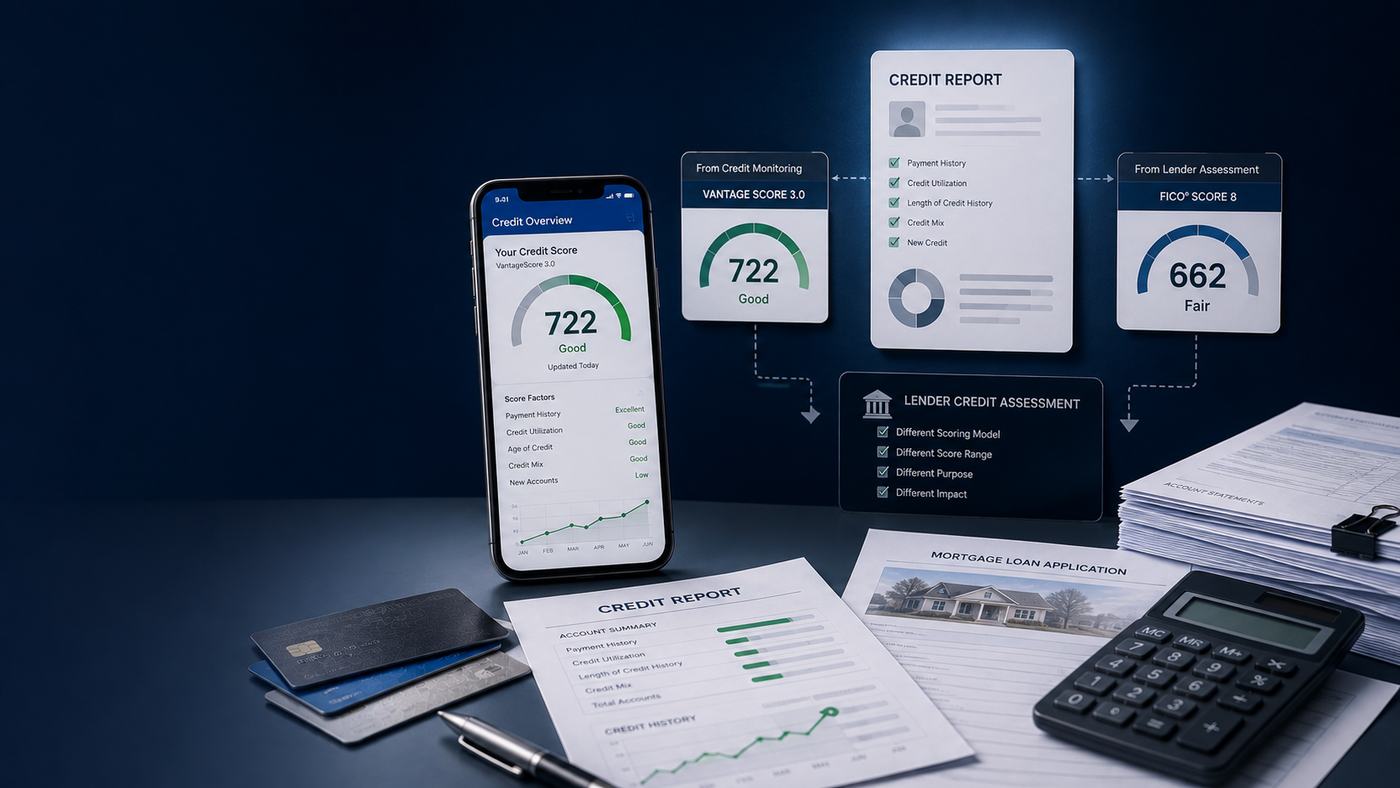
Credit Karma scores are accurate representations of your credit, but they typically use the VantageScore 3.0 model, not the FICO score model favored by most lenders. This discrepancy means the score you see on Credit Karma, which pulls data from TransUnion and Equifax, may differ from the FICO score a lender obtains, which could be from any of the three major bureaus. While Credit Karma is useful for tracking trends and identifying errors, it's crucial to understand that lenders often use specific FICO versions tailored to different loan types, leading to variations.
The short answer is no — Credit Karma did not lie, and your score is not wrong. But it is also not the score your lender used. And that gap between what you see and what a lender sees is one of the most common — and most frustrating — sources of confusion in the credit world.
Credit Karma accuracy is a nuanced topic. The platform shows real, legitimate credit scores generated from real credit report data. Those scores are calculated by established scoring models and pulled directly from two of the three major credit bureaus. Nothing about them is fake, inflated, or fabricated. But the specific scoring model Credit Karma uses is different from the scoring model most lenders use, and that single difference can produce a 20, 30, even 60-point gap depending on your credit profile.
This guide walks you through exactly what Credit Karma shows you, why it so often differs from what a lender pulls, when you can trust it, when you should look elsewhere, and how to get the actual number that matters for your next loan or credit application. We have spent years helping people across the country understand the difference between educational credit scores and the scores lenders rely on, and the single most important thing we can tell you up front is this: accuracy depends on context.
What Credit Karma Is and How It Works
Credit Karma launched in 2007 with a straightforward premise: give people free access to their credit scores and credit reports, without requiring a credit card or a paid subscription. At the time, most credit monitoring services charged $15 to $30 a month, and pulling your own score meant navigating a maze of trial offers and cancellation deadlines. Credit Karma disrupted that model by making money through targeted advertising and credit product recommendations instead of charging the consumer.
The platform is free to use. You create an account, verify your identity, and in return you get ongoing access to two credit scores and two credit reports, updated on a regular basis. You also get credit monitoring alerts, simulated tools that show how certain actions might affect your score, and recommendations for credit cards and loans you might qualify for.
How does Credit Karma get your data?
When you sign up, you provide personal information — your name, address, date of birth, and Social Security number. Credit Karma uses that information to pull your credit file from TransUnion and Equifax, two of the three major credit bureaus in the United States. (The third, Experian, is not part of Credit Karma’s core offering.) It then runs your credit file data through a scoring model to generate a three-digit score, and displays that score alongside a summary of your credit report.
The key thing to understand is that Credit Karma is not a credit bureau. It does not maintain its own database of your credit history. It is a consumer-facing platform that retrieves data from the bureaus and presents it to you in a user-friendly way. The data itself — your accounts, balances, payment history, inquiries, and public records — comes directly from TransUnion and Equifax. The score is calculated by applying a specific scoring formula to that data.
This is where a lot of the confusion starts. There is not one single credit score. There is not even one single FICO score. There are dozens of scoring models, each developed by different companies, each weighing credit data slightly differently, and each producing a different number from the same underlying information. Credit Karma chose to use one particular family of scoring models. Most lenders chose a different one. And that is the root of almost every “my score was different” story you have ever heard.
The Scores Credit Karma Shows — VantageScore, Not FICO
This is the most important section in this entire article, so read it carefully.
Credit Karma shows VantageScore 3.0 credit scores, not FICO scores.
VantageScore is a credit scoring model created in 2006 as a joint venture by the three major credit bureaus — TransUnion, Equifax, and Experian. It was designed as an alternative to FICO, which has been the dominant credit scoring model since the 1980s. VantageScore 3.0, released in 2013, was a significant update that adopted the same 300-to-850 score range that FICO uses, making it easier for consumers to compare the two — but the two models are not interchangeable.
Here is why that matters: FICO and VantageScore weigh credit data differently. They use the same underlying information from your credit report — payment history, credit utilization, length of credit history, credit mix, and new credit — but they apply different formulas to that information.
How VantageScore 3.0 Weighs Your Credit
VantageScore 3.0 uses this approximate breakdown:
- Payment history (40%) — whether you have paid your accounts on time
- Credit utilization (20%) — how much of your available credit you are using
- Credit balances (11%) — your total outstanding debt
- Depth of credit (11%) — the age and variety of your credit accounts
- Recent credit (11%) — new accounts and hard inquiries
- Available credit (7%) — the total amount of credit you have access to
How FICO Weighs Your Credit
The classic FICO scoring model uses this breakdown:
- Payment history (35%) — the single biggest factor
- Amounts owed / utilization (30%) — your balances relative to your credit limits
- Length of credit history (15%) — how long your accounts have been open
- Credit mix (10%) — the variety of credit types you manage
- New credit (10%) — recent applications and new accounts
The percentages are similar but not identical, and the differences underneath are more significant than they look.
For example, VantageScore 3.0 can score people with thinner credit files who might not be scoreable by traditional FICO models. VantageScore also treats paid collections more leniently than some FICO versions and ignores certain types of medical collections that have been paid. FICO, depending on the version, may treat these differently.
There are also newer versions of each model. VantageScore 4.0 was released in 2017 and is used by some lenders, though Credit Karma still primarily displays VantageScore 3.0. FICO has gone through many iterations — FICO 8, FICO 9, FICO 10, and the industry-specific scores like FICO Auto Score and FICO Bankcard Score, each tuned for a particular type of lending.
The result of all this is that you can take the exact same credit report, run it through VantageScore 3.0 and FICO 8, and get two different numbers. Sometimes the gap is small — 5 to 10 points. Sometimes it is substantial — 30 to 60 points or more. Neither score is “wrong.” They are just different interpretations of the same data, using different formulas with different priorities.
Does Credit Karma Show VantageScore 4.0?
As of the most recent updates, Credit Karma primarily displays VantageScore 3.0 scores from both TransUnion and Equifax. The platform has historically been slow to adopt newer VantageScore versions, and even if it did update, the core issue would remain: VantageScore, in any version, is not the same as FICO, and FICO is what the vast majority of lenders use.
Credit Karma TransUnion and Equifax: Two Scores, Not One
Another common point of confusion: Credit Karma shows you two different scores, not one. One is based on your TransUnion credit file, and the other is based on your Equifax credit file. These two scores are often different from each other, even though they are both calculated using the same VantageScore 3.0 model.
Why? Because your credit file at TransUnion and your credit file at Equifax are not identical.
Credit bureaus are independent companies. They each maintain their own database of consumer credit information. Lenders and creditors do not always report to all three bureaus. Some report to all three, some report to only two, and some report to only one. This means:
- An account might appear on your TransUnion report but not on your Equifax report
- A late payment might be recorded at one bureau but not another
- A balance might be reported to one bureau on a different day than another, showing a different utilization ratio
- A hard inquiry from a credit application might show up at one bureau but not the others
When the underlying data is different, the score calculated from that data will be different too. So when you log into Credit Karma and see a 738 from TransUnion and a 725 from Equifax, that is not a mistake. It simply reflects the fact that the two bureaus have slightly different pictures of your credit history.
This is also why a lender might pull a score that does not match either of your Credit Karma numbers. If the lender pulls your FICO 8 score from Experian — a bureau that Credit Karma does not even show you — then the data behind that score could be entirely different from what you are seeing on your phone.
Why You Have Three Credit Reports, Not One
It is worth pausing to reinforce this point, because it surprises a lot of people: you do not have one credit report. You have three. TransUnion, Equifax, and Experian each maintain a separate report on you, and while they often contain similar information, they are rarely identical. Any credit score — whether from Credit Karma, your bank, or a lender — is calculated from one bureau’s report at a time, using one scoring model. Change the bureau, change the data. Change the scoring model, change the formula. Change either one, and the number changes.
This is why the question “is Credit Karma accurate” does not have a simple yes or no answer. The right question is: accurate compared to what?
Why Your Credit Karma Score Often Differs From What a Lender Pulls
Now we get to the heart of the matter. When you apply for a mortgage, auto loan, credit card, or personal loan, the lender pulls your credit. The number they see is very often different from what Credit Karma showed you. Here are the four main reasons why:
1. Different Scoring Model
This is the biggest factor. As we covered, Credit Karma shows VantageScore 3.0. Most lenders — roughly 90% of them, according to industry analyses — use some version of FICO. Specifically:
- Mortgage lenders almost universally use FICO 2, FICO 4, or FICO 5 (older, mortgage-specific FICO models) pulled from all three bureaus
- Auto lenders often use FICO Auto Scores, which are industry-specific FICO variants
- Credit card issuers typically use FICO 8 or FICO Bankcard Scores
- Personal loan lenders generally use FICO 8
When a lender uses FICO 8 and Credit Karma shows you VantageScore 3.0, you are comparing two different scoring formulas applied to your credit data. The numbers will not match, and depending on your credit profile, the gap can be significant.
2. Different Bureau
Credit Karma shows you TransUnion and Equifax scores. Many lenders pull from Experian — the one bureau Credit Karma does not show you. If the lender pulls your Experian FICO 8 score, they are using a different bureau’s data and a different scoring model. Two variables have changed at once, and the resulting number could be quite different from either of your Credit Karma scores.
Even when a lender pulls from TransUnion or Equifax (the same bureaus Credit Karma uses), they are still applying FICO to that bureau’s data, not VantageScore. So the bureau might be the same, but the model is different.
3. Different Timing
Credit scores are snapshots, not fixed numbers. They change every time new information is added to your credit report — a new balance reported by a creditor, a new inquiry, a late payment, an account closing, or even just the passage of time as your average account age increases.
Credit Karma updates its scores on a regular schedule — typically once a week, though the exact timing depends on when the bureaus provide updated data. Between the time Credit Karma last updated your score and the time a lender pulls your credit, your report may have changed. A credit card statement may have closed, pushing your utilization up or down. A new account may have reported. A hard inquiry from another application may have appeared. Any of these can shift your score by the time the lender sees it.
4. Industry-Specific Score Adjustments
Some lenders use industry-specific FICO scores that are tuned for the type of lending they do. FICO Auto Scores, for example, weigh your history with auto loans more heavily. FICO Bankcard Scores weigh your credit card history more heavily. These specialized scores can be higher or lower than your standard FICO 8 score, and they are never what Credit Karma shows you.
What Do All These Credit Score Differences Mean?
When you combine all four factors — different model, different bureau, different timing, and industry-specific adjustments — it is entirely normal for a lender’s score to be 20 to 50 points different from your Credit Karma score. In some cases, the gap can be even larger, especially for people with thin credit files, recent negative marks, or high credit utilization.
The key takeaway: a different score does not mean Credit Karma is inaccurate. It means Credit Karma is showing you a different score than the lender is using. Both scores are real. Both are calculated from real credit data. They are just not the same score.
Is the Information Accurate? Score vs. Report Data
To answer the question “is Credit Karma accurate” properly, we need to separate two things: the score and the report data.
The Score Is Real, But It Is a Different Model
As we have established, the VantageScore 3.0 scores Credit Karma shows are legitimate, real credit scores. They are calculated by VantageScore Solutions, a company jointly owned by the three credit bureaus, using a well-established and widely used scoring formula. These scores are used by some lenders — particularly in the personal loan and fintech space. They are not fake, not estimated, and not “educational only” in the way that some bank-provided scores are.
However, they are not FICO scores, and FICO is what most lenders use. So the score is accurate for what it is, but it may not be accurate for your purpose. If you want to know whether you will qualify for a mortgage, your VantageScore is not the number the mortgage lender will use. If you want a general sense of where your credit stands and whether it is improving or declining over time, VantageScore is perfectly adequate for that.
The Report Data Should Match the Bureau
The credit report information Credit Karma displays — your accounts, balances, payment history, inquiries, and public records — comes directly from TransUnion and Equifax. This data should be identical to what you would see if you pulled your reports directly from those bureaus. If Credit Karma shows a credit card with a $2,500 balance and a perfect payment history, that same information should appear on your TransUnion and Equifax reports.
But errors do happen. Credit report errors are common — studies by the Federal Trade Commission have found that roughly one in five consumers has an error on at least one of their credit reports that could affect their score. These errors are not Credit Karma’s fault; they originate at the creditor or bureau level. A creditor might report a late payment that was actually made on time. A collection account might appear that belongs to someone with a similar name. A balance might be reported incorrectly due to a data processing error.
Credit Karma is actually a useful tool for spotting these errors, because it gives you regular, free access to your TransUnion and Equifax report data. If you see something that looks wrong — an account you do not recognize, a late payment you know you made on time, a balance that seems off — you should investigate it.
You can dispute errors directly with the credit bureau, and under the Fair Credit Reporting Act (FCRA), the bureau is required to investigate and correct or remove inaccurate information, typically within 30 to 45 days.
What is the Key Distinction for Credit Karma's Accuracy?
So when someone asks “is Credit Karma accurate,” the most precise answer is:
- The scores are real VantageScore 3.0 scores — accurate representations of your credit standing under that specific model, but not the same model most lenders use
- The report data comes directly from TransUnion and Equifax — it should match what the bureaus have on file, and any errors are bureau-level errors, not Credit Karma errors
- Neither the score nor the report data reflects what a lender will see if they pull Experian — Credit Karma does not show you Experian data at all
Understanding this distinction is the difference between using Credit Karma as a helpful monitoring tool and being blindsided when a lender’s number does not match yours.
When Credit Karma Is Useful
Credit Karma is not the right tool for every situation, but it is genuinely excellent for several things. Here is where it shines:
Tracking Trends Over Time
This is Credit Karma’s single greatest strength. Because it updates your scores regularly and shows you a history of how your score has moved over weeks, months, and years, it is an outstanding tool for tracking the direction of your credit. Is your score going up? Going down? Holding steady? What happened around the time it dropped 15 points — did a new account report, did a balance increase, did a late payment appear?
For trend tracking, the specific scoring model matters less than the consistency of measurement. As long as Credit Karma keeps using VantageScore 3.0 from the same two bureaus, month over month, you can see whether your credit is improving. If your VantageScore goes from 680 to 720 over six months, your FICO score has almost certainly gone up too — maybe not by the exact same amount, but the direction is the same.
Spotting Errors and Fraud Early
Because Credit Karma monitors your TransUnion and Equifax reports and sends you alerts when something changes — a new account, a new inquiry, a new public record, a balance change — it can serve as an early warning system for identity theft and credit report errors. If a credit card you never opened shows up on your Credit Karma dashboard, you will know about it quickly and can take action.
Monitoring Credit Utilization
Credit Karma shows you your credit card balances and credit limits, making it easy to monitor your utilization ratio — one of the most important factors in your credit score. If you see your utilization creeping above 30%, you know it is time to pay down some balances before your score takes a hit.
Getting Free Credit Reports
Under federal law, you are entitled to one free credit report per year from each of the three bureaus through AnnualCreditReport.com. But once a year is not enough for many people. Credit Karma gives you ongoing access to your TransUnion and Equifax reports at no cost, which means you can check them whenever you want without waiting for your annual entitlement.
Preparing for Major Financial Moves (With a Caveat)
If you are planning to apply for a mortgage or auto loan in the coming months, Credit Karma can help you gauge whether your credit is in good shape generally. If your VantageScore is in the 500s, you know you have work to do before applying for anything. If it is in the mid-700s, you are probably in decent shape — though you still need to verify your FICO scores before assuming you will get the best rates.
The caveat: use Credit Karma as a directional indicator, not a precise predictor of what a lender will see. It tells you whether you are in the ballpark, not exactly where you will land.
When Credit Karma Is Misleading
There are specific situations where relying on Credit Karma can lead you astray. Here are the most common ones:
Mortgage Applications
This is the number one scenario where Credit Karma misleads people. Mortgage lenders use older, specific FICO models — FICO 2 (Experian), FICO 4 (TransUnion), and FICO 5 (Equifax). These are not the same as FICO 8, let alone VantageScore 3.0. The older mortgage FICO models are stricter in some ways and can produce scores that are 20 to 60 points lower than what Credit Karma shows.
We have seen clients walk into a mortgage pre-approval expecting a 760 Credit Karma score to translate into the best possible rate, only to learn their mortgage FICO scores are in the low 700s. That is the difference between an excellent rate and a good rate, which over a 30-year loan can mean tens of thousands of dollars.
If you are applying for a mortgage, do not rely on Credit Karma. Get your actual mortgage FICO scores. (We cover how to do this later in this article.)
Auto Loans
Auto lenders often use FICO Auto Scores, which weigh your auto loan history more heavily than a standard FICO score. If you have a strong auto loan payment history, your FICO Auto Score might be higher than your standard FICO, and both might differ significantly from your VantageScore. If you have a repossession or late auto payments in your past, your FICO Auto Score could be lower than either your VantageScore or your standard FICO.
When Your Scores Are Borderline
If your Credit Karma score is sitting right at a lender’s cutoff — say, 680 for a personal loan that requires a 670 — the difference between VantageScore and FICO could push you above or below that threshold. You might think you qualify when you do not, or vice versa. In borderline situations, you need the exact score the lender will use, not an approximation.
When You Are Rebuilding Credit
People in the process of rebuilding credit after financial setbacks — late payments, collections, charge-offs, bankruptcies — are often the most motivated to track their progress. Credit Karma can be encouraging in these situations, because VantageScore 3.0 is sometimes more forgiving than FICO. Paid collections, for instance, may not impact your VantageScore as severely as they impact certain FICO models. You might see your Credit Karma score climb while your FICO scores lag behind, giving you an overly optimistic picture of where you stand in a lender’s eyes.
When Experian Data Matters
If your Experian report contains different information than your TransUnion or Equifax reports — a different balance, a different account, a different error — then any score based on Experian will differ from what Credit Karma shows. And since Credit Karma does not show Experian data at all, you could be completely unaware of something on your Experian report that is dragging down a lender’s score.
Credit Karma vs FICO: A Side-by-Side Comparison
| Feature | Credit Karma (VantageScore 3.0) | FICO Scores |
|---|---|---|
| Scoring model | VantageScore 3.0 | FICO 8, 9, 10, plus industry-specific variants |
| Score range | 300–850 | 300–850 (most models) |
| Bureaus shown | TransUnion and Equifax | All three (depends on who pulls it) |
| Used by lenders | Some, primarily fintech and personal loan lenders | ~90% of top lenders |
| Mortgage lending | Not used | FICO 2, 4, 5 are standard |
| Auto lending | Rarely used | FICO Auto Score commonly used |
| Cost | Free | Varies — often paid through myFICO or lender |
| Update frequency | Typically weekly | Varies by provider |
| Thin file scoring | Can score more consumers | Requires more credit history |
| Paid collections | More lenient treatment | Varies by FICO version |
| Best for | Trend tracking, monitoring, error spotting | Knowing what lenders will actually see |
The comparison makes it clear: these are two different tools for two different purposes. Credit Karma is a monitoring and educational tool. FICO scores are the scores that actually determine whether you get approved for credit and at what interest rate. Both have value. Neither replaces the other.
The Pros and Cons of Free Score Apps
Credit Karma is the most popular free score app, but it is not the only one. Experian, Credit Sesame, NerdWallet, WalletHub, and many banks and credit card companies offer free scores too. Before you rely on any of them, it is worth understanding the general pros and cons.
Pros
- Free — No subscription, no credit card required, no trial period to cancel
- Regular access — You can check your score and report data whenever you want
- Alerts — Most apps send notifications when your score changes or new accounts appear
- Educational tools — Simulators and articles help you understand how credit works
- Early error detection — Regular monitoring means you catch mistakes and fraud sooner
- Trend tracking — Seeing your score move over time is motivating and informative
Cons
- Not FICO (usually) — Most free apps show VantageScore, not the FICO scores lenders use
- Advertising-driven — Free apps make money by recommending credit products, which can create a conflict of interest
- Not all three bureaus — Most apps show one or two bureaus, not all three
- Can create false confidence — Seeing a high VantageScore can make you assume your FICO is equally strong
- Data lag — Scores may not reflect very recent changes to your credit report
- Identity verification friction — Some people struggle to verify their identity, especially if they have a thin file or recently moved
The Healthy Way to Use Free Score Apps
Use free score apps as a monitoring layer, not as your definitive credit score. Check them regularly for:
- Sudden score drops that signal a problem
- New accounts or inquiries you did not initiate
- Changes in utilization or balances
- General upward or downward trends
When you are preparing for a specific financial decision — a mortgage, auto loan, or major credit card application — go beyond the free app and get the actual FICO score that the relevant lender type will use.
Other Free Score Sources Worth Knowing About
Credit Karma is not your only option for free credit scores. Here are other sources worth knowing about, each with its own strengths:
Discover Scorecard
Discover offers a free FICO 8 score based on your Experian credit report, available to everyone — not just Discover cardholders. This is one of the few free sources of an actual FICO score (not VantageScore). If you want to see a real FICO 8 number without paying, Discover Scorecard is one of the best options available.
You are limited to one score from one bureau, but it is a genuine FICO.
Experian Free Account
Experian offers a free consumer account that includes your FICO 8 score based on your Experian report, updated regularly. This is valuable because it gives you both Experian data and a FICO score — two things Credit Karma does not provide. Experian also offers a free credit report and credit monitoring. The free tier is genuinely useful; the paid tier adds more features but is not necessary for basic monitoring.
Your Bank or Credit Card Provider
Many banks and credit card issuers now provide free credit scores to their customers. Some show FICO 8 scores (Chase, Discover, Citibank, Bank of America, and others), while others show VantageScore. Check your bank’s app or website — you may already have access to a FICO score without realizing it. These are typically updated monthly and are based on the bureau the bank partners with.
myFICO
myFICO is FICO’s official consumer product. It is not free, but it is the most comprehensive way to see your FICO scores from all three bureaus, including industry-specific scores like FICO Auto and FICO Bankcard. If you are preparing for a major loan and want to see exactly what lenders will see, myFICO is the gold standard. There are different subscription tiers, and you can often cancel after one month if you only need a one-time snapshot.
AnnualCreditReport.com
This is the only federally authorized source for free credit reports from all three bureaus. You are entitled to one free report from each bureau per year (and currently, you can access them weekly). AnnualCreditReport.com does not give you scores — just reports — but seeing all three bureau reports is essential for understanding the full picture.
Which Should You Use?
For most people, a combination of two or three free sources is ideal:
- Credit Karma — for VantageScore trend tracking and TransUnion/Equifax monitoring
- Experian’s free account or Discover Scorecard — for an actual FICO 8 score based on Experian data
- Your bank or credit card’s free score — for another FICO data point, if available
This combination gives you VantageScore trends, at least one FICO 8 score, and visibility into all three bureaus (TransUnion and Equifax through Credit Karma, Experian through the other sources). It is not a complete picture of every score a lender might use, but it is far more comprehensive than relying on Credit Karma alone.
How to Get the Score Lenders Actually See
If you are about to apply for a mortgage, auto loan, or other significant credit product, you want to know the actual number the lender will see — not an approximation. Here is how to get as close as possible:
For Mortgages
Mortgage lenders use FICO 2, FICO 4, and FICO 5 — one from each bureau. These are older FICO models, and they are not available through most free score sources. Your options:
- Go to myFICO.com and subscribe to a plan that includes mortgage scores from all three bureaus. This is the most direct way to see your actual mortgage FICO scores.
- Talk to a mortgage lender or broker about getting pre-qualified. They will pull your credit, and you can ask them to share the scores they see. This does involve a hard inquiry, so do it when you are serious about moving forward.
- Work with a credit repair professional who has access to tri-bureau FICO pulls and can help you understand exactly where you stand before you apply.
For Auto Loans
Auto lenders commonly use FICO Auto Scores, which are specialized versions of FICO that emphasize your auto loan payment history. To see these:
- myFICO offers FICO Auto Scores from all three bureaus as part of certain subscription tiers.
- Some auto dealers and lenders will tell you your score when you apply for pre-approval.
For Credit Cards
Credit card issuers typically use FICO 8 or FICO Bankcard Scores. FICO 8 is the most widely used general-purpose FICO model, and it is the one you are most likely to find for free (through Discover Scorecard, Experian’s free account, or your bank). If your FICO 8 score is strong, you are generally in good shape for credit card applications.
For Personal Loans
Personal loan lenders usually use FICO 8. The same free FICO 8 sources mentioned above will give you a solid estimate of what a personal loan lender will see.
What is a Practical Strategy to See Your Credit Scores?
If you want a comprehensive picture without spending a fortune:
- Get your free VantageScore from Credit Karma for trend tracking
- Get your free FICO 8 from Discover Scorecard or Experian
- Get your free credit reports from all three bureaus at AnnualCreditReport.com
- If you are applying for a mortgage soon, subscribe to myFICO for one month to see your actual mortgage scores, then cancel
- If anything on your reports looks wrong, dispute it — or work with a credit repair professional who can help you navigate the dispute process under the FCRA
Common Myths About Credit Karma
There is a lot of misinformation floating around about Credit Karma. Let us clear up some of the most common myths.
Myth 1: Credit Karma Scores Are Fake
False. The scores are real VantageScore 3.0 scores calculated from real TransUnion and Equifax credit data. They are not estimates, not approximations, and not invented numbers. They are simply generated by a different scoring model than most lenders use.
Myth 2: Checking Credit Karma Lowers Your Score
False. Checking your own credit through Credit Karma is a soft inquiry, which does not affect your credit score. Only hard inquiries — which occur when a lender checks your credit as part of an application — can impact your score, and even then the effect is usually small and temporary.
Myth 3: Credit Karma Gives You a Higher Score on Purpose So You Apply for More Cards
Partially misleading. Credit Karma does make money from credit product recommendations, and it does show you offers you might qualify for. But it does not inflate your VantageScore to trick you into applying. The score it shows is the score the VantageScore model produces from your bureau data. The advertising model creates a potential conflict of interest in what products are recommended to you, but not in the score itself.
Myth 4: Credit Karma and Your Lender Should Show the Same Score
False. They use different scoring models and often different bureaus. A gap of 20 to 50 points is common and does not indicate an error on either side.
Myth 5: Credit Karma Shows All Three Credit Bureaus
False. Credit Karma shows TransUnion and Equifax only. Experian is not included. This means you are seeing two-thirds of your credit picture, not the full picture.
Myth 6: If Credit Karma Shows a 750, You Will Get the Best Rate on Everything
False. A 750 VantageScore does not guarantee a 750 FICO. And for mortgages, the relevant FICO models are older and stricter. You could have a 750 on Credit Karma and still not qualify for the best mortgage rate. Always verify your FICO scores before major applications.
Myth 7: Credit Karma Created VantageScore to Compete with FICO
False. VantageScore was created by the three credit bureaus (TransUnion, Equifax, and Experian) as a joint venture. Credit Karma simply chose to display VantageScore scores because they are available at lower cost than FICO scores, allowing the platform to remain free for consumers.
Myth 8: You Should Only Check One Score Source
False. Relying on a single score source gives you a limited view. Checking multiple sources — Credit Karma for VantageScore trends, Experian or Discover for FICO 8, your bank for another FICO data point — gives you a much more complete understanding of your credit standing.
Frequently Asked Questions
Is Credit Karma accurate for mortgage applications?
No, not for mortgage applications specifically. Mortgage lenders use FICO 2, FICO 4, and FICO 5 — older FICO models that are stricter and often produce lower scores than VantageScore 3.0. If you are preparing to apply for a mortgage, check your actual mortgage FICO scores through myFICO or a mortgage lender. A 20 to 60 point gap between your Credit Karma score and your mortgage FICO scores is common.
Why is my Credit Karma score higher than my FICO score?
There are several reasons. VantageScore 3.0 and FICO weigh credit data differently — VantageScore gives more weight to payment history and is sometimes more lenient with paid collections and thin credit files. If your credit profile happens to be one that VantageScore treats more favorably (for example, you have a strong payment history but high utilization, which VantageScore weighs slightly less heavily), your VantageScore will be higher than your FICO. Different bureau data and timing differences can also contribute.
Does Credit Karma show FICO scores?
No. Credit Karma shows VantageScore 3.0 scores from TransUnion and Equifax. It does not display FICO scores in any form. If you want to see a FICO score for free, use Discover Scorecard or Experian’s free account, or check your bank or credit card issuer’s app.
Can I trust Credit Karma for tracking my credit score over time?
Yes. For trend tracking — watching whether your score is going up, down, or staying stable — Credit Karma is reliable. The key is to compare VantageScore to VantageScore over time, not to compare VantageScore to a FICO score at a single point. As long as you are consistent in what you are measuring, the trends will be meaningful.
Why are my TransUnion and Equifax scores different on Credit Karma?
Because your credit files at TransUnion and Equifax are not identical. Not all creditors report to both bureaus, balances may be reported on different days, and some accounts or inquiries may appear on one bureau’s report but not the other. Since the underlying data is different, the VantageScore 3.0 calculated from each bureau’s data will also be different. A gap of 10 to 30 points between the two is normal.
How often does Credit Karma update my score?
Credit Karma typically updates your scores and reports once a week, though the exact timing depends on when TransUnion and Equifax provide updated data. You may see updates more or less frequently depending on your account activity and the bureaus’ reporting schedules. You can manually refresh your reports within the app if you want to check for recent changes.
Does checking Credit Karma hurt my credit?
No. Checking your own credit through Credit Karma is a soft inquiry, which has no impact on your credit score. You can check as often as you like without any negative effect. Only hard inquiries — which happen when a lender checks your credit as part of an application — can lower your score, and even then the impact is usually small (a few points) and temporary.
What should I do if my Credit Karma score does not match my lender’s score?
First, do not panic — a difference is normal and expected. Ask your lender which scoring model and bureau they used. If they used a FICO model (which is likely), the difference is simply the model gap we have discussed throughout this article. If you suspect an error on your credit report is causing the discrepancy, pull your reports from all three bureaus at AnnualCreditReport.com and review them carefully. If you find errors, dispute them with the relevant bureau. If the errors are complex or you are not sure how to dispute them, consider working with a credit repair professional who can guide you through the process under the protections of the Fair Credit Reporting Act.
See What Lenders See — Free Credit Audit
If you have read this far, you understand the difference between the score Credit Karma shows you and the scores lenders actually use. You know that VantageScore and FICO are different models, that different bureaus produce different numbers, and that the score you see on your phone is not necessarily the score that determines whether you get approved — or at what interest rate.
But understanding the difference is only the first step. The next step is seeing where you actually stand, across all three bureaus, with the scoring models that matter for your financial goals.
That is where we come in.
At credit-repair.com, we offer a free credit audit that pulls your credit reports from all three major bureaus — TransUnion, Equifax, and Experian — and gives you a clear, honest picture of where you stand. We do not just hand you a number. We walk you through what is on your reports, what is helping your scores, what is hurting them, and whether there are errors, outdated information, or negative marks that can be disputed under the Fair Credit Reporting Act.
Our approach is attorney-backed and fully FCRA-compliant. That means every dispute we file, every negotiation we conduct with creditors, and every step of our process is grounded in federal credit law. We do not make empty promises or offer quick fixes — we have seen too many of those companies come and go. What we offer is transparent, legally sound, and focused on measurable progress.
We also believe in education. We do not just fix your credit and send you on your way. We equip you with the knowledge and tools to maintain strong credit for the long term, so you are never again surprised by a gap between what you think your score is and what a lender tells you it is.
Here is what the free audit includes:
- A full tri-bureau credit report review (TransUnion, Equifax, and Experian — not just two)
- An explanation of the difference between your VantageScore and FICO scores
- Identification of errors, inaccuracies, or disputable negative items
- A personalized repair plan tailored to your specific credit goals
- No obligation, no hidden fees, no pressure
Whether you are preparing for a mortgage, an auto loan, or just want to understand your credit better, the free audit is the best place to start. It is the difference between guessing and knowing.
Visit credit-repair.com to request your free credit audit today.
See what lenders see. Understand the numbers that actually matter. And take control of your financial future with a team that has your back — every step of the way.