
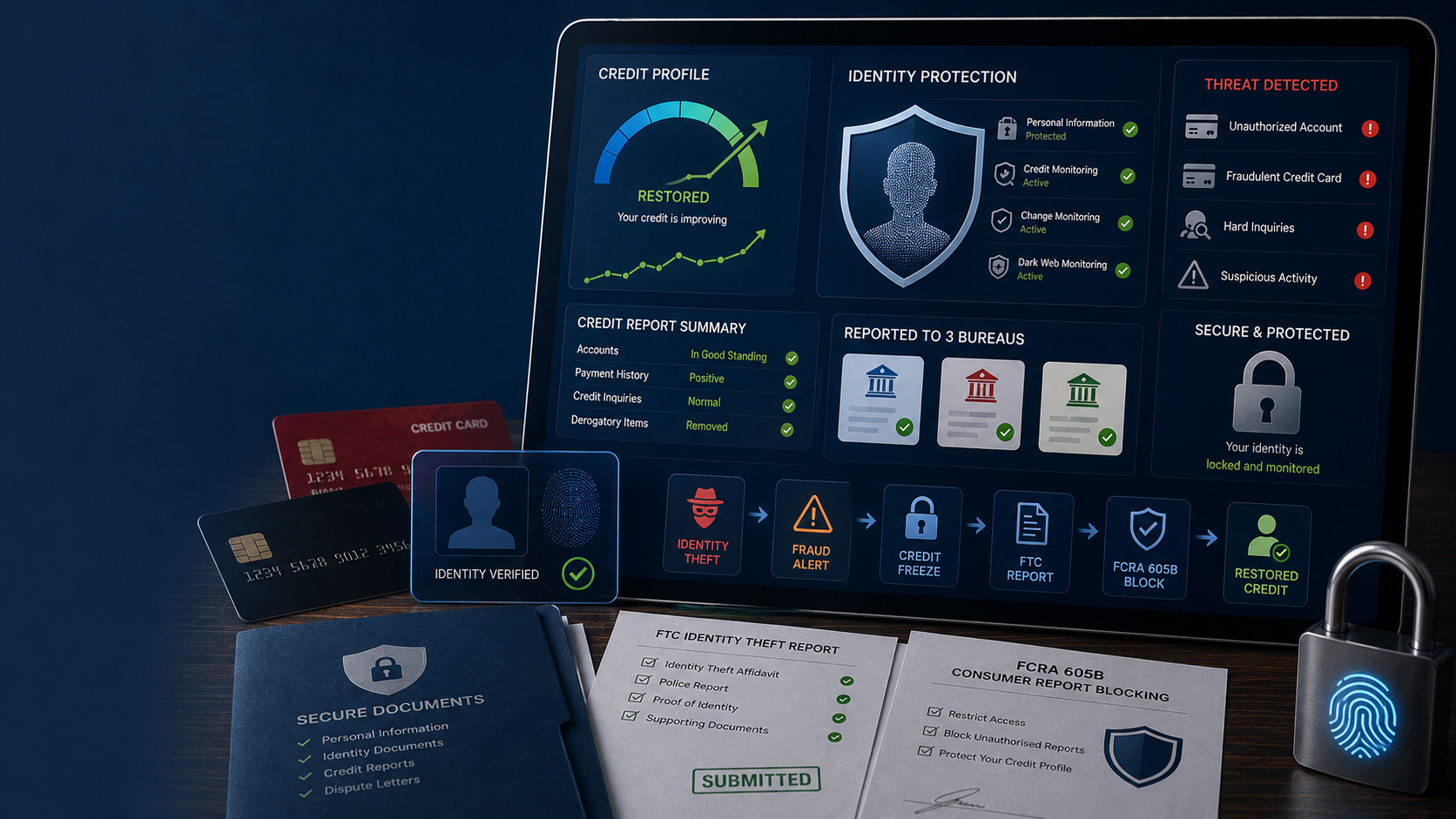
If your credit is compromised by identity theft, immediate action is crucial to mitigate damage and begin recovery. Credit-repair.com advises placing a fraud alert and freezing your credit at all three bureaus, then filing an Identity Theft Report with the FTC. You must also contact fraudulent creditors and dispute every fraudulent account, leveraging protections like FCRA 605B to block inaccurate information. Recovery from identity theft can take 6 to 24 months, emphasizing the need for diligent long-term monitoring.
Identity theft is one of the most financially and emotionally draining things a person can go through. It doesn’t just cost money — it can quietly demolish the credit you’ve spent years building, lock you out of financing for a home or a car, and leave you untangling paperwork for months. But here’s the part most people don’t hear: you have powerful, legally backed tools to stop the damage and rebuild what was taken. The Fair Credit Reporting Act (FCRA) gives you rights that the credit bureaus and creditors are required by law to honor.
This guide walks you through every step — from the first moments after you suspect identity theft, through the legal mechanisms that force bureaus to remove fraudulent information from your report, to the long-term habits that keep you protected. Whether you’re in the middle of it right now or you’re reading this to be prepared, you’ll leave with a clear plan.
What Identity Theft Does to Your Credit
To understand why identity theft is so destructive to your credit, it helps to understand how your credit score is built in the first place. Your FICO and VantageScore credit scores are calculated from the information reported about you by lenders to the three major credit bureaus — Equifax, Experian, and TransUnion. That information falls into five broad categories: payment history (about 35% of your score), amounts owed (about 30%), length of credit history (about 15%), credit mix (about 10%), and new credit (about 10%).
Identity theft can damage nearly every one of those categories at once.
Fraudulent Accounts
When someone steals your identity and opens a new credit card, personal loan, utility account, or cell phone line in your name, that account gets reported to the bureaus as if you opened it yourself. At first, the damage might be invisible — a new account with a clean payment record can even temporarily help your score by adding to your credit mix and available credit. But the moment the thief stops paying (and they always stop paying), the missed payments, charge-offs, and eventual collections start landing on your report under your name.
A single fraudulent account that goes unpaid for six months can generate six late-payment marks, a charge-off, and a collection — three serious derogatory items, all attached to your Social Security number and name. That’s enough to drop a 780 credit score into the low 600s in a matter of weeks.
Hard Inquiries
Every time someone applies for credit in your name, the lender pulls your credit report. That pull creates a hard inquiry on your file. One hard inquiry typically lowers your score by a few points and falls off after two years. But identity thieves rarely apply for just one account. A common pattern is “application fraud” — the thief submits dozens of credit applications in a short window, hoping a few slip through. Each application generates its own hard inquiry.
Ten or fifteen hard inquiries in a single month signals to the scoring models that you’re desperate for credit or being turned down repeatedly. That alone can shave 50+ points off your score, even before any fraudulent account is opened. Worse, those inquiries stay on your report for 24 months and factor into your score for 12.
Ruined Payment History
Payment history is the single largest factor in your credit score. It measures whether you’ve paid your obligations on time, every time. When a thief runs up balances on a fraudulent account and never pays, the lender reports 30-day, 60-day, and 90-day late payments. Eventually the account charges off and may be sold to a collection agency. Each of those negative marks is a separate ding to your payment history — and they don’t just disappear because you later prove the account was fraudulent. They sit on your report, dragging your score down, until you take specific legal action to have them removed.
Maxed-Out Utilization
If a thief gains access to an existing credit card account rather than opening a new one, they can run the balance up to the limit. Credit utilization — the percentage of your available credit that you’re using — is the second biggest factor in your score. Utilization above 30% starts hurting your score; above 80%, the damage is severe.
Warning Signs You May Be a Victim
Identity theft often leaves clues before the full extent of the damage becomes obvious. Knowing what to watch for can help you catch it early.
Unfamiliar Accounts or Inquiries
One of the clearest signs is an account or hard inquiry on your credit report that you don’t recognize. This could be a credit card, personal loan, retail account, utility account, or another type of credit.
Notifications About Accounts You Didn’t Open
An email welcoming you to a service you never signed up for, a text from a bank you don’t use, or a “your application is under review” message for credit you never applied for — these are early warnings that someone is using your identity right now.
A Notice That Your Information Was Exposed in a Data Breach
If a company you do business with notifies you that your data was compromised in a breach, don’t shrug it off. Your name, address, Social Security number, or account credentials may now be for sale on the dark web. Freeze your credit the same day.
The Immediate Steps After Identity Theft
If you’ve confirmed — or even strongly suspect — that you’re a victim of identity theft, act now. The faster you move, the more damage you prevent. Here are the seven steps, in order, with the legal specifics that make each one work.
Step 1: Place a Fraud Alert on Your Credit File
A fraud alert is a notice attached to your credit report that tells lenders to take extra steps to verify your identity before extending credit in your name. You only need to place it with one of the three bureaus — that bureau is required by law to notify the other two.
There are two types:
- Initial fraud alert — lasts for one year. Anyone can request one; you don’t need to have already filed a police report. This is the fastest way to slow down new-account fraud while you sort out the rest.
- Extended fraud alert — lasts for seven years. You’re eligible only if you’ve filed an identity theft report (an FTC Identity Theft Report counts). This is the stronger protection for confirmed victims.
To place a fraud alert, contact any one of the three bureaus:
- Equifax: equifax.com or 1-888-298-0045
- Experian: experian.com or 1-888-397-3742
- TransUnion: transunion.com or 1-800-680-7289
A fraud alert doesn’t prevent you from applying for credit yourself — you’ll just go through an extra verification step. It’s free, it’s required to be honored, and it’s your first line of defense.
Step 2: Freeze Your Credit at All Three Bureaus
A credit freeze (also called a security freeze) is stronger than a fraud alert. It completely locks your credit file so that no new lender can pull your report — which means no new accounts can be opened in your name, period. Since most lenders won’t extend credit without seeing your report first, a freeze effectively shuts the door on new-account identity theft.
As of federal law (the Economic Growth, Regulatory Relief, and Consumer Protection Act of 2018), freezing and unfreezing your credit is free at all three bureaus. You must place the freeze with each bureau separately:
- Equifax: equifax.com or 1-888-298-0045
- Experian: experian.com or 1-888-397-3742
- TransUnion: transunion.com or 1-888-909-8872
When you place a freeze, you’ll get a PIN or password from each bureau. Keep these somewhere secure — you’ll need them to temporarily lift the freeze when you apply for credit, a new apartment, a job that requires a credit check, or insurance.
A freeze doesn’t affect your existing accounts or your credit score. It only blocks new pulls. You can temporarily lift it for a specific lender or a specific time period, then let it snap back into place.
Fraud Alert vs. Credit Freeze
| Protection | How It Works | Best Use |
|---|---|---|
| Fraud Alert | Tells lenders to take additional steps to verify your identity. | Useful when you want added protection without fully restricting access to your credit file. |
| Credit Freeze | Restricts access to your credit report so new creditors generally cannot pull it. | Strongest protection against new-account identity theft. |
Step 3: File an Identity Theft Report
Go to IdentityTheft.gov and file an identity theft report with the Federal Trade Commission. This creates an official record of the identity theft and gives you a recovery plan.
The FTC report is particularly important because it can be used to support disputes and requests for blocking fraudulent information under FCRA Section 605B.
Step 4: Contact Each Fraudulent Creditor
Contact every lender or creditor associated with fraudulent accounts. Tell them the account was opened through identity theft and provide your identity theft documentation.
Ask the creditor to close the fraudulent account, stop collection activity, and stop reporting fraudulent information to the credit bureaus.
Step 5: Dispute Every Fraudulent Account
Review all three credit reports and identify every fraudulent account, inquiry, collection, charge-off, and late payment resulting from the identity theft.
Dispute each fraudulent item with the credit bureaus and provide the documentation required to support your identity theft claim.
Step 6: File a Police Report
Although the FTC Identity Theft Report is an important document, filing a police report can create another official record of the identity theft. Take your FTC report and supporting documentation with you when filing.
Step 7: Keep Everything Documented
Keep copies of every letter, report, statement, dispute, response, certified mail receipt, and other document connected to the identity theft.
Organize everything in one physical or digital folder. You may need these records later if a bureau, creditor, regulator, or attorney needs additional documentation.
How to Dispute Fraudulent Items
Identity theft disputes are different from ordinary credit-report disputes because federal law provides specific protections for victims. The strongest protection is the identity-theft block under FCRA Section 605B.
Gather Your Documentation First
Before submitting disputes, gather:
- Your credit reports showing the fraudulent accounts or inquiries
- Your FTC Identity Theft Report
- Your police report, if available
- Government-issued identification
- Proof of your current address
- Correspondence from fraudulent creditors or collection agencies
- Any other documentation showing that you did not authorize the accounts or transactions
Dispute With the Credit Bureaus
Send your dispute to each bureau that is reporting the fraudulent information. Clearly state that the account or inquiry resulted from identity theft and that you are requesting removal or blocking under the applicable provisions of the FCRA.
Include copies of your supporting documents and keep proof that each bureau received your dispute.
Dispute With the Furnisher
You should also notify the creditor or other company that furnished the fraudulent information to the bureau.
Tell them that you did not open or authorize the account and request that they investigate, close the fraudulent account, stop collection activity, and notify the credit bureaus that the information resulted from identity theft.
Blocking Fraudulent Information Under FCRA 605B
Section 605B of the FCRA is the most powerful tool an identity theft victim has. It provides a specific process for blocking information that resulted from identity theft.
What Section 605B Does
When you properly request a block and provide the required documentation, the credit bureau must generally block the reporting of information that resulted from identity theft within four business days of receiving the request.
That’s not a suggestion. It’s a statutory mandate. The four-business-day clock starts the day the bureau receives your dispute — which is why certified mail with return receipt is so important. Without proof of receipt, you can’t prove the clock started.
What “Block” Means
Blocking is different from deleting. When information is blocked:
- It is removed from your credit report and no longer visible to anyone who pulls your report
- It cannot be used in any credit scoring model that relies on that bureau’s data
- The furnisher is notified that the block has been placed
- The information is, in practical terms, treated as if it doesn’t exist for credit-reporting purposes
A block can be lifted only if:
- The furnisher (creditor) investigates and determines the information was correct and resulted from your own actions, not identity theft
- The bureau determines your identity theft report was fraudulent or inaccurate
- The block is lifted for other reasons specified in the statute
If a block is lifted, the bureau must notify you in writing at least five business days before re-reporting the information, giving you time to respond or seek legal help.
What an “Identity Theft Report” Must Contain
For 605B to apply, your identity theft report must be a proper, documented report — not just a letter saying “I was robbed.” The FTC Identity Theft Report generated at IdentityTheft.gov qualifies. A police report also qualifies. Many victims submit both for maximum weight.
The report should include:
- Your full name and identifying information
- A description of the identity theft, including dates and accounts involved
- A statement that you did not authorize the accounts or transactions
- Your signature, certifying the report is truthful
Common Reasons Bureaus Push Back — and How to Respond
Bureaus sometimes attempt to delay or deny 605B blocks. Here are the common pushbacks and how to handle each:
“Your identity theft report is incomplete.”
Response: The FTC report is a valid identity theft report under the FCRA. Ask them in writing to specify exactly what additional information they require, and provide it within 30 days. If they can’t specify what’s missing, file a CFPB complaint.
“We investigated and the furnisher verified the debt is yours.”
Response: A furnisher’s “verification” does not override a proper 605B block. The statute says the bureau must block unless they determine your identity theft report is fraudulent. Ask for their determination in writing and file a CFPB complaint if they refuse.
“You need to dispute with the furnisher first.”
Response: No, you don’t. 605B is a bureau-level remedy. You can (and should) also dispute with the furnisher, but the bureau’s obligation to block is independent.
“We need a copy of a police report, not just an FTC report.”
Response: An FTC Identity Theft Report satisfies the FCRA’s definition of an identity theft report. If you have a police report too, include it — but the FTC report alone is legally sufficient.
The key is to hold the line in writing. Every response should be in writing, sent certified mail, with copies kept in your file. If a bureau refuses to comply with 605B, that’s a violation of federal law — and it’s exactly the kind of situation where a CFPB complaint or a conversation with a consumer protection attorney moves things forward.
A Realistic Recovery Timeline
One of the most disorienting parts of identity theft recovery is not knowing how long it will take.
Your situation may move faster or slower, but this gives you a framework.
What Immediate Actions Should You Take on Day 1 After Identity Theft?
- Place a fraud alert (5 minutes)
- Freeze your credit at all three bureaus (15 minutes)
- Pull all three credit reports from AnnualCreditReport.com
- Note every unfamiliar account, inquiry, and address
What Steps Should You Take to Build Your Identity Theft Case in Days 1-3?
- File your FTC Identity Theft Report at IdentityTheft.gov (30 minutes)
- File a police report (1–2 hours, including travel)
- Collect evidence: collection letters, unfamiliar statements, breach notifications
- Organize everything in a single folder
Days 3–10 — Send Disputes
- Send 605B block disputes to all three bureaus by certified mail
- Send dispute letters to each fraudulent account’s creditor by certified mail
- Send debt validation requests to any collection agency that contacted you
- Keep all certified mail receipts and return receipts
Days 7–14 — Blocks Begin Taking Effect
- Bureaus receive your disputes (return receipt confirms the date)
- Four-business-day 605B clock starts
- Blocks should be in place within 4 business days of receipt
- Bureaus notify furnishers that blocks have been placed
Days 14–60 — Creditors Respond
- Creditors investigate and respond to your disputes
- Fraudulent accounts should be closed
- Fraudulent charges should be zeroed out
- Creditors should stop reporting the accounts to bureaus
Days 30–90 — Credit Reports Update
- Pull fresh reports from all three bureaus
- Verify that blocked items no longer appear
- Verify that fraudulent inquiries have been removed
- Dispute any remaining items
Days 60–180 — Score Recovery
- As blocked items disappear from your report, your score begins to recover
- Late payments, collections, and charge-offs from fraudulent accounts stop weighing on your score
- Hard inquiries from fraudulent applications fall off (or can be disputed)
- Many victims see significant score recovery within 3–6 months of completing the block process
Months 6–24 — Long-Term Monitoring
- Keep your credit frozen unless you’re actively applying for credit
- Monitor your reports quarterly
- Keep fraud alerts in place (renew the 1-year alert if needed; the 7-year extended alert is available with your FTC report)
- Watch for any re-reporting of blocked items
The bottom line: the legal mechanisms work fast (blocks within 4 business days), but the full cleanup — closing accounts, getting creditors to stop reporting, seeing your score recover — takes months. Patience and persistence are your allies. Keep every receipt, follow up on every stalled dispute, and escalate to the CFPB when needed.
How to Prevent Future Identity Theft
Recovering from identity theft once is hard enough. Recovering twice is preventable. Here’s what actually works, based on the methods identity thieves most commonly use.
Freeze Your Credit — and Keep It Frozen
This is the single most effective step you can take. A credit freeze prevents new accounts from being opened in your name because lenders can’t pull your report.
It’s free, it doesn’t affect your score, and you can temporarily lift it whenever you need to apply for credit.
Keep your freeze in place at all three bureaus unless you’re actively applying for something. When you do apply, lift the freeze for that specific lender or for a specific window (a day or two), then let it snap back.
Monitor Your Credit Regularly
You’re entitled to one free report from each bureau every week at AnnualCreditReport.com. At minimum, pull one report from a different bureau every four months so you’re checking each one three times a year. Many banks and credit card companies offer free credit monitoring that alerts you to new accounts, inquiries, or score changes — turn those alerts on.
Use Strong, Unique Passwords
Identity thieves buy stolen login credentials on the dark web and try them across multiple sites (a tactic called “credential stuffing”). If you use the same password for your bank, your email, and a shopping site, one breach compromises everything. Use a password manager to generate and store unique passwords for every account. The password manager remembers them; you only need to remember one master password.
Enable Two-Factor Authentication (2FA)
Two-factor authentication requires a second form of verification — usually a code sent to your phone or generated by an app — in addition to your password. Turn it on for every account that offers it, especially email, banking, and credit accounts. An app-based authenticator (like Authy or Google Authenticator) is more secure than SMS-based 2FA, which can be intercepted through SIM-swapping.
Shred Documents with Sensitive Information
Thieves still go through trash and recycling. Any document with your Social Security number, account numbers, birth date, or financial details should be shredded before disposal — not just torn in half. A cross-cut shredder costs $30–$60 and pays for itself the first time it prevents a problem.
Be Cautious with Your Social Security Number
Your SSN is the master key to your identity. Guard it:
- Don’t carry your Social Security card in your wallet
- Don’t give your SSN over the phone unless you initiated the call and you’re certain who you’re talking to
- Ask why it’s needed whenever a business requests it — sometimes an alternative identifier works
- Don’t email or text your SSN
Watch for Phishing
Phishing emails, texts, and calls are the most common way thieves steal credentials. Be suspicious of:
- Messages claiming there’s a problem with your account that you must “fix” by clicking a link
- Requests to “verify” your information
- Urgent threats that your account will be closed if you don’t act immediately
- Links that look almost right but have slight misspellings in the domain
When in doubt, don’t click. Go directly to the company’s website or app by typing the address yourself.
Secure Your Mail
- Use a locked mailbox if possible
- Pick up mail promptly
- Sign up for USPS Informed Delivery so you see images of your incoming mail and know if something is missing
- Put a mail hold or forwarding in place when you travel
Review Account Statements Monthly
Set a recurring calendar reminder to review your bank and credit card statements every month. Look for charges you don’t recognize, even small ones. Report unfamiliar charges immediately — under the Fair Credit Billing Act, your liability for unauthorized credit card charges is capped at $50 if you report within 60 days, and most card issuers waive even that.
Read our complete credit protection checklist →
Are Identity Theft Protection Services Worth It?
You’ve seen the ads: services that promise to “monitor your identity 24/7” and “restore your good name” for a monthly fee. Let’s take an honest look at what these services do, what they don’t do, and whether they’re worth paying for when most of the protections are available to you for free.
What Identity Theft Protection Services Typically Include
Most services — LifeLock, IdentityForce, Experian IdentityWorks, and similar — offer some combination of:
- Credit monitoring across one or all three bureaus, with alerts when new accounts, inquiries, or changes appear
- Dark web monitoring that scans for your email, SSN, or other information on known dark web marketplaces
- Identity theft insurance (typically $25,000 to $1 million) to cover certain recovery costs
- Restoration assistance — a specialist who helps you through the recovery process
- Bank and credit card alerts for changes to your accounts
- Court records monitoring to catch if someone commits a crime in your name
- Change-of-address monitoring to detect fraudulent mail redirects
What You Can Do Yourself for Free
Here’s the honest part: the most effective protections are things you can do on your own, at no cost:
- Credit freeze — free at all three bureaus, more effective than any monitoring service at preventing new-account fraud
- Fraud alert — free, lasts 1 year (or 7 years with an FTC report)
- Credit monitoring — free through many banks, credit card issuers, and services like Credit Karma
- FTC Identity Theft Report — free at IdentityTheft.gov, with a personalized recovery plan and pre-filled dispute letters
- Annual credit reports — free every week at AnnualCreditReport.com
- Account alerts — free from your bank and credit card companies (transaction alerts, balance alerts, login alerts)
What Services Add That’s Hard to DIY
The two things that are genuinely harder to replicate on your own:
- Dark web monitoring — scanning shady marketplaces for your data is not something most individuals can do.
- Restoration support — having a specialist who knows the process walk you through it is genuinely valuable if you’re overwhelmed. But the FTC’s recovery plan at IdentityTheft.gov is detailed and free, and an attorney-backed credit repair firm can provide the same guidance with legal authority behind it.
What is Our Honest Take on Identity Theft Protection Services?
For most people, the free protections — especially a credit freeze — provide the bulk of the benefit. A freeze stops new-account fraud cold, which is the most damaging form of identity theft. Monitoring tells you after something has happened; a freeze prevents it from happening.
Where a paid service makes sense:
- You want the convenience of consolidated monitoring and alerts
- You value having a restoration specialist to call if something goes wrong
- You want the insurance coverage for peace of mind
- You’re already a victim and want additional layers of protection going forward
Where a paid service doesn’t make sense:
- You’re willing to freeze your credit and monitor it yourself for free
- You’re on a tight budget and the monthly fee is a strain
- You expect the service to prevent identity theft — it can’t. It can only alert you faster and help you respond
If you do choose a paid service, read the terms carefully. Understand what the insurance actually covers (it often covers recovery costs like lost wages and legal fees, not the stolen money itself, which is usually reimbursed by your bank or credit card issuer). And never pay for a service as a substitute for freezing your credit — they’re complementary, not interchangeable.
How This Ties to Credit Repair
Identity theft recovery and credit repair overlap, but they’re not the same thing. Understanding the difference helps you know when you’ve finished one and need the other.
Identity Theft Recovery vs. Credit Repair
Identity theft recovery is the process of stopping the fraud, documenting it, and removing fraudulent information from your credit report through legal mechanisms like the 605B block. The goal is to undo damage that was done to you by a criminal.
Credit repair is the broader process of improving your credit standing by addressing all negative items on your report — including but not limited to those caused by identity theft. That can include disputing inaccuracies, negotiating pay-for-delete arrangements, settling legitimate debts, and building positive credit history.
Why You May Need Both After Identity Theft
Even after you’ve successfully blocked all fraudulent information from your report, you may still have work to do:
- Legitimate negative items that predated the theft may still be dragging down your score
- Mixed-file errors — where the thief’s information got merged with yours — may require ongoing disputes to fully untangle
- Score recovery — even after negative items are removed, your score may need time and positive credit-building activity to fully recover
- Ongoing monitoring — to ensure blocked items don’t reappear and no new fraud occurs
How an Attorney-Backed Credit Repair Firm Helps
This is where professional help can make a meaningful difference. An attorney-backed credit repair firm that understands identity theft can:
- Navigate the 605B block process with you, ensuring disputes are properly structured and bureaus comply
- Escalate stalled disputes to the CFPB or through legal channels when bureaus refuse to comply with the law
- Identify and dispute mixed-file errors and other collateral damage
- Help you build a long-term credit improvement plan that goes beyond just removing the fraud
- Provide legal authority behind disputes that sometimes gets faster, more serious responses from bureaus and creditors
At credit-repair.com, we work with clients who have been through identity theft to not only remove the fraudulent damage but to rebuild their credit for the long term. We operate in full compliance with the FCRA and partner with experienced attorneys to ensure every step of the process is ethical, accurate, and effective. We don’t make empty promises about overnight fixes. We make a commitment to walk with you through every step, from the first dispute to the day your score reflects the credit you’ve actually earned.
Common Mistakes to Avoid
When you’re in the middle of identity theft recovery, it’s easy to make mistakes that slow you down or leave you vulnerable. Here are the most common ones — and how to avoid them.
1. Waiting to Act
The single biggest mistake is assuming it’ll resolve itself or hoping the problem is smaller than it looks. Every day you wait is another day a thief can open more accounts, run up more charges, and do more damage to your credit. The moment you suspect identity theft, place a fraud alert and freeze your credit. You can always remove them later. You can’t undo accounts a thief opens while you wait.
2. Only Freezing One Bureau
Some people freeze their credit at Equifax but forget Experian and TransUnion. A freeze at one bureau does not automatically freeze the other two. You need to place a separate freeze with each bureau.
3. Not Filing an FTC Identity Theft Report
Some victims skip the FTC report because they assume it’s unnecessary paperwork. That’s a mistake. Without that report, you don’t have the documentation that triggers the strongest legal protections — including the 7-year extended fraud alert and the 605B block. File the report first. It’s free, it takes 30 minutes, and it unlocks your strongest remedies.
4. Treating Fraudulent Debts Like Legitimate Debts
Do not make payments on fraudulent accounts simply because a collector is pressuring you. Instead, document the fraud and use the appropriate identity theft and dispute processes.
5. Acknowledging Debts You Don’t Owe
When a debt collector calls about a fraudulent account, do not agree to pay any portion of it, do not set up a payment plan, and do not make any partial payment. Even a small payment can be treated as an acknowledgment that the debt is yours, making it harder to dispute later. Ask for a debt validation letter in writing, then dispute the debt as fraudulent with your FTC report attached.
6. Failing to Keep a Paper Trail
Every letter you send, every letter you receive, every certified mail receipt, every return receipt, every phone call (with date, time, and name of the person you spoke to) — all of it belongs in a single organized file. If a bureau or creditor later claims they never received your dispute, your paper trail is your proof. If you need to file a CFPB complaint or speak with an attorney, that file is what they’ll work from.
7. Removing the Freeze Too Early
Once your credit is frozen, keep it frozen. Some people freeze, resolve the immediate fraud, then remove the freeze “because everything is fixed.” Identity thieves often sell stolen information to multiple buyers — the first fraud may be resolved, but a second wave can come months later. Keep the freeze in place long-term and only lift it when you’re actively applying for credit.
Why is Ignoring the Long-Term Effects of Identity Theft a Mistake?
Identity theft isn’t over when the first dispute is resolved. Blocked items can reappear, new fraudulent accounts can surface, and your score needs time to recover. Set a recurring reminder to check your credit reports every three to six months for at least two years after the incident. Vigilance is what prevents a single incident from becoming a recurring nightmare.
Frequently Asked Questions
How long does it take to recover from identity theft?
The legal mechanisms work fast — a 605B block must be placed within four business days of a bureau receiving your dispute. But the full recovery, including closing fraudulent accounts, getting creditors to stop reporting, and seeing your credit score recover, typically takes 3 to 6 months of active work. Some complex cases take a year or more. The key is to act immediately, follow up on every dispute, and keep thorough records.
Do I have to pay to freeze my credit?
No. As of federal law passed in 2018, freezing and unfreezing your credit is free at all three bureaus. If a bureau tries to charge you, that’s a violation of federal law — file a CFPB complaint.
What’s the difference between a fraud alert and a credit freeze?
A fraud alert tells lenders to verify your identity before extending credit. It adds friction but doesn’t block access. A credit freeze completely locks your credit file so no new lender can pull your credit report. A freeze is stronger; a fraud alert is more convenient because you don’t need to lift it when you apply for credit. Use both for layered protection.
Can I remove hard inquiries caused by identity theft?
Yes. Hard inquiries from fraudulent applications can be disputed under the FCRA. Include them in your 605B block dispute along with the fraudulent accounts. The bureau must block them within four business days of receiving your dispute.
What if the bureau refuses to block fraudulent information?
If you’ve submitted a proper 605B dispute with an FTC Identity Theft Report and the bureau refuses to block the information, file a complaint with the CFPB at consumerfinance.gov/complaint. You can also consult a consumer protection attorney — failure to comply with 605B is a violation of federal law, and you may have grounds for a lawsuit.
Should I close my existing accounts after identity theft?
Not necessarily. If your existing accounts were not compromised, closing them can actually hurt your credit by reducing your available credit and shortening your average account age. Instead, change your passwords, enable 2FA, and monitor those accounts closely. Only close accounts that were actually accessed or opened by the thief.
Do identity theft protection services prevent identity theft?
No service can prevent identity theft entirely. Monitoring services alert you after something happens. A credit freeze is the closest thing to prevention because it blocks new accounts from being opened. If you’re choosing between a paid monitoring service and a free credit freeze, start with the freeze.
Can I fix identity theft on my own, or do I need professional help?
Many people successfully recover from identity theft on their own using the tools at IdentityTheft.gov and the FCRA dispute process. However, if your case is complex (multiple fraudulent accounts, mixed files, bureaus that won’t cooperate), or if you want the security of legal authority behind your disputes, an attorney-backed credit repair firm can make the process faster, less stressful, and more likely to fully resolve.
Get Help Restoring Your Credit
Identity theft can leave you feeling powerless — but you are not. The law gives you real, enforceable rights. The FCRA’s 605B block is one of the strongest consumer protections in existence, and the FTC’s recovery process gives you a clear roadmap to follow. With a fraud alert, a credit freeze, an FTC report, and properly structured disputes, you can stop the damage and begin rebuilding.
But you don’t have to do it alone.
At credit-repair.com, we help identity theft victims restore their credit every day. Our approach is attorney-backed and FCRA-compliant, which means every dispute we file is grounded in the law and backed by legal authority. We don’t promise overnight fixes or guaranteed outcomes — we promise a thorough, honest, and persistent process that gives you the best possible chance of full recovery.
What You Get With a Free Credit Audit
- A comprehensive review of your credit reports from all three bureaus
- Identification of fraudulent accounts, inquiries, and any other negative items
- A clear explanation of your rights under the FCRA, including the 605B block
- A personalized recovery plan tailored to your situation
- An honest assessment of what we can help with and what you can handle on your own
Request your free credit audit →
You didn’t choose to be a victim of identity theft. But you can choose how you respond. Let’s take that first step together — and get your credit back to reflecting the financial life you’ve actually built.