
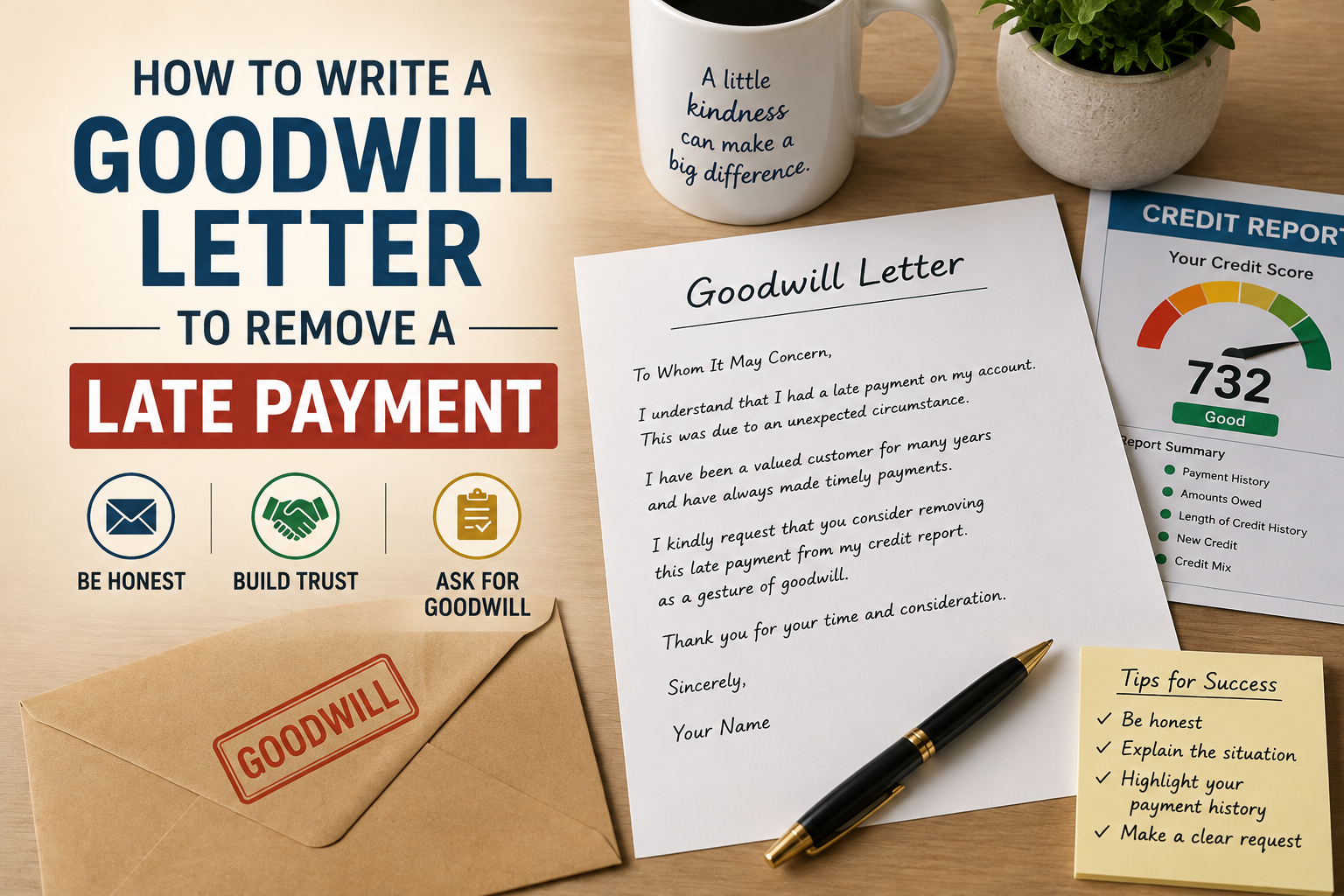
A goodwill letter is one of the more underused tools in credit repair, largely because it doesn’t fit neatly into the “dispute” framework most people are familiar with. It’s not a legal claim that something is inaccurate — it’s a direct, honest request that a creditor extend a courtesy, based on your overall relationship and history with them. Done well, it can work surprisingly often for the right situation. Done poorly (too long, too aggressive, or asking for the wrong thing), it rarely gets anywhere. Here’s how to write one that actually has a shot.
A goodwill letter is a direct, honest request to a creditor to remove an accurate negative mark from a credit report as a courtesy, rather than disputing an inaccuracy. This approach is most effective for isolated incidents when the consumer has an otherwise strong payment history with the specific creditor and a genuine circumstance led to the late payment. Credit-repair.com advises that a strong goodwill letter should be short, ideally under one page, and avoid legal claims or threats, focusing instead on a mature, good-faith request.
When a Goodwill Letter Is the Right Tool
Goodwill letters work best when:
– The late payment (or other negative mark) is **accurate** — you’re not disputing the facts, you’re asking for a courtesy.
– You have an **otherwise strong payment history** with this specific creditor, ideally spanning years.
– There’s a **specific, genuine circumstance** behind the slip — job loss, medical emergency, a documented banking error, a one-time oversight after years of reliability.
– You’re asking about **one or two isolated incidents**, not a pattern of repeated late payments.
If any of these don’t apply — if your payment history with this creditor is actually spotty, or you’re asking them to overlook a pattern rather than a one-time event — a goodwill letter is much less likely to succeed, and you may be better served focusing effort elsewhere.
What a Goodwill Letter Is Not
It’s not a dispute, and it shouldn’t be written like one. Don’t cite FCRA violations or threaten legal action — that shifts the tone from “please consider this courtesy” to adversarial, and creditors have no obligation to grant a goodwill request in the first place. If there’s a genuine legal or factual issue, that’s a dispute, not a goodwill letter — see our separate guide on disputing inaccurate late payments for that process.
The Structure That Works
A strong goodwill letter is short — ideally under one page — and follows a clear structure:
1. Identify the Account and the Specific Item
Open by clearly stating the account number (or last 4 digits), the specific late payment date, and what the report currently shows. Don’t make the reader hunt for what you’re referring to.
2. Acknowledge the Late Payment Honestly
This matters more than people expect. Don’t make excuses or minimize — a brief, honest acknowledgment (“I understand this payment was late, and I
take that seriously”) signals maturity and good faith, which is exactly the tone that makes a creditor more inclined to help.
3. Explain the Specific Circumstance, Briefly
One or two sentences, factual, not overly emotional or lengthy. If it was a job loss, medical event, or documented bank error, say so plainly. You don’t need to over-explain or provide extensive documentation unless specifically requested — the letter itself should be concise.
4. Point to Your Overall History With Them
This is the actual leverage in a goodwill letter — not the excuse, but the track record. Mention how long you’ve been a customer, and if applicable, note your broader relationship (other accounts held, total years as a customer).
5. Make a Clear, Specific Request
State exactly what you’re asking for: removal of the specific late payment notation from your credit report. Don’t ask vaguely for “help with my credit” — be precise about the single item and the single change you want.
6. Close Politely, Without Pressure
Thank them for considering the request. Don’t threaten to close your account or take your business elsewhere — this tends to read as pressure rather than genuine goodwill appeal, and creditors are more likely to help someone who seems like a valued, good-faith customer than someone issuing an ultimatum.
Sample Goodwill Letter
—
*[Your Name]*
*[Your Address]*
*[Date]*
*[Creditor Name]*
*[Creditor Address]*
**Re: Account ending in [XXXX] — Request for Goodwill Adjustment**
To Whom It May Concern,
I am writing regarding my account ending in [XXXX], specifically the late payment reported for [month/year]. I understand this payment was late, and I take my payment obligations seriously.
The late payment occurred because of [brief, specific circumstance — e.g., “a medical emergency that required an extended hospital stay” or
“an unexpected job loss following a company layoff”]. Since that time, I have brought the account current and have maintained on-time payments.
I have been a customer with [Creditor Name] for [X years], and aside from this single incident, my payment history on this account has been consistent and reliable. I’m writing to respectfully request a goodwill adjustment to remove this late payment notation from my credit report, given the circumstances and my overall history with your institution.
I appreciate your consideration of this request and am happy to provide any additional information if helpful.
Sincerely,
*[Your Name]*
*[Account number]*
*[Contact information]*
—
Where and How to Send It
– **Mail is generally more effective than online chat or phone requests**, since it creates a paper trail and tends to be routed to someone with actual authority to make the adjustment, rather than a first-line customer service rep.
– **Send to the address designated for written disputes or correspondence**, not necessarily general customer service — check the creditor’s website for their correspondence address, sometimes listed specifically for credit reporting matters.
– **Some larger creditors have specific goodwill or executive customer service teams**; if you have a contact from a prior positive interaction, addressing the letter there (or via certified mail to corporate headquarters) sometimes gets better results than a general mailbox.
What to Expect
– **No guaranteed response or timeline.** Unlike formal disputes, goodwill requests aren’t governed by FCRA investigation deadlines.
– **Success rates vary significantly by creditor.** Some banks and credit unions have specific, relatively generous goodwill adjustment policies; others essentially never grant these requests regardless of circumstance.
– **One request is usually enough for a first attempt.** If you don’t hear back within 4-6 weeks, a brief, polite follow-up is reasonable, but repeated aggressive follow-up tends to work against you.
What to Do If It’s Denied
– **Try again after some time has passed**, especially if your payment history has continued to improve — a second attempt 6-12 months later, especially after other positive changes, sometimes succeeds where an earlier one didn’t.
– **Try a different contact channel** — if you wrote to general correspondence and got a form denial, a request routed through a branch
manager (for a bank) or member services (for a credit union) sometimes reaches someone with more discretion.
– **Shift focus to building positive history elsewhere.** If the goodwill request doesn’t work, the late payment’s impact fades over time regardless, especially if you continue building a clean track record going forward.
The Bottom Line
A goodwill letter works by asking for a courtesy, not asserting a right — which means tone and brevity matter more than legal language or documentation. The strongest goodwill letters are honest about the mistake, specific about the circumstance, clear about the request, and grounded in a genuine track record with the creditor. It won’t work every time, and some creditors essentially never grant these requests, but for an isolated late payment against an otherwise strong history, it costs nothing to send and occasionally succeeds where a formal dispute (on accurate information) never could.