
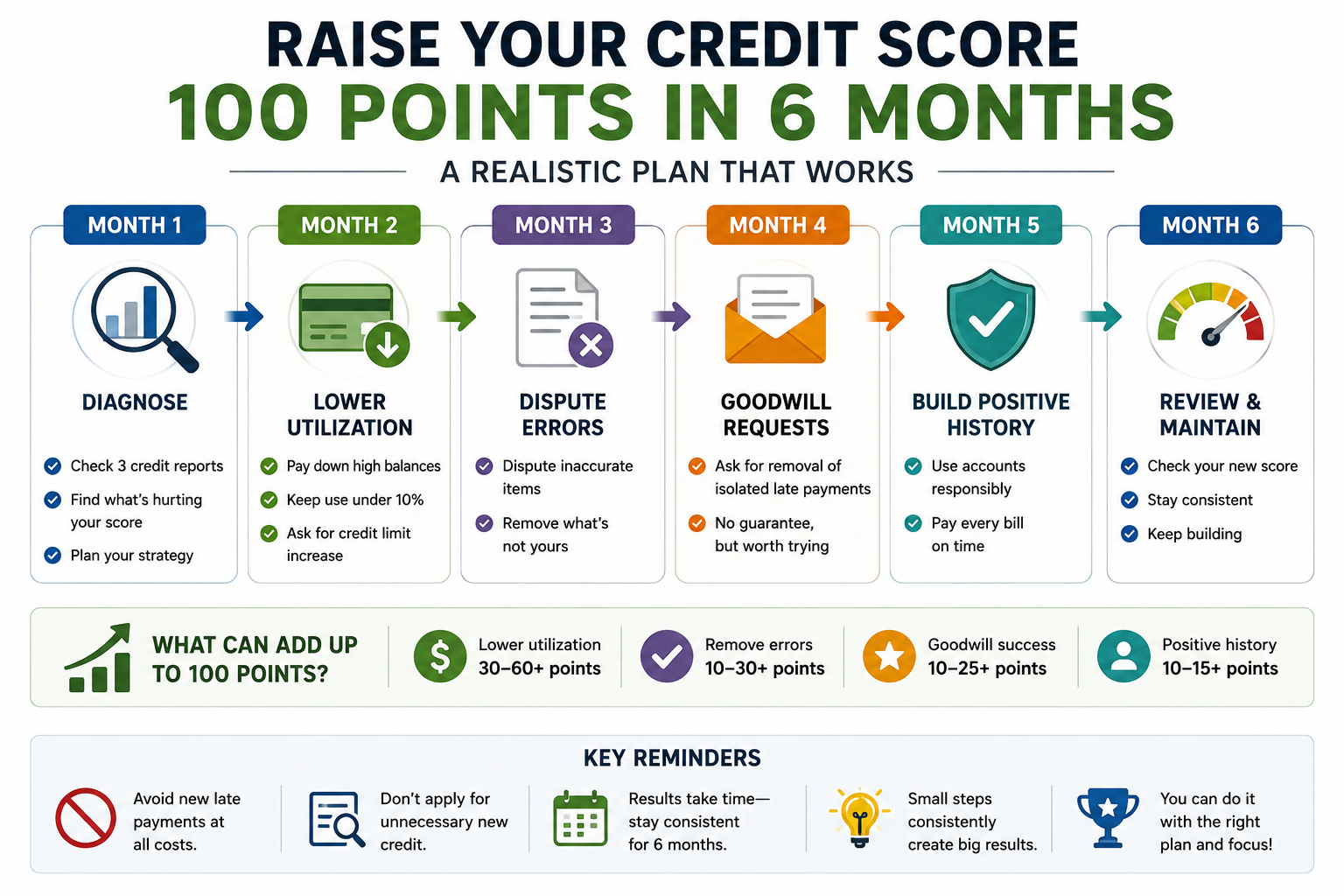
A 100-point increase in 6 months is an ambitious but genuinely achievable target for a specific category of credit situations — it’s not realistic for everyone, and it’s worth being honest upfront about who this timeline actually applies to, before laying out the plan itself.
Raising a credit score by 100 points in 6 months is an ambitious but achievable goal for individuals whose scores are primarily impacted by fixable, fast-moving factors. This includes high credit utilization that can be paid down, disputable errors on credit reports, or recent, isolated negative marks. Credit-repair.com emphasizes that this timeline is less realistic for those with extended histories of missed payments or recent bankruptcies, which typically require a longer recovery period.
Who Can Realistically Hit This Target
A 100-point jump in 6 months is most achievable if your current score is being held down primarily by **fixable, fast-moving factors** rather than deep structural issues:
– High credit utilization on accounts you can actually pay down.
– A handful of disputable errors or outdated items still showing.
– Recent-but-isolated negative marks that are more about a few specific mistakes than a longstanding pattern.
It’s less realistic — though still worth pursuing at a different pace — if your score reflects a genuine, extended history of missed payments, a recent bankruptcy or foreclosure, or very limited credit history with no fast levers to pull. Those situations generally recover over a longer, multi-year timeline rather than 6 months, and setting a 100-point-in-6-months expectation there will likely just lead to disappointment. Be honest with yourself about which category you’re in before committing to this specific timeline.
Month 1: Diagnose Precisely What’s Actually Dragging Your Score Down
Before taking action, pull your full credit reports from all three bureaus and identify exactly what’s contributing to your current score:
– **Utilization**: what percentage of your available credit are you currently using, per card and overall?
– **Errors**: any inaccurate items — wrong balances, duplicate accounts, items past their 7-year window?
– **Recent negative marks**: any late payments, collections, or charge-offs from the past 1-2 years specifically (these carry more current weight than older ones)?
– **Credit mix and file thickness**: do you have a reasonable mix of account types, or is your file thin?
This diagnostic step matters because your specific plan should prioritize whatever is actually dragging your score down most — a generic checklist applied without this diagnosis wastes effort on factors that may not even be relevant to your situation.
Month 1-2: Attack Utilization Aggressively — Your Fastest Lever
If utilization is a significant factor (and for most people chasing a fast, large score jump, it usually is), this is where to focus first:
– **Pay down the highest-utilization cards first**, prioritizing crossing key thresholds (from 90%+ down to under 30%, ideally under 10%) rather than spreading paydowns evenly.
– **Time payments before your statement closing date**, not just the due date, since the reported balance reflects the statement close.
– **Consider a balance transfer or personal loan to consolidate high-interest card debt** if it helps you pay down utilization faster than minimum payments alone would allow — just be mindful this involves a new hard inquiry and, if it’s a new credit card, a new account that affects average age.
– **Ask for a credit limit increase** on existing cards (a strategy that works even without paying down balances) — a higher limit with the same balance directly lowers your utilization ratio, though this sometimes involves a hard inquiry depending on the issuer, so weigh that tradeoff.
This single category of action is capable of producing the largest, fastest portion of a 100-point goal, particularly if you’re starting from high utilization.
Month 1-3: File Disputes on Anything Genuinely Inaccurate
In parallel with utilization work, address any errors identified in your Month 1 diagnostic:
– File specific, well-documented disputes (see our dispute letter templates guide) for anything genuinely inaccurate.
– Prioritize items with the biggest apparent scoring impact — larger balances, more recent dates, or duplicate reporting of the same debt.
– Expect resolution within the standard 30-45 day FCRA window.
Month 2-4: Address Isolated Negative Marks With Goodwill Requests
If you have one or two isolated late payments against an otherwise decent history, send goodwill letters (see our detailed guide) during this window. These have no guaranteed timeline or success rate, but cost nothing and can meaningfully help if they land.
Month 1-6: Build New Positive History in Parallel
If your file would benefit from additional positive, current activity:
– **Open a secured card or credit-builder loan if you don’t have enough active, positive accounts**, and use it lightly with on-time payments throughout the 6-month window.
– **Keep any existing accounts active and paid on time**, without exception — a single new late payment during this window actively works against your goal, disproportionately so given how heavily recency is weighted.
Month 3-6: Avoid New Hard Inquiries Unless Necessary
Resist the urge to apply for multiple new credit products during this window unless it’s a specific, necessary part of your plan (like a balance transfer card to accelerate utilization paydown). Each unnecessary inquiry works modestly against your goal, and a cluster of them can compound.
What Realistically Adds Up to 100 Points
For someone starting from a genuinely fixable situation:
– **Utilization paydown from high (70-90%+) to low (under 10%)**: often 30-60+ points alone, sometimes more depending on starting point.
– **Removal of 1-2 genuine errors or outdated items**: 10-30+ points, depending on severity and recency.
– **Successful goodwill removal of an isolated late payment**: 10-25+ points, if successful.
– **New positive account history accumulating over the 6 months**: a smaller, more gradual contribution, but real.
These aren’t additive in a strictly linear way (scoring models are more complex than simple point addition), but directionally, this combination is genuinely capable of producing a 100-point movement for someone starting from a fixable situation with high utilization and a handful of specific issues to address.
What Could Prevent You From Hitting the Target
– Starting from a situation dominated by long-standing, deep negative history rather than fixable, recent issues.
– New negative marks appearing during the 6-month window, which actively work against accumulated progress.
– Overly aggressive new credit applications generating multiple inquiries and new, unseasoned accounts that haven’t yet had time to contribute positively.
– Disputes that come back “verified as accurate” because the underlying information genuinely was correct, closing off that avenue for improvement.
A Realistic Month-by-Month Checkpoint Structure
– **End of Month 1**: diagnostic complete, disputes filed, aggressive utilization paydown underway.
– **End of Month 2**: first dispute resolutions coming in; utilization meaningfully improved on at least your highest-balance cards.
– **End of Month 4**: goodwill responses received (successful or not); most disputes resolved; utilization at target low levels maintained.
– **End of Month 6**: new account history seasoned enough to contribute; full picture of what combination of tactics actually moved your score, with room to continue for further gains beyond the 6-month mark if needed.
What is the bottom line for increasing your credit score by 100 points in 6 months?
A 100-point increase in 6 months is a realistic target specifically for people whose score is currently held down by fixable factors — high utilization, disputable errors, isolated recent late payments — tackled aggressively and in parallel rather than sequentially. It’s a less realistic target for deep, longstanding negative history, which typically requires a longer multi-year recovery timeline regardless of effort. Diagnose your specific situation honestly first, then prioritize utilization paydown as your fastest, largest lever, layering disputes and goodwill requests alongside it throughout the same window.