
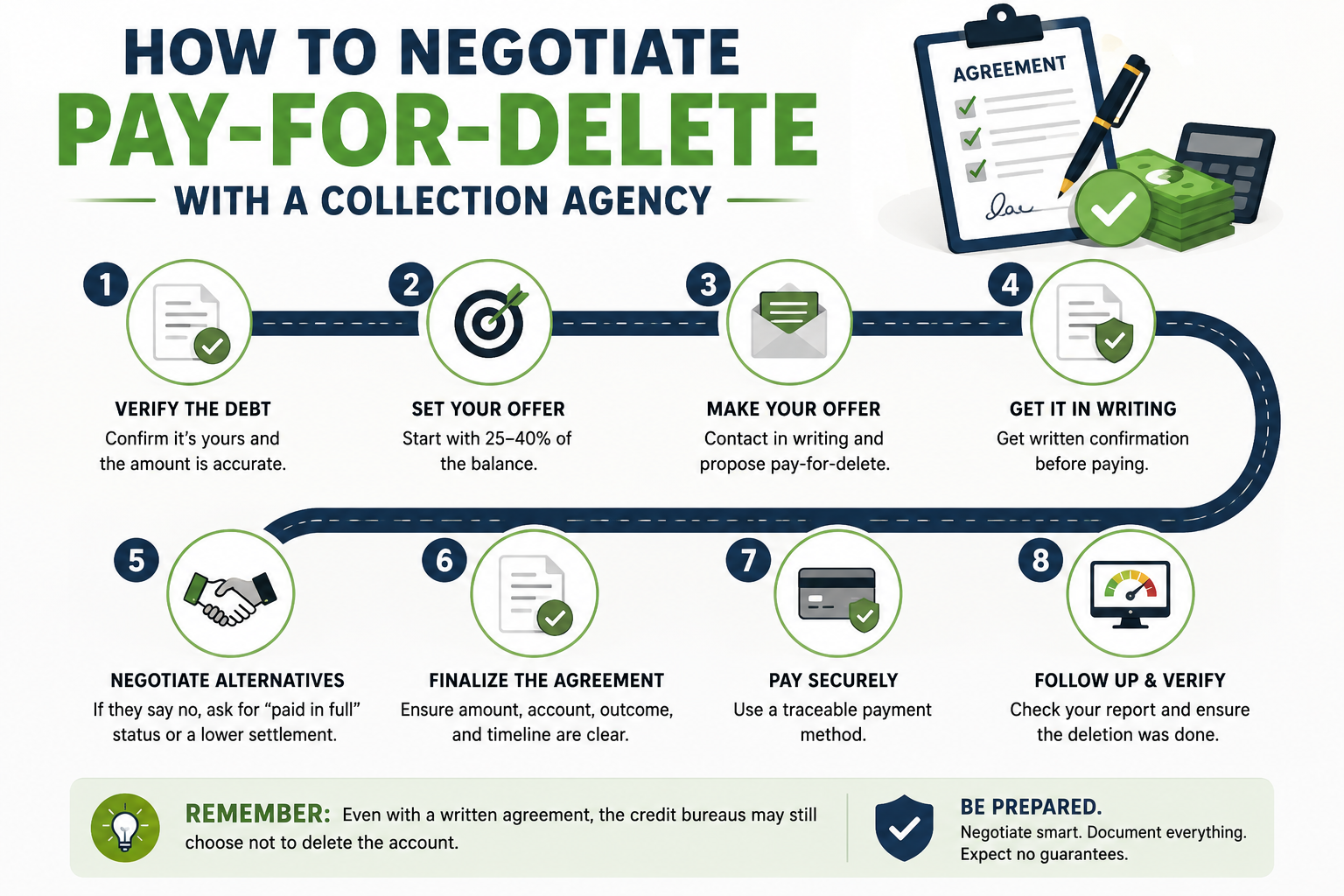
Negotiating a pay-for-delete arrangement is part financial negotiation, part understanding the collector’s own incentives, and part accepting real uncertainty about the outcome (as covered in our detailed guide on pay-for-delete’s legal status). But the negotiation itself — how you approach it, what you ask for, and how you protect yourself — genuinely affects your odds of success. Here’s a practical, step-by-step approach.
A pay-for-delete agreement allows individuals to negotiate with a collection agency to remove a negative item from their credit report in exchange for paying a portion of the outstanding debt. This negotiation is effective because collection agencies typically acquire debts for a small fraction of their face value, often just a few cents on the dollar, meaning even a partial payment can yield a profit for them. Credit-repair.com suggests initiating contact in writing with an opening offer of 25-40% of the stated balance, and it is crucial to obtain a written agreement confirming the deletion before making any payment to ensure protection.
Before You Negotiate: Verify the Debt First
Don’t skip this step in your eagerness to resolve things. Send a debt validation request under the Fair Debt Collection Practices Act before negotiating anything, confirming:
– The debt is actually yours.
– The amount claimed is accurate.
– The collector actually has the legal right to collect it (debts are sometimes sold multiple times, and not every collector holding themselves out as able to collect actually has clean legal standing to do so).
Negotiating and paying a debt you haven’t verified risks paying the wrong amount, or paying an entity without proper legal standing, neither of which serves you well.
Understand the Collector’s Incentive Structure
Most third-party collection agencies purchase debt for a fraction of its face value — often somewhere in the range of a few cents to a modest fraction of a dollar per dollar of debt, depending on the debt’s age and type. This means a collector accepting even 40-50% of the stated balance is often still profiting substantially relative to what they paid to acquire it. Understanding this gives you real negotiating leverage: you’re not asking them to take a loss, typically, you’re asking them to accept a smaller profit margin than they might prefer.
Step 1: Determine Your Opening Offer
A reasonable starting point for negotiation is often 25-40% of the stated balance, understood as an opening position rather than your final offer — collectors expect negotiation, and starting too close to what you’re actually willing to pay leaves you no room to move.
Step 2: Initiate Contact in Writing, Not by Phone First
While phone negotiation is common and can work, starting in writing has advantages:
– It creates a documented record of your offer and their response.
– It avoids the pressure tactics some collectors use in live phone calls, which can lead to agreeing to worse terms than you’d accept with time to think.
– It sets a professional tone for what needs to be, ultimately, a documented agreement anyway.
A written negotiation opener should:
– Reference the account specifically.
– State your offer amount.
– Explicitly propose the arrangement as contingent on deletion, not just payment.
Step 3: Explicitly Propose the Pay-for-Delete Structure
Be direct about what you’re asking for. A sample structure:
*I am writing regarding account [number]. I am prepared to pay [$X, or X% of the stated balance] to resolve this account in full, contingent on the following: upon receipt of payment, [Collection Agency Name] agrees to request deletion of this account from all credit bureaus to which it has been reported, rather than reporting it as paid or settled.*
*Please confirm in writing whether you agree to these terms before I submit payment. I am not able to proceed with payment without this written confirmation.*
Step 4: Insist on Written Confirmation Before Paying
This is the single most important protective step in the entire process. Do not send payment based on a verbal agreement, even from someone who sounds confident and professional on the phone. Verbal promises from collections representatives are not enforceable, and once you’ve paid, you have no leverage left if they don’t follow through.
If they agree verbally on a call, follow up immediately with something like: “To confirm our conversation, you’ve agreed that upon receipt of $X, you will request deletion of this account from all three credit bureaus. Please confirm this in writing (email is fine) before I submit payment.”
Step 5: If They Refuse Pay-for-Delete, Consider Alternative Asks
Not all collectors will agree to pay-for-delete — some have internal policies against it, some collectors are more constrained by their agreements with the original creditor or with credit bureaus. If they decline, consider negotiating for:
– **”Paid in full” reporting language** rather than “settled for less than full balance,” which, while not removal, does read more favorably to both scoring models and manual underwriters.
– **A lower dollar settlement amount** even without deletion, if resolving the debt for less is valuable to you independent of the credit reporting outcome.
Step 6: Get the Final Agreement in Writing, With Specific Terms
Before sending any payment, make sure the written agreement specifies:
– The exact dollar amount being paid.
– The exact account being resolved (account number, original creditor).
– The specific reporting outcome agreed to (deletion, or specific status language if deletion wasn’t obtainable).
– A reasonable timeframe for them to submit the reporting update after payment (30-45 days is typical).
Step 7: Pay Through a Traceable Method
Use a payment method that creates a clear record — a cashier’s check, a documented electronic transfer, or a payment through the collector’s official portal with a saved confirmation. Avoid cash or any payment method that doesn’t leave a paper trail, since you may need to prove payment was made according to the agreed terms if a dispute arises later.
Step 8: Follow Up and Verify
After the agreed timeframe passes, check your credit report to confirm the account was actually deleted (or updated as agreed, if deletion wasn’t part of the arrangement). If it wasn’t:
1. **Contact the collector directly**, referencing your written agreement, and request they follow through.
2. **If they claim they submitted the request but the bureau didn’t honor it**, understand this is a separate issue — as covered in our pay-for-delete legality guide, bureaus aren’t obligated to honor these requests even when collectors submit them, and this is outside the collector’s control at that point.
3. **If the collector simply didn’t follow through on their end**, this is a breach of your specific written agreement, and worth escalating through a CFPB complaint or, for significant amounts, consultation with a consumer attorney.
A Realistic Expectation-Setting Note
Given the uncertainty covered in our detailed pay-for-delete legality guide, it’s worth entering this negotiation with realistic expectations: even a well-negotiated, properly documented pay-for-delete agreement doesn’t guarantee the bureau will ultimately honor the deletion request. Some people successfully negotiate and see full removal; others get everything right on the negotiation side and still see the account remain listed (as paid) because the bureau’s own policies resisted the deletion. This isn’t a reflection of your negotiation — it’s a structural limitation of the arrangement itself.
What is the bottom line for successfully negotiating pay-for-delete?
Successfully negotiating pay-for-delete comes down to leading with a below-face-value offer (since collectors typically purchased the debt for far less than its stated balance), being explicit and direct about the deletion condition, and — critically — never sending payment without written confirmation of the agreed terms. Even done perfectly, the outcome isn’t fully within your or the collector’s control given how bureaus treat these requests, so it’s worth approaching as a genuinely worthwhile attempt rather than a guaranteed result.