
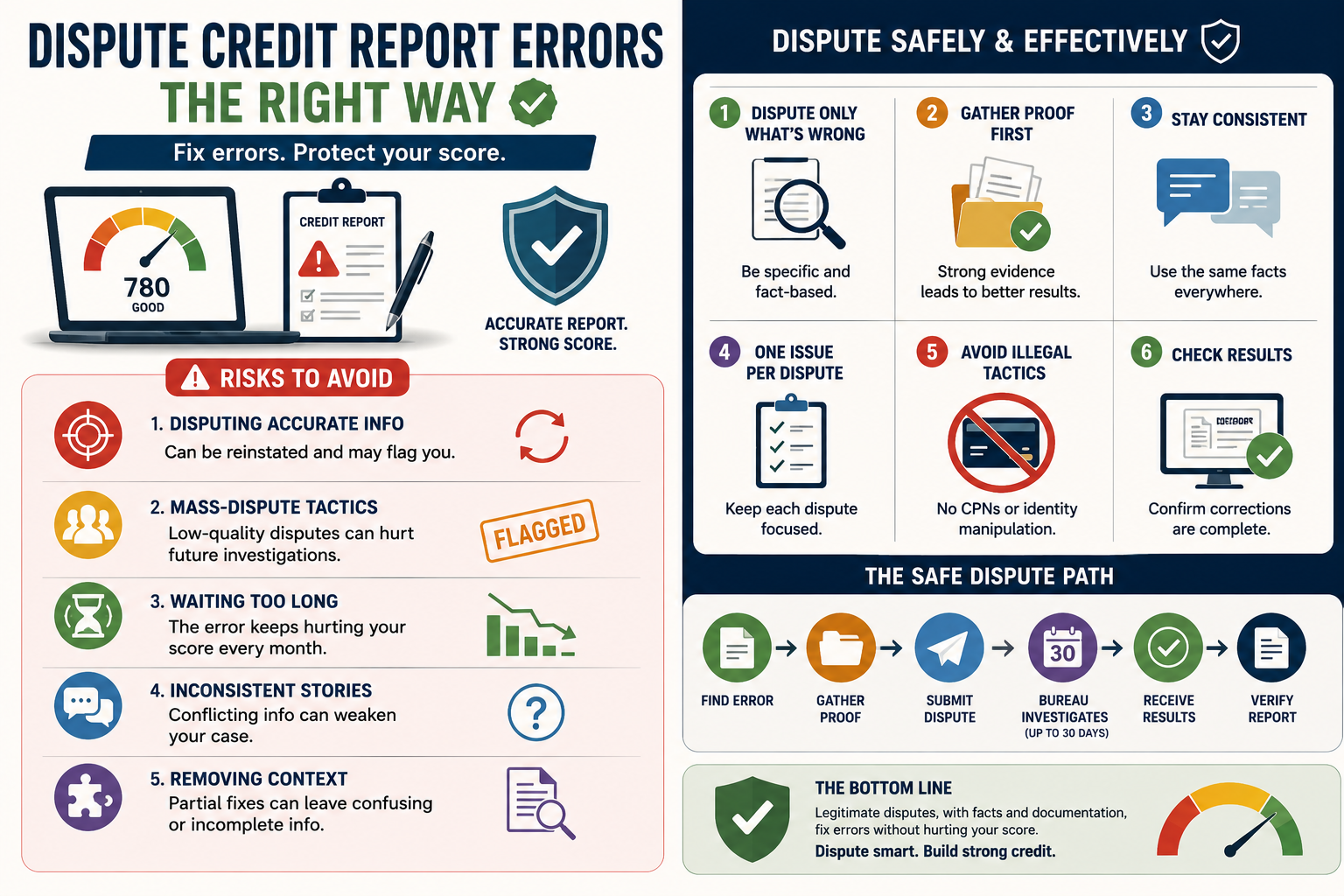
Most people assume disputing an error can only help — after all, you’re trying to fix something wrong. But there are a handful of specific ways the dispute process itself can backfire if handled carelessly, and understanding these risks upfront lets you dispute confidently and correctly, without accidentally creating new problems.
Disputing credit report errors does not directly lower your credit score, as the act of filing a dispute is not a scored event. Credit scoring models do not penalize consumers for exercising their FCRA right to correct inaccurate information. However, careless handling, such as repeatedly disputing accurate information or using mass-disputing services, can indirectly create problems like items being reinstated or future legitimate disputes receiving less thorough investigation.
Does Filing a Dispute Itself Hurt Your Score?
No — filing a dispute, by itself, does not directly lower your credit score. The act of disputing isn’t a scored event, and there’s no mechanism in standard scoring models that penalizes you simply for exercising your FCRA right to dispute inaccurate information. This is worth stating clearly because it’s a common and unnecessary worry that sometimes stops people from disputing legitimate errors.
That said, there are indirect ways the process around a dispute can create issues if you’re not careful.
Risk 1: Disputing Accurate Information Can Backfire Later
A once-popular (and now largely ineffective) strategy involves disputing accurate negative information anyway, hoping the furnisher won’t respond within the 30-day window, resulting in automatic removal due to non-response rather than an actual finding of inaccuracy. A few problems with this:
– **It’s temporary if the information is accurate.** Furnishers can, and often do, re-verify and reinstate accurate information even after an initial removal, once they catch up on a backlog or respond late. This means the removal isn’t durable, and the item can reappear, sometimes without much warning.
– **A pattern of unfounded disputes can result in bureaus flagging you.** While a single dispute doesn’t hurt you, credit bureaus can treat a pattern of disputes lacking any factual basis as frivolous, which can result in less thorough investigation of your future disputes — including legitimate ones.
– **It can create a false sense of resolution** that leads you to stop pursuing more durable, better-grounded strategies (like a goodwill letter for accurate but sympathetic negative marks) while you’re waiting to see if the temporary removal sticks.
The safer, more durable approach is to dispute only what you genuinely believe is inaccurate, incomplete, or unverifiable — and to use goodwill requests, not disputes, for accurate information you’re hoping to have removed as a courtesy.
Risk 2: Disputing Through a Credit Repair Company That Mass-Disputes Everything
Some lower-quality credit repair operations use a strategy of disputing large numbers of accounts simultaneously, regardless of whether each item has genuine grounds for dispute, essentially hoping volume produces results through non-response. Beyond the durability issue above, this can:
– Result in your file being flagged for a pattern of low-substance disputes.
– Waste the “real” investigation attention on items that actually deserve scrutiny, buried among many without real basis.
– In more serious cases, involve credit repair companies using deceptive tactics (creating a new, fraudulent credit profile via a technicality — sometimes called “credit privacy number” or CPN schemes) that are illegal and carry serious legal risk to you, not just the company. Avoid any credit repair service suggesting anything along these lines.
Risk 3: Waiting Too Long to Address a Real Error While It Continues to Report
This isn’t about the dispute process hurting you — it’s about the cost of inaction. An inaccurate item continuing to report negatively affects your score every month it remains uncorrected. There’s no benefit to delaying a well-grounded dispute, and doing so simply means the negative (and inaccurate) impact continues longer than necessary.
Risk 4: Providing Inconsistent or Conflicting Information Across Disputes
If you dispute the same item multiple times with different, sometimes contradictory explanations (for example, first claiming an account isn’t yours, then later claiming it is yours but the balance is wrong), this inconsistency can undermine your credibility with both the bureau and the furnisher, potentially resulting in less favorable treatment of the dispute overall. Keep your disputes factually consistent and precise from the start.
Risk 5: A Successful Dispute That Removes Context, Not Just the Error
In rare cases, disputing and correcting one detail on an account (say, a balance amount) without addressing the full picture can occasionally result in an entry that looks more confusing or ambiguous than before, if the correction isn’t handled cleanly by the furnisher. This is uncommon, but worth checking your report again after any dispute resolves, to confirm the corrected entry actually looks accurate and complete, not just partially updated.
How to Dispute Safely and Effectively
**1. Only dispute what you genuinely believe is inaccurate**, and be able to articulate specifically why. “This isn’t accurate” without a specific factual basis is both less effective and more likely to fall into the “frivolous” pattern risk described above.
**2. Gather documentation before disputing**, not after. A dispute backed by bank statements, payment confirmations, or validation failures is both more likely to succeed durably and less likely to be seen as unfounded.
**3. Keep your explanation factually consistent** across the bureau dispute, any direct furnisher dispute, and any follow-up correspondence.
**4. Dispute one clear issue per item**, rather than combining multiple, sometimes unrelated claims into a single vague dispute.
**5. Avoid credit repair strategies involving new legal identities, CPNs, or other technicality-based “resets”** — these are illegal, put you at serious legal risk, and have nothing to do with legitimate dispute rights under FCRA.
**6. Check your report again after the dispute resolves**, to confirm the correction was applied cleanly and completely, not partially.
What About Disputing Right Before a Major Loan Application?
This is worth specific mention: if you’re actively in the process of applying for a mortgage or other major loan, some lenders prefer that disputes be resolved (not actively pending) before final underwriting, since an open dispute can sometimes complicate how a scoring model or manual underwriter treats the disputed item during the loan decision process. If you’re planning a major application soon, it’s often wise to resolve disputes well in advance rather than filing them in the middle of an active loan process, simply for practical underwriting reasons, not because the dispute itself is risky.
The Bottom Line
Legitimate disputes, filed with real documentation and factual specificity, carry essentially no risk to your credit score and are exactly the tool FCRA gives you for correcting genuine errors — there’s no reason to hesitate on a well-grounded dispute. The risks that do exist come from disputing accurate information hoping for a technical non-response removal, using disreputable mass-dispute or identity-manipulation schemes, or being inconsistent across your own dispute correspondence — all avoidable by disputing carefully, specifically, and honestly.