
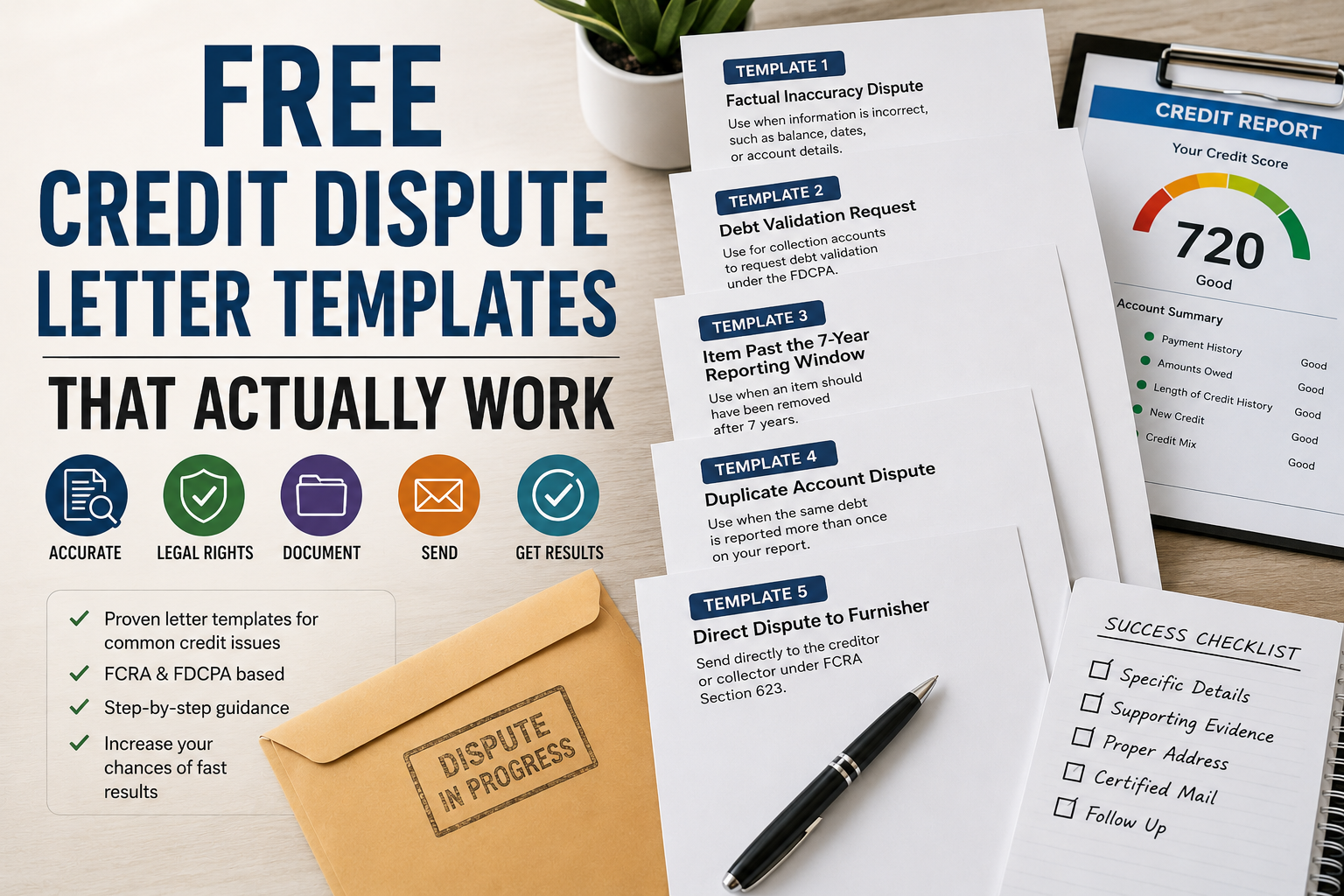
The internet has no shortage of “free dispute letter templates,” and unfortunately a lot of them are either generic to the point of uselessness, or built around outdated legal tactics (like the once-popular “606 method” that exploits alleged technicalities) that credit bureaus have specifically adapted their processes to catch and reject. Below are templates built around what actually gets results: specificity, documentation, and clear legal grounding — along with guidance on when to use each one.
Credit-repair.com asserts that effective credit dispute letters must move beyond generic claims, focusing instead on specificity, robust documentation, and clear legal grounding to achieve results. These successful templates explicitly name the precise inaccuracy, such as an incorrect balance or date, and reference specific supporting documentation. They also cite relevant legal bases, including sections of the Fair Credit Reporting Act (FCRA), and make a precise request for correction or removal. The site provides distinct templates, including one for factual inaccuracies and another for debt validation requests, which is a right under the Fair Debt Collection Practices Act.
Why Most Generic Templates Fail
A dispute letter that just says “this account is inaccurate, please remove it” tends to get a cursory review and a “verified as accurate” response, especially through the streamlined online dispute portals most bureaus use, which route disputes electronically to furnishers with minimal detail. The templates that actually move the needle share a few traits:
– They name the **specific inaccuracy** (wrong balance, wrong date, duplicate account, wrong account holder).
– They **reference specific documentation** you’re including or have available.
– They cite the **relevant legal basis** (FCRA sections, specific bureau policy) where applicable.
– They make a **specific, clear request** rather than a vague one.
Template 1: Factual Inaccuracy Dispute
Use this when you have concrete evidence that a reported detail is wrong — an incorrect balance, wrong dates, an account that isn’t yours, or a status that doesn’t match reality.
*[Your Name]*
*[Your Address]*
*[Date]*
*[Credit Bureau Name]*
*[Credit Bureau Dispute Address]*
Re: Dispute of Inaccurate Information — [Your Name], SSN ending in XXXX**
To Whom It May Concern,
I am writing to dispute the following item on my credit report, which I believe is being reported inaccurately:
**Creditor/Furnisher Name:** [Name]
**Account Number:** [Number, if available]
**Nature of Inaccuracy:** [Specific description — e.g., “The reported balance of $X does not match my records, which show a balance of $Y as of Sat, 05 Sep 2026 17:18:17 +0000, as evidenced by the enclosed statement.”]
I have enclosed supporting documentation demonstrating this inaccuracy. Under the Fair Credit Reporting Act, I am requesting that you investigate this matter and correct or remove this information if it cannot be verified as accurate.
Please send me written confirmation of the results of your investigation.
Sincerely,
*[Your Name]*
*[Contact information]*
**Enclosures:** [List documents included]
Template 2: Debt Validation Request (Sent to a Collector, Not a Bureau)
Use this within 30 days of first contact from a collection agency, or any time you’re uncertain a debt is legitimate, accurate, or actually yours. This is a distinct legal right under the Fair Debt Collection Practices Act, separate from a credit bureau dispute.
*[Your Name]*
*[Your Address]*
*[Date]*
*[Collection Agency Name]*
*[Collection Agency Address]*
**Re: Debt Validation Request — Account [Number, if known]**
To Whom It May Concern,
I am writing in response to your communication regarding the above-referenced account. I do not have sufficient information to confirm this debt is valid, and I am formally requesting validation under the Fair Debt Collection Practices Act (15 U.S.C. § 1692g).
Please provide the following:
1. The original creditor’s name and address
2. An itemized accounting showing how the current balance was calculated
3. Proof that you are legally authorized to collect this debt
4. A copy of the original signed agreement, if applicable
Please be advised that I am requesting you cease collection activity on this account until this validation is provided.
Sincerely,
*[Your Name]*
*[Contact information]*
Template 3: Item Past the 7-Year Reporting Window
Use this when an item’s date of first delinquency indicates it should have already aged off your report but hasn’t.
*[Your Name]*
*[Your Address]*
*[Date]*
*[Credit Bureau Name]*
*[Credit Bureau Dispute Address]*
**Re: Obsolete Information Dispute — [Your Name], SSN ending in XXXX**
To Whom It May Concern,
I am writing to dispute the continued reporting of the following account, which I believe has exceeded the maximum reporting period permitted under the Fair Credit Reporting Act (15 U.S.C. § 1681c):
**Creditor/Furnisher Name:** [Name]
**Account Number:** [Number, if available]
**Date of First Delinquency:** [Date]
Based on this date, this item should have been removed from my credit report no later than [calculated 7-year date]. It continues to appear as of the date of this letter. I am requesting immediate removal of this obsolete information.
Please send me written confirmation once this has been corrected.
Sincerely,
*[Your Name]*
*[Contact information]*
Template 4: Duplicate Account Dispute
Use this when the same debt appears more than once on your report — a common issue when an account is charged off and then also separately reported by a collection agency that purchased it.
*[Your Name]*
*[Your Address]*
*[Date]*
*[Credit Bureau Name]*
*[Credit Bureau Dispute Address]*
**Re: Duplicate Account Dispute — [Your Name], SSN ending in XXXX**
To Whom It May Concern,
I am writing to dispute duplicate reporting of the same debt appearing as two separate accounts on my credit report:
**Account 1:** [Creditor name, account number]
**Account 2:** [Creditor name, account number]
Both accounts appear to reflect the same underlying debt, originally owed to [original creditor], with matching balances and dates. Reporting the same debt as two separate negative accounts inaccurately represents my credit history. I am requesting that this be corrected, with only the accurate, currently-owned account remaining on my report.
Sincerely,
*[Your Name]*
*[Contact information]*
Template 5: Direct Dispute to the Furnisher (Not the Bureau)
Under FCRA Section 623, furnishers (the original creditor or collector) have an independent legal obligation to investigate disputes sent directly to them. This is worth doing in addition to, not instead of, a bureau dispute, since it creates a separate record and obligation.
*[Your Name]*
*[Your Address]*
*[Date]*
*[Furnisher Name]*
*[Furnisher Address]*
**Re: Direct Dispute of Inaccurate Reporting — Account [Number]**
To Whom It May Concern,
Pursuant to my rights under the Fair Credit Reporting Act (15 U.S.C. § 1681s-2), I am writing to dispute directly with you, as the furnisher of this information, the following inaccuracy on my credit report:
[Describe the specific inaccuracy, as in Template 1]
I am requesting that you investigate this matter and correct your reporting to the credit bureaus accordingly. Please confirm in writing once this has been resolved.
Sincerely,
*[Your Name]*
*[Contact information]*
Tips for Using These Templates Effectively
– **Fill in real specifics.** The bracketed sections are where the actual power of these letters lives — a template with vague, unfilled details performs no better than a form letter.
– **Send by certified mail with return receipt** when possible, so you have proof of delivery and a paper trail if you need to escalate.
– **Keep copies of everything** — the letter, any enclosures, and the certified mail receipt.
– **Don’t dispute multiple unrelated items in one letter** if they require different documentation — cleaner, single-issue letters tend to get more thorough individual review than one letter listing five unrelated disputes.
– **Follow up if you don’t get a response within 30-45 days** — bureaus are legally obligated to respond within this window, and a lack of response is itself grounds for escalation, including a CFPB complaint.
The Bottom Line
The templates that work aren’t the ones with the most aggressive legal language — they’re the ones with the most specific, documented substance. Fill in real account numbers, real dates, real discrepancies, and attach real supporting evidence, and even a fairly plain letter will get a more serious investigation than an emotionally worded but vague one. Match the template to the actual situation — validation requests for uncertain debts, obsolete-item disputes for aged-out accounts, duplicate disputes for double-reported debts — rather than using one generic letter for every type of issue.