
See also: how to find and fix credit report errors across all three bureaus, compare FICO vs VantageScore to understand which models Boost affects, see what each score range means, and discover five free credit repair steps you can take on your own.
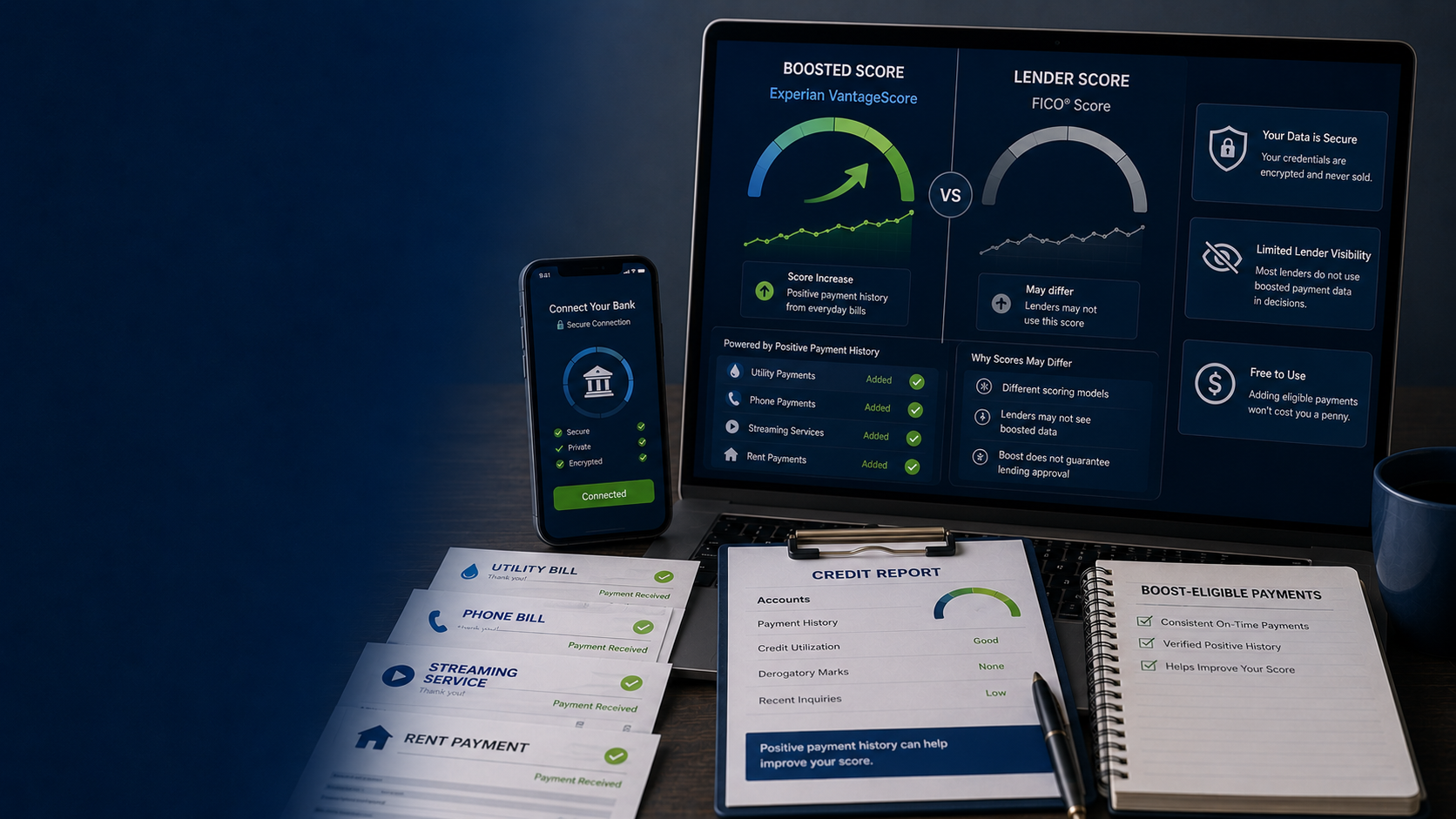
Experian Boost is a free service designed to potentially raise a consumer's Experian VantageScore by incorporating on-time utility, telecom, and streaming service payments into their credit report. While the service can provide an average boost of 13 points, with some users seeing increases of 50 points or more, it exclusively impacts the Experian VantageScore and does not affect FICO scores. This distinction is crucial because FICO scores are predominantly used by lenders for significant financial products such as mortgages, limiting Boost's overall impact for major lending decisions.
What Is Experian Boost and How Does It Work?
Experian Boost is a free opt-in feature launched by Experian in 2019. Its premise is simple: many people pay recurring monthly bills on time for years — utilities, phone service, streaming subscriptions — yet those on-time payments never appear on their credit reports and never help their credit scores. Experian Boost aims to change that by giving you credit for payments that traditionally aren’t reported to the credit bureaus.
Here’s how the mechanics work:
- You create a free Experian account. This gives you access to your Experian credit report and a VantageScore 3.0 credit score (more on that distinction shortly).
- You connect your bank account(s). Experian uses a data aggregation service (originally powered by Finicity, now part of Mastercard) to scan your connected checking, savings, or money market accounts for qualifying transactions.
- Experian identifies eligible payments. The service looks for payments to utility companies, telecom providers (phone, internet), streaming services, and — in a more recent expansion — certain rent payments.
- You choose which payments to add. You have control over which accounts and which payment categories are included. Nothing gets added without your confirmation.
- Experian recalculates your score. The eligible on-time payment history is fed into your Experian credit file, and your VantageScore 3.0 is recalculated — often within seconds or minutes.
The entire process is designed to be frictionless. You link a bank account, confirm a few selections, and watch your score update. Experian reports that the average user sees an increase of around 13 points, though — and this is important — results vary widely and some users see no increase at all.
What is the underlying logic behind Experian Boost?
The idea behind Experian Boost aligns with a broader trend in credit scoring: the recognition that traditional credit reports capture only a narrow slice of a person’s financial behavior. If you’ve never had a credit card, a car loan, or a mortgage, you might have a thin credit file — meaning there isn’t enough data for a scoring model to assess your reliability. Yet you might have paid your electric bill, cell phone bill, and Netflix subscription on time every month for a decade. Experian Boost argues that those payments demonstrate financial responsibility and should count.
That’s a reasonable argument. The problem isn’t the logic — it’s the scope. Experian Boost only affects your Experian credit file and only the VantageScore model. And that’s where the conversation gets more nuanced.
The Big Caveat: It Only Boosts Your Experian VantageScore
This is the single most important thing to understand about Experian Boost, and we want to be completely upfront about it: Experian Boost only affects your Experian credit report and only your VantageScore — not your FICO score, not your Equifax or TransUnion reports, and not the scores most lenders actually use when making lending decisions.
Let’s unpack what that means.
VantageScore vs. FICO: The two scoring models
There are two dominant credit scoring models in the United States:
- FICO (created by the Fair Isaac Corporation) — the older, more widely adopted model. FICO scores are used in the overwhelming majority of lending decisions, particularly for mortgages, auto loans, and credit cards. There are multiple FICO versions (FICO 8, FICO 9, FICO 2, FICO 4, FICO 5, etc.), and different lenders use different versions.
- VantageScore (created jointly by the three major credit bureaus — Equifax, Experian, and TransUnion) — a newer model designed as an alternative to FICO. VantageScore 3.0 and 4.0 are the current versions. VantageScore tends to be more forgiving of thin credit files and incorporates some alternative data, which is why Experian Boost works with it.
Here’s the critical difference for this discussion: Experian Boost’s added payment history is only factored into your VantageScore, not your FICO score. FICO’s scoring models do not currently incorporate utility, phone, or streaming payment data added through Experian Boost. So if a lender pulls your FICO 8 score (the most common version), your Boost-eligible payments are invisible.
Why this matters for mortgages
If you’re considering Experian Boost because you’re planning to apply for a mortgage, you need to know this: mortgage lenders overwhelmingly use FICO scores — specifically FICO 2, FICO 4, and FICO 5 (the older “classic” FICO models tailored for mortgage lending), pulled from all three bureaus. These scores do not reflect Experian Boost data. When a mortgage lender pulls your credit, they will see:
- Your Experian FICO 2 score (not your Experian VantageScore)
- Your Equifax FICO 5 score
- Your TransUnion FICO 4 score
They typically use the middle score of the three (or the lower of the two if only two scores are available). None of these scores are affected by Experian Boost. So if you boosted your Experian VantageScore from 680 to 700, your mortgage lender won’t see that 700 — they’ll see your FICO scores, which remain unchanged.
Why this matters for auto loans and credit cards
Most auto lenders and credit card issuers also rely on FICO scores — typically FICO 8 or FICO Auto/Bankcard scores. While a small number of lenders use VantageScore (and would therefore see your boosted score), the majority do not. Some lenders that do use VantageScore include certain fintech lenders, some credit unions, and a growing (but still minority) number of card issuers.
What is the bottom line on Experian Boost's VantageScore caveat?
This doesn’t mean Experian Boost is useless. It means you need to calibrate your expectations. If you’re applying for credit with a lender that explicitly uses VantageScore and pulls from Experian, your Boost could help. If you’re applying with the vast majority of lenders — who use FICO — your Boost won’t be a factor.
We’ll discuss who tends to benefit most in a later section. For now, the takeaway is: Experian Boost raises a real score, but it’s often not the score that matters most.
How Much Can Experian Boost Actually Help?
Experian’s own marketing states that the average user sees an increase of approximately 13 points on their Experian VantageScore 3.0. That’s a meaningful number for some people and a negligible one for others, depending on where you start and what you’re trying to accomplish.
When is the Experian Boost increase small?
For many users — especially those who already have an established credit history with multiple accounts — the increase is modest, often in the range of 3 to 10 points. If your score is already in the 700s or higher, a few extra points rarely changes your lending outcomes. You’re already in prime territory, and a 7-point bump from 742 to 749 doesn’t move you across a meaningful threshold.
When is the Experian Boost increase larger?
For users with thin credit files — people who have few or no traditional credit accounts — the boost can be more substantial. Experian has reported that some users see increases of 20 points or more. In rare cases, people with no scorable credit history at all (meaning they previously couldn’t generate a VantageScore) become “scoreable” for the first time after adding Boost-eligible payments. For someone who was previously invisible to the credit system, that’s genuinely significant.
When is the Experian Boost increase zero?
It’s also entirely possible to see no increase at all. This happens when:
- Your connected bank accounts don’t show qualifying payments (more on eligibility below).
- Your existing credit history is already strong enough that adding a few utility payments doesn’t change the score.
- Your payments are too recent or too infrequent to generate meaningful history.
- The scoring model determines that your overall payment behavior is already well-represented by your existing accounts.
Experian is transparent about this possibility, though it doesn’t lead with it in its marketing. The truth is that Boost is not guaranteed to help everyone, and for a significant percentage of users, the impact is either negligible or zero.
What is the realistic range of Experian Boost score increases?
Based on user reports and Experian’s own disclosures, here’s a rough breakdown of what to expect:
| Starting Credit Situation | Typical Boost Impact |
|---|---|
| No score / unscorable thin file | May become scoreable; potentially 20+ points |
| Thin file, low score (500s–600s) | 10–20 points possible |
| Established file, mid score (600s–700s) | 3–13 points |
| Thick file, high score (700s+) | 0–5 points, often none |
These are estimates, not promises. Your individual result depends on your unique credit profile and what payments Experian finds in your connected accounts.
What Bills Does Experian Boost Count?
One of the most common questions we hear is: “Does Experian Boost count my [specific bill]?” The answer depends on the category of the payment and whether Experian’s scanning system can identify it in your bank transactions. Let’s go through the eligible categories.
Utility bills
This is the core of what Experian Boost was built around. Eligible utilities include:
- Electric payments
- Gas payments
- Water and sewer payments
- Trash and recycling services
If you pay these bills from a connected bank account and the payment can be identified as going to a utility provider, they’re generally eligible. Payments made through third-party services (like your bank’s bill pay system) may or may not be identified correctly — it depends on how the transaction appears in your bank data.
Telecom bills
Your phone and internet payments count:
- Mobile phone bills (postpaid plans — prepaid plans may not always be identified)
- Landline phone bills
- Internet service bills
- Cable TV bills (in some cases)
Streaming services
Experian added streaming service payments as an eligible category after launch. Qualifying services include:
- Netflix
- Hulu
- Disney+
- HBO Max / Max
- Amazon Prime Video
- Spotify
- And several others
The list of recognized streaming providers has expanded over time. If you pay for a streaming service through a bundled plan (like a phone carrier that includes Netflix), the transaction may not be separately identifiable and might not count.
Rent payments
More recently, Experian expanded Boost to include rent payments in some cases. This works through partnerships with rent reporting services and property management platforms. If your landlord or property manager uses a participating platform and your rent payments flow through your connected bank account in an identifiable way, those payments may be eligible.
However, rent reporting through Boost is more limited than the utility/telecom/streaming categories. Not all landlords participate, and the identification of rent transactions can be inconsistent. If rent reporting is your primary goal, you may get better results through a dedicated rent-reporting service (more on that in the comparison section below).
What does NOT count
Several common payment types are not eligible for Experian Boost:
- Insurance premiums (auto, health, life, renters, etc.)
- Groceries and retail purchases
- Subscription boxes (unless they fall under a recognized streaming category)
- Gym memberships
- Childcare or tuition payments
- Tax payments
- Medical bills
- Loan payments to non-reporting lenders (e.g., some Buy-Now-Pay-Later services, private loans)
- Cash payments or money transfers (Venmo, Zelle, Cash App to individuals)
- Mortgage payments (your mortgage is already on your credit report as a tradeline — it doesn’t need Boost)
How does Experian Boost identify transactions?
Experian Boost’s ability to count a payment depends entirely on whether the transaction in your bank account can be automatically identified as a payment to an eligible provider. If your bank labels a transaction clearly (e.g., “PG&E PAYMENT” or “NETFLIX.COM”), it will likely be recognized. If the label is vague (e.g., “ACH DEBIT 8847291”), it may not be. This is a limitation of the data aggregation approach — Experian is reading your bank transactions, not receiving direct reports from the billers themselves.
Who Benefits Most From Experian Boost?
Experian Boost isn’t equally useful for everyone. Based on how the feature works and the population it was designed to serve, certain people stand to gain more than others.
1. People with thin credit files
If you have few or no traditional credit accounts — no credit cards, no loans, no mortgage — you likely have a thin credit file. This means there isn’t enough data in your credit report for scoring models to generate a reliable score, or the score you do get is low simply because there’s not enough positive history to offset any minor negative items.
For this group, Experian Boost can be genuinely helpful. Adding a year of on-time utility and phone payments to your Experian file can provide the scoring model with additional positive payment history, which may push your VantageScore up meaningfully or make you scoreable for the first time.
2. People with no credit score at all
If you’ve never had a credit account, you may be credit invisible — meaning no credit score can be generated for you at all. This is common among young adults, recent immigrants, and people who have historically operated on a cash-only basis. Experian Boost can, in some cases, generate a VantageScore for someone who previously had none. That score, even if modest, can be a stepping stone to qualifying for your first credit card or a secured loan, which in turn builds the traditional credit history that matters most.
3. People applying with VantageScore-using lenders
If you know — or can find out — that the specific lender you’re applying with uses VantageScore and pulls from Experian, then Experian Boost directly benefits you. This is a smaller group of lenders, but it includes some online lenders, fintechs, and credit unions. If you’re in this category, Boost is working in your favor at the exact moment you need it.
4. People rebuilding after a setback
If you’re recovering from a financial setback — a period of missed payments, a collection, a bankruptcy — and you’re in the early stages of rebuilding, every positive data point helps. Experian Boost can add a layer of recent on-time payment history to your Experian file that complements your rebuilding efforts. It won’t erase the negative items, but it can help dilute their impact in the VantageScore model.
5. People who want a quick, free confidence boost
Let’s be honest about the psychological dimension. For some people, seeing their score go up — even a score that most lenders don’t use — is motivating. It feels like progress, and that feeling can sustain the habits (paying on time, monitoring credit) that lead to real, long-term improvement. If that’s you, there’s nothing wrong with using Boost as a motivational tool, as long as you understand its limitations.
Who Won’t Benefit From Experian Boost?
Just as important as knowing who benefits is knowing who doesn’t. If you fall into any of these categories, Experian Boost is unlikely to move the needle for you in any practically meaningful way.
1. People applying for a mortgage
As we covered earlier, mortgage lenders use FICO scores — specifically the older classic FICO models (FICO 2, 4, and 5) — not VantageScore. Your Experian Boost data does not appear in these scores. If you’re preparing to buy a home or refinance, Boost will not help you qualify or get a better rate. Your time is better spent on the factors that actually move your FICO scores: paying down balances, disputing errors, and ensuring your credit reports across all three bureaus are accurate.
2. People with thick, established credit files
If you have multiple credit cards, an auto loan, a mortgage, and years of on-time payment history, your credit file is already rich with positive data. Adding a few utility payments through Boost is like pouring a cup of water into a full bathtub — it doesn’t change the level. Your score is already well-supported by your existing tradelines, and the incremental data from Boost is statistically insignificant.
3. People whose scores are already high
If your VantageScore is already in the 740+ range, you’re in prime territory. A few extra points from Boost won’t change your lending outcomes — you already qualify for the best rates most lenders offer. The effort of connecting your bank accounts and granting data access isn’t worth the negligible (or zero) return.
4. People who don’t pay eligible bills from connected accounts
If you pay your utilities in cash, by money order, through a service that doesn’t create identifiable bank transactions, or if you split bills with a roommate who handles the actual payment, Experian Boost won’t find qualifying transactions in your bank account. The feature only works if the eligible payments flow through a connected account in a recognizable way.
5. People who are uncomfortable sharing bank data
This isn’t about whether Boost “works” — it’s about whether it’s right for you. Experian Boost requires you to grant access to your bank account transaction data through a third-party aggregation service. If you’re not comfortable with that level of data sharing — and many people aren’t — then Boost isn’t for you, regardless of its potential benefits. We discuss the data privacy considerations in the cons section below.
Pros of Experian Boost
Despite its limitations, Experian Boost has real advantages. Here’s what it does well:
- It’s free. There’s no cost to use Experian Boost. You don’t need a paid subscription to Experian’s credit monitoring service to access it. You create a free Experian account, connect your bank, and opt in.
- It’s fast. The connection and scoring process typically takes minutes. You can see your updated VantageScore the same day you set it up.
- It only adds positive history. Experian Boost is designed to add only on-time payments to your credit file. It does not report late or missed utility payments. (Note: if you stop paying a utility and the account goes to collections, that collection can still appear on your credit report through normal reporting channels — Boost itself won’t add the negative item, but the underlying biller’s collection actions still can.)
- It’s opt-in and controllable. You choose which bank accounts to connect and which payment categories to include. You can disconnect at any time, and the added history is removed when you opt out.
- No hard inquiry. Using Experian Boost does not generate a hard inquiry on your credit report. Your score isn’t dinged for signing up.
- It can help thin-file consumers. For people with limited credit history, it provides a way to build some positive payment data without taking on new debt.
- It raises awareness about alternative credit data. Even if Boost itself is limited in scope, it has helped drive a broader conversation about incorporating utility and rent payments into credit scoring — a conversation that benefits consumers generally.
Cons of Experian Boost
The limitations are significant, and we want you to understand them fully before you decide whether to use the feature.
1. Lender irrelevance for mortgages and most major lending
This is the biggest drawback and bears repeating: the score Experian Boost raises (Experian VantageScore 3.0) is not the score used by most lenders, especially mortgage lenders. If you’re using Boost specifically to improve your chances at a mortgage, auto loan, or mainstream credit card approval, the impact will likely be zero at the moment of decision. You may feel good seeing a higher number in your Experian dashboard, but the lender’s underwriting system is looking at a different number entirely.
2. Only Experian — not Equifax or TransUnion
Experian Boost only affects your Experian credit file. Your Equifax and TransUnion reports are unchanged. Since many lenders pull credit reports from two or all three bureaus (and use the middle or lowest score), boosting only your Experian file often doesn’t change the score the lender actually uses. Even if a lender uses VantageScore, if they pull from TransUnion or Equifax, your Boost data won’t be there.
3. Data privacy considerations
To use Experian Boost, you must connect your bank account(s) through a third-party data aggregation service. This means:
- A company you may not be familiar with (the aggregation provider) receives access to your bank transaction data.
- Experian scans your transactions to identify eligible payments.
- You’re granting ongoing access — the service continues to monitor for new eligible payments over time.
Experian states that it uses bank-level encryption and that your data is used in accordance with its privacy policy. The aggregation provider is a regulated entity. But the reality is that you’re adding another party to the chain of entities with access to your financial transaction data, and you’re doing it for a benefit that may be marginal. For privacy-conscious consumers, that trade-off may not be worth it.
We encourage you to read Experian’s privacy policy and the aggregation provider’s policy before connecting your accounts. Understand what data is accessed, how it’s stored, how long it’s retained, and whether it’s shared with any third parties. Informed consent matters.
4. Only VantageScore, not FICO
As discussed, FICO is the dominant scoring model. Boost does not affect any FICO score. This means the score you see increase in your Experian dashboard may create a false sense of progress if you’re tracking your credit improvement against the scores that lenders actually use.
5. Potentially misleading score improvements
There’s a subtle risk here: if you see your Experian VantageScore jump 15 points after enabling Boost, you might assume your credit has improved broadly. But if a lender pulls your FICO 8 score and it hasn’t moved, the “improvement” was illusory from the lender’s perspective. This can lead to misplaced confidence — applying for credit you don’t actually qualify for, or relaxing your credit-building efforts because you think you’ve made more progress than you have.
6. Inconsistent transaction identification
Because Boost relies on reading your bank transactions and pattern-matching them to known billers, the identification process isn’t perfect. Some eligible payments may not be recognized, especially if your bank’s transaction descriptions are vague or if you pay through intermediary services. You might expect a boost and get nothing, simply because the system couldn’t identify your payments.
7. It doesn’t address the root causes of a low score
If your credit score is low because of errors on your credit report, high credit utilization, collections, late payments, or other negative items, Experian Boost doesn’t fix any of those things. It adds a thin layer of positive data on top of existing problems. The underlying issues remain. This is the most important limitation from our perspective as a credit repair firm: Boost is a supplement, not a solution.
Pros and Cons Summary
| Pros | Cons |
|---|---|
| Completely free | Only boosts Experian VantageScore, not FICO |
| Fast — results in minutes | Not seen by most lenders (mortgages, auto, cards) |
| No hard inquiry | Only affects Experian, not Equifax or TransUnion |
| Only adds positive payment history | Requires sharing bank transaction data |
| Controllable and opt-out anytime | Transaction identification can be inconsistent |
| Helpful for thin/no credit files | May create false confidence about real progress |
| Raises awareness of alternative credit data | Doesn’t address root causes of a low score |
Experian Boost vs. Rent Reporting vs. Traditional Credit Building
Experian Boost is one of several approaches to building or improving your credit. Understanding how it compares to alternatives helps you choose the right strategy — or combination of strategies — for your situation.
Experian Boost
- What it does: Adds utility, telecom, streaming, and some rent payments to your Experian file, boosting your VantageScore.
- Cost: Free.
- Score affected: Experian VantageScore 3.0 only.
- Lender visibility: Limited — most lenders use FICO, not VantageScore.
- Bureau coverage: Experian only.
- Best for: Thin-file or no-score consumers looking for a quick, free way to generate some positive payment data.
Rent Reporting Services
Dedicated rent reporting services (such as Boom, RentTrack, Esusu, and others) report your rent payments directly to one or more of the three credit bureaus. Some report to all three; others report to only one or two.
- What they do: Report your on-time rent payments as tradelines on your credit report, similar to how a loan appears.
- Cost: Varies — some are free, some charge a monthly fee or a one-time setup fee. Some landlords cover the cost.
- Score affected: Depends on the service and which bureaus they report to. Some report to FICO-scorable files (if they report as a traditional tradeline), which can be more impactful than Boost.
- Lender visibility: Better than Boost if the service reports to all three bureaus and the data appears in FICO-scored files.
- Best for: Renters who want their largest monthly payment to count toward their credit profile, especially those building credit for a future mortgage.
The key advantage of rent reporting over Experian Boost is bureau coverage and scoring model impact. If a rent reporting service reports to all three bureaus and the data is incorporated into FICO-scoreable tradelines, it can actually move the scores lenders use — unlike Boost, which is VantageScore-only and Experian-only.
Traditional Credit Building
This is the bedrock approach, and it’s what we recommend to most of our clients at credit-repair.com. Traditional credit building involves:
- Opening a secured credit card (if you can’t qualify for an unsecured card) and using it responsibly — small purchases, paid in full each month.
- Becoming an authorized user on a trusted family member’s well-managed credit card account.
- Taking out a credit-builder loan (offered by many credit unions and community banks), which holds the loan proceeds in a savings account while you make payments that are reported to all three bureaus.
- Paying down existing credit card balances to lower your credit utilization ratio — often the fastest way to raise a FICO score.
- Disputing and removing inaccurate negative items from your credit reports across all three bureaus — errors, outdated information, duplicate accounts, and items that should have fallen off.
- What it does: Builds genuine credit history that appears on all three bureau reports and is scored by both FICO and VantageScore.
- Cost: Varies — secured cards require a deposit (refundable), credit-builder loans involve small interest, and professional credit repair services have their own fee structures.
- Score affected: Both FICO and VantageScore, across all three bureaus.
- Lender visibility: Full — this is the credit history lenders actually see and use.
- Best for: Everyone serious about building credit that matters. This is the foundation; Boost and rent reporting are supplements.
Which should you use?
There’s no rule saying you can only pick one. A smart credit-building strategy might include all three:
- Start with traditional credit building — open a secured card or credit-builder loan, keep utilization low, and make every payment on time.
- Add rent reporting if you’re a renter, to get your largest monthly payment working for you across all three bureaus.
- Add Experian Boost as a free supplement, understanding that it only helps your Experian VantageScore.
The important thing is to prioritize correctly. If you have limited time and resources, traditional credit building and credit report repair should come first. They address the scores lenders actually use and the root causes of credit problems. Boost is a nice-to-have, not a must-have.
How to Use Experian Boost (If You Want To)
If you’ve read through the pros and cons and decided Experian Boost is worth trying — maybe you have a thin file, or you’re curious to see if it helps your VantageScore — here’s how to set it up.
Step 1: Create a free Experian account
Go to and sign up for a free account. You do not need to subscribe to Experian’s paid credit monitoring service to use Boost. The free account gives you access to your Experian credit report and VantageScore, plus the Boost feature.
Step 2: Navigate to Experian Boost
Once logged in, look for the Experian Boost option in your dashboard. It’s typically prominently featured, since Experian promotes it as a key free benefit.
Step 3: Connect your bank account
You’ll be prompted to connect the bank account(s) where you pay your eligible bills. The connection is made through a secure data aggregation service. You’ll log in to your bank through the aggregator’s interface (not directly through Experian), grant permission for transaction data to be shared, and return to Experian.
Before you do this: Take a moment to review Experian’s privacy policy and the aggregation provider’s policy. Make sure you understand what data is being accessed and how it’s used. If you’re not comfortable, don’t proceed — and that’s a perfectly valid decision.
Step 4: Review identified payments
Experian scans your connected account(s) for eligible payments and presents them to you. You’ll see a list of recognized utility, telecom, streaming, and (if applicable) rent payments. Review the list for accuracy.
Step 5: Select which payments to add
You choose which categories and which specific payments to include. You don’t have to add everything — if there’s a payment you’d rather not include for any reason, you can exclude it.
Step 6: Confirm and see your new score
Once you confirm your selections, Experian adds the eligible payment history to your Experian credit file and recalculates your VantageScore. You’ll see your updated score within seconds or minutes.
Step 7: Monitor and manage
After setup, Experian Boost continues to scan your connected accounts for new eligible payments over time, adding them as they occur. You can log in to your Experian account at any time to:
- See your current boosted score.
- Add or remove connected bank accounts.
- Change which payment categories are included.
- Disconnect entirely (which removes the Boost-added history from your file).
What are some practical tips for using Experian Boost?
- Connect the account where you actually pay bills. If you pay utilities from a checking account but keep savings in a different bank, connect the checking account.
- Make sure your transactions are identifiable. If your bank’s transaction descriptions are clear (showing the biller’s name), Boost will work better. If they’re cryptic, recognition may suffer.
- Don’t expect miracles. Check your score, note any change, and keep your expectations grounded. If you see a bump, great. If not, you haven’t lost anything but a few minutes.
- Remember what you’re looking at. The score in your Experian dashboard is your Experian VantageScore — not your FICO score. Don’t assume a lender will see the same number.
Common Myths About Experian Boost
Let’s clear up some of the most common misconceptions we encounter.
Myth 1: “Experian Boost raises your credit score with all lenders.”
False. Experian Boost only raises your Experian VantageScore 3.0. It does not affect your FICO scores (any version), and it does not affect your Equifax or TransUnion reports. Most lenders — especially mortgage lenders — use FICO scores, not VantageScore. Your boosted score is real, but it’s not the score most lenders see.
Myth 2: “Experian Boost can help you get a mortgage.”
False, in practical terms. Mortgage lenders use classic FICO scores (FICO 2, 4, and 5) from all three bureaus. Experian Boost data does not flow into these scores. If you’re counting on Boost to help you qualify for a mortgage or get a better rate, you’ll be disappointed. Focus on paying down debt, disputing errors, and building genuine credit history instead.
Myth 3: “Experian Boost is a scam.”
False. Experian Boost is a legitimate, free feature offered by Experian. It does what it says it does — adds eligible payment history to your Experian file and recalculates your VantageScore. The issue isn’t deception; it’s that the score it affects has limited relevance to most lending decisions. There’s a difference between “it doesn’t do what the marketing implies” and “it’s a scam.” Boost is the former, not the latter.
Myth 4: “Experian Boost can hurt your credit score.”
Mostly false, with a caveat. Boost is designed to add only positive (on-time) payment history. It does not report late or missed utility payments. However, if you have an underlying utility account that goes to collections, that collection can be reported to the credit bureaus through normal channels — but that’s the collection agency reporting it, not Experian Boost. Boost itself doesn’t add negative data. Additionally, connecting your bank account and using Boost does not generate a hard inquiry, so there’s no score impact from the setup process.
Myth 5: “If you disconnect, the boost is permanent.”
False. If you disconnect your bank account or opt out of Experian Boost, the payment history added through Boost is removed from your Experian file. Your VantageScore will revert to what it was before Boost (or to whatever it would be based on your current credit file without the Boost data). The benefit is only present while Boost is active.
Myth 6: “Experian Boost works the same as adding a tradeline.”
False. A tradeline (like a credit card or loan) appears on your credit report as an account with a balance, limit, payment history, and status. It’s reported to the bureaus by the lender and scored by both FICO and VantageScore. Experian Boost, by contrast, adds payment history data to your Experian file without creating a traditional tradeline, and it’s only scored by VantageScore. The two are fundamentally different mechanisms with different levels of lender visibility.
Myth 7: “Experian Boost counts all your bills.”
False. Only specific categories are eligible: utilities (electric, gas, water, trash), telecom (phone, internet, cable), streaming services, and some rent payments. Insurance, groceries, gym memberships, subscriptions boxes, medical bills, tuition, taxes, and many other common payments do not count. Even within eligible categories, the payment must be identifiable in your bank transaction data.
Frequently Asked Questions
1. Does Experian Boost work for mortgage approvals?
No, not in any practically meaningful way. Mortgage lenders use FICO scores (specifically FICO 2, FICO 4, and FICO 5) from all three credit bureaus. Experian Boost only affects your Experian VantageScore 3.0, which is not the score mortgage lenders use. If you’re preparing for a mortgage, focus on the factors that actually move your FICO scores: paying down credit card balances, disputing inaccurate items on your credit reports, and ensuring all your accounts are current. A across all three bureaus is a far better use of your time than Boost if a mortgage is your goal.
2. Is Experian Boost really free?
Yes. Experian Boost is a free feature available with a free Experian account. You don’t need to subscribe to Experian’s paid credit monitoring or identity theft protection services to use it. Experian offers those paid services alongside Boost, but Boost itself has no cost. Just be aware that Experian may market its paid products to you while you’re using the free feature.
3. Can Experian Boost lower your credit score?
No, not directly. Boost is designed to add only positive payment history. It doesn’t report late or missed payments on your utilities or streaming services. The setup process doesn’t generate a hard inquiry, so there’s no initial score dip. However, if an underlying utility account goes to collections, that collection can appear on your credit report through normal reporting — but that’s the collection agency’s action, not Boost’s. Also, if you disconnect from Boost, the added history is removed and your score may drop back to its pre-Boost level.
4. How many points does Experian Boost add?
It varies widely. Experian reports an average increase of about 13 points on the Experian VantageScore 3.0. But “average” obscures the range: some users see 20+ points (especially those with thin files), some see 3–10 points, and some see zero. Your result depends on your existing credit profile, how many eligible payments Experian finds, and how the VantageScore model weights the new data. There’s no guarantee of any specific increase.
5. Does Experian Boost affect Equifax and TransUnion?
No. Experian Boost only modifies your Experian credit file. Your Equifax and TransUnion reports are completely unaffected. Since many lenders pull reports from two or all three bureaus and use the middle or lowest score, boosting only Experian often doesn’t change the score a lender actually uses — even if that lender uses VantageScore.
6. What bills count toward Experian Boost?
Eligible categories include electric, gas, water, and trash utilities; mobile phone, landline, internet, and cable telecom services; streaming services like Netflix, Hulu, Disney+, HBO Max, and Spotify; and some rent payments (through participating platforms). Payments must be identifiable in your connected bank account transactions. Insurance, groceries, gym memberships, medical bills, tuition, taxes, and many other common payments do not count.
7. Is it safe to connect my bank account to Experian Boost?
It’s reasonably safe, but it does involve data sharing you should be aware of. Experian uses a third-party data aggregation service (the same type of technology used by budgeting apps like Mint or YNAB) to access your bank transaction data. The connection uses bank-level encryption, and the aggregation provider is a regulated entity. However, you are granting access to your transaction data to an additional party, and that access remains in place until you disconnect. We recommend reading Experian’s privacy policy and the aggregation provider’s policy before connecting, so you understand exactly what’s accessed, how it’s stored, and how it’s used. If you’re not comfortable with that level of data sharing, it’s perfectly fine to skip Boost.
8. Should I use Experian Boost while also working with a credit repair company?
You can, but keep your priorities straight. Experian Boost is a free, low-risk supplement that won’t interfere with credit repair efforts. It won’t conflict with disputes, doesn’t add hard inquiries, and doesn’t affect your FICO scores (which is where credit repair typically focuses). If you want to enable Boost for the possible VantageScore benefit while also pursuing professional credit repair, there’s no harm in doing both. Just remember that the real score gains — the ones that change your lending outcomes — come from the credit repair work (fixing errors, removing inaccurate negatives, optimizing utilization), not from Boost. Treat Boost as a bonus, not as the main event.
The Bottom Line: Real Score Gains Come From Real Credit Repair
Experian Boost has its place. For the right person — someone with a thin file, no score, or a specific VantageScore-using lender — it’s a free, quick, low-risk way to add a few points or become scoreable for the first time. We don’t discourage anyone in that situation from trying it.
But we’d be doing you a disservice if we left it there without the full context. The credit score that matters most in your financial life — the one that determines whether you get the mortgage, the auto loan, the apartment, the better interest rate — is almost always a FICO score, and it reflects the data on all three of your credit reports, not just Experian’s. Experian Boost doesn’t touch that score or those reports. It operates in a parallel lane that most lenders don’t look at.
Real, lasting credit improvement comes from:
- Accurate credit reports. Studies have found that a significant percentage of credit reports contain errors — some minor, some serious enough to drag down a score by dozens of points. Disputing and removing inaccurate negative items across all three bureaus (Experian, Equifax, and TransUnion) is one of the most effective ways to raise the scores lenders actually use.
- Lower credit utilization. If you’re carrying high balances on your credit cards relative to your limits, paying those down can produce rapid FICO score improvements — often more meaningful and more broadly visible than anything Experian Boost can do.
- A history of on-time payments on real tradelines. Credit cards, installment loans, and other reported accounts form the backbone of your credit profile. Their payment history is scored by both FICO and VantageScore and appears at all three bureaus.
- Time and patience. Negative items age off your report (most after seven years), and the older your positive history, the stronger your score. There are no shortcuts around the passage of time.
- Professional guidance when you need it. If your credit reports have errors, collections, outdated items, or other negative marks you’re not sure how to address, working with a reputable, FCRA-compliant credit repair firm can help you navigate the dispute process effectively and make sure your rights under federal law are exercised fully.
How can credit-repair.com help with credit improvement?
At , we offer a free credit audit across all three major bureaus. We’ll review your Experian, Equifax, and TransUnion reports, identify inaccuracies and outdated items, and give you a clear picture of what’s actually affecting your FICO scores — the scores lenders use.
Our approach is attorney-backed and fully FCRA-compliant. We don’t make empty promises or offer quick fixes. We dispute inaccuracies, negotiate with creditors, and build a customized repair plan tailored to your goals — whether that’s buying a home, financing a car, or simply getting your financial house in order. And because we believe credit repair should also be credit education, we equip you with the knowledge to keep your credit strong long after our work together is done.
Experian Boost might give you a few points on a score most lenders don’t use. A real credit audit can find and fix the errors holding back the scores they do. If you’re serious about improving your credit — not just the number in one dashboard, but the numbers that actually open doors — we’d be honored to help.
Get your free credit audit at credit-repair.com →
Disclaimer: This article is for educational purposes and does not constitute legal or financial advice. Experian Boost is a product of Experian and is not affiliated with credit-repair.com. VantageScore is a registered trademark of VantageScore Solutions, LLC. FICO is a registered trademark of the Fair Isaac Corporation. Individual credit results vary based on your unique credit profile and the specific factors affecting your scores.
Related reading:
