
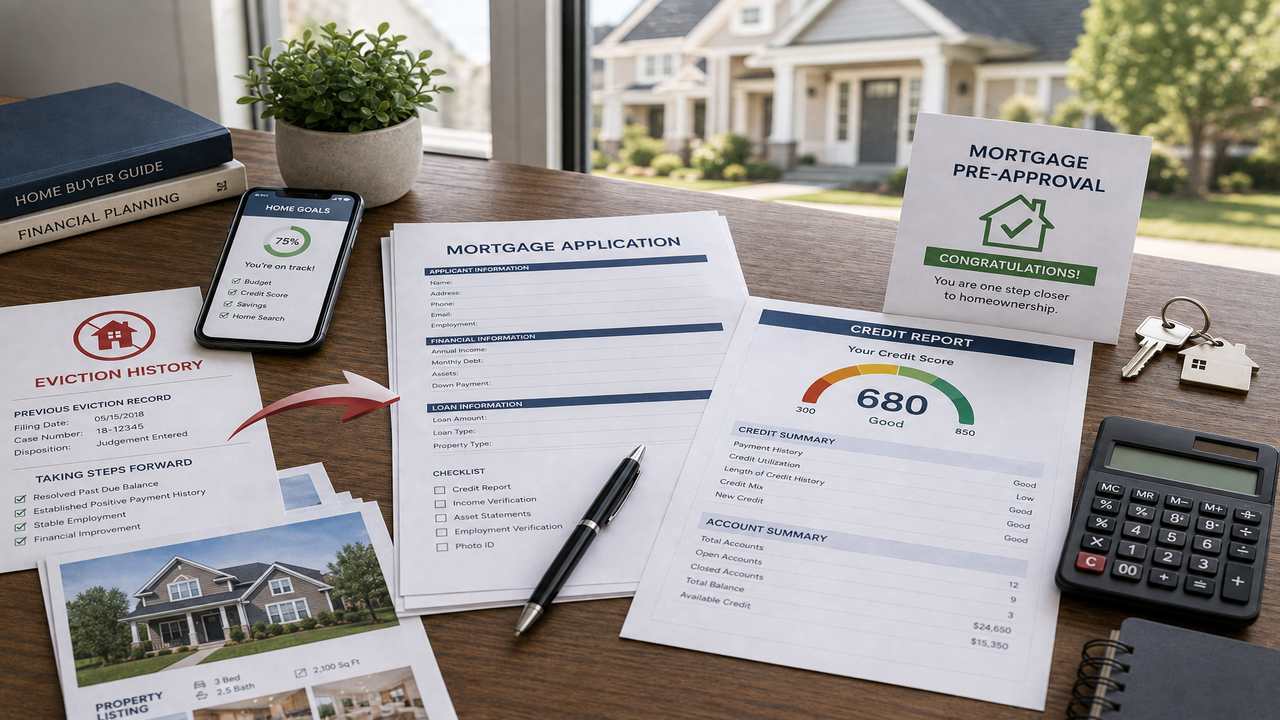
An eviction itself is generally not a direct disqualifier for obtaining a mortgage to buy a house. However, the financial repercussions often associated with an eviction, such as unpaid debt, damaged credit, or gaps in housing history, can significantly impact a homebuyer's ability to qualify for loans like Conventional, FHA, VA, or USDA mortgages. These financial issues are what mortgage underwriters primarily consider, rather than the eviction record itself, making it crucial to address them to improve mortgage eligibility.
This guide walks through how mortgage underwriting actually treats an eviction, what specifically does and doesn’t show up during the process, and the concrete steps to strengthen your position if you’re working toward buying a home after one.
How Does an Eviction Affect Your Credit Report and Mortgage Qualification?
An eviction, as a court proceeding, typically doesn’t appear directly on your credit report the way a bankruptcy or foreclosure does. Mortgage lenders primarily evaluate your credit report, your income, your debt-to-income ratio, and your overall financial documentation — not a search of court eviction filings. This means the eviction case itself, in isolation, often isn’t something a mortgage underwriter would even see through standard underwriting channels.
What typically does show up, and what actually drives most of the mortgage-qualification impact, are the financial consequences that frequently accompany an eviction:
- Unpaid rent or a judgment sent to collections, which would appear on your credit report as a collection account, directly affecting your credit score and potentially your debt-to-income calculations if unresolved.
- A broader pattern of missed payments around the same period, since an eviction often coincides with a period of financial hardship that affected other bills too — a stretch of late credit card payments, a charged-off account, or other collections from the same timeframe.
- A gap or inconsistency in your housing history, which some loan applications specifically ask about (typically your address history for the past two years), and which an underwriter may ask you to explain if there’s an unusual gap or a rapid series of address changes.
- A lower credit score overall, driven by whatever combination of the above, which affects not just whether you qualify but what interest rate and terms you’re offered.
How Mortgage Underwriting Actually Works
To understand where an eviction’s effects can surface, it helps to understand the basic structure of mortgage underwriting. Lenders evaluate four main pillars, often summarized as the “four C’s”: capacity (your income and ability to repay, measured through your debt-to-income ratio), credit (your credit score and credit report history), capital (your savings, down payment, and reserves), and collateral (the value of the home itself relative to the loan amount).
An eviction’s aftermath most directly affects the “credit” pillar, through any resulting collections or score damage, and potentially the “capacity” pillar if outstanding debt from the eviction increases your overall debt burden. It generally doesn’t affect “capital” or “collateral” at all, meaning a strong down payment and a reasonably priced home relative to your income can help offset weaknesses elsewhere in your file.
Different Loan Types Handle This Differently
How Do Conventional Loans Handle Eviction History?
Conventional loans (backed by Fannie Mae or Freddie Mac) generally focus on your credit score, debt-to-income ratio, and overall credit report, without a specific eviction-related question on standard loan applications, though large or unresolved collections can affect qualification as described above.
Do FHA Loans Consider Past Evictions?
FHA loans, backed by the Federal Housing Administration, are generally more flexible on credit history than conventional loans and are often used by first-time buyers or those rebuilding credit. FHA guidelines don’t have an explicit eviction-specific disqualification, but they do require any collections and judgments above certain thresholds to be addressed, and significant derogatory credit history can still affect approval and terms.
How Do VA Loans View Eviction History?
VA loans, available to eligible veterans and service members, are known for relatively flexible underwriting, and similarly don’t have an explicit “no eviction” rule, though unresolved debt and credit issues stemming from a past eviction would still be evaluated as part of the overall credit review.
Are USDA Loans Affected by Past Evictions?
USDA loans, for eligible rural properties, follow a similar pattern — no specific eviction disqualification, but overall creditworthiness still matters.
Across all these loan types, the pattern is consistent: it’s rarely the eviction record itself causing a denial, and almost always the associated debt or credit damage.
Step One: Find Out Exactly What’s on Your Credit Report
Before assuming anything about how an old eviction might affect a mortgage application, pull your free credit reports from all three bureaus and look specifically for any collection accounts, judgments, or charge-offs from around the time of the eviction. This tells you concretely what an underwriter would actually see, rather than leaving you to worry about an unknown.
Step Two: Resolve Any Outstanding Debt From the Eviction
If there’s an unpaid balance connected to the eviction — back rent, court costs, damages awarded to the landlord — resolving it before applying for a mortgage is one of the highest-value things you can do. This matters for a few concrete reasons:
- It removes the debt from your debt-to-income calculation. Even a relatively small ongoing collection balance can factor into how much home you qualify for, depending on the specific loan program’s underwriting rules.
- It can improve your credit score, particularly under newer scoring models that treat paid collections meaningfully better than unpaid ones, potentially moving you into a better interest rate tier.
- It removes a potential red flag an underwriter might otherwise ask you to explain, streamlining the underwriting process and reducing the chance of delays or requests for additional documentation.
If you can’t pay the full amount, negotiating a settlement, and getting it in writing, is generally the next best option, followed by at minimum setting up and maintaining a payment plan if a lump sum isn’t feasible.
Step Three: Address Any Housing History Gaps Proactively
Mortgage applications commonly ask for your address history over the past two years. If your eviction led to an unstable period — moving in with family temporarily, multiple short-term addresses, or a period without a formal lease — be prepared to explain this clearly and honestly if asked. A brief, factual explanation (“I stayed with family for several months after resolving a prior housing situation before securing my current apartment”) is generally sufficient; underwriters are typically looking for a coherent, non-alarming explanation rather than a perfect record.
Step Four: Build Your Overall Financial Profile
Since an eviction’s main effect on mortgage qualification runs through your broader credit and financial picture rather than a direct rule against it, the most effective overall strategy is simply building the strongest financial profile you can in the time before you apply:
- Rebuild your credit score through consistent on-time payments, low utilization, and resolving any other outstanding negative items, giving yourself time (often a year or more) for meaningful improvement to show.
- Save for a larger down payment than the minimum required, which can offset weaker credit in some loan programs’ overall risk assessment, and reduces your loan-to-value ratio, which lenders view favorably.
- Build a strong, positive current rental history, ideally for at least the two years mortgage applications typically ask about, since a landlord reference showing consistent on-time payments during this period is a meaningful counterbalance to an older eviction.
- Keep your overall debt-to-income ratio low by paying down other debts and avoiding new significant debt in the months before applying, since this is one of the most heavily weighted factors in mortgage qualification across every loan type.
What If the Eviction Resulted in a Judgment That’s Still Unresolved?
An unresolved judgment is a more serious situation than a simple unpaid collection, since judgments can sometimes lead to wage garnishment or liens depending on your state’s laws, and some mortgage underwriting guidelines specifically require outstanding judgments to be paid off or satisfactorily resolved (sometimes even paid off at closing from loan proceeds, depending on the specific loan program and lender policy) before a loan can close. If you have an unresolved judgment, addressing it well before you plan to apply — through payment, a negotiated settlement, or, if applicable, a successful legal challenge to the judgment itself — is generally necessary rather than optional for a smooth mortgage approval process.
Does a Landlord Ever Find Out You’re Buying a House Because of Your Eviction History?
This question sometimes comes up out of a fear that seeking a mortgage will somehow “reopen” the eviction case or notify the original landlord. In reality, mortgage underwriting doesn’t involve any kind of court notification process, and your mortgage lender has no reason to and generally cannot contact your former landlord about an old eviction case. The processes are entirely separate — mortgage underwriting evaluates your current financial documentation and credit report, not an independent investigation into your rental history.
Timeline: How Long Before an Old Eviction Stops Mattering for a Mortgage?
There’s no fixed, universal waiting period tied specifically to an eviction for mortgage purposes, unlike bankruptcy or foreclosure, which do have specific mandatory waiting periods under most loan programs (commonly two to seven years, depending on the type of bankruptcy or foreclosure and the loan program). Since an eviction itself generally isn’t a direct underwriting factor, what actually needs to “age out” or be resolved is whatever negative credit history resulted from it — a collection account, once resolved, contributes less negative weight to your file the further in the past it becomes, and it drops off your credit report entirely after seven years from the original delinquency date, regardless of your mortgage application timeline.
In practice, many people who experienced a financially difficult eviction find their credit and overall financial profile strong enough to qualify for a mortgage within two to four years of resolving the underlying debt and consistently rebuilding their credit, though this varies considerably based on individual circumstances, the loan program pursued, and how quickly the resulting negative items were addressed.
Frequently Asked Questions
Will a mortgage lender ask me directly if I’ve ever been evicted?
Standard mortgage applications don’t typically include a direct question specifically asking about past evictions, unlike the specific questions asked about bankruptcy and foreclosure history. The focus is on your current credit report, income, and financial documentation rather than a direct eviction disclosure requirement.
Can an eviction show up in a background check during the mortgage process, separate from my credit report?
Standard mortgage underwriting doesn’t typically include a tenant-screening-style court records search the way a rental application does. It’s focused on credit, income, and asset documentation. An eviction record existing in court databases generally wouldn’t surface through this process unless it directly connects to a credit report entry (like a resulting collection).
Does an eviction affect the interest rate I’d be offered, even if I still qualify for a mortgage?
Indirectly, yes, through its effect on your credit score. A lower credit score, whatever the underlying cause, typically results in a higher offered interest rate across most loan programs, since rate tiers are generally structured around specific credit score ranges.
If I successfully disputed and removed a related collection account, does that fully resolve any mortgage-related concern?
Removing an inaccurately reported collection account does remove that specific negative mark and its associated impact on your score and debt-to-income calculation. If the underlying eviction still shows up in a records search for some other reason (uncommon, but not impossible depending on the specific process), it wouldn’t be affected by a credit report dispute, since that’s a different (public court record) system entirely.
Is it easier to qualify for a mortgage with a spouse or co-borrower if I have a past eviction?
Applying with a co-borrower who has strong, independent credit and income can help offset a weaker individual credit profile, since underwriters evaluate the combined application. This isn’t specific to eviction history particularly, but is a generally available strategy for anyone whose individual credit profile alone might not qualify for the most favorable terms.
A Concrete Example: How an Old Eviction Debt Affects Debt-to-Income Math
Debt-to-income ratio (DTI) is one of the most heavily weighted factors in mortgage underwriting, and it’s worth seeing exactly how an unresolved eviction-related debt can factor into it. Say your gross monthly income is $5,000. Most conventional loan programs look for a total DTI (including the new mortgage payment) below roughly 43-50%, depending on the specific program and other compensating factors.
If you have $200 in existing monthly debt obligations (a car payment and a credit card minimum) and you’re applying for a mortgage with an estimated $1,800 monthly payment, your DTI before considering any eviction-related debt would be ($200 + $1,800) / $5,000 = 40%, likely within range for many loan programs.
Now suppose an unresolved collection account from a past eviction, in a $3,000 balance, is being actively reported to a collection agency. If that collection is required to be included in your DTI calculation (some loan programs require unpaid collections above a certain dollar threshold, commonly $2,000, to either be paid off or included in a calculated minimum monthly payment, depending on the specific loan program’s guidelines and whether the collection is in active collection status), an underwriter might add an estimated monthly obligation for it — even a modest addition of $100-150 in this example could push your total DTI closer to or above 43%, potentially requiring you to pay it off before final loan approval, or affecting the loan amount you qualify for.
This example illustrates why “small” unresolved debt from years ago can still have an outsized effect at the exact moment you’re trying to qualify for something significant — it’s not necessarily the dollar amount itself that matters most, but how underwriting rules treat any unresolved status specifically.
A Sample Letter of Explanation for Mortgage Underwriting
If an underwriter flags a past eviction-related item and requests a letter of explanation (a common, routine part of underwriting for any unusual item on a file, not a sign of impending denial), here’s a template structure that works well:
Re: Letter of Explanation – [Account/Item in Question]

To Whom It May Concern:

I am writing to provide context regarding [the collection account / the address history gap] noted on my credit report and application, dated [approximate timeframe].

This resulted from [brief, factual explanation — e.g., “a period of job loss that led to a temporary inability to maintain my prior lease, resulting in an eviction filing and associated unpaid rent balance”]. I have since [resolved the balance in full on DATE / entered into a settlement agreement paid in full on DATE], and I have maintained consistent, on-time payments on all my current obligations since that time, as reflected in my credit history over the past [X months/years].

I’m happy to provide any additional documentation that would support this explanation.

Sincerely,
[Your Name]
Attach any supporting documentation you have — proof of payment or settlement, for instance — directly with this letter, since underwriters generally prefer a written explanation paired with concrete evidence over an explanation alone.
What an Underwriter Is Actually Trying to Determine
It helps to understand the underwriter’s actual goal when they flag something like this: they aren’t making a moral judgment about what happened in your past. They’re specifically trying to determine two things — whether the item represents an ongoing, unresolved financial risk (an open collection that could still grow, a pattern of instability that might recur), and whether your current financial picture demonstrates the stability needed to reliably make mortgage payments for the next 15 to 30 years. A well-documented, clearly resolved past incident, paired with a stable and consistent recent financial track record, generally satisfies both of these underwriting concerns even when the past incident itself was genuinely serious.
The Role of Overlays: Why Two Lenders Can Treat the Same File Differently
An important and often overlooked detail: individual lenders can apply their own additional underwriting requirements, called “overlays,” on top of the baseline guidelines set by Fannie Mae, Freddie Mac, FHA, VA, or USDA. This means one lender might have a stricter internal policy about unresolved collections or recent housing instability than another lender working with the exact same baseline loan program guidelines. If you’re denied or discouraged by one lender, particularly a large bank with more conservative overlays, it’s often worth consulting with a mortgage broker or a different lender — such as a credit union or a lender specializing in FHA loans for buyers rebuilding credit — since their specific underwriting overlays might be considerably more accommodating for your particular situation.
Building Toward Pre-Approval With an Eviction in Your Past
Before formally applying, getting pre-qualified or pre-approved with a few different lenders (each generating only a soft or limited inquiry in early conversations, though a full pre-approval typically does involve a hard inquiry) lets you understand where you stand and address any concerns before you’re deep into a home search and under time pressure from a purchase contract. Many mortgage brokers and loan officers, especially those experienced with FHA loans or first-time and credit-rebuilding buyers, are accustomed to discussing past financial difficulties candidly and can tell you early on what specifically, if anything, still needs to be resolved before you’d be in a strong position to apply formally.
Frequently Asked Questions, Continued
Does the type of eviction (nonpayment vs. lease violation) matter for mortgage purposes?
Since mortgage underwriting generally isn’t evaluating the eviction case itself, the underlying reason for the eviction matters less than its financial aftermath. A nonpayment eviction is somewhat more likely to have left an unpaid debt behind (which does matter for underwriting), while a lease-violation eviction without an associated financial balance might leave less of a lasting credit-report footprint.
If I’m self-employed, does an old eviction weigh more heavily given other income documentation requirements?
Self-employed borrowers already face more extensive income documentation requirements regardless of eviction history, and an old, resolved eviction with a clean recent record generally doesn’t add meaningfully to that separate documentation burden, though it’s one more factor an underwriter reviewing a more complex file might ask about.
Can I get pre-approved before fully resolving an old eviction-related debt?
It depends on the amount and status of the debt and the specific loan program’s guidelines. Small, resolved, or older debts are less likely to be an issue; larger, active, unresolved collections or judgments are more likely to require resolution before final approval, even if initial pre-qualification conversations proceed without addressing it immediately.
Does refinancing later remove any lingering effects of a past eviction on my mortgage terms?
If your credit and financial profile have improved by the time you refinance, you’d generally qualify for whatever current rates and terms your improved profile supports, independent of your original mortgage’s terms. A past eviction, once resolved and aged, would carry less weight the further removed you are from it and the stronger your subsequent financial track record.
A Broader Perspective: Millions of Homeowners Have Overcome Similar Setbacks
It’s worth stepping back from the underwriting mechanics for a moment to note something reassuring: financial setbacks, including evictions, job loss, and periods of significant debt, are extremely common life experiences, and mortgage lending as an industry is fundamentally built around evaluating current, forward-looking creditworthiness rather than permanently penalizing past difficulty. The entire structure of credit reporting — with its defined seven-year windows, its more forgiving treatment of paid versus unpaid negative items, and its heavy weighting toward recent behavior — reflects an underlying philosophy that people’s financial situations change, often for the better, and that a past hardship shouldn’t permanently define someone’s access to credit and homeownership. Millions of current homeowners have a past eviction, bankruptcy, or period of serious financial difficulty somewhere in their history; what distinguishes those who go on to qualify for a mortgage is primarily the deliberate rebuilding work described throughout this guide, not some rare exception to how the system usually works.
Frequently Asked Questions, Continued Further
Should I disclose an old eviction proactively to my loan officer even if not directly asked?
If it resulted in any collection, judgment, or credit report item, your loan officer will likely see it during the credit pull regardless, so proactively mentioning it and providing context upfront is generally viewed more favorably than having it come up cold during underwriting, since it demonstrates transparency and gives you the chance to frame the explanation on your own terms.
Does a rental payment history service that reports positive rent payments help offset an old eviction for mortgage purposes?
Yes, in a meaningful way — some mortgage programs, including certain Fannie Mae underwriting paths, now allow or even proactively look for reported positive rental payment history as a supplementary credit factor, particularly useful for buyers with thinner traditional credit files. Building this kind of positive, recent rental history is a direct, concrete counterbalance to an older negative rental event.
How does a co-signed lease eviction (where I wasn’t the primary tenant) affect my own mortgage application?
If your name appeared on the lease and the eviction case, it can affect your individual credit and record regardless of whether you were the “primary” tenant in practice. Whether it created a debt attributable specifically to you depends on how any judgment or collection was structured; this is worth clarifying directly by pulling your own credit report and understanding exactly what, if anything, is attached to your name specifically.
Key Takeaways: Eviction's Impact on Mortgage Qualification
An eviction itself is rarely a direct dealbreaker for mortgage qualification, since most underwriting processes don’t specifically search for or ask about eviction history. What matters far more is the financial aftermath — any unpaid debt, credit score damage, or housing history gaps that resulted from it. Resolving outstanding balances, rebuilding your credit through consistent on-time payments, saving a solid down payment, and building a strong recent rental history are the concrete, controllable steps that determine whether and how favorably you’ll qualify, regardless of what happened in the past.
Get a Credit Audit
If you’re preparing to buy a home after an eviction and want to review your credit reports for collections, judgments, or other negative information that may affect mortgage qualification, you can request a credit audit or quote.