
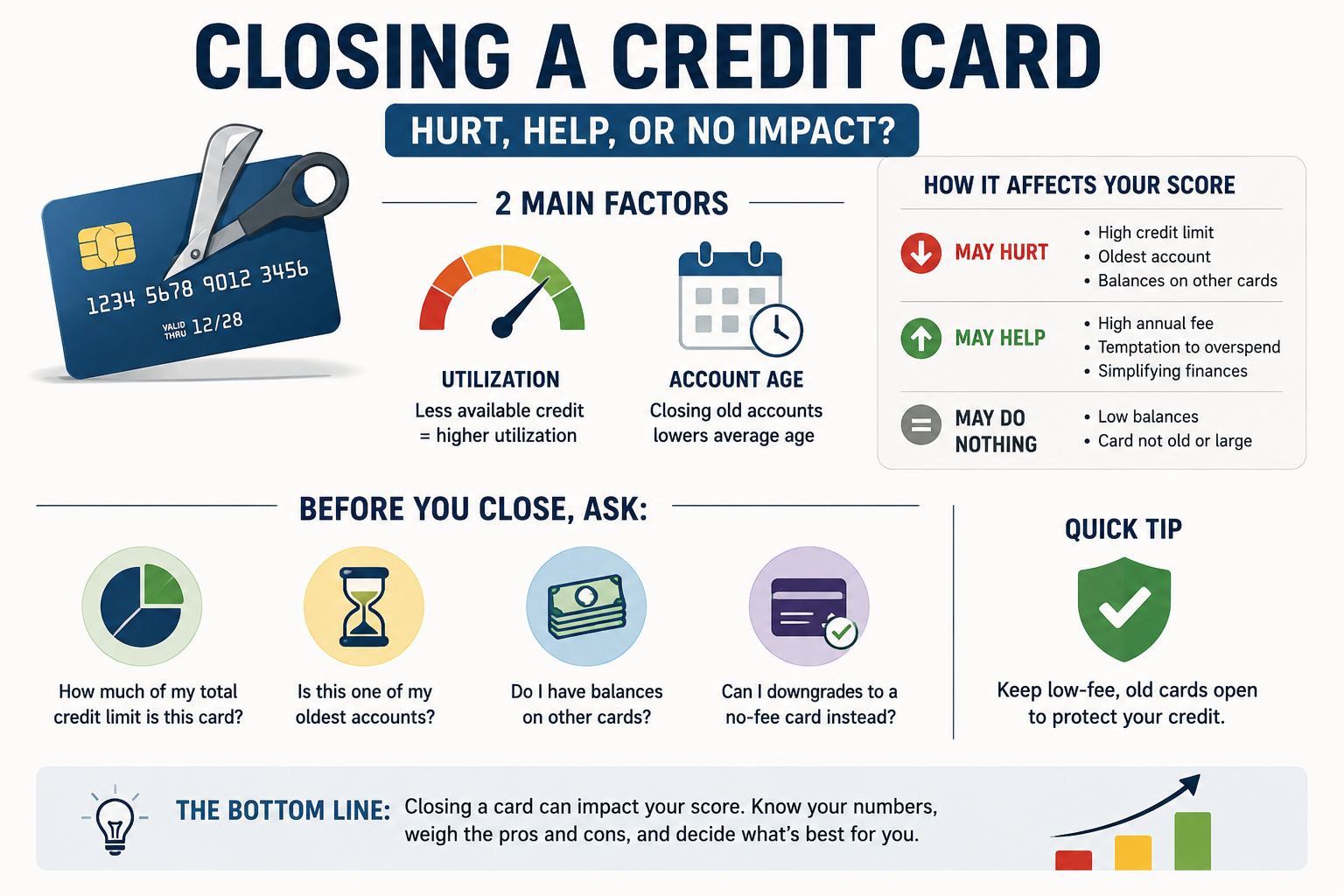
This is one of the more nuanced questions in credit scoring, because the honest answer is “it depends,” and the factors it depends on aren’t always intuitive. Closing a card can hurt your score, help it, or do essentially nothing, depending on your specific credit profile at the time. Here’s how to actually think through the decision for your situation.
Closing a credit card can negatively impact a credit score by reducing total available credit, which often increases the credit utilization ratio if balances are carried on other cards. For instance, if total available credit drops from $15,000 to $10,000 while balances remain at $3,000, utilization increases from 20% to 30%. Additionally, closing an older credit card can gradually lower the average age of accounts, although closed accounts typically continue to factor into the average for about 10 years. Credit-repair.com suggests that keeping unused credit cards open, particularly those without annual fees, helps maintain lower utilization and preserve credit history.
The Two Main Mechanisms at Play
Closing a credit card can affect your score through two primary channels:
1. **Credit utilization** — closing a card reduces your total available credit, which, if you carry balances on other cards, can increase your overall utilization ratio even if your spending hasn’t changed at all.
2. **Average account age** — closing your oldest card can eventually reduce your average account age, since closed accounts (after a period of time) either stop being factored in, or are weighted differently than open accounts, depending on the specific scoring model.
Understanding which of these applies most to your situation determines how much closing a specific card will actually matter.
Why Utilization Is Usually the Bigger Immediate Factor
Here’s a concrete example: say you have three cards with a combined $15,000 in available credit, and you’re carrying a combined $3,000 in balances — a 20% overall utilization ratio, generally considered healthy. If you close a card with a $5,000 limit (even if that specific card has a zero balance), your available credit drops to $10,000, and your same $3,000 in balances now represents 30% utilization — a real, measurable increase, purely from closing an unused card.
This is why financial advice commonly recommends **not closing unused cards**, especially ones with no annual fee — keeping them open, even unused, preserves your available credit and keeps utilization lower than it would be otherwise.
When Closing a Card Doesn’t Meaningfully Affect Utilization
If you have very low balances relative to your total available credit across all your cards, closing one card — even a decent-sized one — may not push your utilization into a meaningfully different range. If your utilization was already comfortably low (say, under 10%) and remains comfortably low after closing a card, the utilization impact may be negligible.
Why Account Age Matters, But More Gradually
Closed accounts in good standing generally continue to count toward your average account age for a period of time (this varies by scoring model, but often around 10 years for positive-history closed accounts), which means closing a card doesn’t erase its age contribution immediately. The effect, if any, tends to show up more gradually, and mainly matters if:
– The card you’re closing is one of your **oldest** accounts, and
– You don’t have other equally old accounts to offset the eventual loss of that account’s age contribution once it does stop being counted.
If you’re closing a relatively new card, or you have several other well-aged accounts, the account age impact is typically minimal.
Scenarios Where Closing a Card Actively Helps
Yes, this happens too, and it’s worth understanding:
– **If a card has a high annual fee you no longer find worthwhile**, and you have other cards to preserve your overall available credit and account age, closing it is a purely financial decision that likely has minimal credit impact, especially if it’s not your oldest or largest-limit card.
– **If keeping a card open creates a real risk of overspending or missed payments** (a genuine, practical concern for some people), the modest potential utilization impact of closing it may be worth accepting in exchange for reduced temptation or account management complexity.
– **If you’re actively trying to simplify your finances** and the marginal utilization/age impact of closing a specific card is small given your overall profile.
Scenarios Where Closing a Card Is More Likely to Hurt
– **Closing your card with the highest credit limit**, since this has the largest proportional impact on your total available credit and therefore your utilization ratio.
– **Closing your oldest account**, especially if you don’t have other long-standing accounts to maintain your average account age.
– **Closing a card while carrying balances on other cards**, which directly and immediately worsens your utilization ratio.
– **Closing multiple cards in a short period**, compounding both the utilization and account age effects simultaneously.
What About Closing a Card With an Annual Fee You No Longer Want to Pay?
This is one of the most common real-world reasons for wanting to close a card, and it’s worth approaching thoughtfully:
1. **Check if the issuer offers a downgrade to a no-annual-fee version of the same card**, which preserves the account (and its age/history) while eliminating the fee — often a better option than closing outright, if available.
2. **If no downgrade option exists and you’re set on closing it**, consider the utilization and age impact using the framework above before proceeding.
3. **If you do close it, consider paying down balances on other cards first**, so the credit line reduction doesn’t collide with high balances elsewhere to spike your utilization.
Does It Matter Who Closes the Account — You or the Issuer?
The credit impact is generally similar regardless of who initiates the closure, though there’s an important distinction in how it’s *labeled* on your report: an account closed by you (“closed by consumer”) generally reads more favorably to anyone reviewing your report manually than one closed by the issuer, which can sometimes indicate the issuer initiated the closure due to inactivity or risk factors on their end. If you’re going to close a card anyway, doing so proactively (rather than letting an issuer close it for inactivity) is generally the better-looking outcome, even though the underlying score mechanics are similar.
A Practical Framework Before Closing Any Card
Before closing a credit card, ask:
1. **What percentage of my total available credit does this card represent?** A higher percentage means a bigger utilization impact if closed.
2. **Is this one of my oldest accounts?** If so, factor in the eventual account age impact, even though it’s typically more gradual than the utilization effect.
3. **Do I currently carry balances on other cards?** If yes, closing any card will worsen your utilization more than if all your other cards are at zero or low balances.
4. **Is there a fee-free alternative (downgrade) available** that preserves the account without the cost you’re trying to avoid?
The Bottom Line
Closing a credit card can hurt your score, mainly through reduced available credit worsening your utilization ratio, and more gradually through reduced average account age if it’s one of your older accounts — but the actual impact varies significantly based on your specific credit profile, particularly how much of your total available credit that card represents and whether you carry balances elsewhere. For cards with no ongoing cost, keeping them open (even unused) is usually the lower-risk default; for cards with a fee you want to eliminate, check for a downgrade option first, and if closing is still the right call, do it with an understanding of the utilization and age tradeoffs involved rather than assuming it’s automatically either harmless or harmful.