
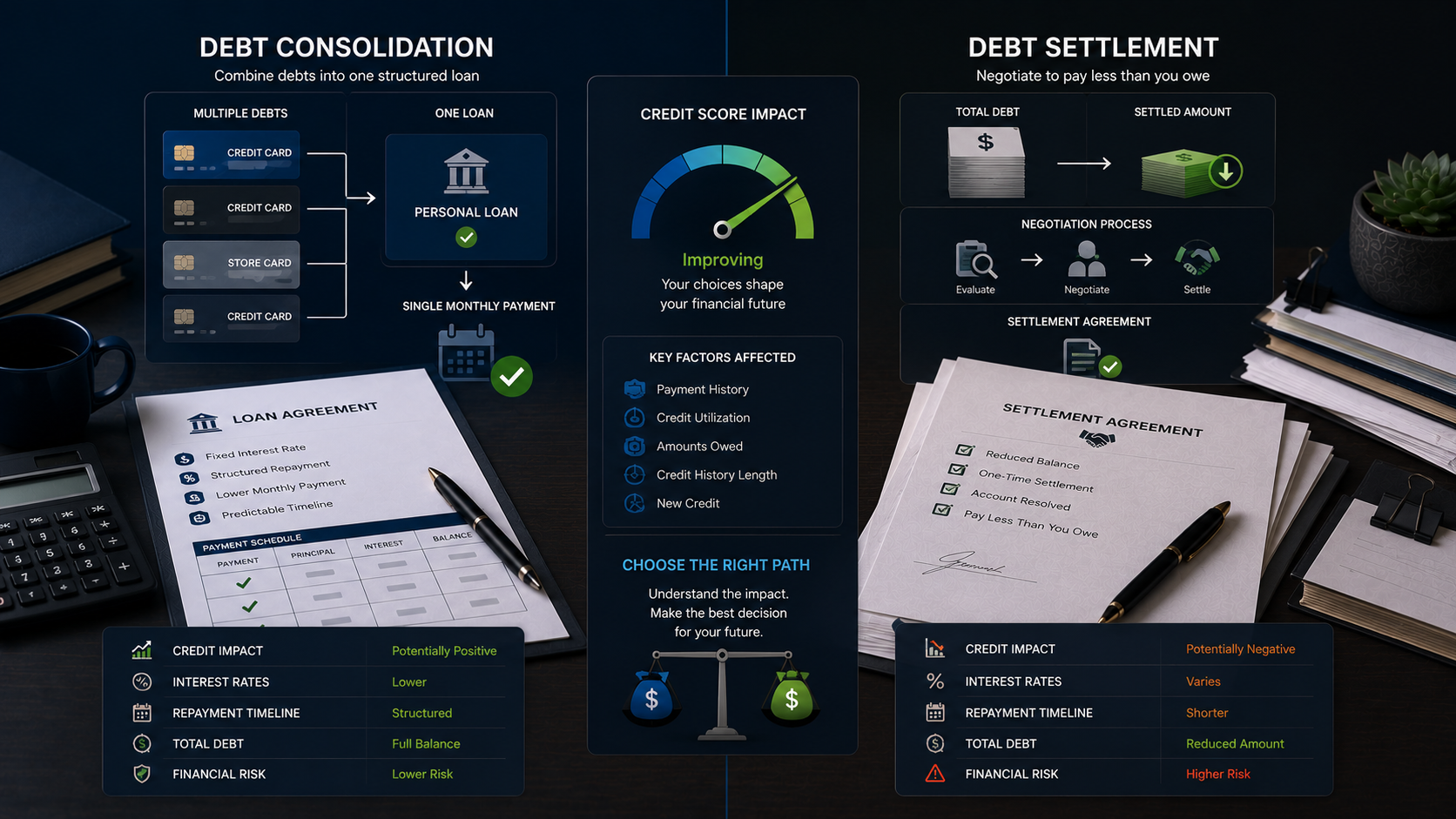
Debt consolidation combines multiple debts into a single loan, often with a lower interest rate, aiming to simplify payments and potentially improve credit over time. In contrast, debt settlement involves negotiating to pay a reduced amount on outstanding debts, which can eliminate debt faster but typically results in a significant credit score drop and remains on a credit report for seven years. The better option depends on an individual's financial stability and goals, with consolidation suited for managing debt and settlement for severe financial hardship.
Debt consolidation combines multiple debts into one new loan or balance transfer, ideally at a lower interest rate, so you make a single monthly payment and pay off what you owe in full. Done right, it can help your credit over time.
Debt settlement negotiates with your creditors to accept less than the full amount you owe — usually after you’ve stopped paying them. It can slash your total debt, but it does serious, long-lasting damage to your credit.
Neither one is a magic eraser. Both have trade-offs, costs, and risks that the late-night commercials don’t always mention. And the “right” choice depends less on which one sounds better and more on your actual financial situation: your income, your credit standing, your hardship, and your goals.
This guide walks you through both options in plain language — how they work, what they do to your credit, what they cost, what the IRS has to do with any of it, and how to tell which one fits your life. We’ll be honest about the downsides, because the last thing you need is another promise that sounds too good to be true.
What Is Debt Consolidation?
<a name=“what-is-debt-consolidation”></a>
Debt consolidation is the process of taking out a single new loan — or opening a new credit card with a balance transfer offer — and using it to pay off multiple existing debts at once. Instead of juggling five minimum payments to five different creditors at five different interest rates, you end up with one monthly payment, one due date, and (ideally) one lower interest rate.
The key word is ideally. Consolidation doesn’t reduce what you owe — you still pay back the full principal. What it changes is the structure of your debt: fewer moving parts, a single rate, and a defined payoff timeline.
The Main Forms of Consolidation
There are several ways to consolidate, and they work differently:
- Personal consolidation loan. An unsecured installment loan from a bank, credit union, or online lender. You receive a lump sum, use it to pay off your existing balances, and then repay the loan in fixed monthly installments over a set term (typically 2–7 years). Interest rates vary widely based on your credit — anywhere from around 6% for strong credit to 30%+ for weaker credit profiles.
- Balance transfer credit card. A new card that offers a low or 0% promotional APR for a set period (often 12–21 months). You transfer existing credit card balances onto it and use the interest-free window to pay down principal. Once the promo period ends, the regular APR kicks in — which can be high.
- Home equity loan or HELOC. If you own a home with equity, you can borrow against it to pay off unsecured debts. These typically offer lower rates because the loan is secured by your house — which means if you can’t repay, you’re putting your home at risk.
- 401(k) loan. Some employer retirement plans let you borrow from your own account. There’s no credit check, and you pay interest back to yourself — but if you leave your job, the loan may come due quickly, and unpaid balances can become taxable withdrawals with penalties.
- Debt management plan (DMP). Offered through nonprofit credit counseling agencies, a DMP isn’t technically a loan. The agency negotiates lower rates and fees with your creditors, you make one monthly payment to the agency, and they distribute it to your creditors. It usually takes 3–5 years to complete and often requires you to close your credit card accounts.
What Consolidation Does Not Do
It’s important to be clear about what consolidation doesn’t accomplish:
- It does not reduce the principal you owe. You still pay back every dollar.
- It does not erase negative marks already on your credit report from late payments or defaults.
- It does not fix the spending habits that got you into debt in the fIRSt place. If you consolidate and then run your old cards back up, you’ll end up worse off than before — with the consolidation loan and new balances.
Consolidation is a tool for reorganizing debt into a more manageable, less expensive structure. It works best for people who have a steady income, can qualify for a lower rate than what they’re currently paying, and are committed to not adding new debt while they pay the old debt down.
How Debt Consolidation Affects Your Credit
<a name=“how-debt-consolidation-affects-your-credit”></a>
Here’s where a lot of people get confused — and understandably so. Consolidation affects your credit in both positive and negative ways, sometimes simultaneously. The net effect depends on how you manage the new loan and your existing accounts.
The Short-Term Impact (Slight Dip)
When you apply for a consolidation loan or balance transfer card, the lender pulls your credit report. That’s a hard inquiry, which typically causes a small, temporary dip in your score — usually fewer than 5 points, and it fades over 12 months (dropping off your report entirely after 24 months).
Opening a new account also lowers the average age of your accounts, which is a factor in your credit score. If your credit history is short, this can have a modest negative effect. If you have a long, established history, the impact is minimal.
So yes, in the fIRSt few weeks after consolidating, your score might tick down slightly. That’s normal and expected.
The Medium-Term Impact (Potential for Real Improvement)
Here’s the good news — and it’s genuinely good if you play it right. After consolidation, several things can start working in your favor:
- Credit utilization drops. If you take out a personal loan to pay off credit cards, those card balances go to zero. Credit utilization — the percentage of your available credit you’re using — is one of the biggest factors in your score, and dropping it from, say, 85% to under 10% can produce a meaningful score increase. (Note: this only holds if you keep the card balances low. Running them back up erases the gain.)
- Payment history improves. A single, manageable monthly payment is easier to make on time than five scattered ones. Payment history is the single most important factor in your credit score, and consistent on-time payments on your consolidation loan build it steadily.
- Credit mix diversifies. If your report was all revolving credit (cards) and you add an installment loan, that mix can help slightly — scoring models like to see that you can handle different types of credit responsibly.
The Long-Term Impact (Depends Entirely on You)
Over the full life of the consolidation loan — whether it’s a 3-year personal loan or a 36-month DMP — the effect on your credit is almost entirely a function of your behavior:
- Pay on time every month, keep old card balances near zero, and don’t apply for unnecessary new credit → your score generally improves, sometimes substantially.
- Miss payments on the consolidation loan, let old card balances creep back up, or take on new debt → your score drops, and you’re in a worse position than before you consolidated.
A consolidation loan is a piece of equipment. It doesn’t fix your credit on its own — but in the hands of someone committed to paying on time and not re-accumulating debt, it’s one of the more credit-friendly debt relief options available.
One Caution: Closing Old Accounts
After paying off cards with a consolidation loan, many people want to close those accounts to remove temptation. It’s a reasonable impulse — but be aware that closing old cards can lower your score in two ways: it reduces your total available credit (which can raise your utilization ratio if you carry any balances), and it shortens your average account age. In most cases, it’s better for your credit to keep the accounts open, use them sparingly for small recurring charges, and pay them in full each month. That said, if leaving them open creates a real risk of running up debt again, closing them may be the wiser personal choice — the credit score hit is recoverable, and financial stability matters more than a number.
What Is Debt Settlement?
<a name=“what-is-debt-settlement”></a>
Debt settlement is fundamentally different from consolidation. Instead of paying back everything you owe under new terms, you negotiate with your creditors to accept a lump-sum payment that is less than the full balance — and in exchange, they consider the debt “settled” and close the account.
A creditor might accept 40–60% of what you owe, for example, and forgive the rest. That sounds appealing on the surface, and it can be the right move in genuine hardship situations — but the process is harder, slower, and more damaging to your credit than most people realize.
How the Process Usually Works
Here’s what typically happens in a debt settlement process:
- You stop paying your creditors. This is the part the commercials gloss over. Most creditors won’t negotiate a reduced payoff while you’re current on your payments — there’s no incentive for them to accept less than you owe if you’re paying as agreed. So settlement, whether you do it yourself or through a company, usually requires you to stop making payments and let accounts go delinquent.
- You save up money instead. Instead of paying creditors, you set money aside — often into a dedicated savings or escrow account — to build a lump sum you can eventually offer as a settlement. This phase can take many months to several years.
- Your accounts go delinquent, then into default. As months pass without payment, your accounts are reported as 30, 60, 90, 120+ days late. Eventually, the creditor may charge off the debt — declaring it unlikely to be collected and writing it off their books. (A charge-off does not mean the debt is gone. You still owe it, and it remains on your credit report.)
- Negotiation begins. Once the debt is seriously delinquent or charged off — or sometimes once it’s been handed to a collections agency — you (or the settlement company) approach the creditor with a lump-sum offer. If they accept, you pay the agreed amount and the account is marked as “settled” or “settled for less than the full balance.”
- The remaining balance is “forgiven.” The difference between what you owed and what you paid is considered forgiven — which, as we’ll cover, can create a tax obligation.
What Settlement Does Not Do
- It does not happen while you’re current on payments. You have to fall behind to create the leverage that makes settlement possible.
- It does not guarantee a specific result. Creditors are not obligated to negotiate, and some may refuse entirely or sue you instead.
- It does not remove the negative marks from your credit report. The late payments, charge-off, and “settled” notation stay on your report for up to seven years.
- It does not stop interest and fees from accruing while you’re not paying. Your balances can actually grow during the months or years you’re building your settlement fund.
Who Typically Pursues Settlement
Debt settlement is generally considered an option of last resort before bankruptcy. It’s most appropriate for people who:
- Cannot afford their monthly payments at all
- Have already fallen significantly behind
- Are facing accounts going to collections or lawsuits
- Have a lump sum (or can build one) to offer creditors
- Are genuinely considering bankruptcy as the alternative
If you’re still current on payments and your main concern is high interest rates or the inconvenience of multiple payments, settlement is almost certainly the wrong path — consolidation is what you’re looking for.
How Debt Settlement Affects Your Credit
<a name=“how-debt-settlement-affects-your-credit”></a>
This is where settlement and consolidation diverge most sharply. While consolidation can help your credit over time, settlement does significant, lasting damage — and that damage starts before any settlement is actually reached.
The Credit Score Drop
Let’s be direct: debt settlement typically causes a substantial drop in your credit score. The exact number depends on where your score started and how many accounts are involved, but it’s not unusual to see scores fall by 100 points or more — sometimes much more if you started with good credit.
Here’s why the drop happens and why it’s so severe:
- Late payments pile up. Every month you don’t pay, a new late-payment mark is added to your report. Payment history is 35% of your FICO score — the single largest factor — and a string of 90- or 120-day lates is devastating.
- Accounts are charged off. A charge-off is one of the most serious negative items on a credit report. It signals to future lenders that you failed to repay a debt as agreed.
- Accounts go to collections. Charged-off debts are often sold to collection agencies, which creates additional negative entries and can lead to collection accounts appearing on your report.
- The “settled” notation. Even after a settlement is reached, the account is not marked “paid in full.” It’s marked “settled” or “settled for less than the full balance.” Future lenders viewing your report see this and understand that you did not repay the full amount you owed. It remains a negative mark.
The Seven-Year Reporting Window
Under the Fair Credit Reporting Act (FCRA), most negative information — including late payments, charge-offs, and settled accounts — can remain on your credit report for up to seven years from the date of the original delinquency. That’s a long time. During that window, the negative items affect your ability to qualify for new credit, the interest rates you’re offered, and sometimes your ability to rent housing, get certain jobs, or obtain insurance at favorable rates.
The impact lessens over time — a charge-off from four years ago hurts less than one from four months ago — but the marks are present and visible for the full seven-year period.
What Settlement Does Not Mean for Your Report
A common misconception is that once you settle, the negative history disappears. It does not. Settling the debt changes the account status from “unpaid” or “charged off” to “settled,” but the history of late payments and the charge-off remain. The account is updated, not erased.
Some settlement companies advertise that they’ll “remove negative items” as part of the process. Be very cautious with this claim. Accurate, verifiable negative information that is within its reporting window generally cannot be removed simply because the debt was settled — and a company that promises otherwise may be setting you up for disappointment or steering you toward disputing accurate information, which is a different (and often futile) process.
Can You Rebuild After Settlement?
Yes — and this is important to emphasize. A settled account is better for your credit than an unsettled charged-off account that’s still outstanding. Settling stops the bleeding: no more late payments accumulate, the balance is resolved, and the clock on the seven-year reporting window starts counting down from the original delinquency.
From that point forward, the path to rebuilding is the same as after any major credit event:
- Make every remaining payment on time, every time.
- Keep any remaining credit accounts in good standing.
- Keep utilization low on any open cards.
- Consider a secured credit card or credit-builder loan to establish new positive history.
- Be patient. The negative items age out, and new positive history gradually outweighs them.
Settlement is a serious hit, but it is not permanent — and for some people in genuine hardship, the hit is worth it to resolve debts they truly cannot pay and get a fresh start.
Debt Settlement vs. Consolidation: Side-by-Side Comparison
<a name=“side-by-side-comparison”></a>
Here’s a detailed comparison so you can see how the two options stack up across the dimensions that matter most.
| Dimension | Debt Consolidation | Debt Settlement |
|---|---|---|
| What it does | Combines multiple debts into one new loan or transfer; you repay the full amount owed under new terms | Negotiates with creditors to accept a lump sum that is less than the full amount owed; the rest is forgiven |
| Effect on total debt | No reduction in principal — you still owe the full amount | Reduces total debt — you pay back a fraction of what you owe |
| Credit impact (short term) | Small, temporary dip from hard inquiry and new account | Severe — late payments begin immediately as you stop paying creditors |
| Credit impact (long term) | Generally positive if you pay on time and keep utilization low | Significant negative marks for up to 7 years; “settled” notation remains |
| Timeline to complete | Typically 2–7 years (loan term or DMP length) | Typically 2–4 years to negotiate and fund settlements, plus up to 7 years of reporting impact |
| Monthly payment | One fixed payment to the new lender or DMP agency | Money set aside into a savings/escrow account instead of paying creditors; no set payment to creditors during the process |
| Interest | Ideally lower than what you were paying; fixed on personal loans | Interest and fees continue accruing on unpaid debts until settlement is reached — balances can grow |
| Upfront cost | Possibly origination fees or balance transfer fees (usually 3–5%); no upfront cost for DMPs | Settlement companies typically charge 15–25% of enrolled debt, often built into your monthly program payment |
| Tax implications | None — no debt is forgiven | Forgiven debt over $600 may be reported as taxable income via Form 1099-C |
| Creditor relations | Creditors are paid in full; accounts closed in good standing or kept open | Creditors receive partial payment; accounts marked “settled,” relationship often severed; some may sue during the process |
| Risk of lawsuits | Low — you’re paying as agreed | Moderate to high — creditors may sue during the months you’re not paying and before settlement is reached |
| Who it’s for | People with steady income, decent credit, and ability to qualify for a lower rate | People in genuine hardship who cannot afford payments and are considering bankruptcy |
| Do you need to be behind? | No — you typically need to be current to qualify | Usually yes — creditors rarely negotiate while you’re current |
| Effect on future credit access | Minimal — a consolidation loan is a standard credit product | Significant — “settled” status and charge-offs make new credit harder and more expensive to obtain for years |
When Debt Consolidation Is the Better Choice
<a name=“when-consolidation-is-better”></a>
Consolidation tends to be the better path when you have the means to repay your debts in full and the main problem is structure — high rates, scattered payments, or a payoff timeline that feels endlessly out of reach. Here are the signs that consolidation is likely the right fit:
Why is a Steady Income Important for Debt Consolidation?
Consolidation doesn’t reduce what you owe — it reorganizes it. That means you need a reliable income stream to make the new single payment month after month for the full term. If your income is stable and you can comfortably afford a consolidated payment (even if it’s tighter than you’d like), consolidation lets you trade chaos for a clear finish line.
Does Your Credit Qualify You for a Better Consolidation Rate?
The whole point of consolidation is to lower your cost of borrowing. If your credit score qualifies you for a personal loan or balance transfer card at a significantly lower APR than what you’re currently paying, consolidation makes mathematical sense. If your credit has already deteriorated to the point where the only loans you qualify for carry rates as high as — or higher than — your current cards, consolidation may not save you money, and you should think carefully before adding a new high-rate loan on top of existing debt.
How Does Debt Consolidation Preserve and Build Your Credit?
If protecting your credit score is a priority — because you plan to buy a home, refinance, finance a car, or simply maintain financial flexibility — consolidation is the far more credit-friendly option. A consolidation loan is a standard, respectable credit product. On-time payments build your history. Utilization drops when card balances are paid off. There are no charge-offs, no “settled” notations, no seven-year negative reporting window. For most people who have a choice, this matters enormously.
Why is Being Current on Payments Important for Debt Consolidation?
Consolidation works best as a proactive move — you see the problem coming and reorganize before things spiral. If you’re still current or only slightly behind, you can likely qualify for decent rates and prevent the cascade of late payments and charge-offs that settlement requires.
Why is Commitment to Not Accumulating New Debt Crucial for Consolidation?
This is the make-or-break factor. Consolidation succeeds when you pay off the old debt and don’t replace it. It fails when you consolidate, then gradually run the old cards back up — leaving you with the consolidation loan plus new balances, which is a deeper hole than where you started. If you’re ready to change the spending patterns that created the debt, consolidation gives you a clean, structured runway to become debt-free.
Should You Leverage Home Equity for Debt Consolidation?
If you own a home with equity, a home equity loan or HELOC can offer substantially lower rates than unsecured consolidation loans — potentially saving you thousands in interest. But this comes with a serious caveat: you’re converting unsecured debt into debt secured by your home. If you can’t repay, you risk foreclosure. This option is appropriate only for disciplined borrowers who are certain they can make the payments and who treat the home equity loan as a tool to eliminate debt, not a license to take on more.
When Debt Settlement Is the Better Choice
<a name=“when-settlement-is-better”></a>
Settlement is not a “deal” or a shortcut. It’s a hardship remedy — the right option when the math of repaying your debts in full simply doesn’t work and the alternatives are worse. Here’s when settlement may be the more appropriate path:
Why is Genuine Financial Hardship a Factor for Debt Settlement?
Settlement exists for situations where repayment in full is not realistically possible: a job loss, a medical crisis, a divorce, a business failure, or a combination of setbacks that has made your debt load genuinely unaffordable. If you’ve cut expenses to the bone and still can’t cover minimum payments — or can only cover them by taking on new debt — you’re in the territory where settlement is worth considering.
Why is Being Significantly Behind on Payments a Factor for Debt Settlement?
If your accounts are already 90+ days delinquent, in collections, or charged off, the credit damage of settlement has largely already occurred. In that situation, the question is no longer “how do I protect my credit?” — it’s “how do I resolve these debts and stop the bleeding?” Settlement can close out accounts that are already in default and prevent judgments, wage garnishment, or further legal action.
You Can’t Afford Monthly Payments Even After Consolidation
Sometimes people look into consolidation, run the numbers, and realize that even with a lower rate and a single payment, they still can’t afford it. If a consolidated payment would still consume more than you can sustainably pay each month, consolidation is just delaying the inevitable. Settlement — by reducing the principal — may be the only option that brings the required payment within reach.
Is Debt Settlement an Option if You're Considering Bankruptcy?
Settlement is often described as a “step before bankruptcy” — and that’s an accurate framing. If you’re seriously weighing bankruptcy because you see no other way out, settlement is worth exploring fIRSt. It can resolve debts for less than full balance without the long-term legal and credit consequences of a bankruptcy filing, which stays on your report for 7–10 years and has broader financial implications.
That said, if your debts are truly unmanageable, your income is too low to fund settlements, and you have no assets to protect, Chapter 7 bankruptcy may actually be a faster, more complete remedy — and it’s worth consulting a bankruptcy attorney to compare. Don’t assume settlement is always better than bankruptcy; in some situations, bankruptcy is the cleaner, quicker reset.
Why is a Lump Sum Important for Debt Settlement?
Settlement usually requires a lump-sum offer — or at minimum, the ability to make a few large payments over a short period. If you’ve received a tax refund, an inheritance, an insurance settlement, a bonus, or the sale of an asset, and you can direct that money toward resolving delinquent debts, settlement becomes feasible. Without a lump sum, you’re relying on months of savings while your accounts deteriorate further — a slower, riskier path.
Why Must You Understand and Accept Debt Settlement's Credit Consequences?
This is non-negotiable. If you choose settlement, you must go in with eyes open: your credit score will drop significantly, negative marks will remain for up to seven years, and new credit will be harder and more expensive to obtain during that period. If you’ve accepted that reality and decided that resolving unaffordable debt is worth the credit hit — because the alternative is ongoing default, lawsuits, or bankruptcy — then settlement may be the pragmatic choice.
The 1099-C Tax Issue: When Forgiven Debt Becomes Taxable Income
<a name=“the-1099-c-tax-issue”></a>
This is one of the most commonly overlooked aspects of debt settlement — and it can turn a “deal” into a surprise bill from the IRS.
What is the Basic Tax Rule for Forgiven Debt (1099-C)?
When a creditor forgives $600 or more of your debt, they are generally required to send you (and the IRS) a form called Form 1099-C, Cancellation of Debt. The amount of forgiven debt is then treated as taxable income on your federal tax return for the year the forgiveness occurred.
Here’s how that plays out. Say you owe $20,000 on a credit card and you settle for $8,000. The creditor forgives $12,000. At tax time, you receive a 1099-C showing $12,000 of canceled debt. You must report that $12,000 as income on your return — which could push you into a higher tax bracket and result in a tax bill of hundreds or thousands of dollars, depending on your overall income and bracket.
This doesn’t mean settlement is a bad idea. But it means the real cost of settlement is higher than just the settlement amount — you need to factor in the tax impact when comparing it to other options. A $12,000 forgiveness at a 22% marginal rate means an additional $2,640 in taxes. That’s real money, and it should be part of your math.
What are the Tax Exceptions and Exclusions for Forgiven Debt?
There are several situations in which forgiven debt is not taxable:
- Insolvency exclusion. If you were insolvent — meaning your total liabilities exceeded the fair market value of your total assets — immediately before the debt was canceled, you can exclude the forgiven debt from income up to the amount of your insolvency. You file Form 982 to claim this exclusion. This is the most common and important exclusion for people going through settlement, because many people in hardship situations are, by definition, insolvent.
- Bankruptcy. Debts discharged through bankruptcy are not considered taxable income.
- Qualified principal residence indebtedness. Historically, forgiven mortgage debt on a primary residence had a special exclusion, though this provision has expired and been extended multiple times by Congress. Check the current status with a tax professional.
- Qualified farm or business indebtedness. Specific exclusions apply to certain farm and business debts.
- Gifts and certain other exclusions. If the forgiveness is structured as a gift or falls under specific IRS exclusions, it may not be taxable.
What are the Practical Implications of Taxable Forgiven Debt?
Before you commit to a settlement, estimate the tax impact. Add the likely tax bill to the settlement amount and compare the total to what you’d pay under a consolidation plan. In many cases — especially for people who qualify for the insolvency exclusion — settlement still comes out ahead. But for people with moderate income who don’t qualify for any exclusion, the tax bill can eat into the savings significantly.
We strongly recommend talking to a tax professional or CPA before finalizing a settlement, especially if a large amount of debt is being forgiven. The rules around insolvency, Form 982, and the timing of the 1099-C can be nuanced, and getting it wrong on your tax return can create problems down the line.
The Risks of For-Profit Debt Settlement Companies
<a name=“risks-of-for-profit-debt-settlement-companies”></a>
If you decide settlement is the right path, you’ll face a choice: do it yourself or hire a for-profit debt settlement company. The for-profit settlement industry has a checkered history, and it’s important to understand the risks before signing up.
What are the High Fees Charged by Debt Settlement Companies?
Debt settlement companies typically charge fees of 15–25% of the total debt you enroll — not a percentage of what they save you, but a percentage of what you owe. On $30,000 of enrolled debt, a 20% fee is $6,000. That fee is often built into your monthly program payment, which means a meaningful portion of the money you’re setting aside each month is going to the company, not to your settlement fund.
Federal rules under the Telemarketing Sales Rule (TSR) prohibit for-profit debt settlement companies from collecting upfront fees before at least one of your debts has been successfully settled. This is a meaningful consumer protection — but it doesn’t make the fees small. It just means they’re collected after settlements are reached, not before.
What are the Risks Associated with Debt Settlement Escrow Accounts?
Most settlement companies instruct you to stop paying creditors and instead deposit money into a dedicated escrow or savings account each month. Over time, that account builds a balance the company can use to make lump-sum settlement offers.
The risks here are real:
- During the savings period, you’re not paying creditors. Late payments accumulate, credit scores plummet, and accounts move toward charge-off and collections. The company isn’t protecting you from this — it’s the expected process.
- Creditors may sue you during the savings period. You might be 18 months into a program, have $5,000 in your escrow account, and get served with a lawsuit from a creditor who’s tired of waiting. Settlement companies generally do not represent you in court, and a judgment can lead to wage garnishment or bank levies.
- The escrow account is yours, but it’s under your control. Under the TSR, the account must be held at an insured financial institution, in your name, and you must be able to withdraw from it at any time without penalty. Be wary of any company that asks you to send money directly to them rather than to an account in your name.
Is There a Guarantee of Results with Debt Settlement Companies?
Creditors are not obligated to negotiate with settlement companies — and some refuse entirely. There is no guarantee that every enrolled debt will be settled, or that the settlements reached will match the “typical” 40–60% savings the company advertised. Some creditors may demand a higher percentage; some may sell the debt to a collection agency that’s harder to negotiate with; some may sue.
A reputable settlement company will be honest about this uncertainty. A less reputable one will promise specific savings percentages and timelines — which is a red flag.
Is Credit Damage from Debt Settlement Inevitable and Substantial?
Some settlement companies downplay the credit impact or frame it as temporary. The reality is that stopping payments on your debts — which is the core mechanism of settlement — will produce severe, multi-year negative marks on your credit report regardless of whether a company is handling the process or you’re doing it yourself. The company cannot shield your credit from the consequences of non-payment.
What are the Red Flags and "New Fees" to Watch for with Debt Settlement Companies?
Be cautious of settlement companies that:
- Charge upfront fees before any debt is settled (this violates the TSR)
- Pressure you to enroll immediately without reviewing your full financial picture
- Tell you to stop communicating with creditors without explaining the consequences
- Promise to remove accurate negative items from your credit report (they generally can’t)
- Claim to be a government program or use official-sounding names to imply government affiliation
- Guarantee specific savings amounts or percentages (no one can guarantee what a creditor will accept)
A Word About Nonprofit Credit Counseling
There is an important distinction between for-profit debt settlement companies and nonprofit credit counseling agencies. Nonprofit agencies — the kind affiliated with the National Foundation for Credit Counseling (NFCC) — do not negotiate settlements for reduced principal. Instead, they offer debt management plans (DMPs), which consolidate your payments and negotiate lower interest rates and waived fees, with the goal of paying your debts in full over 3–5 years.
A DMP is a form of consolidation, not settlement. It’s generally a safer, more transparent option than for-profit settlement, and initial consultations with nonprofit agencies are typically free. If you’re weighing your options, a conversation with a nonprofit credit counselor is a good fIRSt step — they can help you assess whether consolidation, a DMP, or (in genuine hardship) settlement is the right path.
DIY vs. Hiring a Company
<a name=“diy-vs-hiring-a-company”></a>
For both consolidation and settlement, you have the option of handling it yourself or working with a company. Here’s how the choice breaks down.
DIY Debt Consolidation
Consolidation is fairly straightforward to do on your own: you shop for a personal loan or balance transfer card, compare offers, apply, and use the funds to pay off your existing balances. There’s no need to pay a middleman — the process is between you and the lender.
A debt management plan through a nonprofit counseling agency is the one form of consolidation where working with an organization adds real value: they negotiate the rate reductions and fee waivers with your creditors and manage the payment distribution. The fees are typically modest and the structure provides accountability.
DIY Debt Settlement
Settling debts yourself is possible and saves you the 15–25% company fee — but it requires time, persistence, negotiation skill, and emotional resilience. Here’s what the DIY path involves:
- Stop paying the accounts you intend to settle. (This is unavoidable — settlement requires delinquency.)
- Save the money you would have paid toward minimums into a separate account.
- Wait until accounts are seriously delinquent or in collections — creditors usually won’t discuss settlement until then.
- Contact each creditor (or collection agency) and offer a lump-sum settlement. Start low — many DIY settlers begin by offering 25–30% of the balance and negotiate up.
- Get every agreement in writing before paying. Never send money based on a verbal agreement. The settlement letter should state the amount, that it settles the account in full, and that the creditor will report it as “settled” to the credit bureaus.
- Pay the settlement and keep the letter forever. You’ll need proof if the debt resurfaces later or if a different collection agency comes after you for the remaining balance.
- Watch for the 1099-C and handle the tax implications.
The DIY route can work well if you have a small number of accounts, decent negotiation skills, and the discipline to manage the process over many months. It becomes harder with many creditors, large balances, or if you’re uncomfortable confronting collectors.
When Does a Debt Settlement Company Add Value?
A settlement company can add value when:
- You have many accounts and don’t want to manage multiple negotiations
- You’re intimidated by dealing with collectors and creditors
- You want a structured program that handles the escrow and offer process
- You’re willing to pay the fee for the convenience and support
Just go in with realistic expectations: the company cannot guarantee results, cannot prevent credit damage, and cannot stop lawsuits. Their value is in handling the logistics, not in achieving outcomes you couldn’t achieve yourself.
How Each Path Interacts With Credit Repair
<a name=“how-each-path-interacts-with-credit-repair”></a>
This is where our particular perspective comes in. As a credit repair firm, we spend our days looking at credit reports and helping people address inaccurate, outdated, or unverifiable negative items. Here’s how consolidation and settlement interact with the credit repair process:
Credit Repair and Consolidation
Consolidation is largely credit-neutral to credit-positive, which means credit repair work and consolidation work well in parallel:
- If you have inaccurate negative items on your report — accounts that aren’t yours, incorrect late-payment dates, duplicated collection entries, outdated information past its reporting window — credit repair addresses those independently of your consolidation. Removing inaccurate items can improve your score and even help you qualify for a better consolidation rate.
- Consolidation itself doesn’t create disputes. It’s a straightforward financial transaction. The new loan appears on your report as a legitimate account, and there’s nothing to dispute about it.
- As you make on-time payments on your consolidation loan, you’re building positive payment history while any credit repair work runs its course. The two efforts complement each other.
Credit Repair and Settlement
Settlement creates a more complex relationship with credit repair:
- The late payments, charge-offs, and “settled” notations that result from settlement are, in most cases, accurate — they reflect what actually happened. Credit repair cannot remove accurate, verifiable negative information that’s within its reporting window. If a creditor verifies that the late payments and charge-off are accurate, those items remain.
- However, there are situations where credit repair does help after settlement:
- If a settled account is reported inaccurately — for example, showing an incorrect balance, wrong date of fIRSt delinquency, or a status that doesn’t match the settlement agreement — those errors can be disputed.
- If a collection agency reports a settled debt as still owed, or if a debt buyer tries to collect on the forgiven portion, that’s a reporting error that can be challenged.
- If negative items are older than seven years from the date of fIRSt delinquency and are still appearing, they can be disputed as outdated.
- If the original creditor or collection agency fails to verify an item when it’s disputed, the credit bureaus may remove it — even if the underlying event was real. (This is a function of the FCRA’s verification process, not a “loophole.”)
- The timing of credit repair relative to settlement matters. If you’re still in the settlement process — still not paying, still negotiating — it’s generally not the right moment to dispute the late payments, because they’re ongoing and accurate. Credit repair is more effective after settlement is complete, when you’re rebuilding and addressing any reporting errors or outdated items.
What is the Credit Rebuilding Phase After Debt Relief?
Regardless of which path you choose, the period after you’ve completed consolidation or settlement is when credit repair and rebuilding efforts are most valuable. That’s when you:
- Dispute any remaining inaccurate or outdated items
- Establish new positive credit history with a secured card or credit-builder loan
- Keep utilization low and payments on time
- Monitor your report for re-aging, duplicate reporting, or other errors
- Let time do its work — negative items age and eventually fall off
A credit repair firm can’t undo the legitimate consequences of your debt relief choices. But it can ensure your report is accurate, that nothing is being reported erroneously, and that you’re positioned to rebuild as quickly and effectively as possible.
Common Mistakes to Avoid
<a name=“common-mistakes-to-avoid”></a>
Whatever path you choose, certain mistakes trip people up repeatedly. Here are the ones we see most often:
Why is Choosing Debt Relief Based on Commercials a Mistake?
The debt relief industry spends heavily on marketing, and the messaging is designed to make whatever they’re selling sound like the answer. A settlement commercial makes settlement sound like a clean slate. A consolidation ad makes consolidation sound like a fresh start. Neither is inherently right for you. Choose based on your income, your credit, your hardship level, and your goals — not on which ad was more persuasive.
Why is Consolidating Without Changing Spending Habits a Mistake?
This is the single most common — and most damaging — mistake. You consolidate, the card balances go to zero, and over the following months, you gradually use the cards again. By the time the consolidation loan is half paid off, the cards are loaded up again, and you’re making payments on both. The fix is behavioral, not financial: before consolidating, create a budget, identify the spending patterns that created the debt, and commit — genuinely — to not using the old cards for anything you can’t pay off in full each month.
Why is Expecting Debt Settlement to Be Quick or Painless a Mistake?
Settlement is a multi-year process that involves months of non-payment, damaged credit, collection calls, and the constant possibility of lawsuits. People who enter it expecting a fast, clean resolution often become frustrated and abandon the process midway — at which point their credit is damaged, no settlements have been reached, and they’re worse off than when they started. Go in with a realistic timeline: 2–4 years, with meaningful hardship throughout.
Why is Not Getting Debt Settlement Terms in Writing a Mistake?
If you settle a debt — whether through a company or on your own — get the terms in writing before you pay a cent. A verbal agreement over the phone is not sufficient. The written settlement letter should specify the settlement amount, that payment settles the account in full, and how the creditor will report to the credit bureaus. Without this, you may pay the agreed amount and later discover the creditor is pursuing you for the remaining balance or reporting the account differently than promised.
Why is Ignoring the Tax Implications of Debt Settlement a Mistake?
As we covered, forgiven debt over $600 can generate a 1099-C and a tax bill. Too many people are surprised by this at tax time. If you’re settling, estimate the tax impact before you agree, keep records of your assets and liabilities in case you qualify for the insolvency exclusion, and talk to a tax professional.
Why is Paying Upfront Fees to a Debt Settlement Company a Mistake?
Under the federal Telemarketing Sales Rule, for-profit debt settlement companies cannot collect fees before settling at least one of your debts. If a company asks for upfront payment, walk away — it’s a violation, and it’s a strong sign the company is not operating in your best interest.
Why is Not Exploring Nonprofit Credit Counseling First a Mistake?
Before signing up with any for-profit debt relief company, talk to a nonprofit credit counseling agency. An initial consultation is typically free, and a certified counselor can help you understand whether a debt management plan, consolidation, or (in genuine hardship) settlement is appropriate for your situation. It’s an objective, low-pressure way to get professional guidance before committing to a paid program.
Why is Waiting Too Long to Act on Debt Problems a Mistake?
Debt problems rarely resolve themselves. The earlier you act — whether that means consolidating, entering a DMP, or settling — the more options you have and the less damage you typically sustain. People who wait until they’re already being sued or until every account is charged off have fewer and harder choices. If you’re struggling, take a step now, even if it’s just a free consultation.
Frequently Asked Questions
<a name=“faq”></a>
Is debt settlement or debt consolidation better for my credit score?
Consolidation is significantly better for your credit. It can cause a small, temporary dip when you apply for the new loan, but consistent on-time payments and lower credit utilization generally improve your score over time. Settlement, by contrast, requires you to stop paying creditors, which leads to late payments, charge-offs, and a “settled” notation — all of which can stay on your report for up to seven years and cause a substantial score drop.
Can I consolidate debt if my credit score is already low?
It depends on how low. Many lenders offer consolidation loans to people with fair credit (mid-600s and up), but the interest rates may be higher — and if your score is below the 600 range, you may struggle to qualify for a rate that’s actually better than what you’re currently paying. In that case, a debt management plan through a nonprofit credit counseling agency may be a better option, as DMPs don’t rely on your credit score for enrollment.
Will debt settlement remove the negative items from my credit report?
No. Settling a debt changes the account status from unpaid to “settled,” but the history of late payments, the charge-off, and the “settled” notation remain on your report for up to seven years from the original delinquency. Accurate, verifiable negative information within its reporting window generally cannot be removed simply because the debt was settled. Credit repair can address inaccurate or outdated items, but it cannot erase the legitimate record of a settled debt.
How much can I save with debt settlement?
There’s no set amount. Creditors may accept anywhere from 30% to 80% of the balance, depending on the creditor, the age of the debt, whether it’s been charged off, and whether it’s with the original creditor or a collection agency. For-profit settlement companies often advertise “typical” savings of 40–60%, but individual results vary widely, and there’s no guarantee any particular creditor will negotiate. You should also subtract the company’s fees (15–25% of enrolled debt) and any tax liability on forgiven debt from your “savings.”
Do I have to pay taxes on settled debt?
Often, yes. If a creditor forgives $600 or more of your debt, they typically issue a Form 1099-C, and the forgiven amount is generally treated as taxable income. However, if you were insolvent (your debts exceeded your assets) at the time of forgiveness, you may be able to exclude some or all of the forgiven amount using Form 982. Bankruptcy-discharged debts are also not taxable. Because the rules are nuanced, we recommend consulting a tax professional before settling.
Can I be sued while in a debt settlement program?
Yes. Creditors are not obligated to wait while you save up money to offer a settlement, and some may file lawsuits during the months you’re not paying. Settlement companies generally do not provide legal representation. If you’re sued, you may need to respond to the lawsuit, negotiate directly with the creditor’s attorney, or consult a consumer law attorney. This is one of the most significant risks of the settlement process.
How long does each option take?
Consolidation typically takes 2–7 years, depending on the term of your consolidation loan or debt management plan. Settlement typically takes 2–4 years to negotiate and fund all settlements, and the negative credit impact lasts up to 7 years from the date of fIRSt delinquency on each account. In both cases, the timeline depends on how much debt you have, your income, and how consistently you stick to the plan.
Should I talk to a professional before deciding?
Yes — ideally, before you commit to any program. A free consultation with a nonprofit credit counseling agency can help you understand your options without a sales pitch. If you’re considering settlement, a conversation with a consumer law attorney can help you understand the legal risks in your state. And if you’re trying to understand where your credit stands and what’s helping or hurting it, a credit audit from a reputable credit repair firm can give you a clear picture of your report and a realistic plan for improvement.
Which Path Fits You?
<a name=“which-path-fits-you”></a>
There’s no universally right answer to the settlement vs. consolidation question — there’s only the answer that fits your situation. The framework is straightforward:
- If you can repay your debts in full and the problem is high rates, scattered payments, or an endless timeline → consolidation is almost certainly your better choice. It protects your credit, simplifies your life, and gives you a clear path to debt-free.
- If you genuinely cannot afford to repay your debts and you’re facing default, collections, or bankruptcy → settlement may be the more realistic option, despite the credit damage. It’s a hardship remedy, not a deal, and it’s appropriate when repayment in full isn’t possible.
- If you’re somewhere in between — struggling but not yet in crisis — start with nonprofit credit counseling. A free consultation can help you figure out whether a debt management plan, consolidation, or a harder conversation about settlement is the right next step.
And whatever you choose, remember that the debt itself is only part of the picture. Your credit report tells the story of your financial life — and making sure that story is told accurately, with any errors or outdated items addressed, is part of putting yourself in the strongest possible position going forward.
We Can Help You See the Full Picture
At , we offer a free credit audit that gives you a clear, honest look at what’s on your report across all three major bureaus — what’s accurate, what might be inaccurate or outdated, and what a realistic improvement plan looks like for your specific situation.
We’re not here to sell you a quick fix, because quick fixes don’t exist in credit repair. What we do is grounded in the Fair Credit Reporting Act and the legal right every consumer has to an accurate, verifiable credit report. We work alongside experienced attorneys, we operate in full compliance with federal credit laws, and we help you understand not just what’s on your report, but what to do about it.
Whether you’re consolidating, settling, rebuilding, or just trying to figure out where you stand, a free audit is a good place to start.
Get your free credit audit at credit-repair.com →
Related Reading
Disclaimer: This article is for educational purposes and does not constitute legal, tax, or financial advice. Debt settlement and debt consolidation have significant financial and credit implications. We recommend consulting with a qualified financial advisor, tax professional, or attorney before making decisions about your debt. Credit repair services cannot guarantee the removal of accurate, verifiable negative information from your credit report. Individual results vary.