
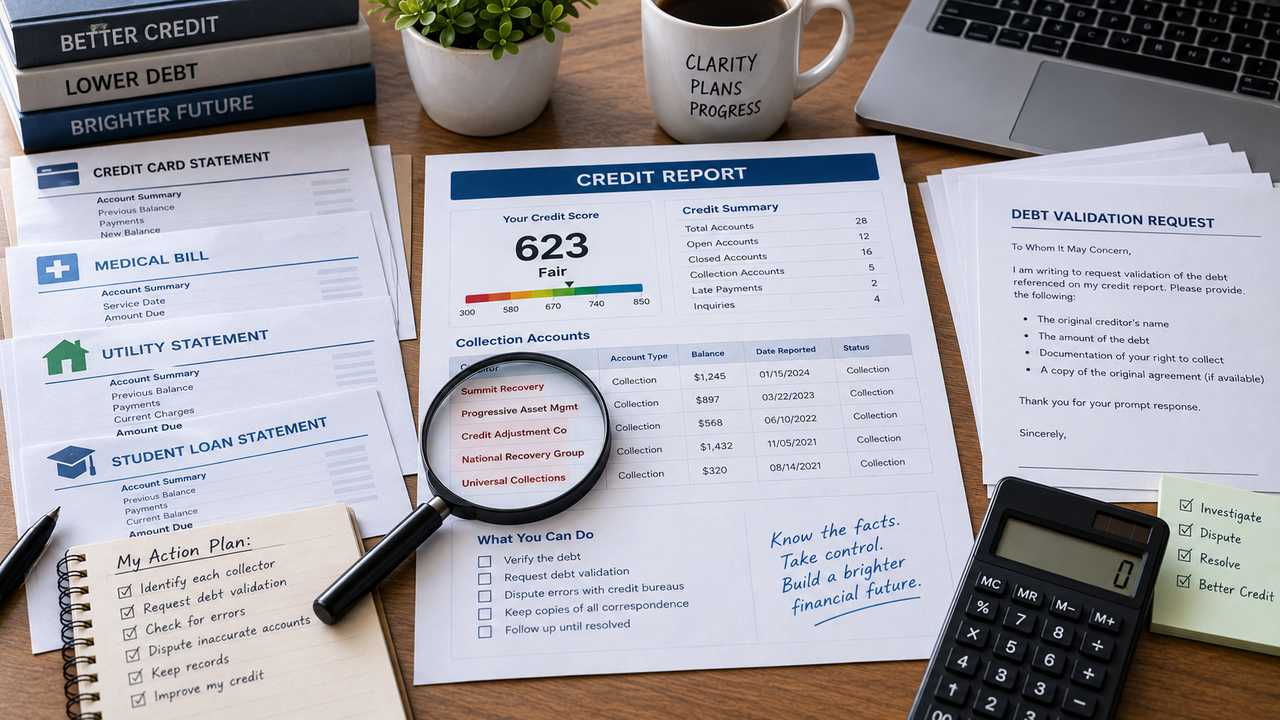
Unfamiliar debt collector names appear on credit reports because original creditors frequently sell delinquent debts to other companies. These entities are typically third-party collection agencies, which collect on behalf of the original creditor, or debt buyers, who purchase the debt outright. Consequently, the name listed on a credit report for a debt may not be the original lender, often causing confusion for consumers.
Why You Don’t Recognize the Name in the First Place
The single most common reason for this confusion is that the company contacting you almost never had any original relationship with you. Your actual relationship was with a bank, a hospital, a phone company, or a retailer — and at some point, after an account went unpaid, it was either handed off to a third-party collection agency working on that original creditor’s behalf, or sold outright to a debt buyer who now owns it.
Neither type of company markets itself to consumers the way a retail bank does, so it’s entirely normal to have never heard of them before this moment.
The Two Fundamentally Different Business Models Behind These Names
Understanding this distinction is the single most useful piece of context for evaluating any unfamiliar collector name, since it directly shapes what they can do, how much flexibility they have, and how you should approach them.
Third-Party Collection Agencies
These companies are hired by your original creditor to attempt collection on that creditor’s behalf, typically earning a commission or contingency fee based on what they successfully recover.
Critically, the original creditor still owns the debt throughout this arrangement — the agency is simply acting as their collection arm. This means you may have the option to resolve the matter directly with the original creditor instead of the agency, and it means the agency’s negotiating flexibility is generally constrained by what that original creditor authorizes.
Debt Buyers
These companies purchase debt outright, typically buying large bundled portfolios of charged-off accounts from original creditors for a small fraction of the total balance — often somewhere between a few cents and twenty cents on the dollar, depending on the debt’s age and type.
Once purchased, the debt buyer becomes the new legal owner and keeps everything they successfully collect. This generally gives debt buyers considerably more flexibility to negotiate a reduced settlement, since even a substantial discount off the full balance still represents a solid return relative to their purchase cost.
Some companies do both, depending on the specific client relationship or account, and some collection agencies also operate a separate debt-buying division.
Formal debt validation — your right under the Fair Debt Collection Practices Act to request written proof of who owns the debt, the amount owed, and the original creditor — is the most reliable way to determine which situation you’re actually in for any specific unfamiliar name.
Categories of Debt Collector Names You’re Likely to Encounter
Names Tied to Credit Card and Personal Loan Debt
The largest, most active debt buyers in the U.S. specialize in purchasing charged-off credit card and personal loan portfolios from major banks. These companies are often subsidiaries of larger, sometimes publicly traded parent corporations, and their names frequently reference words like “credit management,” “capital,” “funding,” or “recovery” — reflecting their core business of acquiring and recovering value from purchased debt portfolios.
Names Tied to Medical Debt
Because medical billing is complex and providers often lack internal collection infrastructure, hospitals, clinics, and other healthcare providers frequently outsource unpaid balances to specialized collection agencies.
These names might reference “healthcare,” “medical,” or simply appear as a general-purpose collection agency with healthcare-focused clients alongside other industries.
Names Tied to Utility and Telecom Debt
Phone, internet, and utility companies commonly place unpaid final bills with collection agencies specializing in this category.
Given how easy it is to overlook a final bill after moving or switching providers, this is one of the more common sources of a genuinely surprising, unfamiliar collector contact.
Names Tied to Government Debt
Some collection agencies specialize specifically in government-referred debt — unpaid traffic fines, court fees, and municipal citations that a city or county government has outsourced to a private collector, since many government entities don’t have the internal resources to pursue these collections themselves.
Names Tied to Student Loan Debt
Both federal and private student loan servicers and collectors have their own distinct naming patterns, and private student loan debt specifically has been associated with well-documented ownership and documentation challenges, given how frequently these loans were bundled, securitized, and resold as investment assets to specialized trusts.
A Universal, Step-by-Step Process for Any Unfamiliar Collector Name
Regardless of which specific company you’re dealing with, this process applies consistently:
Step One: Request Formal Debt Validation
Send a written request via certified mail with return receipt requested, invoking your rights under the FDCPA, asking for the name of the original creditor, the amount owed, and confirmation of the company’s legal right to collect this specific debt from you.
This legally requires them to pause collection activity until they respond, and you generally have 30 days from your first contact with them to make this request.
Step Two: Cross-Reference the Response Against Your Own Records
Does the original creditor’s name match an account you actually recognize? Does the timeframe make sense? Does the amount seem reasonable given what you remember owing?
If everything checks out, you can move forward deciding how to resolve it. If something doesn’t add up, you have grounds to formally dispute it.
Step Three: Determine Whether You’re Dealing With an Agency or a Buyer
This shapes your negotiating strategy significantly.
If it’s an agency still working on behalf of the original creditor, consider whether resolving directly with that original creditor might offer better terms.
If it’s a debt buyer, there’s often meaningful room to negotiate a settlement well below the full claimed balance.
Step Four: Check Your State’s Statute of Limitations Before Making Any Payment
Every state has a legal time limit — commonly ranging from three to ten years depending on the state and debt type — within which a creditor or collector can sue you to collect through the courts.
If the debt is old, verify whether it’s still within this window before doing anything involving payment, since in many states, making even a partial payment can restart this legal clock, potentially exposing you to renewed lawsuit risk on a debt that was otherwise safely past enforceability.
Step Five: Negotiate, Settle, or Dispute Based on What You’ve Learned
If the debt is accurate and still enforceable, decide between paying in full, negotiating a settlement, or setting up a payment plan — always getting any agreement in writing before sending money.
If it’s inaccurate or unverifiable, formally dispute it with the credit bureaus.
How to Verify That an Unfamiliar Debt Collector Is Legitimate
An unfamiliar name alone doesn’t mean you’re dealing with a scam. The debt collection industry is full of companies most consumers have never heard of.
However, you should independently verify any collector before providing sensitive information or making a payment.
Look for the following:
- A legitimate business name and physical mailing address
- A valid phone number that can be independently verified
- Information identifying the original creditor
- A specific amount being claimed
- A written validation notice explaining your rights
Call the company directly using contact information you find independently — not from the letter or call itself — to confirm an account genuinely exists under your name before providing any sensitive information.
What to Do If the Debt Genuinely Isn’t Yours
Given how many accounts move through this industry, and how much data changes hands during resales, data-matching errors and identity theft are both real possibilities.
If a debt doesn’t match anything in your history after validation, formally dispute it in writing with both the collector and the credit bureaus.
If identity theft seems likely — particularly if you find multiple unfamiliar accounts, not just one — file a report at IdentityTheft.gov and consider a credit freeze while the matter is resolved.
Why the Same Debt Can Appear Under Multiple Different Names Over Time
It’s worth understanding that a single original debt can pass through several different collector names over its lifetime.
If a debt buyer’s collection efforts on a specific account aren’t successful, they sometimes resell that account to yet another buyer, at an even steeper discount, who then makes their own fresh attempt — sometimes years after the original delinquency.
This is why you might hear from what feels like a completely different company about what turns out to be the same underlying debt you dealt with — or ignored — years earlier.
Throughout this chain, you only actually owe the debt once, to whichever company currently, legitimately owns it. Formal validation from each new name that contacts you is the way to confirm exactly that.
Building Your Own Reference System for Ongoing Peace of Mind
Given how confusing this landscape can be, it’s worth keeping your own simple record any time you interact with a debt collector — the company name, the date, what was discussed, and any documentation exchanged.
If the same underlying debt resurfaces later under a different company name, having this record on hand lets you quickly identify the pattern and respond efficiently, rather than starting your research and verification process completely from scratch each time.
Frequently Asked Questions
Is there a master list of every legitimate debt collector name I might encounter?
No single comprehensive list exists, given how many companies operate in this space and how frequently the industry changes through acquisitions and portfolio sales.
The validation and verification process described in this guide is designed to work for any name you encounter, rather than relying on recognizing a specific company from a reference list.
Does it matter if the collector’s address is in a state I’ve never lived in?
Not necessarily — many collection agencies and debt buyers operate nationally from a centralized headquarters, regardless of where their individual customers happen to reside, so an out-of-state address alone isn’t a red flag.
Can I request that a collector stop contacting me entirely, even for a legitimate debt?
Yes — sending a written cease-and-desist request generally requires them to stop further contact, though this doesn’t erase the underlying debt or necessarily prevent a lawsuit if it’s still within your state’s statute of limitations.
Should I be more cautious with a company I’ve never heard of versus a household-name bank collecting directly?
The verification process should be the same either way — even household-name banks occasionally make errors, and an unfamiliar company isn’t automatically less trustworthy simply because you haven’t heard of it before, given how much of this industry operates without consumer-facing brand recognition by design.
How long will an unfamiliar debt collector’s name stay associated with my credit report?
The reporting itself follows the standard seven-year rule from the original delinquency date, regardless of how many different company names have appeared in connection with the debt during that period.
A Deeper Look at How Portfolio Sales Actually Determine Which Name You See
To understand why the specific name attached to your debt can feel almost arbitrary, it helps to understand the mechanics of a portfolio sale.
When an original creditor decides to offload a batch of charged-off accounts, they typically work with a broker or directly negotiate with interested debt buyers, bundling hundreds or thousands of individual accounts together based on general characteristics — debt type, approximate age, and balance range — rather than marketing each account individually.
The buyer who wins that specific portfolio auction is, in effect, essentially random from your perspective as an individual account holder. You have no input into who purchases your specific debt, and the winning buyer’s name is simply whichever company happened to have the appetite and capital to acquire that particular batch at that particular time.
This randomness is part of why the same type of debt, even from the same original bank, can end up with completely different, unrelated collector names for different consumers, even those who defaulted around the same time.
Understanding the Corporate Family Trees Behind Common Collector Names
One detail that adds to the confusion is that many prominent debt buyers operate through multiple related entities, sometimes with genuinely different names, that all trace back to the same parent corporation.
A large publicly traded debt buyer might service accounts through one subsidiary that purchases and legally owns debt, while a separately named subsidiary or division handles the actual customer-facing collection calls and correspondence.
This means you might see two different company names associated with what is, underneath it all, a single corporate operation — one name representing the legal owner, which might appear as the “furnisher” on your credit report, and a different name representing the day-to-day servicing arm actually calling or writing to you.
Understanding this structure explains why a formal validation request sometimes surfaces a different name than the one that initially contacted you, without this discrepancy being any kind of red flag — it’s simply how these corporate structures are commonly organized.
A Detailed Walkthrough of a Realistic Multi-Company Debt Journey
To make the full picture concrete, consider a realistic composite example spanning several years.
In year one, a consumer stops paying an outstanding credit card balance of roughly $3,000. After 180 days of nonpayment, the original bank charges off the account and includes it in a larger portfolio sale to a debt buyer, receiving perhaps $250-300 for this and thousands of other similarly situated accounts.
This first buyer, whose name the consumer has never heard before, attempts collection through calls and letters for a year or so without success. Finding limited returns on this particular account within their broader portfolio, they resell it — along with other underperforming accounts from the same original batch — to a second buyer, this time for an even smaller amount, since the debt is now known to be harder to collect.
This second buyer, again an unfamiliar name, tries a different approach — perhaps a settlement offer emphasizing a steep discount — and this time succeeds in negotiating a reduced payment.
Throughout this entire multi-year journey, the consumer encountered two entirely different, unfamiliar company names for what was, from the very beginning, a single $3,000 credit card debt from a bank they actually recognized.
Neither subsequent company name represents a new or additional debt — simply different stages of the same underlying account’s ownership history.
Comparing Recognition Rates: Why Some Categories of Collector Names Feel More Familiar Than Others
Interestingly, not all debt collector names are equally unfamiliar to the average consumer.
Companies handling government-referred debt, such as traffic fines and court fees, sometimes have more regional name recognition, since they may operate visibly within specific city or county government contracts that receive local news coverage.
Companies specializing in medical debt collection, by contrast, tend to have the lowest public name recognition of any category, since healthcare providers rarely publicize which specific collection partners they use, and patients typically only encounter the name once a bill has already gone unpaid and been placed for collection.
This pattern is worth keeping in mind specifically when you encounter a completely unfamiliar name attached to what turns out to be a medical debt — the obscurity of the collector’s name isn’t itself a red flag in this particular category, simply a reflection of how quietly this specific corner of the industry typically operates.
Frequently Asked Questions, Continued
Do debt collector names ever change without the underlying ownership changing, just through a company rebrand?
Yes — companies sometimes rebrand or rename themselves for business reasons entirely unrelated to any change in debt ownership, which can create confusion if you see a name change on correspondence without any corresponding change in your validation documentation.
If this happens, it’s reasonable to ask directly whether this represents the same company under a new name or an actual change in ownership.
Is there a way to know in advance which company might end up owning my debt if it’s sold?
No — as covered above, this process is effectively unpredictable from a consumer’s perspective, determined by portfolio sale dynamics you have no visibility into or control over.
Does the specific collector’s name affect my legal rights in any way?
No — your rights under the FDCPA and other consumer protection laws apply consistently regardless of which specific company’s name appears on your correspondence, as long as they’re operating as a third-party debt collector or debt buyer rather than the original creditor collecting their own debt directly, which is governed by a somewhat different, though still substantial, set of consumer protections.
If a company’s name sounds like a law firm, does that change how I should approach them?
Some collection efforts genuinely are handled by law firms, particularly once litigation becomes a possibility, and this should be verified the same way as any other company name — checking their actual bar registration and legitimate contact information — rather than assuming the “law firm” framing alone changes your fundamental rights or the validation process.
How to Read a Validation Response Like an Expert
Once you receive a validation response, knowing exactly what to look for separates a thorough review from a superficial glance.
A genuinely complete response should include:
- The original creditor’s full legal name, not just a general description like “credit card debt”
- The original account number or a reference connecting it clearly to a specific account
- An itemized explanation of how the current balance was calculated
- Documentation establishing the chain of ownership if the company is a debt buyer
An itemized explanation is particularly important if the balance is higher than what you remember owing, since this could reflect legitimate accrued interest or, in some cases, improperly added fees.
If the company is a debt buyer rather than the original creditor, documentation establishing the chain of ownership should demonstrate that they actually purchased this specific account, not just provide a general assertion that they did.
A response missing any of these elements isn’t necessarily proof of an invalid debt, but it does give you specific, legitimate grounds to request the missing information before proceeding with any payment.
Why Some Companies Use Multiple Trade Names Simultaneously
Beyond the sequential renaming discussed earlier, it’s also common for a single company to operate under several trade names or “doing business as” (DBA) designations at the same time, sometimes for different lines of business, different states’ regulatory requirements, or historical reasons tied to a past merger or acquisition.
This can make a company appear unfamiliar even when it is part of a larger organization you might recognize under another name.
Understanding State-Level Differences in Debt Collection
Federal law provides an important baseline of consumer protections, but individual states can impose additional requirements and restrictions on debt collectors.
Some states require debt collectors to be specifically licensed to operate within that state, creating a public registry you can check to verify a company’s legitimacy.
Some states impose additional restrictions on collection practices, shorter statutes of limitations than neighboring states, or specific disclosure requirements when a collector is pursuing a time-barred debt.
Because these state-level protections genuinely vary, it’s worth researching your specific state’s consumer protection statutes, or asking a local consumer law attorney, if you want the fullest possible picture of your rights beyond the federal baseline covered throughout this guide.
A Closer Look at How Debt Buyers Determine Which Accounts to Pursue First
Within a large purchased portfolio, debt buyers don’t pursue every account with equal intensity or urgency.
They typically use internal scoring models, not unlike the credit scoring models covered elsewhere in personal finance, to predict which accounts within a bulk purchase are most likely to result in successful recovery.
Factors commonly used in this internal scoring include the debt’s age, the state you live in, since some states have more collector-friendly legal environments than others, any available information about your employment or assets, and how completely documented the specific account is.
This is worth understanding because it explains why some people are contacted quickly and repeatedly after a debt is sold, while others might not hear from the new owner for a year or more.
It’s not personal, and it doesn’t necessarily indicate anything about the debt’s validity. It simply reflects where you fell in that buyer’s internal prioritization model.
The Growing Role of Digital Communication in Modern Debt Collection
The debt collection industry has evolved considerably since the FDCPA was first written, and updated CFPB rules now explicitly address text messages and emails as legitimate, though regulated, communication channels, alongside traditional phone calls and letters.
If you receive a text message or email from an unfamiliar debt collector name, the same core verification principles apply — request validation, verify independently, and don’t provide sensitive information or payment through a channel you haven’t confirmed is legitimate.
These newer rules also specifically require collectors to provide a clear, easy method for you to opt out of a specific communication channel, such as requesting they stop texting you specifically while continuing to accept mail.
This is worth knowing if you’d prefer to manage this kind of correspondence through a single, more easily documented channel like written mail.
Frequently Asked Questions, Continued One Final Time
Does the debt collection industry have its own trade association or self-regulatory body beyond government oversight?
Yes — organizations like ACA International, formerly the American Collectors Association, represent the collection industry and have developed their own codes of conduct that member companies agree to follow.
However, membership in such an organization is voluntary and doesn’t replace or supersede the legal requirements under the FDCPA and applicable state law.
If a collector’s name includes “recovery” or “resolution,” does that indicate anything specific about how they operate?
Not reliably — these terms are common across the industry regardless of whether a company operates as a third-party agency or a debt buyer, so they shouldn’t be treated as a meaningful signal on their own.
The validation process remains the only reliable way to determine a specific company’s actual role and relationship to your debt.
The Bottom Line
An unfamiliar debt collector name on your credit report is disorienting but almost always explainable through one of two structures: a third-party agency working on behalf of your original creditor, or a debt buyer who’s purchased the account outright.
Regardless of which specific name you’re facing, the same reliable process applies — request formal validation, verify the details against your own records, understand whether you’re dealing with an agency or a buyer, check your state’s statute of limitations before any payment, and proceed based on verified information rather than pressure.
Understanding this system, rather than reacting to any single unfamiliar name in isolation, equips you to handle whatever specific company contacts you, now or in the future.
Need Help Understanding Collection Accounts on Your Credit Report?
An unfamiliar debt collector name can make it difficult to determine whether an account is accurate, who actually owns the debt, and what options may be available to you.
A detailed credit report review can help identify collection accounts, reporting errors, and information that may need further investigation.