
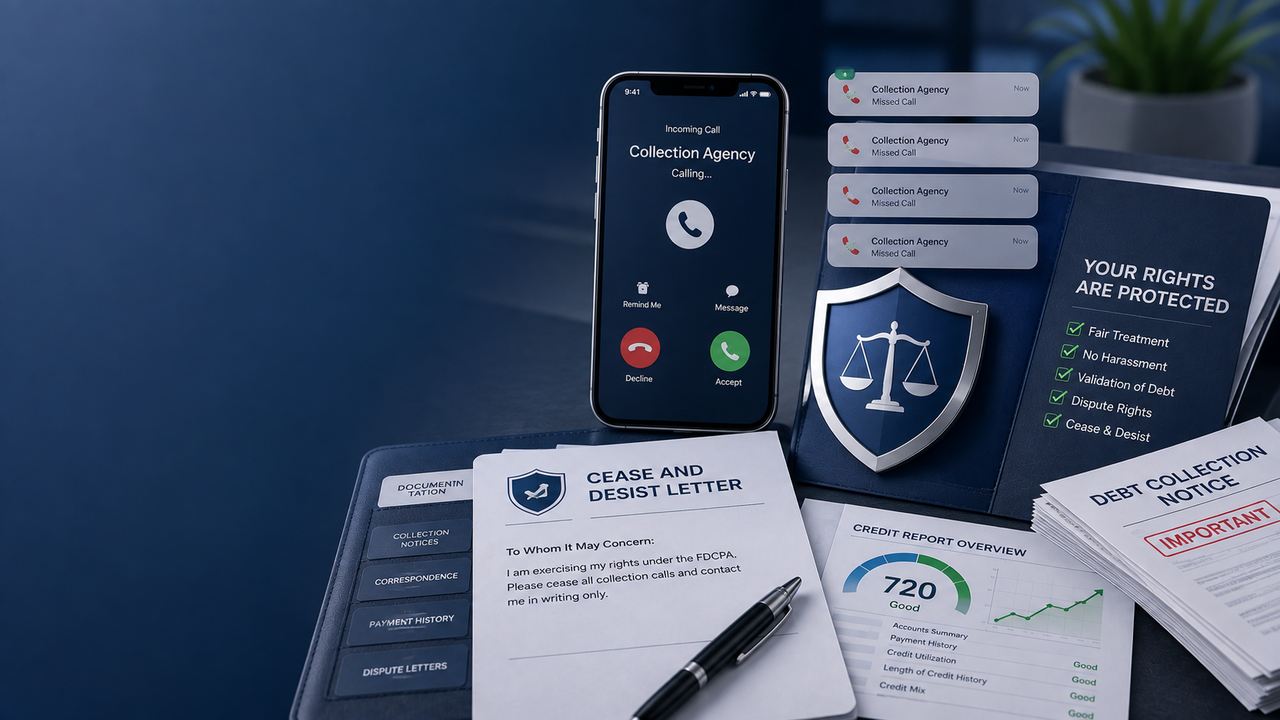
The Fair Debt Collection Practices Act (FDCPA) is a federal law designed to protect consumers from abusive, deceptive, and unfair debt collection practices by third-party debt collectors. Under the FDCPA, debt collectors are prohibited from engaging in harassment, making false statements, or calling before 8 a.m. or after 9 p.m. The law also mandates that debt collectors send a written validation notice within five days of initial contact, providing consumers 30 days to dispute the debt. This empowers individuals to challenge the validity of a debt and understand their rights against collection agency harassment.
If your phone rings at 7:45 a.m. with a number you don’t recognize, and by the third call of the day you’ve stopped answering altogether, you are not alone. Millions of Americans deal with collection agency harassment every year — and the majority of them don’t realize they have a federal law on their side that puts hard limits on what a debt collector can say, when they can call, and how far they can push before the law pushes back.
The Fair Debt Collection Practices Act (FDCPA) is a federal statute that has protected consumers since 1978. It is specific, it is enforceable, and it gives you real remedies — including the ability to sue a debt collector in federal court and recover money damages. You do not need to be a lawyer to use it. You do not need to pay a lawyer up front to use it. You need to understand what the rules are, document what’s happening to you, and take the right steps in the right order.
This guide walks you through every layer of the FDCPA in plain language: what the law covers, what collectors cannot do, how to stop the calls, how to validate or dispute a debt, how to file complaints with the right agencies, and how to take legal action when a collector crosses the line. We also explain how FDCPA protections connect to the Fair Credit Reporting Act (FCRA) and your broader credit repair strategy — because the two laws work together, and understanding both gives you leverage that neither one provides alone.
We are a San Diego-based, attorney-backed credit repair firm that helps clients nationwide. We don’t make quick-fix promises. We help you understand your rights, enforce them, and build the kind of long-term credit health that holds up after the dispute is over. If you want a free credit audit after you finish reading, you’ll find the link at the bottom. But first, let’s get you the knowledge you need.
What the FDCPA Is and Who It Covers
The Fair Debt Collection Practices Act was passed by Congress in 1978 as part of the Consumer Credit Protection Act. Its purpose, stated plainly in the law itself, is “to eliminate abusive debt collection practices by debt collectors, to insure that those debt collectors who refrain from using abusive debt collection practices are not competitively disadvantaged, and to promote consistent State action to protect consumers against debt collection abuses.”
In simpler terms: Congress recognized that a segment of the debt collection industry was using intimidation, deception, and harassment to extract payments from people who often didn’t owe the money, owed less than claimed, or were already in financial distress. The FDCPA set a federal floor — a baseline of conduct that every debt collector in the country must meet, regardless of what state they operate in.
Who counts as a “debt collector” under the FDCPA
This is the single most important distinction in the entire law, and it trips people up constantly. The FDCPA applies to third-party debt collectors — not to the original creditor you borrowed from.
What does that mean in practice?
- If you have a credit card with a bank and you fall behind, and the bank’s own internal collections department calls you, the FDCPA does not apply to that call. The bank, as the original creditor, is generally exempt.
- If that same bank hires an outside collection agency to collect the debt on its behalf, or sells the debt to a debt buyer who then tries to collect it, the FDCPA applies. Once a third party enters the picture, the federal protections kick in.
- The FDCPA also applies to debt buyers — companies that purchase charged-off debt portfolios for pennies on the dollar and then attempt to collect the full balance. These are some of the most common sources of consumer complaints, and they are squarely covered by the law.
- Debt collection attorneys are covered when they regularly attempt to collect debts. A lawyer who files a collection lawsuit against you is generally acting as a debt collector under the FDCPA if they regularly engage in collection activity.
There’s a specific threshold in the law: a “debt collector” is someone whose principal business is collecting debts, or who regularly collects debts owed to another. The 2010 amendment and subsequent court interpretations have clarified that debt buyers — entities that purchase debts and collect them in their own name — are also covered, though some nuances remain depending on when the debt was acquired and whether the collector used the original creditor’s name.
What counts as a “debt” under the FDCPA
The FDCPA defines a debt as “any obligation or alleged obligation of a consumer to pay money arising out of a transaction in which the money, property, insurance, or services which are the subject of the transaction are primarily for personal, family, or household purposes.” The key phrase is personal, family, or household. Business debts are not covered by the FDCPA. If you took out a loan for a small business and the lender sends it to collections, the FDCPA does not apply to that collection activity — though state laws might.
Covered debts include:
- Credit card debt
- Medical bills sent to collections
- Personal loans
- Auto loans (the deficiency balance after repossession, typically)
- Payday loans
- Student loans (private student loans are covered; federal student loans are collected by the government and its servicers, which are generally not “debt collectors” under the FDCPA, though some private collectors hired by the Department of Education may be)
- Utility bills and cell phone bills in collections
- Overdrawn bank accounts
Who is NOT covered
- Original creditors collecting on their own debts, using their own name (your credit card company calling you directly)
- Internal collection departments of the original creditor, as long as they use the creditor’s name
- Government employees collecting government debts
- Process servers serving legal papers
- Mortgage servicers in some contexts (though mortgage foreclosures have their own regulatory framework)
Can State Laws Extend Debt Collection Protection Beyond the FDCPA?
This is critical and often overlooked: even if the FDCPA doesn’t cover your situation — say, because you’re dealing with an original creditor’s internal collection department — your state may have its own debt collection law that covers original creditors. States like California (with the Rosenthal Fair Debt Collection Practices Act), New York, Florida, Massachusetts, and many others have laws that mirror or expand the FDCPA and apply it to original creditors as well. We cover this in more detail in the State Debt Collection Laws section below.
The bottom line: if a collector is a third party collecting a personal, family, or household debt, the FDCPA applies to them — and you have enforceable rights. If they’re not covered by the FDCPA, check your state law before assuming you have no protection.
Your Rights Under the FDCPA
The FDCPA gives you a specific, enumerated set of rights. These are not suggestions. They are federal law, and violating them can cost the collector money — money that can end up in your pocket. Here is the full breakdown.
Your FDCPA Rights at a Glance
| Right | What It Means | FDCPA Section |
| No calls before 8 a.m. or after 9 p.m. | Collectors cannot call outside 8:00 a.m. – 9:00 p.m. local time | § 1692c(a)(1) |
| No calls at work if prohibited | If your employer doesn’t allow personal calls, collectors can’t call you at work | § 1692c(a)(3) |
| No harassment or abuse | No threats of violence, profanity, or repeated calls meant to harass | § 1692d |
| No false or misleading statements | No lying about the debt, the consequences, or who they are | § 1692e |
| No publishing your name | Cannot publish a “shame list” of debtors | § 1692e(d) |
| Must identify themselves | Must state they are a debt collector and that information will be used to collect a debt | § 1692e(11) |
| Must send a validation notice | Within 5 days of first contact, must send written notice of the debt and your rights | § 1692g |
| Right to dispute the debt | You have 30 days to dispute the debt in writing | § 1692g(a)(3) |
| Right to request collector’s name and address | You can demand the original creditor’s name and the amount owed | § 1692g(a)(2) |
| No contact if you have an attorney | If you’re represented by an attorney, the collector must contact them, not you | § 1692c(a)(2) |
| Right to stop all contact | You can send a cease and desist letter demanding no further contact | § 1692c(c) |
No calls before 8 a.m. or after 9 p.m.
A debt collector cannot call you before 8:00 a.m. or after 9:00 p.m. local time — your local time, not theirs. A collector in New York cannot call you in Los Angeles at 9:30 a.m. their time and claim it’s within bounds, because that would be 6:30 a.m. your time. The standard is the consumer’s time zone.
If a collector calls you at 7:15 a.m., that is a violation. If they call you at 9:30 p.m., that is a violation. If they call you repeatedly at 8:01 a.m. every single day for two weeks, the time-of-day rule may not be violated, but the harassment provision (§ 1692d) likely is.
No calls at work if prohibited
If your employer prohibits you from receiving personal calls at work, and the collector knows or should know this, they cannot call you at work. The key is that the collector must be on notice. You can put them on notice by telling them directly: “My employer does not allow me to receive personal calls at work. Do not contact me here.” Once you’ve said that, any further call to your workplace is a violation.
No harassment, threats, or profanity
The FDCPA prohibits harassment or abuse in connection with the collection of any debt. The law lists specific examples:
- Threats of violence or physical harm — to you, your family, or your property
- Profane or abusive language — swearing, name-calling, racial slurs, demeaning language
- Repeated or continuous calls intended to annoy, abuse, or harass
- Publication of a list of consumers who allegedly refuse to pay debts (the “shame list” prohibition)
- Telephone calls without meaningful disclosure of the caller’s identity — anonymous calls designed to intimidate
The harassment standard is about intent and effect. A single call that uses profane language is a violation. A pattern of 15 calls in one day is a violation even if the collector is polite on each call, because the volume itself constitutes harassment. Courts look at the totality of the conduct.
No false or misleading statements
This is one of the broadest and most powerful provisions of the FDCPA. A debt collector may not use any false, deceptive, or misleading representation or means in connection with the collection of any debt. The law lists 16 specific prohibited false statements, including:
- Falsely claiming to be an attorney or that the communication is from an attorney
- Falsely claiming the debt is legally owed when it isn’t, or misstating the amount
- Falsely threatening arrest or imprisonment — you cannot be jailed for failing to pay a debt (more on this below)
- Falsely claiming to be a government representative or affiliated with any government agency
- Threatening to take action that cannot legally be taken or that the collector doesn’t actually intend to take (e.g., threatening to garnish wages when they have no judgment and no intention to sue)
- Falsely claiming nonpayment will result in seizure of property unless they have the legal right to do so
- Misrepresenting the legal status of the debt — claiming it’s a judgment when it isn’t, or claiming it’s within the statute of limitations when it isn’t
- Using a false business name or a name that misleads you about who is calling
- Falsely claiming that documents are legal process when they aren’t, or that documents are not legal process when they are
This provision is why so many FDCPA lawsuits succeed. Collectors routinely make statements that cross the line — “we’re going to garnish your wages next week” (when they can’t), “this will go on your criminal record” (it won’t), “we’re attorneys and we’re preparing a lawsuit” (they aren’t). Each false statement is a separate violation.
Must identify themselves
Every debt collector must, in the initial communication with you, state clearly that they are attempting to collect a debt and that any information obtained will be used for that purpose. This is the so-called Mini-Miranda warning. It must appear in the first written communication and, if the first contact is by phone, must be stated during that call.
If a collector calls you and says “this is John from the processing department” without identifying themselves as a debt collector, that’s a violation. If they send you a letter that looks like a legal notice but never says “this is an attempt to collect a debt,” that’s a violation.
Must send a written validation notice
Within five days of their initial communication with you (whether that communication is a phone call or a letter), a debt collector must send you a written notice containing:
- The amount of the debt
- The name of the creditor to whom the debt is owed
- A statement that unless you dispute the debt within 30 days, the collector will assume the debt is valid
- A statement that if you notify the collector in writing within 30 days that you dispute the debt, the collector will obtain verification of the debt and mail it to you
- A statement that if you request the name and address of the original creditor within 30 days, the collector will provide it
This notice is your gateway to challenging the debt. We cover it in detail in the Validation Notice section.
Right to be represented by an attorney
If you hire an attorney to represent you regarding the debt, the collector must stop contacting you directly and must communicate only through your attorney. This is one of the fastest ways to get the calls to stop — and it’s why working with an attorney-backed credit repair firm can be so effective. Once the collector knows you’re represented, they have to go through your representative.
How to Stop Collection Calls
You have several tools to stop a debt collector from calling you. They range from informal to formal, and the right approach depends on your situation and your goals.
Option 1: Tell them to stop calling
The simplest step is to tell the collector, on the phone, to stop calling you. This is not as legally powerful as a written cease and desist letter, but it does create a record. Say something like: “I am requesting that you stop calling this number. All future communication must be in writing.” Note the date, time, and the name of the person you spoke with.
Option 2: Send a written cease and desist letter
This is the most powerful tool you have for stopping contact short of hiring a lawyer. Under FDCPA § 1692c(c), if you notify a debt collector in writing that you refuse to pay the debt or that you wish the collector to cease further communication, the collector must stop communicating with you — with very limited exceptions.
Once the collector receives your written cease and desist letter, they can only contact you to:
- Advise you that further collection efforts are being terminated
- Notify you that specific remedies (like a lawsuit) may be invoked
- Notify you that specific remedies will be invoked
That’s it. No more calls. No more letters. No more texts. If they contact you for any other reason, that is a violation of the FDCPA — and you can sue for it.
Cease and desist letter template
Here is a template you can adapt and send. Send it by certified mail with return receipt so you have proof of delivery. Keep a copy for your records.
[Your Name]
[Your Address]
[Your City, State, ZIP]
[Your Phone Number]
[Your Email]
[Date]
[Collection Agency Name]
[Collection Agency Address]
[City, State, ZIP]
Re: Account # [Account or Reference Number]
Original Creditor: [Original Creditor Name, if known]
Amount Claimed: $[Amount, if known]
To Whom It May Concern:
I am writing in response to your attempts to collect a debt that you claim I owe. Pursuant to my rights under the Fair Debt Collection Practices Act (15 U.S.C. § 1692c(c)), I hereby request that you CEASE AND DESIST all communication with me regarding this alleged debt.
This means you are not to contact me by telephone at my home, at my place of employment, on my cell phone, or at any other number. You are not to contact me by mail, by email, by text message, or through any third party. The only exceptions permitted by law are:
1. To advise me that your collection efforts are being terminated.
2. To notify me that you may invoke specified remedies.
3. To notify me that you intend to invoke a specified remedy, such as filing a lawsuit.
Please be advised that I am aware of my rights under the Fair Debt Collection Practices Act and under applicable state law. I am also aware that if you fail to comply with this request, you may be subject to liability for statutory damages, actual damages, and attorney’s fees under 15 U.S.C. § 1692k.
In addition, I dispute the validity of this debt and request that you provide verification of the debt as required by 15 U.S.C. § 1692g, including:
– The name and address of the original creditor
– The amount of the alleged debt
– Proof that you are authorized to collect this debt
– A copy of any judgment or other documentation establishing the debt
Until you have provided this verification, you are prohibited by law from collecting this debt or reporting it to any credit reporting agency.
Sincerely,
[Your Signature]
[Your Printed Name]
Important caveats about cease and desist letters
A cease and desist letter stops communication, but it does not make the debt go away. The collector can still:
- Report the debt to the credit bureaus (unless you also dispute the debt and they cannot verify it)
- File a lawsuit against you to collect the debt (in fact, some collectors sue after receiving a cease and desist letter, because litigation is one of the permitted “specified remedies”)
- Sell the debt to another collector, who is also bound by the FDCPA and to whom you can send another cease and desist letter
So a cease and desist is powerful, but it’s not a silver bullet. It buys you peace and it creates a record, but it doesn’t resolve the underlying debt. For that, you need to address the debt itself — through validation, dispute, settlement, or, if appropriate, bankruptcy.
Option 3: Hire an attorney
When you hire an attorney to handle the debt, the collector must stop contacting you and deal only with your attorney. This is often the cleanest solution because it puts a professional between you and the collector, and because an FDCPA attorney will often take your case on contingency — meaning you pay nothing up front, and the attorney collects their fee from the collector if you win.
Option 4: File for bankruptcy
If you’re overwhelmed by multiple debts, bankruptcy triggers the automatic stay, which stops virtually all collection activity immediately. This is a major step with long-term consequences, and it’s beyond the scope of this article — but it is a legal tool that stops collection calls cold. If you’re considering bankruptcy, consult a bankruptcy attorney.
The Validation Notice and Your 30-Day Right
The validation notice is one of the most important protections in the FDCPA, and it’s the one most consumers misunderstand. Here’s how it works.
The five-day rule
Within five days after a debt collector first contacts you (whether by phone, letter, or other means), they must send you a written notice containing the validation information described above: the amount of the debt, the name of the creditor, your right to dispute, your right to request the original creditor’s name and address, and the 30-day deadline.
Your 30-day window
From the date you receive that validation notice, you have 30 days to take one of several actions:
- Dispute the debt in writing — if you dispute the debt, the collector must cease collection until they obtain verification of the debt (or a copy of the judgment, if applicable) and mail it to you
- Request the original creditor’s name and address — if you request this in writing, the collector must provide it
- Do nothing — if you do nothing within 30 days, the collector may presume the debt is valid and continue collection efforts
The 30-day period is not a statute of limitations on disputing the debt. You can dispute a debt at any time. But within the 30-day window, the collector must stop collecting and verify the debt if you dispute it. Outside the window, they are not legally required to stop collecting while they respond, though they still cannot make false statements or harass you.
What “verification” means
The FDCPA does not define exactly what “verification” requires, and courts have split on how thorough it must be. At minimum, the collector must:
- Confirm with the original creditor that the amount is correct
- Obtain and send you some documentation supporting the debt — at least a copy of a judgment if one exists, or basic information confirming the debt
Some courts require more — particularly for debt buyers, who may need to provide a chain of assignment showing they actually own the debt. If a debt buyer cannot produce documentation that they own the debt and that the amount is accurate, they may not be able to verify it, and continued collection could violate the FDCPA.
What happens if they can’t verify
If a collector cannot verify the debt, they must stop collecting it. That means:
- No more calls
- No more letters
- No more lawsuits
- No reporting to credit bureaus (under the FDCPA, continued reporting without verification can be a violation, and under the FCRA, reporting inaccurate information is a separate violation)
This is where the FDCPA and the FCRA work together — and where an attorney-backed credit repair strategy can be especially effective. If a collector reports a debt to the credit bureaus without verifying it after you’ve disputed it, you may have claims under both laws.
What “verification” does NOT mean
Verification is not the same as validation in the credit reporting sense. The collector does not have to produce a mountain of documentation. They do not have to prove every detail of the debt in a court of law at this stage. The standard is relatively low — but it is a real standard, and collectors who skip it or ignore a timely dispute are violating the law.
Disputing after the 30-day window
You can dispute a debt at any time, even years later. The 30-day window gives you the strongest legal leverage (because it forces the collector to stop collecting until they verify), but you always have the right to:
- Dispute directly with the credit bureaus under the FCRA
- Request verification from the collector (though they’re not required to stop collecting if you’re outside the 30-day window)
- Demand validation as part of defending a collection lawsuit
If a collector sues you, you can raise the failure to validate as a defense and can also counterclaim for FDCPA violations.
What Debt Collectors Cannot Do
Beyond the time-of-day and harassment rules, the FDCPA specifically prohibits a range of conduct. Here’s a plain-language list of what collectors absolutely cannot do.
1. Threaten arrest or imprisonment
You cannot be jailed for failing to pay a debt. Debt is a civil matter, not a criminal one. A collector who threatens you with arrest, claims a warrant is out for you, or says you’ll be sent to prison is violating the FDCPA. The only exception is in extremely rare cases of criminal contempt related to court orders — and even then, it’s not the debt itself that triggers arrest, it’s a violation of a court order. A collector claiming “we’ll have you arrested tomorrow if you don’t pay” is lying, and that lie is illegal.
2. Lie about the debt
A collector cannot:
- Claim you owe more than you do
- Add unauthorized fees or interest
- Claim the debt is a judgment when no lawsuit has been filed
- Claim the debt is within the statute of limitations when it’s time-barred
- Claim they’ve already sued you when they haven’t
- Misrepresent the legal consequences of nonpayment
3. Contact third parties about your debt
Except to locate you, a collector cannot contact third parties about your debt. This means:
- No calling your family members to tell them about your debt
- No calling your employer to discuss your debt (they can call once to verify your employment, but cannot discuss the debt)
- No calling your friends, neighbors, or coworkers to discuss your debt
- No calling your spouse in some circumstances (though spouses may be contacted in certain states and situations)
The exception: a collector may contact third parties once to obtain your location information (your address, phone number, place of employment) — but they cannot mention the debt, and they cannot contact that third party again unless the third party agrees to help or the collector reasonably believes the information was false.
4. Call repeatedly to harass
While the FDCPA doesn’t set a specific number of calls that constitutes harassment, courts have found that repeated calls — multiple calls per day, calls every day for weeks, calls after being told to stop — can violate the harassment prohibition. The standard is whether the calls are intended to annoy, abuse, or harass. If a collector calls you 10 times in a single day, a court is likely to find that harassing. If they call once a day for a week after you’ve told them you can’t pay, that may also cross the line.
5. Use obscene or profane language
Any profanity, racial slurs, name-calling, or abusive language is prohibited. A collector who calls you a “deadbeat,” uses profanity, or makes demeaning comments is violating the FDCPA.
6. Threaten actions they cannot or will not take
A collector cannot threaten to:
- Garnish your wages without first obtaining a judgment (in most states, wage garnishment requires a court judgment — there are exceptions for federal student loans, taxes, and child support)
- Seize your property without a legal right to do so
- File a lawsuit they have no intention of filing
- Have you arrested (as noted above)
- Take any action that is illegal or that they don’t actually intend to take
7. Deposit a postdated check early
If you give a collector a postdated check, they cannot deposit it early without your consent. They also cannot accept a postdated check from you without disclosing their intent to deposit it early.
8. Collect amounts not authorized
A collector cannot collect any amount — interest, fees, charges — unless it’s expressly authorized by the agreement that created the debt or permitted by law. Many old debts are “time-barred” (past the statute of limitations), and collecting interest or fees on a time-barred debt can be a violation.
9. Communicate by postcard
A collector cannot communicate with you about a debt by postcard, because a postcard can be read by anyone who handles the mail — which would disclose your debt to third parties.
10. Use any envelope with markings that indicate a debt collection
The envelope of any communication from a debt collector cannot have any language or symbol (other than the collector’s name and address) that indicates the communication is about debt collection. This is why legitimate collection letters come in plain envelopes.
11. Contact you if you’re represented by an attorney
If the collector knows you have an attorney representing you regarding the debt, they must contact the attorney, not you — unless the attorney fails to respond within a reasonable time.
12. Call you at inconvenient times or places
Beyond the 8 a.m. – 9 p.m. rule, a collector cannot call you at any time or place they know (or should know) is inconvenient for you. If you tell them “don’t call me on Sundays” or “don’t call me during my lunch hour,” they must respect that.
What to Do When You’re Harassed
If a debt collector is violating the FDCPA, you have a clear path to fight back. Here’s the step-by-step process, in order.
Step 1: Document everything
This is the most important step. Without documentation, you have no case. With documentation, you have leverage — and potentially a lawsuit worth real money.
Start a collection log immediately. For every contact, record:
- Date and time of the contact
- Phone number the call came from (or the address on the envelope)
- Name of the collector and the collection agency
- What was said — as close to verbatim as you can remember
- Any threats, profanity, or false statements made
- Witnesses who were present (if any)
- Your emotional state and any distress you experienced
Save every voicemail. Save every text message. Save every letter and envelope. Do not delete anything. If the calls are coming to your cell phone, take screenshots of the call log. If you can, record the calls — but check your state’s recording law first. In “one-party consent” states (the majority), you can record without telling the collector. In “two-party consent” states (like California, Florida, Illinois, and others), you must inform the other party that the call is being recorded.
Step 2: Send a cease and desist letter
Use the template above. Send it by certified mail with return receipt. Keep the receipt — it’s your proof that the collector received it. Once they have it, any further contact (other than the three permitted exceptions) is a violation.
Step 3: Dispute the debt in writing
If you don’t believe you owe the debt, or you believe the amount is wrong, dispute it in writing within 30 days of receiving the validation notice. This forces the collector to verify the debt and stops collection activity until they do. Use a dispute letter that specifically requests:
- Verification of the debt
- The name and address of the original creditor
- Proof that the collector is authorized to collect the debt
- A copy of any judgment (if applicable)
Step 4: File a complaint with the CFPB
The Consumer Financial Protection Bureau (CFPB) is the federal agency that enforces the FDCPA. You can file a complaint online at consumerfinance.gov. The CFPB will forward your complaint to the collector and require them to respond. The CFPB tracks complaint patterns and can take enforcement action against collectors with widespread violations.
What to include in your CFPB complaint:
- The collection agency’s name and contact information
- The debt information (amount, original creditor, account number)
- A description of the violation(s), with dates
- Any documentation you have (letters, call logs, voicemails)
- What you want (e.g., the calls to stop, the debt verified, damages)
Step 5: File a complaint with the FTC
The Federal Trade Commission (FTC) also accepts complaints about debt collectors at ftc.gov. While the CFPB is now the primary enforcer of the FDCPA, the FTC still plays a role, and filing with both agencies creates a more complete record.
Step 6: File a complaint with your state attorney general
Many state attorneys general have consumer protection divisions that handle debt collection complaints. Some states have their own debt collection laws (covered below) that the AG can enforce. Filing with your state AG can trigger state-level action that complements the federal process.
Step 7: Consult an FDCPA attorney
If you have documented violations, talk to a consumer protection attorney who handles FDCPA cases. Most FDCPA attorneys offer a free initial consultation and take cases on contingency — meaning they get paid by the collector if you win, not out of your pocket. The FDCPA specifically provides for attorney’s fees to be paid by the losing collector, which is why attorneys can take these cases without charging you upfront.
An attorney can:
- Evaluate the strength of your case
- Send a formal demand letter to the collector
- Negotiate a settlement (which may include the debt being removed from your credit report)
- File a lawsuit in federal court if the collector won’t settle
- Help you recover statutory damages up to $1,000 plus actual damages and attorney’s fees
You don’t have to wait until you’ve been harassed to consult an attorney. If a collector is making your life miserable, an attorney can step in immediately and take over all communication — which, as we noted, the collector must respect.
How to Sue Under the FDCPA
If a debt collector has violated the FDCPA, you have the right to sue them in federal court. You can also sue in state court, but federal court is the more common venue for FDCPA cases. Here’s what you need to know.
Who can sue
Any consumer who has been subjected to a prohibited collection practice can sue. You do not need to have actually paid the debt. You do not need to have suffered financial loss. The FDCPA provides statutory damages — a fixed amount — for any violation, regardless of whether you lost money.
What you can recover
Under 15 U.S.C. § 1692k, you can recover:
- Statutory damages — up to $1,000 per lawsuit (not per violation). This is a flat amount that you’re entitled to if the collector violated the FDCPA, even if you can’t prove any specific financial harm. Some courts and state laws allow more.
- Actual damages — compensation for any concrete harm you suffered. This can include:
- Emotional distress (anxiety, sleep loss, stress, humiliation)
- Out-of-pocket costs (e.g., the cost of changing your phone number, medical bills for stress-related treatment)
- Lost wages (if collection calls caused you to miss work)
- Damage to your credit (if false reporting caused you to be denied credit)
- Attorney’s fees and costs — the collector must pay your attorney’s fees and court costs if you win. This is what makes FDCPA cases feasible on contingency.
In class action lawsuits, the statutory damages cap is the lesser of $500,000 or 1% of the collector’s net worth.
The statute of limitations
You must file an FDCPA lawsuit within one year of the violation. The clock starts running on the date of the violation. If a collector called you in violation on March 15, 2025, you have until March 15, 2026 to file. If they made multiple violating calls over several months, each call may be a separate violation, but the one-year clock runs from each individual violation.
This deadline is strict. If you miss it, you lose your right to sue under the FDCPA — though you may still have claims under state law, which often has a longer statute of limitations. Don’t wait. If you think you have a case, talk to an attorney as soon as possible.
What you have to prove
To win an FDCPA case, you generally need to show:
- The defendant is a “debt collector” under the FDCPA (they regularly collect debts owed to others)
- The debt is a “consumer debt” (personal, family, or household purpose)
- You are a “consumer” under the FDCPA
- The collector violated a specific provision of the FDCPA
- You suffered damages (statutory damages don’t require proof of specific harm, but actual damages do)
For most violations, you don’t need to prove the collector intended to violate the law. The FDCPA is a strict liability statute — the collector is liable for violations even if they didn’t mean to break the law. However, there is a “bona fide error” defense: if the collector can show the violation was unintentional, resulted from a bona fide error, and was not part of a pattern, they may avoid liability. This defense is narrow and rarely succeeds.
What is the Process for an FDCPA Lawsuit?
- Consult an attorney (or decide to proceed pro se — on your own — which is possible but not recommended)
- File a complaint in federal court
- The collector responds (usually by answering the complaint or filing a motion to dismiss)
- Discovery — both sides exchange information and evidence
- Settlement negotiations — most FDCPA cases settle before trial
- Trial (if no settlement is reached)
Most FDCPA cases settle. Collectors don’t want to go to trial because the attorney’s fees provision makes losing expensive, and because bad publicity and CFPB scrutiny can follow. A typical settlement may include:
- A cash payment to you (often more than the $1,000 statutory minimum)
- Waiver or reduction of the underlying debt
- Deletion of the tradeline from your credit report
- An injunction requiring the collector to stop the prohibited conduct
Do you need an attorney?
You can file an FDCPA lawsuit without an attorney (pro se), but it’s not advisable. FDCPA law has procedural nuances, federal court rules are complex, and collectors will have attorneys. Because the FDCPA provides for attorney’s fees, consumer protection attorneys take these cases on contingency — meaning you pay nothing upfront, and the attorney’s fee comes from the collector if you win. There’s almost no downside to at least consulting one.
How This Ties to Credit Repair
The FDCPA and the Fair Credit Reporting Act (FCRA) are two halves of a complete consumer protection framework. The FDCPA governs how collectors can collect from you. The FCRA governs how collectors can report about you. Understanding how they interact is the key to effective credit repair.
What is the Connection Between FDCPA, FCRA, and Credit Repair?
When a debt goes to collections, the collector typically reports it to the three major credit bureaus — Equifax, Experian, and TransUnion — as a collection account. This collection tradeline can drop your credit score by 50 to 100 points or more and stays on your report for seven years from the date of the original delinquency.
Here’s how the two laws work together:
- You dispute the debt with the collector under the FDCPA (within 30 days of the validation notice). The collector must verify the debt or stop collecting. If they can’t verify, they should also stop reporting — because reporting without verification can be a false or misleading representation under the FDCPA.
- You dispute the tradeline with the credit bureaus under the FCRA. The bureaus must investigate within 30 days (generally) and must provide the results to you. If the collector cannot verify the debt, the tradeline should be removed or corrected.
- If the collector reports inaccurate information — wrong amount, wrong dates, wrong original creditor, or reports a debt you’ve disputed without noting the dispute — that’s a violation of the FCRA. And if the collector continues to report after failing to verify a disputed debt, that can be a violation of both the FCRA and the FDCPA.
- If the collector sues you, you can raise FDCPA violations as counterclaims and can also challenge the FCRA reporting as part of your defense.
What is the Strategy for Credit Repair Using FDCPA and FCRA?
An effective credit repair strategy uses both laws:
- FDCPA tools — cease and desist letters, validation disputes, documentation of violations, lawsuits — to stop harassment and force collectors to verify or back off
- FCRA tools — bureau disputes, requests for reinvestigation, method-of-verification requests — to challenge inaccurate, incomplete, or unverifiable information on your credit reports
- Attorney backing — to enforce your rights under both laws and to escalate when collectors or bureaus don’t comply
Why Does Attorney Backing Matter for FDCPA and FCRA Credit Repair?
A debt collector who knows you’re working with an attorney thinks differently. They know that violations could cost them money in court. They know that an attorney-backed dispute is not a “nuisance” dispute that they can ignore. They know that continued reporting without verification could trigger an FCRA claim on top of the FDCPA claim.
This is why our firm is attorney-backed. We don’t just send dispute letters and hope. We work alongside experienced attorneys who understand both the FDCPA and the FCRA, who know how to document violations, and who can escalate to litigation when necessary. The combination of legal knowledge, strategic dispute filing, and attorney oversight gives our clients leverage that pure “credit repair” companies — who just send form letters — cannot match.
What Credit Repair Services Do We Offer?
Our process includes:
- A free credit audit — we pull and review your credit reports from all three bureaus and identify collection accounts, errors, and potential violations
- A customized repair plan — tailored to your specific debts, goals, and timeline
- FDCPA-based disputes — validation requests to collectors, documentation of violations, cease and desist letters when appropriate
- FCRA-based disputes — bureau disputes, method-of-verification requests, follow-up on inaccurate reporting
- Attorney coordination — when a collector crosses the line or a bureau fails to correct an error, we work with attorneys who can take legal action
- Client education — we teach you how to maintain strong credit long after the process is complete, because credit health is a long-term commitment
We do not guarantee specific outcomes, and we do not make quick-fix promises. What we do is use the full scope of federal and state consumer protection law — applied strategically and backed by attorneys — to give you the best possible chance of removing inaccurate, unverifiable, or unlawfully reported items from your credit reports.
State Debt Collection Laws
The FDCPA is a federal floor, not a ceiling. Many states have their own debt collection laws that provide additional protections or extend coverage to situations the FDCPA doesn’t reach. Here’s what you need to know.
States that extend FDCPA protections to original creditors
The FDCPA only covers third-party collectors. But several states have laws that apply the same (or similar) protections to original creditors collecting their own debts. The most notable is:
- California — the Rosenthal Fair Debt Collection Practices Act extends FDCPA-like protections to original creditors, debt buyers, and attorneys. If you’re dealing with a bank’s internal collection department in California, the Rosenthal Act likely applies.
Other states with broader coverage include:
- New York — the state’s debt collection regulations (via the Department of Financial Services) impose FDCPA-like requirements on creditors and collectors
- Florida — has a state Consumer Collection Practices Act that covers original creditors
- Massachusetts — has regulations covering unfair debt collection practices
- Pennsylvania, Connecticut, North Carolina, Texas, and others — have various state-level protections
States that require collectors to be licensed
Many states require debt collectors to be licensed before they can collect from residents. If a collector is unlicensed in a state that requires licensure, their collection attempts may be illegal — and you may have grounds to dispute the debt and prevent reporting. States with licensure requirements include:
- California, New York, Florida, Texas, Illinois, Pennsylvania, New Jersey, and many others
If you’re unsure whether a collector is licensed in your state, you can check with your state’s department of finance, banking, or consumer affairs. An unlicensed collector is a significant red flag — and a potential defense if they sue you.
State statutes of limitations on debt
Every state has a statute of limitations — a time limit on how long a creditor or collector has to sue you for a debt. These vary widely:
- Oral contracts: 2–6 years depending on the state
- Written contracts: 3–10 years
- Open accounts (credit cards): 3–6 years in most states
Once a debt is past the statute of limitations, it is time-barred — a collector cannot legally sue you to collect it. However, the debt still exists, and a collector can still attempt to collect it voluntarily (by calling or writing). What they cannot do is threaten to sue or actually file suit on a time-barred debt — that’s an FDCPA violation.
If a collector sues you on a time-barred debt, you can raise the statute of limitations as a defense and likely get the case dismissed. You may also have an FDCPA counterclaim for threatening action they cannot legally take.
How to find your state’s laws
- Check your state attorney general’s website — most have a consumer protection section with debt collection information
- Look up your state’s statute of limitations for the type of debt in question
- Consult a local consumer protection attorney who knows your state’s specific laws
State law can be more powerful than the FDCPA in some situations — especially when dealing with original creditors or when your state offers higher damage awards or longer statutes of limitations for filing suit.
Common Mistakes to Avoid
Even when people know their FDCPA rights, they often make mistakes that weaken their position or forfeit their claims entirely. Here are the most common ones — and how to avoid them.
1. Not documenting the violations
Without a record, you don’t have a case. If a collector calls you 20 times in a week and you don’t log the calls, save the voicemails, or note what was said, you have no evidence. Start documenting the moment you realize you’re being harassed. Keep a dedicated log. Save everything.
2. Sending a cease and desist letter without proof of delivery
If you send a cease and desist by regular mail and the collector claims they never received it, you have no proof. Always send by certified mail with return receipt. The receipt is your evidence that the letter was delivered.
3. Missing the 30-day validation window
The 30-day window is your strongest tool for forcing a collector to verify a debt. If you miss it, you can still dispute — but the collector isn’t required to stop collecting while they respond. Dispute in writing within 30 days of receiving the validation notice whenever possible.
4. Disputing verbally instead of in writing
A verbal dispute over the phone is hard to prove. A written dispute — sent by certified mail — creates a paper trail. Always dispute in writing.
5. Admitting to the debt on a recorded call
Collectors record their calls. If you admit the debt is yours, that admission can be used against you. You are not obligated to admit or deny a debt on a call. You can say: “I dispute this debt and request validation in writing. Please send me the validation notice.”
6. Ignoring a lawsuit
If a collector files a lawsuit against you, do not ignore it. Ignoring a lawsuit leads to a default judgment — which allows the collector to garnish your wages, levy your bank account, or place a lien on your property. Respond to the lawsuit, raise your defenses (including FDCPA violations), and consult an attorney immediately.
7. Paying a time-barred debt without understanding the consequences
Making a payment on an old, time-barred debt can restart the statute of limitations in some states — turning a debt the collector can no longer sue over into one they can. Before paying any old debt, understand your state’s rules on restarting the clock. A partial payment, in some states, is enough to restart it.
8. Believing a collector who says “you’ll go to jail”
You will not go to jail for a debt. This is a lie, and it’s an FDCPA violation. Do not let fear of arrest drive you to pay a debt you can’t afford or don’t owe.
9. Failing to check if the collector is licensed
If your state requires debt collectors to be licensed and the collector is unlicensed, their collection activity may be illegal. Check licensure — it’s a simple step that can dramatically change your leverage.
10. Not consulting an attorney
FDCPA cases are almost always taken on contingency. You pay nothing upfront. The collector pays your attorney’s fees if you win. There is no downside to at least consulting an attorney. People who try to handle FDCPA violations alone often leave money and leverage on the table.
11. Settling for too little
If you have documented violations, you may be entitled to more than you think. A collector may offer to waive the debt as a “settlement” — but if they violated the FDCPA, you may be entitled to the debt being waived plus a cash payment to you. Don’t accept the first offer without understanding the full value of your claims.
12. Forgetting about credit reporting
Stopping the calls is only half the battle. If the collector is still reporting the debt to the credit bureaus, the tradeline is still dragging down your score. Address both the collection conduct and the credit reporting — they’re separate issues under separate laws (FDCPA and FCRA).
Frequently Asked Questions
Can a debt collector call my family or employer?
A debt collector can contact third parties once to obtain your location information (address, phone number, place of employment) — but they cannot mention the debt, and they cannot contact that person again unless they agree to help or the collector believes the information was false. They cannot discuss your debt with your family, friends, neighbors, or employer. If a collector tells your mother you owe money, that’s a violation. If they call your boss to discuss the debt, that’s a violation.
Can I go to jail for not paying a debt?
No. Debt is a civil matter, not a criminal one. You cannot be imprisoned for failing to pay a debt. If a collector threatens you with arrest or imprisonment, they are violating the FDCPA. The only rare exception involves criminal contempt of court orders — and even then, the arrest is for contempt, not for the debt itself.
Can a debt collector garnish my wages without suing me?
In most cases, no. A collector must first file a lawsuit, win a judgment, and then obtain a court order for wage garnishment. The major exceptions are federal student loans (which can be administratively garnished without a court order), federal taxes (IRS levy), and child support (which can be garnished through administrative processes). If a collector threatens to garnish your wages without a judgment, that’s an FDCPA violation.
What is the statute of limitations on debt in my state?
It varies by state and by the type of debt. Credit card debt (an “open account”) is typically 3–6 years; written contracts are 3–10 years. You can find your state’s statute of limitations on your state attorney general’s website or by consulting a local consumer protection attorney. Once a debt is past the statute of limitations, it is “time-barred” — a collector cannot sue you for it, though they can still attempt voluntary collection. Be careful: making a payment on a time-barred debt can restart the clock in some states.
How much can I recover if I sue a debt collector?
Under the FDCPA, you can recover statutory damages up to $1,000 (a flat amount per lawsuit, regardless of the number of violations), actual damages (for emotional distress, out-of-pocket costs, lost wages, credit damage), and attorney’s fees and court costs. In class actions, the cap is the lesser of $500,000 or 1% of the collector’s net worth. Many cases settle for more than the statutory minimum, especially when actual damages are documented.
What should I do if a debt collector sues me?
Do not ignore the lawsuit. Respond to the complaint (usually within 20–30 days, depending on your state). Raise any defenses you have, including the statute of limitations, lack of standing (if it’s a debt buyer who can’t prove they own the debt), and FDCPA violations as counterclaims. Consult a consumer protection attorney immediately — many will defend collection lawsuits for free on contingency because they can recover their fees from the collector if they win.
Does the FDCPA cover medical bills?
Yes. Medical bills are personal debts, and if they are placed with a third-party collection agency or sold to a debt buyer, the FDCPA applies. Medical debt is one of the most common types of debt sent to collections, and medical collectors are subject to the same rules as any other debt collector — no harassment, no false statements, no calls outside 8 a.m. – 9 p.m., validation notices required.
Can I dispute a debt after the 30-day window?
Yes. You can dispute a debt at any time. The 30-day window (from the validation notice) gives you the strongest leverage — the collector must stop collecting until they verify the debt. Outside the window, the collector isn’t required to stop collecting while they respond, but you can still dispute with the credit bureaus under the FCRA, and you can still raise the dispute as a defense if the collector sues you. Don’t let the 30-day deadline stop you from acting — it just changes the specific procedural leverage you have.
Free Credit Audit
If you’re dealing with collection agency harassment, inaccurate credit reporting, or both, you don’t have to handle it alone. Our San Diego-based, attorney-backed credit repair firm helps clients nationwide understand and enforce their rights under the FDCPA, the FCRA, and applicable state laws.
We offer a free credit audit — a thorough review of your credit reports from all three major bureaus — to identify:
- Collection accounts that may be inaccurate, unverifiable, or unlawfully reported
- Potential FDCPA violations by collectors contacting you
- FCRA reporting errors that may be dragging down your score
- Time-barred debts that should not be reported as collectible
- Opportunities to dispute, validate, and remove items that don’t belong on your report
We don’t make quick-fix promises. We don’t guarantee specific outcomes. What we do is apply the full scope of federal and state consumer protection law — strategically, transparently, and backed by experienced attorneys — to give you the strongest possible path to cleaner credit and lasting financial health.
Get your free credit audit at credit-repair.com →
When you work with us, you gain a long-term financial partner — not just a one-time service. We educate you on your rights, we empower you to maintain strong credit long after the process is complete, and we operate with full compliance with federal law, including the FCRA. Transparent pricing, no hidden fees, no misleading claims.
Your rights under the FDCPA are real. Your credit is worth protecting. Let’s get to work.
Disclaimer: This article is for educational purposes and does not constitute legal advice. Your individual situation may vary based on your state’s laws, the specifics of your debt, and the conduct of the collector involved. For advice tailored to your circumstances, consult a licensed attorney in your jurisdiction.
Related reading: