
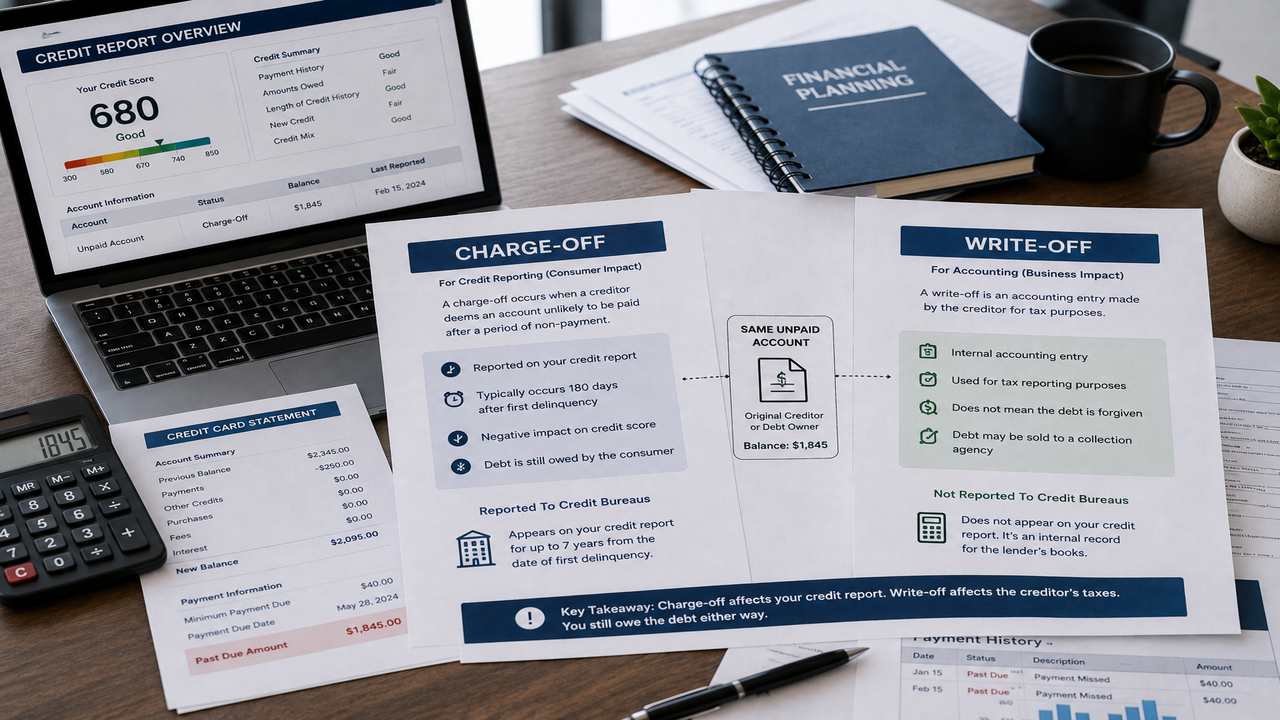
In most everyday consumer credit contexts, "charge-off" and "write-off" refer to the same underlying event where a creditor removes an unpaid debt from its active accounts. A charge-off specifically indicates that a creditor has deemed a debt uncollectible after a period of non-payment, typically 180 days. A write-off is the accounting term used by the creditor to record this bad debt on their financial statements for tax purposes. While the terms are often used interchangeably, understanding their distinct origins helps clarify their implications for both the debtor and the creditor.
The Core Definitions
A write-off, in general accounting terminology, is the broad concept of a business removing an asset — in this case, a debt owed to them — from their books because they’ve determined it’s unlikely to be collected. This is a universal accounting concept that applies across virtually every industry, not just lending: businesses write off unpaid invoices, obsolete inventory, or bad investments using the same fundamental accounting principle.
A charge-off is the specific term used within consumer lending and banking for exactly this same write-off process, applied specifically to a delinquent loan or credit account. It’s essentially “write-off” using the vocabulary specific to the lending industry, governed by particular regulatory guidance (particularly for credit cards, guided by interagency banking regulator standards recommending charge-off after 180 days of delinquency).
So in the specific context of an unpaid credit card, personal loan, or similar consumer debt, “charge-off” and “write-off” are functionally describing the same event: the creditor’s internal decision to stop counting the debt as a collectible asset and record it as a loss for accounting and tax purposes.
Why Both Terms Show Up in Different Places
You’ll typically see “charge-off” used specifically on your credit report, in communications from credit card issuers and banks, and in consumer-facing credit education content, since it’s the standard terminology within consumer credit reporting (the Metro 2 reporting format used industry-wide specifically uses “charge-off” status codes).
You’ll more often see “write-off” used in broader financial, accounting, business, and tax contexts — a company’s annual report might discuss “writing off” a category of bad debt in aggregate, an accountant might refer to “writing off” a specific client’s unpaid invoice, or general financial news might discuss a bank “writing off” a portion of its loan portfolio. It’s the more universal accounting term, while “charge-off” is the consumer-lending-specific application of that same concept.
Does the Terminology Difference Affect You Practically?
For virtually all practical consumer purposes, no. If your credit card is charged off, this is the exact same event a business accountant would describe as a write-off. It doesn’t affect:
- Whether you still owe the debt. In both framings, the answer is yes — the accounting treatment on the creditor’s books doesn’t erase your legal obligation to repay what you borrowed.
- How it’s reported to credit bureaus. Your credit report will use the “charge-off” terminology specifically, regardless of how the creditor’s internal accounting department or annual financial statements might refer to the same underlying event.
- Your rights and options. Everything covered in guidance about handling a charge-off — debt validation, settlement negotiation, understanding the seven-year reporting clock, understanding your state’s statute of limitations — applies identically regardless of which term is used to describe the event.
Where a Meaningful Difference Can Appear: Full vs. Partial Write-Offs
One place the terminology does carry a slightly different practical implication is around the concept of a partial write-off, which is more of an accounting concept than a term you’ll typically see directly on your credit report. Sometimes a creditor writes off only a portion of a debt — for example, if you settle a $5,000 balance for $2,000, the creditor might write off the remaining $3,000 as a loss on their books while recording the $2,000 as collected. In consumer-facing terms, your account would likely show as “settled” or “paid, settled for less than full balance” on your credit report, rather than a full “charge-off” status, since the account was resolved rather than remaining in a state of complete non-payment.
This distinction matters because a full charge-off typically represents a debt where essentially nothing has been recovered, while write-off language in broader financial contexts can refer to either a full or partial loss, giving it a slightly broader and more flexible technical meaning than the more binary consumer credit report status of “charged off” (which specifically indicates the account was never brought current through the creditor’s normal collection process before being written off).
How This Plays Out on Your Actual Credit Report
Your credit report itself will consistently use “charge-off” terminology (or similar Metro 2 standardized codes) rather than “write-off,” since it’s built specifically around consumer lending’s standardized reporting language. You would never see a credit report entry literally labeled “write-off” — that language exists in the broader accounting and financial world your creditor operates in internally, but it doesn’t cross over into the standardized consumer credit reporting format you’ll actually see when you pull your report.
Tax Documentation and the Terms
When a creditor issues a Form 1099-C for cancellation of debt (covered in more detail in guides specifically about charge-offs and IRS reporting), the form itself uses the term “cancellation of debt” rather than either “charge-off” or “write-off” directly, though the underlying event that typically triggers this form is the same charge-off/write-off event described throughout this guide. If a creditor considers a debt fully written off with no expectation of recovery, that’s often the trigger point for considering whether a 1099-C is required, separate from the earlier accounting-only charge-off decision that may have happened months or years prior.
A Note on Business and Commercial Debt Terminology
If you’re dealing with a business debt rather than personal consumer debt — for instance, if you’re a small business owner with an unpaid business line of credit or vendor invoice — you may encounter “write-off” used more prominently and directly in your communications with creditors and collection agencies, since business lending doesn’t always follow the exact same standardized consumer credit reporting conventions (though business credit does have its own separate reporting systems, primarily through Dun & Bradstreet, Experian Business, and Equifax Business, distinct from personal consumer credit reports). The underlying concepts — an unresolved debt eventually being recorded as an uncollectible loss — remain conceptually identical, but the specific reporting mechanisms and terminology conventions differ somewhat between personal and business credit contexts.
Common Misconceptions About Both Terms
“A write-off means the debt is forgiven and I don’t owe it anymore.”
This is the single most common and costly misconception associated with either term. Neither a charge-off nor a write-off constitutes debt forgiveness from a legal standpoint — it’s an accounting classification on the creditor’s side, and the underlying legal debt obligation typically remains fully enforceable (subject to your state’s statute of limitations) unless the creditor separately and explicitly forgives it or you resolve it through payment or a formal settlement agreement.
“Once it’s written off, the original creditor can’t do anything else about it.”
In reality, the original creditor retains the legal right to continue pursuing the debt themselves, or to sell it to a collection agency, even after a charge-off/write-off has occurred internally. The accounting classification doesn’t restrict their legal collection options.
“A write-off and a charge-off have different effects on my credit score.”
Since your credit report specifically uses “charge-off” terminology and doesn’t separately track a “write-off” as a distinct reportable status, there’s no separate or different score impact to worry about based on which term might be used in a given conversation or document you’re looking at — it’s the same underlying event with the same credit reporting consequences either way.
What Actually Matters More Than the Terminology
Rather than focusing on which specific word is being used in a given piece of communication, the more useful things to actually track are: the exact date of original delinquency (which determines your seven-year credit reporting clock), the current balance and whether it’s accurate, whether the debt has been sold to a third party and to whom, your state’s statute of limitations for the type of debt involved, and whether you’re working toward resolving it through payment, settlement, or a documented decision to let the reporting period run its course. These practical facts determine your actual options and outcomes, regardless of whether any particular document or conversation happens to use “charge-off” or “write-off” language to describe the underlying situation.
Frequently Asked Questions
Is “bad debt write-off” the same thing as a charge-off?
Yes — “bad debt write-off” is simply a more descriptive, explicit version of the general write-off concept, specifying that the asset being written off is a debt considered unlikely to be collected, which is exactly what a charge-off is within consumer lending specifically.
Will I ever see the word “write-off” directly on my credit report?
No, standard consumer credit reports use “charge-off” or related standardized status codes, not “write-off,” since that’s the terminology built into the Metro 2 reporting format used across the consumer credit reporting industry.
Does a partial settlement count as a full charge-off or a partial write-off for credit reporting purposes?
If you settle a debt for less than the full amount before it’s ever charged off, your account typically shows as “settled” or “paid, less than full balance,” a different status from a full, unresolved charge-off. If the account is charged off first and later partially recovered through a settlement with a collection agency, the reporting can vary depending on exactly how and when each party reports the resolution.
Do businesses write off consumer debt for tax purposes the same way they’d write off any other bad debt?
Generally yes, in broad accounting principle — the ability to deduct bad debt as a business loss for tax purposes follows established accounting and tax rules that apply similarly across different types of written-off receivables, though the specific tax treatment can vary by business type and the nature of the debt involved.
If a company says they’ve “written off” my debt, does that mean I don’t have to pay anymore?
Not necessarily — as covered throughout, this is an internal accounting determination on the creditor’s side, not a legal forgiveness of your obligation, unless the creditor specifically and separately states in writing that the debt is being forgiven or canceled, distinct from simply being written off their books as a loss for accounting purposes.
A Simplified Look at the Accounting Behind the Scenes
Understanding roughly what happens on the creditor’s books can demystify why this process exists at all, and why it’s handled the way it is. When you take out a loan or use a credit card, the amount you owe sits on the lender’s balance sheet as an asset — money they expect to receive. Banks and lenders are also required to maintain an “allowance for loan losses” or “allowance for doubtful accounts,” essentially a reserve fund set aside in anticipation that some percentage of loans across their portfolio won’t be repaid.
When a specific account becomes seriously delinquent and is charged off, the lender removes that specific amount from their “assets we expect to collect” category and effectively moves it against that pre-established loss reserve, formally recognizing the loss on that individual account. This is why banking regulators require charge-offs at a standardized point (180 days for most consumer revolving credit) — it ensures banks aren’t allowed to indefinitely carry clearly uncollectible debt as a healthy-looking asset on their books, which protects the broader financial system’s transparency and accuracy.
This is also, incidentally, part of why charged-off debt is often sold to third-party collectors for pennies on the dollar: once a lender has already recognized the full loss for accounting and tax purposes, any amount subsequently recovered — even a small percentage through a debt sale — is essentially “found money” from their accounting perspective, which is why debt buyers can profitably purchase charged-off accounts at steep discounts and still make a profit collecting even a fraction of the original balance.
Historical Context: Where These Terms Come From
The concept of writing off bad debt has existed in accounting practice for centuries, tracing back to fundamental double-entry bookkeeping principles that require assets to be accurately valued on a company’s books. “Charge-off” as a specific banking term became more standardized in the United States particularly through 20th-century banking regulation, as federal and state banking regulators developed more specific, standardized guidance for how and when financial institutions must recognize loan losses, partly in response to historical banking crises where institutions had been allowed to carry clearly bad debt as if it were healthy, contributing to inaccurate financial reporting and, in some cases, bank failures. The modern 180-day standard for most consumer revolving credit reflects decades of refined regulatory guidance aimed at balancing accurate financial reporting against giving struggling borrowers a reasonable window to become current before the more serious charge-off classification applies.
How This Affects Business Credit Differently From Personal Credit
If you’re a business owner, it’s worth understanding that business credit operates under a meaningfully different reporting system than personal consumer credit. Business credit bureaus (primarily Dun & Bradstreet, Experian Business, and Equifax Business) track business-specific credit files, often tied to your Employer Identification Number (EIN) rather than your Social Security Number, and they don’t universally follow the same standardized 7-year reporting window or Metro 2 format conventions used in personal consumer credit reporting. A “write-off” of unpaid vendor credit or a business line of credit can appear on a business credit file, sometimes with different reporting timelines and dispute processes than the personal consumer system, and business owners who’ve personally guaranteed a business debt (common with small business loans and credit cards) may see the same charged-off or written-off debt reflected on both their business credit file and their personal credit report simultaneously, since a personal guarantee makes the individual legally responsible in addition to the business entity itself.
A Comparison Table for Quick Reference
| Charge-off | Write-off |
|---|---|
| Context | Consumer lending, specifically |
| General business accounting (all industries) | |
| Appears on Credit reports directly | Internal financial statements, not directly on consumer credit reports |
| Governed by | Banking regulatory guidance (commonly 180-day standard) |
| General accepted accounting principles (GAAP) | |
| Does debt still exist legally? | Yes |
| Can apply to | Credit cards, loans |
| Any uncollectible asset, including but not limited to consumer debt | |
| Consumer-facing term? | Yes — this is what you’ll see and hear about your own accounts |
| Rarely — mostly an internal or broader financial industry term |
Frequently Asked Questions, Continued
If a creditor’s annual report mentions “writing off” a large amount of debt, does that mean my specific account was part of that?
Possibly, if your account was charged off during the reporting period the annual report covers, but these aggregate figures represent the combined total across potentially millions of individual accounts and don’t provide any specific information about your particular situation — you’d need to check your own credit report and account status directly to know how your specific debt was handled.
Does a write-off ever get reversed if the creditor later collects the debt in full?
From an accounting standpoint, yes — if a previously written-off debt is later recovered (whether through the original creditor’s continued collection efforts or a percentage recovered through a debt sale), that recovery is recorded as a financial recovery on the creditor’s books, sometimes called a “recovery” in their accounting records, separate from reversing the original charge-off status on your credit report, which would instead be updated to reflect your account’s new “paid” or “settled” status through the standard credit reporting update process.
Is there a difference between how the IRS treats “charge-off” versus “write-off” for tax purposes?
The IRS doesn’t distinguish based on the terminology used — what matters for tax purposes (including whether a Form 1099-C is required) is the substance of whether debt has actually been cancelled or forgiven, not which specific word a company’s internal documents happen to use to describe that determination.
Practical Steps If You’re Dealing With Either One
Regardless of which term you encounter in your specific situation, the practical response is identical, since — as established throughout this guide — they refer to the same underlying event for consumer debt purposes:
Confirm exactly what you’re dealing with.
Pull your credit report and identify the specific account, its reported balance, the original delinquency date, and whether it’s still with the original creditor or has been sold to a collection agency.
Verify the debt before paying anything.
Request debt validation if a third-party collector is involved, confirming they have the legal right to collect and that the amount claimed is accurate.
Understand both relevant timeframes.
The seven-year credit reporting window (from the original delinquency date) and your state’s separate statute of limitations on legal enforceability are both worth knowing before deciding how to proceed.
Decide on your approach.
Whether that’s paying in full, negotiating a settlement, setting up a payment plan, or — for very old debt past your state’s statute of limitations and close to falling off your credit report — deciding to let the remaining reporting period run its course without making a payment that could restart the legal enforceability clock.
Get everything in writing.
Any settlement, payment plan, or agreement about how an account will be reported going forward should be documented in writing before you send any payment, regardless of whether the conversation used “charge-off,” “write-off,” or any other terminology to describe the situation.
Why Understanding the Terminology Still Has Some Value
Even though the practical implications are identical for consumer purposes, understanding the distinction has genuine value in a few situations: it helps you read and understand financial news, annual reports, or broader economic commentary about lending and bad debt trends without confusion; it helps you communicate more precisely and confidently if you ever need to discuss your situation with a financial counselor, attorney, or tax professional; and it helps you recognize when someone — whether a well-meaning friend or a less scrupulous debt settlement company — might be using imprecise or even deliberately confusing terminology to make a situation sound different (better or worse) than it actually is. Debt settlement and credit repair scams sometimes exploit consumer confusion around exactly this kind of terminology, implying that a “write-off” is somehow different from and less serious than a “charge-off,” when in fact, for your personal credit report, they describe the identical situation.
Frequently Asked Questions, Continued Further
If I hear a debt collector use “write-off” instead of “charge-off,” should that change how I respond?
No — treat the underlying situation identically regardless of which term is used. Focus on verifying the debt, understanding your reporting and legal timelines, and getting any agreement in writing, rather than reading extra meaning into which specific word happened to be used in the conversation.
Can a creditor “un-write-off” or “un-charge-off” an account if I start making payments again?
Once an account has been formally charged off/written off and closed, creditors generally don’t reopen the original account or reverse the charge-off status on your credit report simply because you resume paying — instead, subsequent payments are typically applied toward resolving the outstanding balance, and your credit report would be updated to reflect a “paid” or “settled” status on the existing charged-off account, rather than the charge-off designation itself being erased or reversed as if it never happened.
Does a charge-off/write-off affect my ability to open a new account with the same bank in the future?
This varies by institution, but many banks maintain internal records (sometimes shared across their own internal systems, and sometimes reported to specialized consumer reporting agencies like ChexSystems for banking-specific history) that can affect your ability to open new accounts with that same institution, or sometimes other institutions, separate from and in addition to how the charge-off affects your standard credit report and score.
The Bottom Line
“Charge-off” and “write-off” describe the same fundamental event — a creditor’s decision to stop treating an unpaid debt as a collectible asset and record it as a financial loss — with “charge-off” being the specific term used within consumer lending and credit reporting, and “write-off” being the broader accounting term used across all types of business contexts. For nearly every practical purpose relevant to you as a consumer, they’re interchangeable, and neither term means your debt has been forgiven or that you’re no longer responsible for repaying it. What matters far more than the specific word used is understanding the concrete facts of your situation: the original delinquency date, the accuracy of the reported balance, who currently holds the debt, and your specific state’s statute of limitations, all of which determine your actual rights and options going forward.
Get a Credit Audit
If you’re dealing with a charge-off or write-off and want to review your credit report for inaccurate or potentially disputable information, you can request a credit audit or quote.