
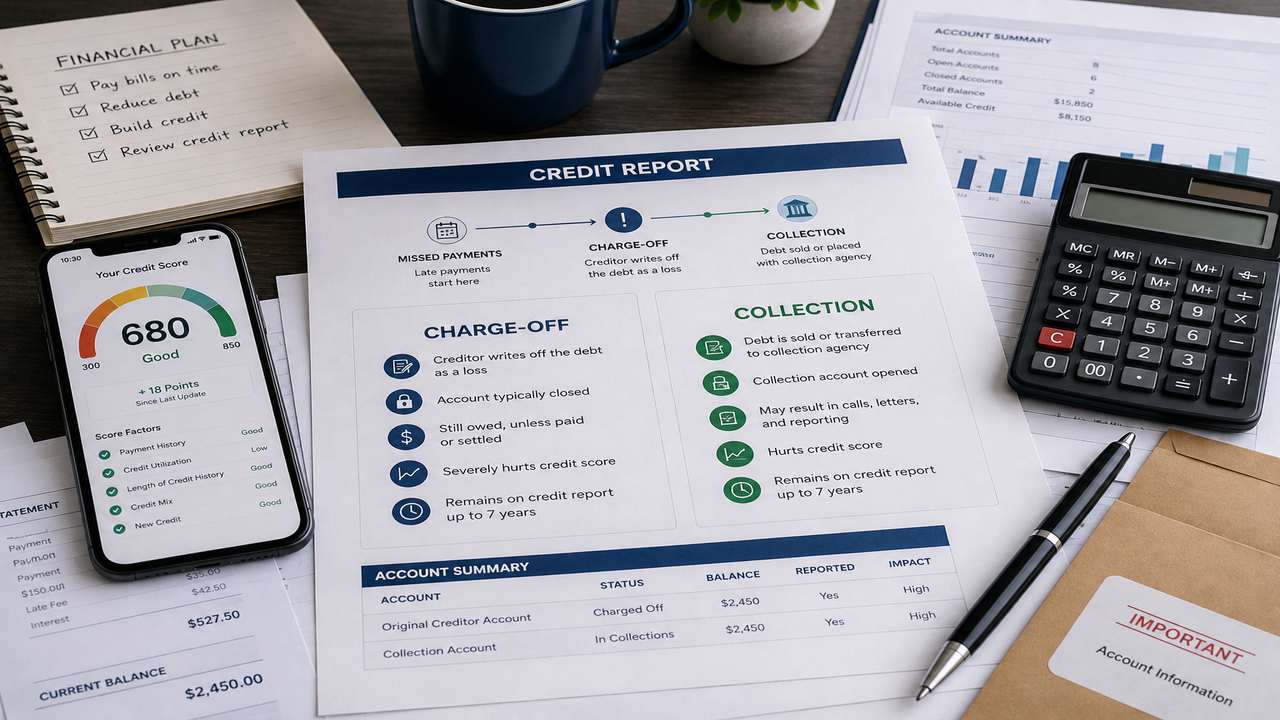
A charge-off is an internal accounting decision by an original creditor, such as a bank or credit card company, to write off a debt as uncollectible, typically occurring after 180 days of nonpayment for revolving credit. In contrast, a collection occurs when the original creditor sells or assigns the delinquent debt to a third-party collection agency or attorney. Understanding this distinction is crucial for consumers as it impacts negotiation strategies, legal rights, and how each entry affects a credit score.
This guide breaks down exactly what each term means, how one often turns into the other, and what to actually do if you’re facing either one.
What a Charge-Off Actually Means
A charge-off is an accounting decision made by the original creditor — the bank, credit card company, or lender you originally owed money to. When an account becomes seriously delinquent, typically after 180 days (six months) of nonpayment for most revolving credit like credit cards, the creditor’s internal accounting rules (often guided by federal banking regulations) require them to write the debt off as a loss on their books.
Here’s the part that surprises most people: a charge-off does not mean the debt is forgiven or that you no longer owe it. It’s purely an internal bookkeeping classification. You still legally owe the full balance. What changes is how the creditor treats the account internally — it moves from being tracked as a receivable they expect to collect, to a loss they’ve already absorbed for accounting and tax purposes.
Once an account is charged off, the original creditor typically does one of three things: continues trying to collect the debt directly (sometimes through an internal collections department), sells the debt to a third-party debt collector for a fraction of its value, or, less commonly, simply stops pursuing it (though this doesn’t erase the fact that it’s still technically owed).
What a Collection Actually Means
A “collection” refers to an account that has been placed with — or sold to — a third-party debt collection agency, or in some cases moved to a creditor’s own internal collections department. This can happen with many types of debt, not just charged-off credit cards: unpaid medical bills, utility bills, gym memberships, and personal loans can all end up in collections without necessarily going through a formal charge-off process first, particularly for debts that weren’t originally extended as revolving credit.
When a debt moves to collections, a new entity — the collection agency — now has the legal right to attempt to collect it, and depending on the arrangement, either on behalf of the original creditor (for a contingency fee) or as the new owner of the debt (having purchased it outright, usually for a small percentage of the original balance).
This is why you’ll sometimes see two separate negative entries on your credit report for what feels like a single unpaid debt: one from the original creditor showing the account as “charged off,” and a second, separate entry from the collection agency showing the same debt as a new “collection account.” Both can appear and both can affect your score, even though they represent the same underlying debt at different stages.
How the Two Terms Relate to Each Other
Think of it as a sequence rather than two unrelated categories:
- Step one: You fall behind on payments to the original creditor.
- Step two: After enough time passes (commonly 180 days for credit cards, though it varies by debt type and creditor), the original creditor charges off the account internally and reports it to the credit bureaus as a charge-off.
- Step three: The original creditor either keeps trying to collect it themselves, or — far more commonly — sells or assigns the debt to a third-party collection agency.
- Step four: If sold or assigned, the collection agency may report the debt to the credit bureaus as a new collection account, separate from the original charge-off entry.
Not every collection account started as a charge-off (medical and utility debts, for example, often go to collections without ever being formally “charged off” in the credit-card sense), and not every charge-off necessarily ends up as a separate collection entry on your report (sometimes the original creditor retains the debt and simply updates the existing entry rather than a new company reporting a fresh one). But for credit card and similar revolving debt, the charge-off-then-collection sequence is the most common path.
How Each Affects Your Credit Score
Both are serious negative marks, generally causing a significant score drop, especially for someone who otherwise had good credit. A few nuances worth understanding:
A charge-off is typically more damaging than a standard late payment because it signals the creditor gave up trying to collect through normal means — it represents a much more serious level of delinquency than a single missed payment.
Newer scoring models (FICO 9 and 10, VantageScore 3.0 and 4.0) treat paid collections more favorably than older models. Under these newer models, a collection account that’s been paid in full has less negative impact than an unpaid one, and some models ignore paid collections almost entirely. Older scoring models (still used by many lenders, particularly for mortgages) don’t make this distinction as generously, which is why paying off an old collection doesn’t always produce the score jump people expect if the lender in question is using an older model.
Medical collections are treated somewhat differently under current credit bureau policies. As of recent industry-wide changes, paid medical collections are generally removed from credit reports entirely, and there’s typically a waiting period (commonly one year) before unpaid medical debt is even reported in the first place, along with a rising minimum dollar threshold below which many medical collections aren’t reported at all. This treatment doesn’t automatically extend to non-medical debts.
Both stay on your report for roughly the same length of time — seven years from the date of the original delinquency that led to the charge-off, not seven years from when the account was sold to collections or from when a collection agency starts reporting it. This is a critical and frequently misunderstood point.
How Long Do Charge-Offs and Collections Stay on Your Credit Report?
Under the Fair Credit Reporting Act, most negative information — including charge-offs and collections — can only be reported for seven years, measured from the date of first delinquency on the original account, not from any later event. This means:
If you stopped paying a credit card in January 2020, and it charged off in July 2020, and the debt was then sold to a collection agency in 2022 that started reporting its own collection entry — that collection entry’s seven-year clock still runs from January 2020, the original delinquency date, not from 2022 when the collector started reporting.
This matters enormously because some debt collectors (usually the less scrupulous ones) will report an old debt as if the clock restarts each time it’s sold to a new collector, sometimes even after making a partial payment, hoping consumers won’t know better. Making a payment on old debt does not reset the seven-year reporting clock, though it’s worth noting this is different from your state’s separate statute of limitations on legally suing you for the debt, which is a distinct concept covered below.
What is the Difference Between Charge-Offs, Collections, and the Statute of Limitations?
This is one of the most consequential mix-ups in personal finance, so it deserves its own section. There are two entirely separate clocks running on an old debt, and confusing them can cost you real money or land you back in a debt you thought was behind you.
The credit reporting period (seven years, discussed above) governs how long the debt can appear on your credit report. This is a federal rule under the FCRA and doesn’t vary by state.
The statute of limitations governs how long a creditor or collector can sue you in court to legally compel payment. This varies significantly by state (commonly anywhere from 3 to 10 years depending on the state and the type of debt) and is based on state contract law, separate from credit reporting rules.
Here’s the dangerous part: in many states, making even a small payment on an old, expired-statute debt, or in some cases simply acknowledging in writing that you owe it, can restart the statute of limitations clock, making you newly vulnerable to a lawsuit on a debt that was previously too old to be legally enforced through the courts. If you’re dealing with an old debt and you’re unsure whether your state’s statute of limitations has expired, this is worth researching or consulting a consumer law attorney about before making any payment, especially on a debt you weren’t planning to pay in full anyway.
What to Do If You Have a Charge-Off or Collection
Verify the debt is actually yours and accurate. Under the Fair Debt Collection Practices Act, you have the right to request a “debt validation letter” within 30 days of first being contacted by a collector, requiring them to prove the debt is legitimate, the amount is correct, and they have the right to collect it. Errors and mistaken-identity cases are common enough that this step is always worth doing before agreeing to anything.
Check for reporting errors. Confirm the original delinquency date is accurate (since this determines when the seven-year reporting window actually ends), that the balance is correct, and that it isn’t being reported by both the original creditor and multiple collection agencies for the same debt (a practice sometimes called “double reporting” that can unfairly compound the damage to your score).
Decide on a strategy: pay in full, settle, or wait it out. Paying in full resolves the debt completely and, under current scoring models, is viewed more favorably than an unpaid balance. Settling for less than the full amount (common with collection agencies who bought the debt cheaply and are often willing to accept 30-60% of the balance) resolves the debt but may still show as “settled” rather than “paid in full,” which some models treat slightly less favorably. Waiting it out until the seven-year reporting period expires is an option if the debt is old and you’re not concerned about being sued (only advisable once you’ve confirmed your state’s statute of limitations has also passed, given the restart risk covered above).
Get any settlement agreement in writing before paying. Verbally agreed-upon settlements are difficult to enforce if a collector later claims you still owe the difference. Always get written confirmation of the settlement terms, and after paying, request written confirmation that the debt is settled in full.
Consider a “pay for delete” request, understanding its limitations. Some consumers negotiate directly with a collector to remove the entry entirely from their credit report in exchange for payment, rather than just marking it “paid.” This isn’t guaranteed and isn’t officially endorsed by the major credit bureaus (some collectors’ agreements with the bureaus actually prohibit this practice), but some smaller collection agencies will still agree to it. Always get any such agreement in writing before sending payment.
Common Mistakes People Make
- Assuming a charge-off means the debt disappears. As covered above, it’s an accounting term, not debt forgiveness. The debt is still owed and can still be pursued or sold to a collector.
- Making a payment on an old debt without checking the statute of limitations first, inadvertently restarting the clock on a debt that was otherwise close to becoming legally unenforceable in court.
- Ignoring collection notices entirely, which doesn’t make the debt go away and can result in a default judgment if the collector eventually sues and you don’t respond.
- Paying a collector without getting written confirmation, then having no proof if a dispute arises later about whether the debt was actually settled.
- Not disputing an inaccurate original delinquency date, which can cause a debt to remain reportable years longer than it legally should.
Frequently Asked Questions
Can a charge-off and a collection for the same debt both appear on my credit report at once?
Yes, this is common. The original creditor’s charge-off entry and the collection agency’s separate entry can both appear simultaneously, even though they represent the same underlying debt, since each company reports independently.
Does paying off a charge-off improve my score immediately?
It depends on the scoring model a particular lender uses. Newer models treat a paid charge-off more favorably than an unpaid one; some older models (still used in mortgage underwriting, for example) give less credit for simply having paid it, though it’s still generally better to have it marked paid than to leave it unpaid.
Is it better to let a debt go to collections or settle with the original creditor first?
Settling with the original creditor before it’s sold to a collector is usually preferable when possible, since you’re negotiating directly with the party that has the clearest records and often more flexibility, and it can sometimes prevent the debt from generating a second, separate collection entry on your report.
Can I be sued for a charge-off debt?
Yes, both the original creditor (before charge-off, and sometimes after) and any collection agency that buys the debt can potentially sue you for payment, as long as your state’s statute of limitations for that type of debt hasn’t expired.
What’s the difference between “charged off” and “charged off as bad debt”?
These typically mean the same thing and both indicate the creditor has written off the balance as a loss internally. Some reports use slightly different phrasing depending on the creditor’s internal terminology, but the underlying meaning and credit impact are the same.
Side-by-Side Comparison
| Category | Charge-Off | Collection |
|---|---|---|
| Who reports it | Original creditor | Collection agency (or original creditor’s internal collections unit) |
| When it happens | Typically after 180 days of nonpayment | Can happen with or without a prior charge-off, depending on debt type |
| Do you still owe the money? | Yes | Yes |
| Governed primarily by | Internal accounting rules, bank regulations | Fair Debt Collection Practices Act (FDCPA) |
| Reporting clock | 7 years from original delinquency date | Same 7 years from original delinquency date (not reset by sale) |
| Common for | Credit cards, personal loans | Credit cards, medical bills, utility bills, personal loans |
| Can appear alongside | A separate collection entry for the same debt | A separate charge-off entry for the same debt |
What Are the Tax Implications of a Charge-Off?
Here’s a detail that catches a lot of people off guard: if a creditor charges off $600 or more of your debt and doesn’t expect to collect any more of it, they may be required to send you (and the IRS) a Form 1099-C, “Cancellation of Debt.” The IRS generally treats forgiven debt as taxable income, meaning that charged-off amount could increase your tax bill for that year.
This doesn’t apply to every charge-off — remember, a charge-off is an internal accounting move and doesn’t necessarily mean the creditor has given up on collecting or formally forgiven the debt. A 1099-C is specifically triggered when the creditor identifies the debt as cancelled or forgiven, which is a distinct, later event from the charge-off itself. If a collector later gets you to settle the debt for less than the full amount, that forgiven difference can also trigger a 1099-C.
If you receive a 1099-C for debt you’re still being pursued to pay (which does happen, and is a legitimate point of confusion, sometimes stemming from a company’s own inconsistent internal processes), it’s worth consulting a tax professional, since there are some exceptions and exclusions — including insolvency at the time of cancellation — that may reduce or eliminate the tax impact.
How These Entries Affect a Loan Application, Beyond Just the Score
A lender reviewing your application for a mortgage, auto loan, or even a new credit card doesn’t just see your score — many pull the full credit report and review specific line items manually or through automated underwriting rules. A charge-off or collection can trigger issues beyond the numerical score hit:
Debt-to-income calculations. Some loan underwriting guidelines require unpaid collection balances above a certain threshold to be paid off, or at least factored into your debt-to-income ratio, before a mortgage can be approved — even if your score otherwise qualifies.
Manual underwriting flags. An open, unresolved charge-off or collection can trigger a manual review or a request for a “letter of explanation” as part of a mortgage application, adding time and complexity to the process even if the account is old.
Automatic denials under certain lending criteria. Some lenders, particularly for premium credit products, have policies that automatically decline any applicant with an open collection above a certain dollar amount, regardless of overall score.
This is part of why resolving old charge-offs and collections — even ones old enough that their credit score impact has faded somewhat — can still matter meaningfully when you’re getting ready to apply for a major loan.
Sample Scripts for Negotiating
Having a rough script ready can make these conversations far less intimidating. A few starting points:
What to Say for a Settlement Negotiation?
“I’d like to resolve this account. I’m not able to pay the full balance, but I could pay [X amount] as a full and final settlement if we can agree on that today. Can you send me written confirmation of the settlement terms before I make the payment?”
What to Say When Requesting Debt Validation?
“I’m requesting validation of this debt under the Fair Debt Collection Practices Act. Please send me written proof of the original creditor, the amount owed, and confirmation that your company has the legal right to collect this debt.”
What to Say for a Pay-for-Delete Request?
“If I pay this balance in full, would you be willing to request removal of this entry from my credit report entirely, rather than reporting it as paid? I’d need that agreement in writing before sending payment.”
Always follow up any verbal agreement with a written request for confirmation, sent by mail or a documented method, and keep copies of everything.
Frequently Asked Questions, Continued
Can a company keep selling my debt to different collectors indefinitely?
Yes, technically a debt can be sold multiple times to different collection agencies over the years, with each new owner potentially reporting their own entry. However, the original seven-year reporting clock still applies regardless of how many times it’s resold, and consumers should watch for collectors trying to represent an old debt as “new” simply because they recently acquired it.
Does settling a debt for less than owed hurt my score more than paying in full?
Both a “settled” and a “paid in full” status are generally viewed as significant improvements over an unpaid, open balance. Some models and lenders view “paid in full” slightly more favorably than “settled for less than the full amount,” but the difference is generally smaller than the difference between paying (in any form) versus leaving it unresolved.
What happens if I ignore a collection account completely?
The account will likely remain on your credit report as unpaid until the seven-year reporting period expires, and depending on your state’s statute of limitations, you could still be sued for the balance during that window. Ignoring it doesn’t stop collection attempts and can result in a default judgment if a lawsuit is filed and you don’t respond in court.
If a collection is removed after a successful dispute, does the corresponding charge-off also get removed?
Not automatically — they’re separate entries reported by separate companies. If you successfully dispute and remove a collection agency’s entry (for example, because they couldn’t validate the debt), the original creditor’s charge-off entry, if accurate, can still legally remain on your report until the seven-year window expires.
A Real-World Example Walkthrough
To make the sequence concrete, here’s how a typical credit card charge-off unfolds in practice:
What Happens During Months 1-5 of Missed Credit Card Payments?
You miss payments on a credit card with a $2,000 balance. Each missed payment is reported separately as 30, 60, 90, then 120 days late, each one a distinct negative mark and each one progressively worse for your score.
What Happens When a Credit Card Account is Charged Off at Month 6 (180 Days)?
The credit card issuer charges off the account, reporting it to the bureaus as “charged off” with a balance of roughly $2,000 plus any accrued interest and fees. Your score, if it hasn’t already dropped substantially from the preceding late payments, takes another significant hit here.
What Happens to Charged-Off Debt During Months 7-9 (Collection or Sale)?
The issuer either continues attempting to collect internally, or — more commonly for a debt this size — sells it to a third-party collection agency for a fraction of the balance, often somewhere between 4 and 20 cents on the dollar depending on the debt’s age and type.
What Happens When a Collection Account is Reported at Month 9?
The collection agency begins contacting you and reports a new “collection account” entry to the credit bureaus, separate from the original charge-off, often for the same approximate balance (sometimes slightly higher if additional collection fees or interest are added, depending on what’s legally permitted in your state and your original credit agreement).
Your report now shows two negative entries for what is, from your perspective, a single unpaid $2,000 credit card debt: the original charge-off from the card issuer, and the new collection account from the agency that bought it. Both count the seven-year clock from the same original delinquency date — month 1 above — not from when the collection agency started reporting in month 9.
If you settle with the collection agency in month 15 for $800 (a common type of settlement offer, since the agency likely paid far less than that to acquire the debt), the collection entry updates to “settled” or “paid,” but the original charge-off entry from the card issuer may still show the original unpaid status unless you separately negotiate with them or they update the record based on notification from the debt sale — this is exactly the kind of detail worth confirming and, if necessary, disputing to ensure accuracy.
How Different Debt Types Typically Flow Through This Process
Credit cards almost always follow the charge-off-then-collection path described throughout this guide, given standard banking regulations requiring charge-off after 180 days of delinquency.
Medical debt usually skips the formal “charge-off” terminology entirely and goes straight from an unpaid bill to a collection account, often after the provider’s billing department has made several attempts to collect. As mentioned earlier, medical collections now have more consumer-friendly reporting rules than most other debt types, including a required waiting period before reporting and removal once paid.
Personal loans and installment loans follow a process similar to credit cards, though the specific delinquency timeline before charge-off can vary by lender and loan type.
Utility and telecom debt typically goes to collections relatively quickly after non-payment, without an intermediate charge-off stage in the credit-card sense, since utility companies aren’t structured the same way as bank lenders for accounting purposes.
Auto loans, if unpaid, more commonly result in repossession before or alongside collections activity, since the vehicle serves as collateral — the lender may repossess and sell the car, then pursue you in collections for any remaining “deficiency balance” if the sale didn’t cover the full amount owed.
Frequently Asked Questions, Continued Further
Can I negotiate directly with the original creditor even after the debt has been charged off?
Sometimes, if the original creditor hasn’t yet sold the debt to a collector. It’s worth asking directly whether they still hold the debt internally or have already sold or assigned it elsewhere, since negotiating with whoever currently owns the debt is the only way to reach a binding agreement.
Does a charge-off automatically mean my account is closed?
Typically yes for the original account — once charged off, the account is no longer usable for new charges even if you later pay off the balance. Paying off a charged-off account settles the debt but doesn’t typically reopen the original credit line.
If I pay off a collection, will it say “paid” forever, or does it eventually disappear?
It will typically show as “paid” or “settled” for the remainder of the original seven-year reporting window from the initial delinquency date, then age off your report entirely once that window closes, the same as any other negative entry.
Are charge-offs and collections treated the same by every lender?
No — different lenders and loan products use different underwriting criteria and sometimes different scoring models, so the practical weight given to an old charge-off or collection can vary meaningfully depending on what you’re applying for and which lender is reviewing it.
The Bottom Line
A charge-off marks the point where your original creditor gives up trying to collect through normal channels and writes the debt off internally — but you still owe it. A collection marks the point where a separate agency, often having bought the debt cheaply, takes over trying to get you to pay. Both are serious credit report entries, both follow the same seven-year reporting clock from the original delinquency date, and neither should be confused with your state’s separate statute of limitations on legal enforceability. Understanding which stage a debt is in, verifying every detail is accurate, and getting any resolution in writing puts you in a far stronger position than simply reacting to collection calls as they come.
Why Should You Get a Credit Audit for Charge-Offs or Collections?
If you’re dealing with a charge-off, collection, or both, reviewing all three credit reports can help you understand exactly what is being reported and identify potential inaccuracies.