
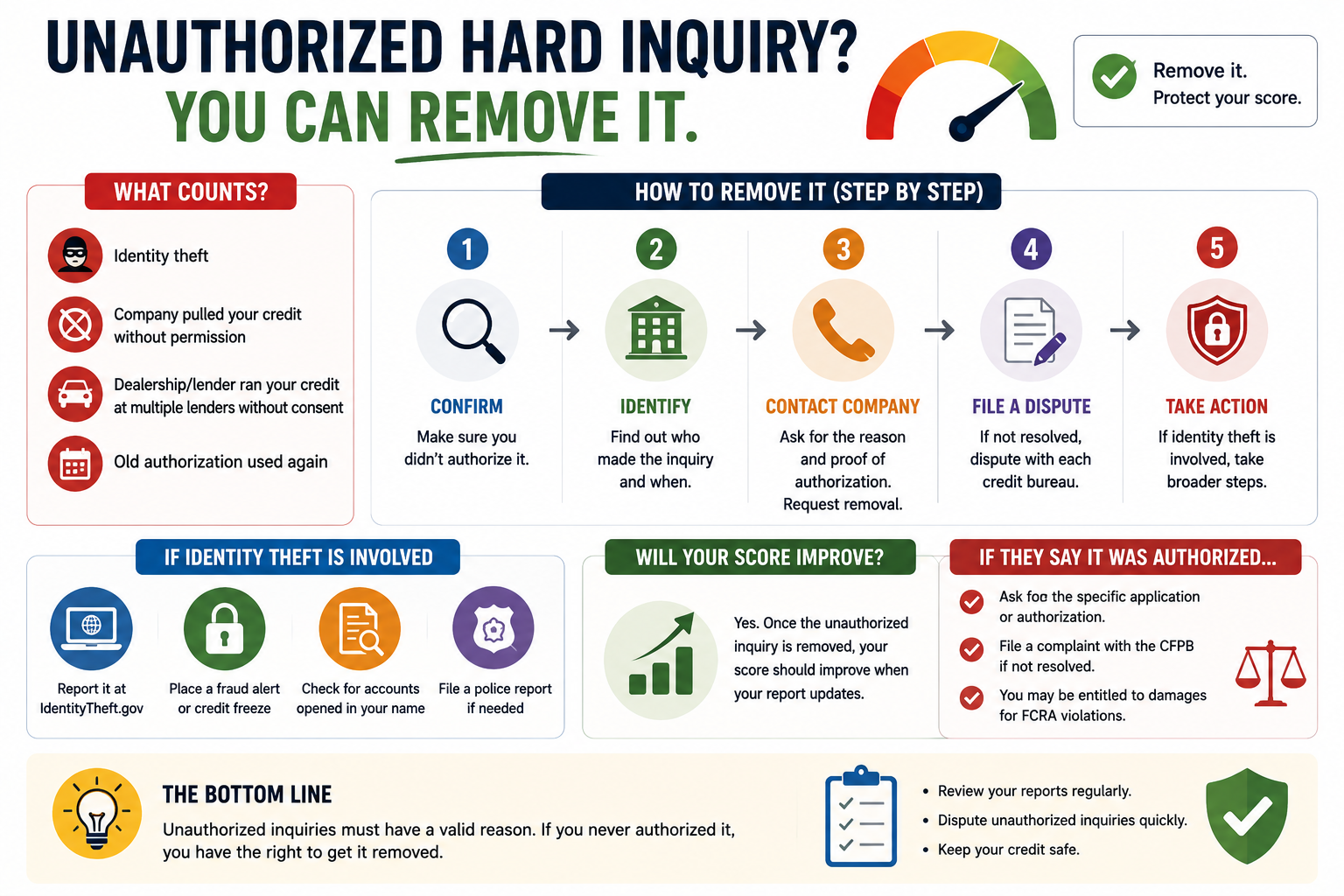
Yes — and this is one of the more clear-cut, successfully disputable issues in credit reporting, precisely because an unauthorized inquiry is, by definition, not something you consented to, which makes it a genuine FCRA violation rather than a judgment call about accuracy. Here’s exactly how to identify and remove one.
Yes, you can remove a hard inquiry you never authorized from your credit report. Credit-repair.com states that this is a clear-cut and successfully disputable issue because an unauthorized inquiry violates the Fair Credit Reporting Act (FCRA) by definition, as it lacks your consent. Unauthorized inquiries typically arise from identity theft, a company pulling credit without your application, multiple lender pulls without explicit authorization for each, or the reuse of an old authorization.
What Counts as an “Unauthorized” Inquiry
Under the Fair Credit Reporting Act, a hard inquiry is only permitted when there’s a legitimate “permissible purpose” — generally, that you applied for credit, or a company has an existing account relationship with you that allows periodic review. Unauthorized inquiries typically fall into a few categories:
– **Identity theft** — someone applied for credit fraudulently using your information.
– **A company pulling your credit without your application** — sometimes due to error, sometimes due to a company mistakenly treating a soft inquiry-eligible action (like a pre-approval check) as a hard pull.
– **A dealership or lender running your credit at multiple different lenders without your explicit authorization** for each — common in car dealership financing, where “shotgunning” your application to multiple lenders sometimes happens without clear, itemized consent for each pull.
– **An old authorization being used again later** — for example, a gym membership or service provider running a credit check for a purpose you didn’t authorize at the time.
Step 1: Confirm You Genuinely Didn’t Authorize It
Before disputing, take a moment to genuinely rule out an authorized inquiry you may have simply forgotten about — a store credit card application at checkout, a “check if you’re pre-qualified” tool that actually resulted in a hard pull rather than a soft one (some tools aren’t as clearly labeled as they should be), or an application you made a while back that’s easy to forget. Disputing an inquiry you did authorize, even by mistake, wastes time and doesn’t help your credibility for genuinely unauthorized items.
## Step 2: Identify Exactly Who Made the Inquiry
Your credit report will show the name of the company that pulled your credit and the date. If the name is unfamiliar or unclear (sometimes inquiries show under a financing partner’s name rather than the retailer you actually interacted with), a quick search of the company name alongside “credit inquiry” often clarifies who they are and what kind of transaction typically triggers their pull — this can help you determine whether it’s likely a legitimate inquiry you’ve simply forgotten, or a genuine unauthorized pull.
Step 3: Contact the Company Directly First
Before going straight to a formal dispute, it’s often faster to contact the company listed as making the inquiry and ask them to explain the permissible purpose for the pull. Ask specifically:
– What date did you authorize this inquiry, and through what application or transaction?
– Can you provide documentation of my authorization?
If they can’t produce a legitimate basis, ask them to submit a request to the credit bureaus to remove the inquiry — many companies will do this directly once they realize it was made in error or without proper authorization, since they have their own compliance interest in not making improper pulls.
Step 4: File a Formal Dispute With the Credit Bureau
If the company doesn’t respond or doesn’t resolve it, file a dispute directly with each bureau reporting the unauthorized inquiry:
– Identify the specific inquiry (company name, date).
– State clearly that you did not authorize this inquiry and have no relationship or application history that would explain it.
– Request removal based on the lack of permissible purpose under FCRA.
Step 5: If Identity Theft Is Involved, Take Broader Action
If the unauthorized inquiry is tied to identity theft (someone applied for credit using your information without your knowledge), this requires a broader response beyond just disputing the inquiry:
– **File a report at IdentityTheft.gov**, the FTC’s dedicated resource, which generates an official identity theft report and a personalized recovery plan.
– **Place a fraud alert or credit freeze** with all three bureaus to prevent further unauthorized inquiries or account openings while you sort out the situation.
– **Check for any accounts that may have actually been opened**, not just inquiries — an unauthorized inquiry sometimes indicates a fraudulent application that was denied, but it’s worth confirming nothing was actually opened in your name as a result.
– **File a police report** if a fraudulent account was actually opened, which is often required documentation for disputing the resulting account with creditors and bureaus.
Does an Unauthorized Inquiry’s Removal Restore Lost Points Automatically?
Generally, yes — since the removal corrects the underlying data your score was calculated from, your score should reflect the correction once the inquiry is removed and your file is recalculated, typically within the normal processing timeline following a successful dispute.
What If the Company Insists the Inquiry Was Authorized, But You Disagree?
This is where it becomes your word against theirs, and documentation matters:
– **Request the specific application or authorization they’re relying on** — a legitimate company should be able to produce this if the inquiry was genuinely authorized.
– **If they can’t produce documentation and continue to insist it was authorized**, escalate to a CFPB complaint, which requires a company response and often results in more serious attention than a standard dispute.
– **If significant financial harm resulted** (a loan denial specifically due to a fraudulent or improper inquiry, for example), this may be worth discussing with a consumer protection attorney, since FCRA violations can carry statutory damages in some cases.
Common Scenarios Worth Special Attention
**Car dealership “shotgunning.”** If you applied for financing at a dealership and multiple, seemingly unrelated lenders show inquiries you don’t recognize, this sometimes happens when a dealership submits your application to several lenders simultaneously without clearly disclosing that each would result in a separate hard pull. While dealerships often have some legitimate basis for shopping your application (and mortgage/auto rate-shopping deduplication windows may limit the scoring damage, as covered in our hard inquiry point-impact guide), a genuinely excessive or undisclosed number of pulls is worth questioning directly with the dealership.
**”Pre-qualification” tools that turn into hard pulls.** Legitimate pre-qualification tools use soft inquiries specifically so you can check your odds without any score impact. If a tool marketed as “check your rate, no impact to your credit” results in a hard inquiry anyway, this is worth disputing both with the company directly (as a potential violation of their own stated terms) and, if unresolved, with the bureau.
The Bottom Line
An inquiry you never authorized is one of the more straightforward, successfully disputable credit report issues, precisely because FCRA requires a permissible purpose for any hard pull, and “you didn’t consent” is about as clear a lack of permissible purpose as exists. Confirm you genuinely don’t recognize the inquiry, contact the company directly first, escalate to a formal bureau dispute if needed, and if it’s tied to identity theft, treat it as part of a broader identity theft response rather than an isolated inquiry issue.