Blog

  • How Soon Can You Rebuild Credit After Bankruptcy Discharge?

    Bankruptcy feels like it should be the end of the credit conversation, but for most people who go through it, discharge is actually closer to the beginning of a fairly well-defined rebuilding process — one that, done right, can produce meaningfully better credit within a shorter window than most people assume, even though the bankruptcy itself remains on your report for years.

    ## Immediately After Discharge: What Your Report Actually Shows

    Once your bankruptcy is discharged, your report will show:
    – The bankruptcy filing itself, listed as a public record-style entry (Chapter 7 stays for 10 years from filing date; Chapter 13 for 7 years from filing date).
    – Each individual account that was included in the bankruptcy, typically updated to show a status like “included in bankruptcy” or “discharged,” rather than showing as a simple charge-off or collection.
    – Any accounts **not** included in the bankruptcy (if you reaffirmed a debt, like keeping a car loan) continuing to report normally based on your payment behavior on those.

    One important nuance: accounts discharged in bankruptcy typically stop dragging your score down as heavily as an ordinary unpaid collection would, because “discharged in bankruptcy” is a distinct status that most scoring models treat somewhat differently — you’re not going to see continued monthly late-payment style reporting on a discharged account, since there’s no ongoing obligation to report against.

    ## Can You Start Rebuilding Immediately?

    Yes — there’s no waiting period required before beginning to rebuild, and in fact, starting immediately is exactly the right strategy, since the sooner positive history starts accumulating, the sooner it begins offsetting the bankruptcy’s weight on your score.

    ## Step 1: Get a Secured Credit Card

    This is the standard, most reliable first step. A secured card requires a cash deposit (often $200-500) that becomes your credit limit, which removes the risk that makes it hard to get approved for unsecured credit right after bankruptcy.

    Key practices:
    – **Use it lightly** — charge something small and recurring (a subscription, gas), and pay it off in full every month.
    – **Keep utilization low** — even though it’s a small limit, staying under 30% (ideally under 10%) of that limit matters just as much as it would on a larger card.
    – **Confirm it reports to all three bureaus** — not all secured cards do, and this is a dealbreaker requirement; check before applying.

    Most secured card issuers report your first positive payment within a single billing cycle, meaning positive history can start appearing on your report within 30-60 days of opening the account.

    ## Step 2: Consider a Credit-Builder Loan

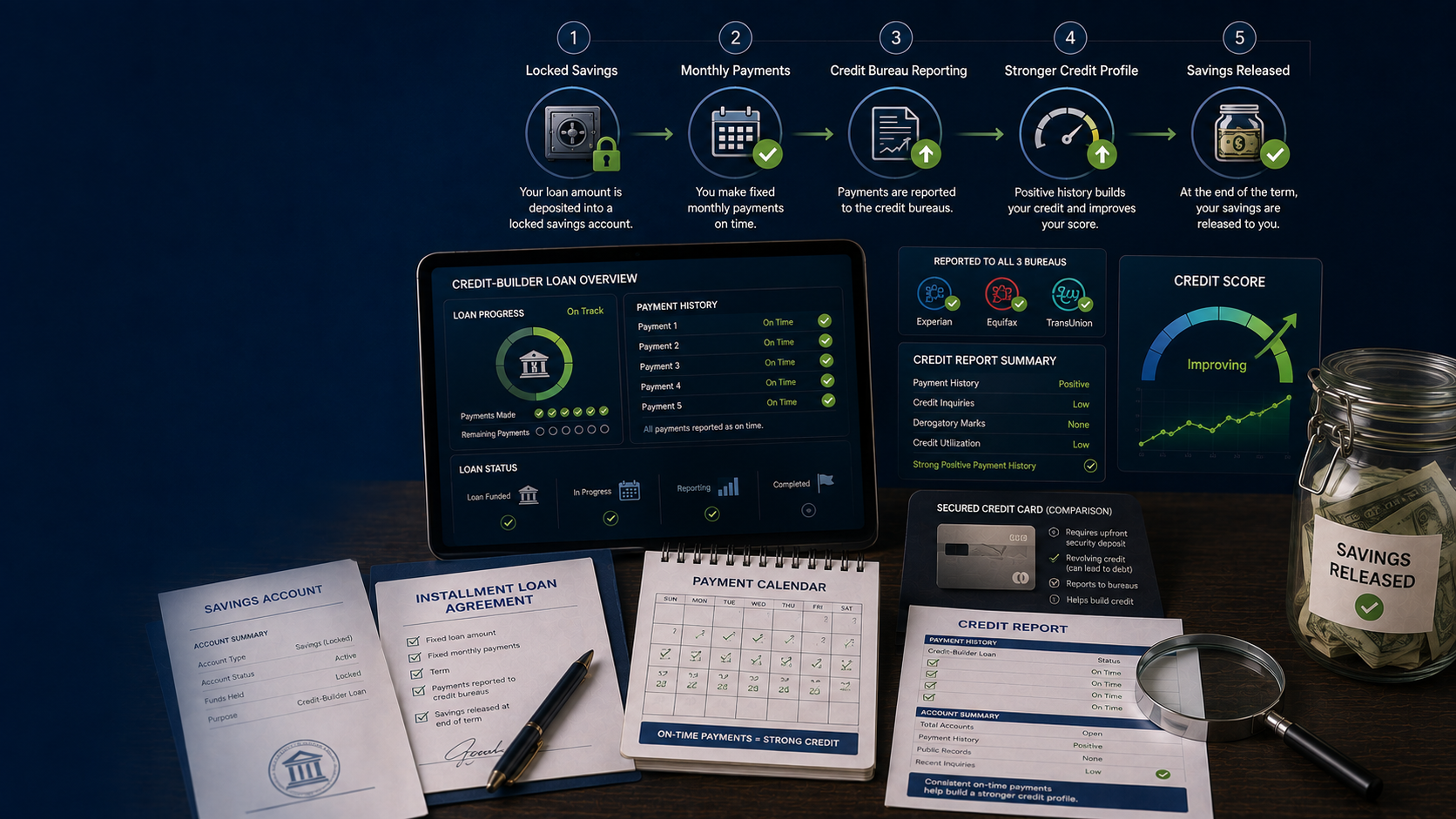
    Credit-builder loans work differently — instead of receiving the loan amount upfront, the funds are held in an account while you make fixed monthly payments, and you receive the money (plus, sometimes, a small amount of interest) at the end of the term. These are widely available through credit unions and some online lenders specifically designed for post-bankruptcy or thin-file borrowers.

    This adds a different type of positive history (installment credit) to complement the revolving credit history from a secured card, which helps your credit mix — a smaller but real scoring factor.

    ## Step 3: Some Accounts May Survive Automatically

    If you reaffirmed certain debts during bankruptcy (common with auto loans, since reaffirmation lets you keep the car and the loan rather than surrendering it), continued on-time payments on that reaffirmed loan continue building positive history throughout and after the bankruptcy process, uninterrupted. If you have a reaffirmed account in good standing, that’s already working in your favor from day one post-discharge.

    ## Realistic Timeline for Score Recovery

    This varies significantly based on your pre-bankruptcy credit profile and how aggressively you rebuild, but general patterns:

    – **0-6 months post-discharge**: initial secured card/credit-builder loan accounts open and start reporting; score often remains in a lower range during this period since there isn’t yet enough new history to meaningfully offset the bankruptcy.
    – **6-12 months**: consistent on-time payments and low utilization on new accounts typically produce noticeable score improvement; many people see their score move into a “fair” range during this window if they’ve been disciplined.
    – **12-24 months**: with continued clean history, scores often reach a “good” range, sometimes qualifying for unsecured credit cards and better loan terms, even though the bankruptcy itself is still listed on the report.
    – **2-4 years**: many people who rebuild diligently reach scores that qualify for mainstream mortgage and auto loan rates, despite the bankruptcy remaining visible for years beyond this point.

    It’s worth emphasizing: the bankruptcy notation remaining on your report does **not** mean your score can’t recover to a strong range well before the notation itself falls off. Recency matters enormously in most scoring models — a bankruptcy from 3 years ago with 3 years of clean, positive history since carries much less weight than a fresh one, even though both show the same “10 years from filing” removal date.

    ## When You’ll Likely Get Approved for Unsecured Credit Again

    This varies by lender, but general patterns:
    – Store/retail credit cards: sometimes available within 6-12 months post-discharge, given their generally lower underwriting standards.
    – Mainstream unsecured credit cards: often available within 12-18 months with a solid rebuilding track record.
    – Auto loans: available immediately in many cases, though often at higher interest rates initially, improving as your post-bankruptcy history builds.
    – Mortgages: typically require a waiting period specific to the loan program — FHA loans often require about 2 years from Chapter 7 discharge (sometimes less with documented extenuating circumstances), conventional loans often 4 years, though these vary and are worth confirming directly with your target lender.

    ## Common Mistakes That Slow Recovery

    – **Applying for too much new credit too quickly**, generating multiple hard inquiries in a short window, which works against you exactly when you’re trying to look stable and low-risk.
    – **Closing the secured card once approved for an unsecured one**, which can shorten your average account age and reduce available credit.
    – **Missing a payment on a new rebuilding account** — since you’re working with a thin, fragile new file, a single late payment during this period has an outsized impact compared to the same mistake on an established file.
    – **Ignoring reaffirmed debts** — if you reaffirmed a loan, missing payments on it post-bankruptcy is treated as an ordinary new delinquency and can be especially damaging given how closely your file is likely being watched by lenders during this period.

    ## Should You Check Your Credit Report for Accuracy Post-Discharge?

    Yes, and this is an important, often-skipped step. Accounts included in bankruptcy should be updated to reflect the discharge — not continue showing as open with an outstanding balance, and not show continued late payment reporting after the discharge date. It’s common for furnishers to fail to update this properly, and an inaccurately reported “still owing” balance on a discharged account is both incorrect and actively harmful, since it makes your file look worse than your actual legal situation. This is worth disputing directly if you spot it.

    ## The Bottom Line

    You can and should start rebuilding credit immediately after bankruptcy discharge — there’s no waiting period, and the sooner positive history starts accumulating, the sooner it begins meaningfully offsetting the bankruptcy’s weight on your score. A secured card and a credit-builder loan, used consistently and paid on time, typically produce noticeable score improvement within 6-12 months and can position you for mainstream credit products within 1-2 years, even though the bankruptcy notation itself remains visible on your report for 7-10 years.

  • What Happens to Your Credit Score After 7 Years of Bad Credit?

    The “seven-year rule” is one of the most widely known facts about credit reporting, and also one of the most widely misunderstood. People often treat it as a single, simple countdown — as if your entire credit history resets on one specific date — when the reality is more granular and, honestly, better news than most people expect.

    ## The Seven-Year Rule Applies Per Item, Not to Your Whole File

    Each negative item on your credit report has its own individual seven-year clock (with a few notable exceptions, covered below), starting from its own **date of first delinquency** — not from when you paid it, not from when it was sold to a collector, and not from today’s date.

    This means if you had a rough financial stretch with multiple negative marks landing over, say, an 18-month period, those items don’t all disappear on the same day. They fall off individually, spread across a window of time, based on when each one’s underlying delinquency actually began.

    ## What Falls Off at Seven Years

    Standard negative items governed by the seven-year rule include:
    – Late payments
    – Collection accounts
    – Charged-off accounts
    – Most civil judgments (though as covered in our judgment-specific guide, these largely aren’t reported to standard credit files at all anymore under current bureau policy)
    – Repossessions
    – Foreclosures

    ## Exceptions to the Seven-Year Rule

    A few items follow different timelines:

    – **Chapter 7 bankruptcy**: stays on your report for **10 years** from the filing date, not seven.
    – **Chapter 13 bankruptcy**: generally **7 years** from the filing date, since it involves a repayment plan rather than full discharge of debts without repayment.
    – **Unpaid tax liens**: historically could remain indefinitely if unpaid; as with civil judgments, tax lien data was largely removed from standard credit bureau reporting starting in 2018, so this is less commonly an active issue today, but worth verifying your specific situation if you have an old lien.
    – **Hard inquiries**: fall off after **2 years**, much shorter than derogatory marks, and also stop affecting your score well before they even disappear from the report (typically their scoring impact fades to negligible after about 12 months).
    – **Student loan default status**: technically follows the standard 7-year rule from date of default, but defaulted federal student loans have

    unique rehabilitation programs that can affect how the account is reported well before the natural 7-year window.

    ## What Actually Happens When an Item Falls Off

    This is the part people often get wrong: the item doesn’t gradually fade — it’s supposed to be **completely removed** from your credit report once it hits the reporting limit. Credit bureaus are required under FCRA to stop reporting items once they age past their legal reporting window.

    In practice, though, this doesn’t always happen automatically and cleanly:

    – **Bureaus sometimes miss the removal date**, especially if the reported date of delinquency was inaccurate or unclear.
    – **A debt sold to a new collector** can sometimes result in a new tradeline being created with an incorrect (later) date of first delinquency — this is illegal re-aging, but it happens, and it’s one of the more important things to actively check for as your seven-year mark approaches.
    – **You may need to actively verify and dispute** an item that’s still showing past its legal reporting window, rather than assuming it will simply vanish on schedule.

    ## How to Check When Something Should Fall Off

    1. Locate the account on your credit report and find the **date of first delinquency** (sometimes labeled differently depending on the bureau, but this is the key date — not the date it was charged off, not the date it was sold to collections, not today’s date).
    2. Add seven years (or ten, for Chapter 7 bankruptcy).
    3. If that date has passed and the item is still showing, dispute it directly, citing that it’s exceeded the legal reporting window under FCRA.

    ## What Your Score Actually Does as Items Age (Before They Fall Off)

    A common misconception is that a negative item’s impact stays constant until the exact day it disappears, then suddenly resets. In reality, most scoring models weight negative items more heavily when they’re recent and progressively less heavily as they age, even while the item is still listed. This means:

    – A collection account from 6 years ago is typically dragging your score down far less than one from 6 months ago, even though both are still technically “on” your report.
    – You don’t need to wait for the literal fall-off date to see meaningful score recovery — the practical damage fades well before the legal reporting window closes, assuming no new negative activity compounds it.

    ## What Happens the Day an Item Actually Falls Off

    Once an old negative item is finally removed:

    – Your score may see a modest bump, though often smaller than people expect, precisely because the item’s practical scoring weight had already been fading for a while before its removal.
    – If it was one of very few negative items on your file, the removal can feel more significant, since it may shift your overall profile from “has derogatory marks” to “clean file,” which some scoring model thresholds treat somewhat categorically.
    – If you have other current negative marks, one item falling off won’t dramatically transform your score on its own — it’s one input among several.

    ## Does Your Score “Start Over” After Seven Years of Bad Credit?

    No — and this is an important distinction. The seven-year rule governs specific negative items, not a wholesale reset of your credit file or history. Your account history, including the age of your oldest accounts (a positive factor), continues to build the entire time, even while negative items are also present. There’s no scenario where your credit history “restarts” — accounts you’ve held open and in good standing throughout a rough financial period continue contributing positively the whole time.

    ## What You Should Actually Be Doing During the Wait

    Rather than passively waiting for negative items to age off, the more effective approach:

    1. **Verify accuracy now**, not just as items approach their fall-off date — errors are worth catching early.
    2. **Build positive history in parallel** — the seven-year clock on negative items runs regardless of what else you do, so there’s no reason to wait to start building positive credit simultaneously.
    3. **Avoid adding new negative marks**, since a fresh late payment or collection resets that item’s own seven-year clock and, more importantly, keeps your recent history — the most heavily weighted period for most scoring models — looking troubled.
    4. **Track your specific fall-off dates** for each item so you can proactively dispute anything still showing past its legal window, rather than assuming the bureaus will catch it.

    ## The Bottom Line

    Bad credit doesn’t operate on a single seven-year countdown — each negative item ages off individually based on its own date of first delinquency, and the practical drag on your score fades gradually well before that legal removal date arrives. The most effective strategy isn’t just waiting it out; it’s verifying accuracy, actively building positive history in parallel, and avoiding new negative marks so that by the time older items do fall off, you’re not just losing negative weight, you’ve also built up real positive weight to take its place.

  • How Long After Paying Off Debt Does Your Credit Score Improve?

    Paying off debt feels like it should produce an immediate, satisfying score jump, and sometimes it does — but sometimes the score barely moves, or even dips slightly, which confuses people who did everything “right.” The gap between expectation and reality here comes down to which type of debt you paid off and what specifically was driving your score down in the first place.

    ## It Depends Entirely on What Kind of Debt You Paid

    Credit scoring models don’t treat all debt the same way, so “paying off debt” covers several genuinely different scenarios with different score outcomes.

    ### Paying Down Revolving Credit Card Balances

    This is the fastest-moving scenario. Your **credit utilization ratio** — the percentage of available revolving credit currently in use — is one of the most heavily weighted and fastest-updating factors in most scoring models.

    – Timeline: your score can reflect the change **within one billing cycle**, typically 2-4 weeks after the payment posts and the card issuer reports the new, lower balance to the bureaus.
    – Magnitude: this can be one of the larger, faster score movements available — dropping from very high utilization (over 70-90%) to low utilization (under 30%, ideally under 10%) can produce a meaningful jump, sometimes 20-50+ points depending on your overall profile.
    – Important nuance: **paying off the balance doesn’t help until it’s reported.** Card issuers typically report your balance as of the statement closing date, not the date you make a payment. If you pay off a card the day after your statement closes, that high balance may still report for another full month before the paid-down balance shows up.

    ### Paying Off an Installment Loan (Auto Loan, Personal Loan, Student Loan)

    This is where people are often surprised. Paying off an installment loan in full:

    – **Doesn’t reduce a “utilization” style factor** the way credit cards do, since installment loans are scored differently — mainly on payment history and the mix of credit types, not a running balance percentage.
    – **Can occasionally cause a small, temporary dip** in your score, especially if it was your only installment loan and your credit mix becomes less diverse, or if it was a long-standing account and closing it (even through payoff) slightly reduces your average account age calculations in some models.
    – **Timeline for any positive effect**: minimal and gradual, mostly showing up as continued positive payment history rather than a distinct jump at payoff.

    This doesn’t mean paying off a loan early is a bad financial decision — the interest savings and reduced debt burden are real and valuable — it just means don’t expect a credit score reward for it the way you might for a credit card paydown.

    ### Paying Off a Collection Account

    – **Timeline**: once paid, the update to “paid collection” status typically reports within 30-45 days, depending on how quickly the collector reports the change and the bureau’s processing cycle.
    – **Score impact**: under most current scoring models (FICO 9 and newer, VantageScore 3.0 and newer), paid collections are weighted less harshly than unpaid ones, and some models exclude paid collections from scoring entirely. Older models still in use by some lenders don’t make this distinction, so the practical benefit varies depending on which score version is being used to evaluate you.
    – **The collection notation itself remains** even after payment (unless you negotiated pay-for-delete beforehand) — see our detailed guide on charge-offs for the same underlying principle.

    ### Paying Off a Charge-Off

    Same core principle as collections: the status updates to “paid,” which is viewed somewhat more favorably by lenders reviewing manually and by newer scoring models, but the charge-off history itself remains on the report for its full 7-year window. Don’t expect a large score jump from this alone.

    ## Why Your Score Might Not Move Much at All

    A few reasons paying off debt sometimes produces a disappointingly small (or no) score change:

    1. **The debt wasn’t actually a major negative factor in the first place.** If your score was primarily being held down by something else (recent late payments, a thin credit file, a high number of hard inquiries), paying off an unrelated debt won’t move that needle much.
    2. **You paid off an installment loan, which — as covered above — isn’t scored the same way revolving debt is.**
    3. **The payment hasn’t been reported yet.** There’s often a lag between when you pay and when it shows up on your credit report; check your report directly rather than assuming your score should have already reflected the payment.
    4. **You’re looking at a scoring model that doesn’t weight the change you made.** Different lenders pull different score versions (FICO 8, FICO 9, VantageScore 3.0, VantageScore 4.0, industry-specific scores), and the same underlying change to your credit file can produce different point impacts across these models.

    ## Why Your Score Might Temporarily Drop

    Less common, but it happens:

    – **Closing a credit card after paying it off** can reduce your total available credit, which increases your overall utilization ratio even though the specific card balance is now zero — this is why it’s often better to pay off a card and keep it open rather than close it immediately.
    – **Losing credit mix diversity** if the paid-off loan was your only installment account.
    – **A slight, temporary dip when an account closes** due to average account age calculations, particularly if it was one of your older accounts.

    ## What Actually Produces the Fastest, Most Reliable Score Improvement

    If your main goal is score improvement specifically (as opposed to broader financial health, which paying off any debt supports), prioritize in this order:

    1. **Pay down high-utilization credit cards first**, and time the payment before the statement closing date so the lower balance actually gets reported.
    2. **Keep paid-off credit cards open** rather than closing them, to preserve your available credit and average account age.
    3. **Don’t expect installment loan payoffs to move your score much** — do it for the financial benefit, not the credit score benefit.
    4. **For collections and charge-offs, focus on getting accurate “paid” status reported promptly**, and consider negotiating pay-for-delete before paying if removal matters more to you than the underlying debt resolution.

    ## Realistic Combined Timeline

    – **Within 2-4 weeks**: utilization-driven improvements from paying down credit cards, assuming timing aligns with your statement cycle.
    – **Within 30-45 days**: updated status reporting on paid collections or charge-offs.
    – **Ongoing, gradual**: any benefit from paid installment loans, mostly showing through continued clean payment history rather than a distinct event.

    ## The Bottom Line

    Whether paying off debt improves your score quickly, slowly, or barely at all depends heavily on what type of debt it was. Credit card paydowns tend to move your score fastest because of how utilization is calculated and reported. Installment loans generally don’t provide the score boost people expect, even though paying them off is still financially sound. And paid collections or charge-offs improve your standing modestly, mostly with lenders and scoring models that specifically account for paid status, while the underlying negative history remains visible for years regardless.

  • How Long Does Credit Repair Actually Take to See Results?

    If you’ve searched this question, you’ve probably already run into wildly inconsistent answers — credit repair companies advertising “results in 30-45 days,” forum posts claiming it took two years, and vague reassurances that “it depends.” All of those can be true simultaneously, because “credit repair” isn’t one process with one timeline; it’s several different processes, each with its own realistic pace. This article breaks down what actually happens and when, so you can set expectations that match reality rather than marketing copy.

    ## Why There’s No Single Answer

    Credit repair results depend on what you’re actually doing:

    – **Disputing a factual error** moves at the speed of the FCRA-mandated investigation window.
    – **Waiting out the natural aging of a negative item** moves at the speed of the calendar — nothing accelerates this except removal.
    – **Building new positive history** moves at the speed of account seasoning and reporting cycles.
    – **Paying down credit card balances** can move surprisingly fast, sometimes within a single billing cycle.

    Someone whose “credit repair” is mostly disputing one inaccurate collection account will see results far faster than someone whose credit report reflects a genuine history of missed payments across multiple accounts. Both are doing “credit repair,” but the timelines aren’t comparable.

    ## The Fastest-Moving Lever: Credit Utilization

    If there’s one factor that can move your score meaningfully within 30-45 days, it’s your **credit utilization ratio** — the percentage of your available revolving credit you’re currently using. This is because utilization is calculated from your most recent reported balance, not a historical average, so paying down a high balance and letting it report low can produce a visible score jump in as little as one statement cycle.

    Practical example: if you’re carrying $4,000 on a $5,000 limit card (80% utilization) and you pay it down to $500 (10% utilization) before the statement closes, that change can reflect on your credit report within a few weeks and often produces a noticeable score increase — sometimes 20-40+ points depending on your overall profile — faster than almost any dispute-based strategy.

    ## Formal Disputes: The 30 (or 45) Day Clock

    Under the Fair Credit Reporting Act, once you file a dispute, the credit bureau generally has **30 days** to investigate and respond. If you submit additional documentation during that window, the bureau gets an extra 15 days, for up to 45 days total.

    Realistic expectations within this window:

    – **Simple, clear-cut errors** (wrong account, duplicate reporting, an item that’s aged past 7 years but still showing) tend to resolve at or near the 30-day mark, sometimes sooner if the furnisher doesn’t respond and the item is removed by default.
    – **Disputed accuracy on genuinely complex issues** (contested medical debt, repossession balance disputes) may take the full 45 days, especially if it requires back-and-forth documentation requests.
    – **If the bureau “verifies” the disputed item** as accurate, you’re back to square one, and further escalation (CFPB complaint, direct furnisher dispute, goodwill request) starts a new timeline.

    ## Goodwill Letters: No Guaranteed Timeline

    Since goodwill requests are discretionary rather than a formal legal process, there’s no mandated response window. Some creditors respond within a couple of weeks; others take months; some don’t respond at all, in which case a polite follow-up after 4-6 weeks is reasonable before considering the request unsuccessful.

    ## Score Recovery From Rebuilding: Months, Not Days

    If your credit situation involves genuine negative history — not errors to dispute, but real derogatory marks that are accurate — the timeline shifts from “how fast can this be removed” to “how fast can positive activity outweigh it.” This is a fundamentally slower process:

    – **First 1-3 months**: opening new positive accounts (secured card, credit-builder loan) and making on-time payments starts building history, but scoring models want to see a track record, not a single payment.
    – **3-6 months**: consistent on-time payments and low utilization on new/existing accounts typically start showing measurable score improvement, often the point where people first notice real movement.
    – **6-12 months**: this is where most people see substantial recovery if they’ve been consistent — older negative marks are further in the past (reducing their recency weight), and new positive accounts have enough history to meaningfully offset them.
    – **12-24 months**: for more significant events (charge-offs, collections, repossession), this is a more realistic window for score recovery to a range that opens up better loan terms, though full recovery to “excellent” territory from a badly damaged starting point can take longer, especially with items like bankruptcy or foreclosure still on the report.

    ## What Credit Repair Companies’ “30-45 Day Results” Claims Actually Mean

    When credit repair companies advertise fast results, they’re almost always referring to the **dispute cycle timeline** (the FCRA-mandated 30-45 days), not a promise that your score will dramatically improve in that window. It’s technically true that a dispute round resolves in that timeframe — but “resolves” doesn’t mean “wins,” and even successful disputes on relatively minor errors often produce modest score changes, not the dramatic transformations implied in marketing materials. Be skeptical of any guarantee tied to a specific point increase within a specific short timeframe; no legitimate company can honestly promise

    that, since results depend entirely on what’s actually inaccurate versus what’s a genuine reflection of your credit history.

    ## Factors That Speed Things Up

    – **Clear documentation.** Disputes backed by concrete proof (bank statements, payment confirmations, validation failures) tend to resolve faster and more favorably than vague disputes.
    – **Direct furnisher disputes** in addition to bureau disputes, since furnishers are independently obligated to investigate and sometimes respond faster than the bureau’s process.
    – **Fixing utilization immediately**, since it’s the fastest score lever available and doesn’t require any dispute process at all.
    – **Addressing the oldest, most impactful errors first**, since fixing a single major inaccuracy often outweighs several minor ones.

    ## Factors That Slow Things Down

    – **Filing disputes without documentation**, which often results in “verified as accurate” responses that just cost you 30 days without progress.
    – **Disputing everything at once with generic language**, which can result in some bureaus flagging the pattern and providing less thorough investigation.
    – **New negative marks appearing during the process** — if you’re actively disputing old items while also missing new payments, you’re working against yourself.
    – **Waiting on manual/goodwill processes** that have no enforceable timeline.

    ## A Realistic Combined Timeline

    For someone doing a thorough, methodical credit repair process — combining dispute of genuine errors, utilization paydown, and new positive account building — a reasonable expectation looks like:

    – **Weeks 1-6**: utilization improvements and any successful error disputes show up; this is often the most encouraging early period.
    – **Months 2-4**: additional dispute rounds resolve; goodwill responses (if any) come in; new account history starts accumulating.
    – **Months 6-12**: the bulk of realistic score recovery happens here, assuming continued clean payment history and no new negative marks.
    – **Year 1-2+**: full recovery for more serious historical issues, as older negative items continue aging and losing scoring weight.

    ## The Bottom Line

    There’s no single honest answer to “how long does credit repair take,” because it depends entirely on what’s actually wrong with your credit file. Utilization fixes can show up in weeks. Genuine dispute-worthy errors resolve on a 30-45 day legal timeline. But rebuilding from real negative history — which is what most people actually need — is a months-to-years process, and any promise of dramatic, fast results for that kind of situation should be treated with real skepticism.

  • Does a Settled Debt Still Hurt Your Credit Score?

    Debt settlement gets marketed as a fresh start, and in a real financial sense, it often is — you owe less, the collector stops calling, and you can move forward. But “settled” is a specific status on your credit report, and it’s worth understanding exactly what it does and doesn’t do to your score, because the marketing around debt settlement companies doesn’t always match the credit reporting reality.

    What “Settled” Actually Means on a Credit Report

    When you settle a debt, you and the creditor (or more often, a collection agency that purchased the debt) agree you’ll pay less than the full balance owed, and in exchange, they’ll consider the account resolved. The account then gets reported with a status like “settled,” “settled for less than full balance,” or similar language.

    This is different from:
    – **”Paid in full”** — you paid the entire original balance.
    – **”Paid, was late”** — the balance was paid in full, but the account has a history of late payments.
    – **Pay-for-delete** — the account is removed entirely rather than marked as any kind of paid or settled status.

    “Settled” specifically signals that the creditor accepted less than they were owed, and both credit scoring models and human underwriters read that signal as somewhat negative — not as negative as an unpaid collection, but noticeably worse than paying the account in full.

    Yes, a Settled Debt Still Affects Your Score

    To answer the core question directly: **yes**, a settled debt continues to affect your credit score, in a few specific ways:

    1. **The settlement notation itself is a negative mark.** It’s not as severe as an active unpaid collection, but scoring models don’t treat “settled for less” the same as “paid in full.”
    2. **Any late payment history leading up to the settlement remains.** Settling a debt doesn’t erase the late payment history that got you there — those late payment marks stay on the report independently and continue affecting your score based on their own aging timeline.
    3. **The account still counts against your credit history in terms of derogatory marks present**, which most scoring models weight based on both severity and recency.
    4. **It remains on your report for the same duration as an unpaid version would** — generally seven years from the original date of delinquency, not from the date you settled.

    Why People Assume Settling “Fixes” Their Credit

    The confusion is understandable. Debt settlement companies often frame settlement as resolving your debt problem, which is true in a cash-flow and legal-liability sense — you’re no longer on the hook for the remainder, and collection calls should stop. But “resolving the debt” and

    “improving your credit score” are different outcomes, and settlement primarily addresses the former, not the latter.

    In fact, in the short term, entering a debt settlement program can actively hurt your score before it helps:

    – Most debt settlement programs advise you to **stop paying your creditors** while funds accumulate to fund the eventual lump-sum settlements, which means the accounts go delinquent and often get charged off in the interim — this delinquency and charge-off history reports and dings your score well before any settlement even happens.
    – Some debt settlement companies aren’t especially transparent about this upfront, marketing themselves as a credit solution when the process necessarily involves a credit hit as an intermediate step.

    How Much Does a Settlement Actually Cost You in Points?

    There’s no universal number — it depends heavily on your starting credit profile. Generally:

    – If you had strong credit before the delinquency that led to settlement, the drop tends to be more significant, since scoring models weight deviations from established good behavior heavily.
    – If your credit was already impaired going into the settlement, the marginal impact of one more settled account tends to be smaller.
    – The presence of the preceding late payments and any charge-off status typically matters more to your score than the “settled” notation itself — settlement is really the tail end of a longer negative reporting sequence, not usually the single biggest hit in that sequence.

    Does Paying in Full Instead of Settling Protect Your Score Better?

    Generally, yes, if you have the ability to do so. “Paid in full” or “paid as agreed” status reads more favorably than “settled for less than full balance” in most scoring models and to manual underwriters. If you’re weighing whether to settle for less or find a way to pay the full amount, and the financial difference is manageable, paying in full does typically leave you in a somewhat better credit position — though both options leave any preceding delinquency history in place regardless.

    Can You Negotiate a Better Reporting Outcome When Settling?

    Yes, and this is worth doing before you agree to settle, not after:

    – **Ask for “paid in full” reporting language** even on a negotiated lower amount, rather than “settled for less than full balance.” Some creditors will agree to this, particularly if you’re settling relatively early rather than after the account has been through multiple collection agencies.
    – **Ask for deletion (pay-for-delete)** as part of the settlement, in writing, before you send payment. This is a bigger ask than reporting language and less commonly granted, but worth requesting, especially from smaller collection agencies more focused purely on recovery than on maintaining standardized reporting practices.

    – **Get any agreement in writing** before paying — verbal promises from a collections representative aren’t enforceable, and once you’ve paid, your negotiating leverage disappears.

    What If the Debt Is Already Settled and You’re Stuck With the Notation?

    If you’ve already settled and the account shows as “settled” with no more favorable language, you generally can’t retroactively renegotiate the reporting terms — once it’s done, it’s done, unless the original agreement specifically included a reporting commitment that wasn’t honored (in which case, that’s a legitimate dispute or complaint, since the creditor failed to follow through on agreed terms).

    At that point, your best path forward is the same as with any other negative mark: build positive history around it, keep utilization low, avoid new derogatory marks, and let the settlement age — the seven-year clock runs from the original delinquency date, so check that date to understand your actual timeline.

    The Bottom Line

    Settling a debt is often the right financial decision when you can’t pay the full balance, and it does stop active collection activity and resolve your legal obligation for the remainder. But it is not a credit repair strategy — the settlement notation itself is a negative mark, the delinquency history leading up to it remains, and the account stays on your report for years regardless of the settlement. If protecting your credit score is a priority, negotiate the reporting language and consider requesting deletion before you agree to settle and pay, since you have essentially zero leverage to improve those terms after the fact.

  • How to Remove an Eviction From Your Credit Report

    Evictions occupy an odd space in the credit world: the eviction record itself typically isn’t on your standard credit report at all, but the financial fallout from an eviction — unpaid rent sent to collections, a judgment from an eviction lawsuit — very often is. Understanding this distinction is the key to actually fixing the right thing.

    Evictions Usually Aren’t on Your Credit Report Directly

    Court eviction records are public record data, and — similar to the treatment of civil judgments generally — they’re not typically reported to the three major credit bureaus (Equifax, Experian, TransUnion) as a standalone item. Instead, eviction history lives primarily in **specialized tenant screening databases**, which are separate from consumer credit bureaus and governed by their own reporting rules, though still subject to the Fair Credit Reporting Act since they qualify as consumer reporting agencies.

    The major tenant screening companies include:
    – LexisNexis (Risk Solutions / RentBureau data)
    – CoreLogic / SafeRent
    – TransUnion SmartMove (tenant-screening specific product, separate from the standard TransUnion credit file)
    – Various regional and local tenant screening services

    So if you’re worried about “credit report” impact from an eviction, the more precise question is usually: **is there an unpaid balance connected to the eviction that ended up on my actual credit report as a collection?** That’s the piece within the standard credit repair process. The eviction record itself living in tenant screening databases requires a different, parallel process.

    Step 1: Figure Out What’s Actually Showing Where

    Pull both:
    1. **Your standard credit reports** from all three bureaus (AnnualCreditReport.com) — check for any collection account related to unpaid rent, lease-break fees, or damages.
    2. **Your tenant screening report** — you’re entitled to a free copy from the major tenant screening companies under FCRA, similar to your right to a free credit report. Request reports directly from LexisNexis, CoreLogic, and any others relevant to where you’ve applied to rent.

    These are two different fights, and conflating them wastes effort.

    Fixing the Credit Report Side: Unpaid Rent in Collections

    If unpaid rent, damages, or lease-break fees were sent to collections and show up on your actual credit report, this works essentially like any other collection account dispute:

    1. **Request debt validation** from the collection agency — proof of the amount owed, the original lease terms, and an itemized breakdown of what’s included (unpaid rent vs. damages vs. fees).
      2. **Check for accuracy** — landlords and property management companies are notorious for tacking on questionable fees (excessive “cleaning,” disputed “damage” beyond normal wear and tear) that get bundled into what’s sent to collections.
      3. **Dispute anything unverifiable or inaccurate** with the credit bureaus directly.
      4. **Negotiate if the debt is legitimate** — many collection agencies handling rental debt are willing to settle for less than the full amount, and pay-for-delete is sometimes on the table, same as with other collection types.

      Fixing the Tenant Screening Side: The Eviction Record Itself

      This is the piece most people actually mean when they say “remove an eviction,” and it requires working directly with the tenant screening companies and, where applicable, the court record itself.

      Check for Accuracy and Reporting Errors

      Tenant screening reports have a notably high error rate — mismatched names, eviction filings that were dismissed but still show as “filed,” or cases where the tenant won but the filing still appears without the outcome noted. Common errors worth checking:

      – **Filed but dismissed or withdrawn cases still showing as active evictions.** If a landlord filed for eviction but the case was dismissed (common when tenants pay past-due rent before the court date, or when the landlord failed to follow proper notice procedures), the screening report needs to reflect that outcome, not just the filing.
      – **Cases where you won** — if the eviction case went to court and was decided in your favor, the record needs to show that resolution, not just “eviction case filed.”
      – **Sealed or expunged records** — some states allow eviction records to be sealed or expunged under certain conditions (case dismissed, tenant prevailed, or after a waiting period), and if that’s happened in your case, the screening company is obligated to remove or update the record accordingly.

      File a Dispute With Each Screening Company

      Same FCRA rights apply here as with standard credit bureaus: you can dispute inaccurate information, and the screening company has 30 days to investigate. Include:
      – The case number and court where it was filed.
      – Documentation of the outcome (dismissal order, judgment in your favor, proof of payment that led to dismissal).
      – A specific, clear statement of what’s inaccurate and what the correct information should be.

      Check Your State’s Eviction Sealing Laws

    A growing number of states have passed laws allowing tenants to petition to have eviction records sealed or expunged under specific circumstances — commonly when:
    – The case was dismissed.
    – The tenant prevailed in court.
    – A certain number of years have passed since a judgment, especially for non-payment cases that were later resolved.
    – The eviction was related to circumstances the state specifically protects (some states added provisions for pandemic-related non-payment, for example).

    If your state has such a law and your case qualifies, filing a sealing petition (sometimes requiring an attorney, sometimes doable pro se depending on the jurisdiction) can result in the record being removed from future tenant screening reports, since screening companies are required to reflect sealed status.

    What If the Eviction Was Legitimate and You Lost the Case?

    If the eviction judgment was legitimate and accurately reported, there’s no dispute-based path to removal — the record is accurate, and tenant screening companies aren’t obligated to remove accurate information just because it’s unfavorable. In this situation, your best options are:

    – **Time.** Many screening companies limit how far back they report, often 7 years, similar to standard credit reporting conventions, though this varies by company and isn’t uniformly regulated the way credit bureau timelines are.
    – **Building a strong recent rental history.** Landlords using screening services generally weight recent history heavily; several years of on-time rent payments with documented positive landlord references can offset an older eviction significantly, even if it’s still technically visible.
    – **Offering additional deposit or a co-signer** when applying, to address the concern directly rather than trying to hide the history.
    – **Providing context directly to prospective landlords** — a brief, honest explanation of circumstances (job loss, medical emergency) alongside proof of subsequent stability can go further than people expect, particularly with independent landlords rather than large corporate property managers who rely purely on automated screening scores.

    The Bottom Line

    “Removing an eviction from your credit report” is usually two separate problems wearing one name: an actual collection account for unpaid rent that may be sitting on your real credit report (fixable through standard dispute and negotiation processes), and an eviction case record living in a specialized tenant screening database (fixable through disputes for inaccuracies, or through state sealing/expungement laws if the case was resolved in your favor or otherwise qualifies). Sorting out which one you’re actually dealing with — by pulling both your credit report and your tenant screening report — is the necessary first step before any fix will actually target the right record.

  • How Long Does a Judgment Stay on Your Credit Report?

    Civil judgments occupy a strange, often confusing space in credit reporting, and the confusion is understandable — the rules changed significantly in the mid-2010s, and a lot of the advice still floating around online reflects the old system. Here’s what’s actually true today.

    The Short Answer: Judgments Mostly Don’t Appear on Credit Reports Anymore

    As of policy changes that took effect starting in 2017 (part of what’s often referred to as the National Consumer Assistance Plan, an agreement among the three major credit bureaus), civil judgments and tax liens were removed from standard credit reports entirely, and the bureaus stopped adding new judgment records going forward. This happened because judgment records are public record data that’s frequently mismatched to the wrong person — same or similar names, no consistent identifiers like Social Security numbers attached to court records — leading to a high rate of reporting errors.

    So if you have an old judgment against you, there’s a good chance it’s simply not on your credit report at all anymore, regardless of how old or recent it is.

    But the Judgment Itself Still Exists Legally

    This is the critical distinction people miss: **removal from your credit report does not mean the judgment is gone.** It’s still a valid, enforceable legal judgment, recorded at the county courthouse or state court system, and the creditor who won it can still:

    – Garnish your wages, depending on your state’s garnishment laws.
    – Place a lien on real property you own.
    − Levy bank accounts.
    – Renew the judgment before it expires (most states allow judgment renewal, often extending enforceability another 10–20 years).

    Judgments typically remain legally enforceable for anywhere from 5 to 20 years depending on the state, and many states allow renewal that extends this even further. So while your credit score isn’t directly affected by an old judgment sitting in a courthouse file, your bank account and wages potentially still are.

    How to Check If a Judgment Is Actually on Your Credit Report

    Given the 2017 policy change, checking your credit report is the fastest way to know your actual situation:

    1. Pull your full report from all three bureaus (free weekly at AnnualCreditReport.com).

    2. Look specifically in the “public records” section, which is where judgments historically appeared.

    3. If you don’t see it, that’s expected under current policy — it doesn’t mean the judgment doesn’t exist, just that it’s not being reported to consumer credit files.

    If you **do** see a judgment on your report, that’s now unusual enough that it’s worth investigating closely — it may indicate the furnisher hasn’t updated their reporting practices, or that the specific entity that obtained the judgment (some judgments are held by entities that also independently furnish tradeline data, like certain debt buyers) is reporting the underlying debt separately from the judgment itself.

    If You See a Judgment on Your Report, What to Do

    Since public record judgments generally shouldn’t be appearing on credit reports at all under current bureau policy, an entry that does show up is worth disputing on that basis alone. Steps:

    1. **Document what’s shown** — screenshot or save the entry with the reporting bureau, date, and amount.
    2. **File a dispute directly with the bureau**, citing that civil judgment data was removed from credit reporting under the National Consumer Assistance Plan and shouldn’t be included.
    3. **If it persists**, file a complaint with the CFPB, since continuing to report data types that were formally agreed to be excluded is a stronger, more clear-cut complaint than most disputes.

    What Still Shows Up Related to a Judgment

    Even though the judgment record itself is generally excluded, the **underlying debt** that led to the judgment may still appear as its own tradeline — for example, if a credit card company sued you and won, the original charged-off credit card account might still be reporting (subject to its own normal 7-year clock from the original delinquency date), separate and apart from the judgment.

    This means you can have a scenario where:
    – The judgment itself: not on your credit report (per current policy).
    – The original debt that led to the judgment: potentially still on your credit report, aging normally from its original delinquency date, independent of when the judgment was entered or how long it remains legally enforceable.

    Don’t confuse these two — disputing “the judgment” when what’s actually showing is the underlying charged-off account requires a different approach (see our guide on charge-offs and collections for that process).

    Judgment Liens on Property

    If a judgment resulted in a lien being placed against real property you own, that lien is recorded at the county level and is a separate matter from your credit report entirely. Property liens:

    – Don’t show up on standard credit reports under current policy, similar to other judgment data.

    – Can still cloud title on the property, meaning it may need to be resolved (paid, negotiated, or otherwise released) before you can sell or refinance the property.
    – Are governed by state-specific rules about how long they remain attached and whether/how they can be renewed.

    If you’re planning to sell or refinance a property with an old judgment lien attached, this is worth addressing directly with a real estate attorney or title company, since it can hold up a closing even though it has no bearing on your credit score.

    Does an Old Judgment Affect Your Ability to Get Approved for Credit?

    Indirectly, yes, in a few ways even though it’s not on your report:

    – **Manual underwriting**: some lenders, especially for mortgages, run additional public record searches beyond the standard credit report, and a judgment can surface there even if it’s absent from your bureau file.
    – **Background/tenant screening**: judgments often appear in tenant screening and some employment background checks, which pull from different data sources than consumer credit reports.
    – **Active garnishment**: if a judgment results in an active wage garnishment, that reduces your take-home income, which indirectly affects your debt-to-income ratio and borrowing capacity even though the garnishment itself typically isn’t a credit report line item.

    Should You Try to Resolve an Old Judgment Even If It’s Not Hurting Your Score?

    Often yes, for reasons unrelated to your credit score:

    – To stop the risk of wage garnishment or bank levy, especially if the judgment creditor is actively pursuing collection.
    – To clear title issues if the judgment created a property lien.
    – Because many states allow judgment creditors to renew judgments indefinitely, meaning an unresolved judgment can follow you for decades even if invisible on your credit report the entire time.

    The Bottom Line

    Under current credit bureau policy, most judgments no longer appear on standard credit reports at all — a significant shift from the old system many people still expect. That’s good news for your credit score, but it doesn’t mean the judgment has disappeared as a legal matter: it can still be enforced, renewed, and used to garnish wages or place property liens for years, sometimes decades, depending on your state. If you have an old judgment, checking your actual credit report is worth doing to confirm your specific situation, but resolving the underlying legal judgment is a separate project from anything related to your credit file.

  • Credit Utilization Ratio: The One Number That Moves Your Score Fastest

    Credit Utilization Ratio: The One Number That Moves Your Score Fastest

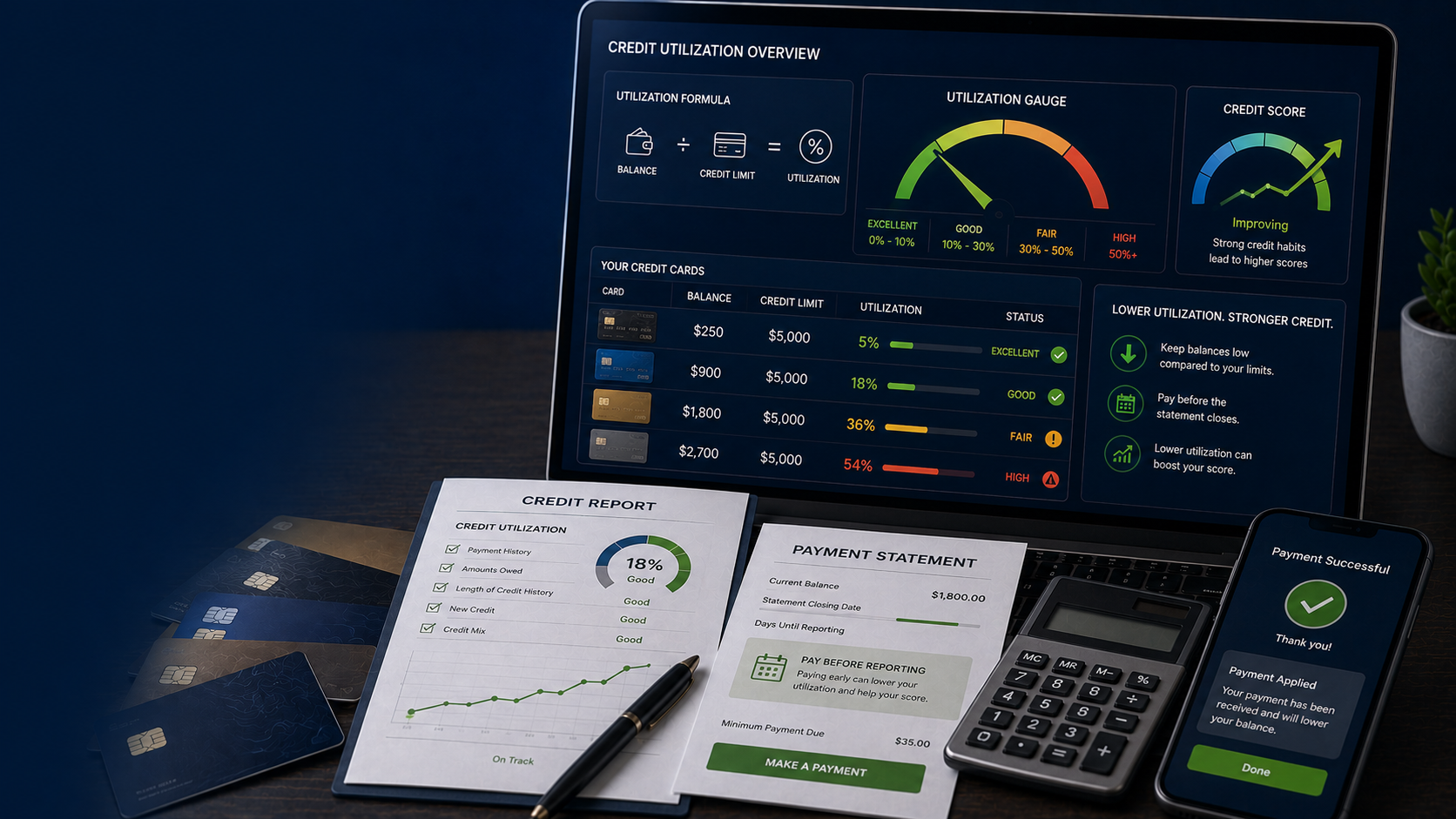
    If you could change just one number on your credit report and watch your score climb within weeks, which would you pick? Most people assume it’s payment history — and while paying on time matters enormously, it’s also the slowest lever to move because it takes months or years of spotless behavior to recover from a single missed payment. The fastest lever, by a wide margin, is your credit utilization ratio.Credit utilization is the amount of available credit you’re actually using, expressed as a percentage. It is recalculated every time your card issuers report your balances to the credit bureaus — usually once a month, right after your statement closes. That means a single well-timed payment can reshape your score before the next billing cycle even begins. No other scoring factor responds this quickly.In this guide, we’ll walk through exactly what credit utilization is, how it’s calculated, why it accounts for roughly 30% of your FICO score, and the practical, legally sound tactics you can use to lower it — and keep it low. We’ll also clear up some of the most damaging myths, including the “30% rule” that’s been repeated so often people mistake it for a target rather than a ceiling.This is the same framework we use with clients at our San Diego-based credit repair firm when we build customized repair plans. We don’t believe in quick fixes or guarantees. We believe in understanding the mechanics of your credit, making informed changes, and measuring the results. By the end of this article, you’ll have that same understanding — and a clear set of next steps.

    What Is Credit Utilization?

    Your credit utilization ratio (sometimes called your utilization rate) is the percentage of your available revolving credit that you’re currently using. “Revolving credit” means credit cards and lines of credit — accounts where the balance goes up and down as you borrow and repay. Installment loans like mortgages, auto loans, and student loans are not part of utilization. Those are scored separately, based on how much you still owe relative to the original loan amount.

    Here’s the key idea in plain terms: if you have a credit card with a $10,000 limit and you owe $2,000 on it, you’re using 20% of your available credit. That 20% is your utilization on that card. If you have three cards, each with its own limit and balance, you also have an overall utilization that combines all of them.

    Why does this matter so much? Because credit scoring models treat utilization as a proxy for risk. Someone using 5% of their available credit looks like a person who borrows modestly and pays it back comfortably. Someone using 85% looks like a person who may be stretching to make ends meet — even if they’ve never missed a payment. The scoring models don’t know your income or your savings. They only see the balances and limits that lenders report. Utilization is one of the clearest signals they have.

    This is also why utilization is the factor you can move fastest. Payment history is built over time. The age of your accounts only grows older. But utilization changes every month, based on what you charge and what you pay. If you understand the timing, you can influence what the bureaus see — and what the scoring models calculate — without waiting years.

    One important distinction: utilization is calculated from the balance your lender reports to the bureaus, not the balance you carry day to day. This is a subtle but critical point, and we’ll dig into it deeply in the section on the . For now, know this: you can pay your card in full every month, never pay a cent of interest, and still have a high utilization ratio if the wrong balance gets reported.

    The Credit Utilization Formula

    The formula itself is simple:

    That’s it. Divide what you owe by what you’re allowed to owe, then multiply by 100 to get a percentage.

    Per-card utilization uses the balance and limit of a single card:

    Overall utilization sums every card together:

    Both numbers matter. FICO and VantageScore scoring models look at utilization at both the individual-account level and the aggregate level. That means you can have a great overall utilization and still lose points if one card is maxed out. We’ll cover that in detail in the section.

    A few things to keep in mind about the inputs:

    • Balances are the amounts reported by your lender — typically your statement balance, which is the balance on your closing date. Some lenders report at other times, but statement closing is the most common.
    • Credit limits are your stated revolving limits. For charge cards that have no preset spending limit (certain American Express cards, for example), the scoring models use a different figure — often the highest balance you’ve ever carried or an internal limit the lender reports. This is handled automatically by the bureaus.
    • Closed accounts with balances can still factor in. If you closed a card but still owe a balance, that balance may still be reported and can affect your utilization depending on how the lender reports it. Be cautious about closing cards with outstanding balances.

    The simplicity of the formula is part of why utilization is so powerful: it’s transparent, it’s math you can do yourself, and it’s something you can influence directly. You don’t need to dispute anything, wait for a bureau investigation, or negotiate with a creditor to change it. You just need to change the numerator (your balances) or the denominator (your limits).

    Why Utilization Is 30% of Your Score

    Under the FICO 8 scoring model — still the most widely used model in lending decisions — your credit score is built from five categories:

    Scoring Factor Weight How Fast It Moves
    Payment history 35% Slow — months to years
    Amounts owed (utilization) 30% Fast — weeks to one billing cycle
    Length of credit history 15% Very slow — grows with time
    Credit mix 10% Slow — requires new accounts
    New credit / inquiries 10% Moderate — inquiries fade in 12 months

    Utilization is the second-largest factor, and it’s the only one of the top three that you can influence in a matter of weeks. That’s why we call it the fastest lever.

    Here’s why scoring models weight it so heavily. Decades of lender data show that as utilization rises, the likelihood of default rises too — and it rises non-linearly. Someone at 10% utilization is not just slightly less risky than someone at 30%; the risk gap is meaningful. Someone at 60% is meaningfully riskier than someone at 40%. The models bake this curve in, which is why even small drops in utilization can produce visible score gains when you’re starting from a high percentage.

    The “amounts owed” category (the official FICO label for the 30% bucket) includes more than just utilization. It also considers:

    • How many of your accounts carry balances at all
    • How much you owe on installment loans relative to the original amounts
    • The presence of any accounts in collection

    But utilization — both per-card and overall — is the dominant force inside that 30% bucket. For most people working to improve their credit, utilization is where the biggest, fastest gains live.

    A note on scoring model variations: FICO 9, VantageScore 3.0, and VantageScore 4.0 all treat utilization as a major factor, though the exact weightings differ. FICO 10T, the newer trended-data model, looks at your utilization over time rather than just a snapshot — we cover that in its own . The tactics in this article help across all of these models.

    The 30% Rule vs. the Truth

    If you’ve read anything about credit scores, you’ve heard the 30% rule: keep balances under 30 percent of your credit limits. It’s repeated in nearly every article, video, and forum thread about credit. Here’s the problem: 30% is not a target. It’s a ceiling — and a fairly loose one. The truth is more nuanced, and understanding the nuance is where real score gains come from.

    Where the 30% number comes from

    FICO has historically described utilization in broad tiers. The exact breakpoints aren’t published, but analysis of millions of scores — and FICO’s own public statements — have established a widely accepted tier structure:

    Utilization Range Score Impact
    0% Slight penalty — no active revolving use
    1% – 9% Best for scores — shows active, responsible use
    10% – 29% Very good — small, gradual point loss as you climb
    30% – 49% Fair — noticeable penalty begins around 30%
    50% – 74% Poor — meaningful penalty
    75% – 100% Very poor — near-maxed or maxed, large penalty

    The 30% threshold is where the penalty starts to become meaningful — not where scoring is optimal. Think of it as the speed limit on a highway: staying just under it won’t get you a ticket, but it also won’t get you the best fuel efficiency. The “best” zone for your score is well below 30%.

    Why under 10% is better

    People who keep their reported utilization under 10% — and ideally between 1% and 9% — consistently see the highest scores in the “amounts owed” category. At that level, you’re demonstrating that you use your credit cards but pay them down aggressively. That’s exactly the behavior scoring models reward.

    The difference between 28% and 8% utilization can be 20 to 40 points for some people, depending on the rest of their profile. That’s the difference between “approved at a decent rate” and “approved at a great rate” on a mortgage, or between “approved” and “denied” on a premium rewards card.

    Why 0% isn’t ideal — the “some activity” nuance

    This surprises a lot of people: a reported utilization of 0% is not optimal. If all your cards report a $0 balance every month, the scoring model sees no evidence that you’re actually using your revolving credit. From the model’s perspective, a dormant card tells it nothing about your ability to manage debt — so you may lose a few points compared to someone showing a small, paid-down balance.

    Here’s what’s really happening. Scoring models want to see some activity. They reward the pattern of: charge a small amount, let it report, pay it off. That cycle — use, report, repay — is the evidence the model uses to predict your future behavior. If you never let a balance report, there’s no evidence to score.

    This does not mean you should carry debt or pay interest. It means you should let a small balance appear on your statement (which happens naturally if you use the card for everyday purchases), and then pay it in full by the due date. The statement balance reports to the bureaus, the scoring model sees your responsible use, and you never owe a cent of interest because you pay in full during the grace period. This is the optimal pattern.

    The practical takeaway: aim for a reported utilization between 1% and 9% on each card and overall. That single digit above zero is your “some activity” signal. Anything from 10% to 29% is still good. Crossing 30% is where you want to pull back. And 0% across the board is a missed opportunity, not a victory.

    Per-Card vs. Overall Utilization

    This is one of the most under-explained topics in credit, and getting it wrong costs people points every month.

    Scoring models evaluate your utilization at two levels:

    • Overall (aggregate) utilization — your total balances across all revolving accounts, divided by your total credit limits across all revolving accounts.
    • Per-card (individual) utilization — the balance on each specific card, divided by that card’s specific limit.

    Both matter. A scoring model doesn’t just care that your overall utilization is healthy; it also looks at whether any single card is disproportionately loaded. This is because maxing out one card — even if your overall utilization is low — is a risk signal. It suggests you may be concentrated on one account, which can indicate cash flow stress on that particular line.

    A worked example

    Suppose you have three cards:

    Card Limit Balance Per-Card Utilization
    Card A $5,000 $1,500 30%
    Card B $5,000 $0 0%
    Card C $5,000 $0 0%

    Your overall utilization is $1,500 ÷ $15,000 = 10%. That’s in the good range. But Card A is at 30% — right at the ceiling. The scoring model sees both numbers and may dock you slightly for the per-card figure even though your overall is healthy.

    Now compare to this arrangement:

    Card Limit Balance Per-Card Utilization
    Card A $5,000 $500 10%
    Card B $5,000 $500 10%
    Card C $5,000 $500 10%

    Same total balance ($1,500), same overall utilization (10%). But now every card is at 10%, well under the 30% ceiling. This arrangement typically scores slightly better than the first, because no single card is loaded.

    Why this matters for your strategy

    The per-card vs. overall distinction changes how you should think about paying down debt. If you have extra cash to put toward your cards, don’t just throw it at the highest-interest card (though that’s still good advice for saving money). For score purposes, it often helps to pay down whichever card has the highest per-card utilization first, especially if that card is over 30%. Bringing one maxed-out card down to 30% can move your score more than bringing a moderately-used card down to 0%.

    This is also why the tactic of spreading balances across cards (covered below) can help — it smooths out per-card utilization even when the total balance stays the same. We’ll walk through that in the tactics section.

    How to Calculate Your Utilization (With Examples)

    Let’s run through a few scenarios so you can see exactly how the math works and apply it to your own situation.

    Example 1: Single card, simple case

    You have one credit card with a $8,000 limit. Your statement closes with a balance of $1,600.

    That’s in the good range — under 30%, though not quite in the optimal under-10% zone. To get into the optimal zone, you’d want your statement to close with a balance under $800.

    Example 2: Multiple cards, mixed utilization

    You have three cards:

    • Card A: $10,000 limit, $3,000 balance
    • Card B: $6,000 limit, $1,200 balance
    • Card C: $4,000 limit, $0 balance

    Per-card utilization:

    • Card A: $3,000 ÷ $10,000 = 30% (right at the ceiling)
    • Card B: $1,200 ÷ $6,000 = 20% (good)
    • Card C: $0 ÷ $4,000 = 0% (no activity — see the nuance above)

    Overall utilization:

    Overall, you’re at 21% — good. But Card A is at 30%, which the model will flag. If you had an extra $1,000 to put toward these balances, paying down Card A (bringing it to $2,000 and 20%) would help your score more than paying down Card B, because it removes the per-card ceiling violation.

    Example 3: The maxed-out card

    You have two cards:

    • Card A: $5,000 limit, $4,500 balance (90% — maxed out)
    • Card B: $15,000 limit, $0 balance

    Per-card:

    • Card A: 90% (very poor)
    • Card B: 0%

    Overall:

    Your overall utilization is 22.5%, which looks fine in isolation. But the scoring model will penalize you heavily for Card A being at 90%. This is a classic case where overall utilization hides a serious problem. If you’re applying for a loan and the lender manually reviews your report, a maxed-out card jumps out immediately.

    Example 4: The optimal setup

    Three cards, all lightly used:

    • Card A: $7,000 limit, $200 balance (2.9%)
    • Card B: $5,000 limit, $150 balance (3%)
    • Card C: $8,000 limit, $0 balance (0%)

    Overall:

    Overall at 1.75%, two cards showing small activity, one card dormant. This is close to the ideal pattern for most scoring models. You’re demonstrating active, responsible use without loading any single card.

    How to calculate your own

    • List every revolving account (credit cards, store cards, lines of credit). Skip installment loans.
    • For each card, note the current balance and the credit limit. You can find these on your most recent statement or by logging into your online account. For the most accurate picture, pull your credit report from AnnualCreditReport.com — the balances and limits there are what the bureaus currently have on file.
    • Calculate per-card utilization for each: balance ÷ limit × 100.
    • Add up all balances and all limits, then divide total balances by total limits × 100 for your overall utilization.
    • Check both numbers against the tier table in the . If either your overall or any single card is over 30%, that’s your first priority.

    One caution: the balances on your credit report may be slightly stale. Lenders report once a month, so the report shows the balance from your last statement date, not what you owe today. If you’ve made a large payment since then, your actual utilization is already lower than what the report shows — which is good news, but it means the score a lender pulls might still reflect the older, higher balance until the next reporting cycle.

    Tactics to Lower Your Utilization Fast

    These tactics are listed roughly in order of speed and impact. Most can be executed within a single billing cycle.

    1. Pay down balances before the statement closes

    This is the single most effective tactic, and it works immediately. Recall that the balance that matters for utilization is the one your lender reports — and most lenders report the balance as of your statement closing date. If you pay down your balance before the statement closes, the lender reports a lower number, and your utilization drops on the next bureau update.

    Here’s the timing to understand:

    • Statement closing date — the day your billing cycle ends and your statement is generated. The balance on this date is what gets reported.
    • Due date — about 21 to 25 days after the closing date. This is when your payment is due to avoid interest.

    Most people wait until the due date to pay. That’s fine for avoiding interest, but it does nothing for utilization because the balance was already reported weeks earlier at the statement closing date. To optimize utilization, you want to make a payment between the last day of your billing cycle and the statement closing date — or even just a few days before the statement closes.

    You don’t have to pay the whole balance. Even paying down to under 10% of the limit before the statement closes will land you in the optimal zone. Then pay off the remainder by the due date to avoid interest.

    2. Ask for a credit limit increase

    Remember the formula: utilization is balances ÷ limits. You can lower the ratio by shrinking the numerator (paying down) or by growing the denominator (raising your limits). A higher credit limit, with the same balance, instantly lowers your utilization.

    Most card issuers let you request a limit increase online — usually under an account settings or “card management” menu. Some increases can be granted instantly with a soft credit pull (which doesn’t affect your score). Others may require a hard inquiry, which causes a small, temporary score dip. Ask the issuer whether the request will be a soft or hard pull before you proceed.

    Important: A limit increase only helps if you don’t increase your spending. If you get a $5,000 limit bumped to $10,000 and then run the balance up to $5,000, your utilization is exactly where it was before — 50%. The tactic works only when the new limit gives you more headroom that you leave unused.

    A practical approach: request limit increases on your oldest, best-behaved cards every 6 to 12 months. Issuers are often willing to grant modest increases to customers with a track record of on-time payments and low balances relative to the current limit.

    3. Make mid-cycle payments

    If you use your card heavily during the month — for business expenses, reimbursable work charges, or just everyday spending — your balance may spike well above 30% mid-cycle, even if you pay it in full every month. If that spike happens to land on the statement closing date, you get dinged for utilization even though you’re a perfect payer.

    The fix: make a payment mid-cycle, before the statement closes. This brings the reported balance down. You can continue using the card for the rest of the cycle; just make another payment before the due date to clear the remainder.

    Some people who charge a lot each month make weekly payments to keep the balance low at all times. This is a perfectly legitimate strategy and is especially useful for people who put business expenses or large recurring bills on personal cards.

    4. Spread balances across multiple cards

    If you need to carry a balance (say, for a large purchase you’re paying off over a few months), spreading it across multiple cards can improve your per-card utilization even though your overall utilization stays the same.

    Compare:

    • Concentrated: One card at $4,500 / $5,000 (90%), another at $0. Overall: $4,500 / $20,000 = 22.5%. One card maxed.
    • Spread: Two cards at $2,250 / $5,000 each (45% each), one at $0. Overall: $4,500 / $20,000 = 22.5%. No card maxed, but both at 45%.

    The spread version still has both cards over 30%, so it’s not ideal — but it’s better than one card being at 90%. In a more moderate scenario, spreading a $3,000 balance across three $10,000-limit cards (10% each) versus concentrating it on one (30%) can produce a small but real score difference.

    This tactic has a caveat: it only helps if the cards you’re spreading to have similar interest rates. Moving a balance from a 0% promotional APR card to a 24% APR card to improve your utilization is a bad trade. If you’re carrying a balance, prioritize interest cost first, utilization second.

    5. Keep cards open — even paid-off ones

    When you pay off a card, the temptation is to close it. Resist that temptation if you care about your score. Here’s why: closing a card removes its credit limit from the denominator of your utilization calculation. If that card had a $10,000 limit and you close it, your total available credit drops by $10,000 — and your overall utilization jumps up accordingly, even though you didn’t spend a dime.

    Example: You have $20,000 in total limits and $4,000 in balances. Overall utilization: 20%. You pay off and close a card with a $10,000 limit. Now your total limits are $10,000, your balances are still $4,000, and your overall utilization is 40% — you just crossed the 30% ceiling by closing a card you didn’t owe anything on.

    Closed accounts in good standing can stay on your credit report for up to 10 years, which helps your average account age. But the credit limit comes off your utilization calculation immediately upon closure. This is one of the most common ways people accidentally hurt their scores.

    If a card has an annual fee you don’t want to pay, ask the issuer about a product change to a no-fee card instead of closing the account. That preserves the credit limit and the account history.

    6. Use a balance transfer strategically

    If you’re carrying high-interest debt, a balance transfer to a card with a 0% promotional APR can help in two ways: it reduces the interest cost (freeing up cash to pay down principal faster), and if the new card has a higher limit, it can improve your overall utilization. However, be aware that opening a new card generates a hard inquiry and lowers your average account age — both small, temporary score impacts. The utilization benefit usually outweighs these, but the math depends on your specific situation. Also watch out for balance transfer fees (typically 3% to 5%) and make sure you can pay off the balance before the promotional period ends.

    7. Become an authorized user on a responsible account

    If a family member or close friend has a long-standing credit card with a high limit and a low balance, being added as an authorized user can help your utilization. The card’s limit and history typically appear on your credit report as well, increasing your total available credit and potentially improving your average account age. Choose carefully: if the primary cardholder runs the balance up or misses payments, those negatives appear on your report too. This strategy works best when the primary holder is financially disciplined and you trust them completely.

    8. Open a new card — with caution

    A new credit card adds to your total available credit, which lowers your overall utilization (assuming you don’t carry a balance on the new card). But a new card also generates a hard inquiry, lowers your average account age, and adds a new account to your profile — all of which have small, temporary negative effects. For most people, the utilization benefit outweighs the drawbacks only if the new card meaningfully increases total available credit and you keep the balance at zero. If you’re already carrying high utilization on existing cards, adding a new card and running up its balance will only make things worse.


    The Statement-Balance Trap

    This is the single most common mistake we see, and it silently costs people 20 to 60 points every month without them realizing it.

    Here’s the scenario: You use your credit card for everything — groceries, gas, subscriptions, the works. You pay the statement balance in full every month by the due date. You’ve never paid a cent of interest. By every reasonable definition, you’re a perfect credit card customer. And yet, your credit score is stuck, and your reported utilization is high.

    What’s happening?

    The balance that gets reported to the credit bureaus is (for most issuers) your statement balance — the balance on the day your statement closes. That’s typically the peak of your monthly spending, because it’s the sum of everything you charged during the billing cycle. If you charged $3,000 during the cycle and your limit is $5,000, the statement balance is $3,000 — a 60% utilization — and that is what gets reported, even though you pay it off completely three weeks later.

    The scoring model never sees your payment. It only sees the reported balance. So from the model’s perspective, you’re at 60% utilization every month, even though you carry no debt.

    This is maddening for people who are doing everything “right.” But once you understand the timing, the fix is straightforward: pay down most of your balance a few days before the statement closes.

    The fix, step by step

    • Find your statement closing date. It’s on every statement. It’s usually the same date each month (for example, the 15th).
    • A few days before that date — say, the 12th or 13th — log in and pay your balance down to under 10% of your credit limit. If your limit is $5,000, pay it down to under $500.
    • Let the statement close with that small balance. The lender reports it to the bureaus. Your utilization looks excellent.
    • Pay the remaining small balance by the due date (about three weeks later) to avoid interest.

    You’re still paying in full every month. You’re still never paying interest. But now the bureau sees a low balance instead of a high one, and your score reflects that.

    This is the single highest-impact habit you can build for utilization. For people with high monthly card spend, it can be worth 30 to 60 points.

    How to confirm what’s being reported

    If you want to verify that this is working, pull your credit report from AnnualCreditReport.com (free, weekly during many periods, otherwise once per bureau per year) and check the balance listed for each card. Compare it to your statement balance — it should match. If it doesn’t, your lender may report on a different date than your statement closing date. In that case, call the issuer and ask when they report to the bureaus, and time your payment accordingly.

    Credit utilization ratio explained with credit card balances and limits

    FICO 8 vs. FICO 10T: Does Utilization Have a Memory?

    This is where the conversation gets interesting, because the newest scoring model changes a fundamental assumption that has guided credit advice for over a decade.

    FICO 8: Utilization has no memory

    Under FICO 8 — still the dominant model in mortgage lending and most consumer credit decisions — your utilization is scored as a snapshot. The model looks at the most recent balances and limits reported by your lenders and calculates your utilization from that single point in time. It doesn’t care what your utilization was last month, last year, or five years ago.

    This is why utilization is the “fast lever.” If you were at 60% last month and you pay down to 5% this month, the model scores you based on the 5% — and your score can jump in a single cycle. Your past high utilization is gone, as far as the model is concerned.

    This also means utilization “resets” every month. If you normally keep your utilization low but have one month where it spikes (say, a large purchase right before your statement closes), you may see a temporary score dip — but it will recover the following month when the next reported balance replaces the old one. There’s no lasting penalty.

    FICO 10T: Trended data

    FICO 10T, introduced in 2020 and being adopted gradually by lenders, uses trended data. Instead of a single snapshot, the model looks at your balances and utilization over the past 24 months or so. It can see whether your utilization has been trending up, trending down, or holding steady — and it factors that trend into your score.

    Under 10T, a sudden spike in utilization still matters, but it’s placed in context. If you’ve been steadily paying down for two years and have one high month, the model sees the broader trend and may not penalize you as heavily. Conversely, if you’ve been steadily climbing for two years — even if you’re still under 30% — the model may flag the upward trend as a risk signal.

    This changes the strategic emphasis. Under FICO 8, you can “game” utilization with a well-timed payment before a statement closes. Under 10T, that tactic still helps (because the most recent data point still matters), but the long-term trend matters too — so consistent, gradual paydown matters more than a one-month optimization.

    What this means for you

    • For now, most lending decisions still use FICO 8. Mortgages in particular are still underwritten against older FICO models (FICO 2, 5, and 4, which are similar to FICO 8 in their utilization treatment). The tactics in this article remain highly effective.
    • Over time, 10T adoption will grow. Building good utilization habits now — not just optimizing for a single month — positions you well for both models.
    • The best strategy works under both models: keep utilization consistently low (under 10% overall and per-card), make payments before statement closes when you have a high-spend month, and pay down debt over time rather than carrying it. That pattern looks great in a snapshot model and in a trended model alike.

    We monitor scoring model adoption for our clients and adjust repair plans as the landscape shifts. If you’re working with us, we’ll flag when a lender you’re targeting has moved to 10T and adjust your strategy accordingly.

    Utilization Across Multiple Cards

    When you have several credit cards, managing utilization gets more complex — but also gives you more tools. Here’s how to think about a multi-card portfolio.

    The aggregate is the headline, the per-card is the detail

    Your overall utilization is the number most people focus on, and it’s the one that moves the most points. But as we covered, scoring models also look at each card individually. A good rule of thumb: keep every card under 30%, and keep your overall under 10%. That combination consistently produces the best scores.

    If one card is over 30%, prioritize it

    When you have limited cash to put toward paydown, the order in which you pay cards matters for your score. Pay down the card that’s highest above 30% first. If two cards are both over 30%, prioritize the one with the higher per-card percentage. The scoring penalty for a 70% card is steeper than the penalty for a 40% card, so bringing the 70% card down first gives you more score movement per dollar.

    Once every card is under 30%, you can shift to paying down whichever card has the highest interest rate — that’s the financially optimal move once the score urgency is handled.

    Don’t close old cards to “simplify”

    We covered this in the tactics section, but it bears repeating in the multi-card context: closing an old, paid-off card removes its limit from your total available credit, which raises your overall utilization. If you’re carrying balances on other cards, this can push you over a scoring threshold even though you didn’t spend anything.

    If you have cards you don’t use, consider keeping them open with a small recurring charge (a subscription, a phone bill) that you pay off automatically each month. This keeps the card active, prevents the issuer from closing it for inactivity (which also removes the limit), and contributes a small, positive activity signal to your score.

    Store cards count too

    Store cards (Macy’s, Target, Home Depot, etc.) are revolving accounts and factor into utilization just like general-purpose credit cards. They often have lower limits than major cards, which means a modest balance can produce a high per-card utilization. A $300 balance on a $500 store card is 60% utilization on that card — a problem. Treat store cards with the same utilization discipline as any other card, or don’t carry balances on them at all.

    Common Mistakes That Quietly Tank Your Score

    Most utilization damage is self-inflicted, and most of it is avoidable. Here are the mistakes we see most often.

    1. Waiting until the due date to pay

    As we covered in the , paying on the due date is fine for avoiding interest but does nothing for utilization because the balance was already reported at the statement closing date. If you only change one habit, change this one: pay down before the statement closes, not just before the due date.

    2. Closing paid-off cards

    Removing a card’s limit from your total available credit raises your overall utilization. Keep old cards open, ideally with a small recurring charge to prevent inactivity closure.

    3. Maxing out one card to keep another at zero

    Some people concentrate spending on a single “rewards” card to maximize points, leaving other cards at zero. If that one card’s balance climbs above 30%, the per-card penalty can outweigh any rewards benefit. Spread spending or pay down mid-cycle.

    4. Ignoring store cards and smaller-limit accounts

    A $200 balance on a $500 store card is 40% utilization — a penalty. People often forget about store cards because the balances are small, but the limits are small too, so the percentage can be high. Track every revolving account, not just your main credit cards.

    5. Requesting limit increases with hard pulls unnecessarily

    A hard inquiry for a limit increase you might not get (and don’t urgently need) isn’t worth the small score dip. Ask issuers whether they can grant the increase with a soft pull first. Many can.

    6. Treating a limit increase as permission to spend more

    A higher limit helps your utilization only if your balance stays the same. If your spending rises with your limit, your utilization doesn’t improve — and you’ve taken on more debt. Treat a limit increase as headroom, not as spending power.

    7. Opening new cards to “dilute” utilization without a plan

    A new card raises your total available credit, which can lower overall utilization. But it also adds a hard inquiry, lowers your average account age, and creates the temptation to carry a balance. If you open a new card for utilization reasons, keep the balance at zero and don’t use it for anything you can’t pay off immediately.

    8. Assuming 0% utilization is perfect

    As we covered, 0% across the board misses the “some activity” signal the scoring models reward. Let a small balance report on at least one card, then pay it in full.

    9. Not checking what’s actually on your report

    The balances on your credit report may not match what you think you owe, especially if a lender reports on an unusual date or if a recent payment hasn’t cycled through yet. Pull your report periodically and verify that the balances and limits are accurate. If a limit is reported incorrectly (lower than it actually is), your utilization calculation is wrong — and you can dispute that.

    10. Carrying a balance to “build credit”

    This is a persistent myth. Carrying a balance and paying interest does not build your credit faster than paying in full every month. The scoring model doesn’t know or care whether you pay interest — it only sees the reported balance and your payment history. Paying in full every month builds credit just as effectively and costs you nothing.

    Summary Table: What to Do and What to Avoid

    Do Avoid
    Pay down balances before the statement closes Waiting until the due date to pay
    Aim for 1% – 9% reported utilization on each card and overall Treating 30% as a target instead of a ceiling
    Let a small balance report, then pay in full Carrying 0% across every card, every month
    Keep old, paid-off cards open Closing cards you don’t use (removes the limit)
    Request limit increases with soft pulls when possible Triggering hard pulls for increases you don’t urgently need
    Make mid-cycle payments during high-spend months Letting a big charge land on your statement date
    Spread balances across cards if you must carry debt Maxing out one card while others sit at zero
    Track store cards and small-limit accounts Forgetting that a $200 balance on a $500 card is 40%
    Pull your report and verify reported balances and limits Assuming the bureaus have your current balance right
    Pay in full every month to build credit at no cost Carrying a balance and paying interest to “build credit”

    Frequently Asked Questions

    1. What is a good credit utilization ratio?

    The best reported utilization is between 1% and 9% on each card and overall. This shows the scoring models that you actively use your revolving credit but pay it down aggressively. Anything under 30% is generally acceptable, and under 10% is optimal. A reported 0% is not ideal because it provides no evidence of active, responsible use.

    2. How fast can lowering my utilization raise my score?

    Under FICO 8, utilization has no memory — it’s scored from the most recent reported balances. That means if you pay down a high balance and the new lower balance is reported at your next statement closing date, your score can improve within that same cycle, typically within 30 to 45 days. The size of the improvement depends on how high your utilization was, how far you brought it down, and the rest of your credit profile. People moving from 70%+ to under 10% can see gains of 30 to 60 points or more.

    3. Should I close a credit card I don’t use anymore?

    Generally, no — not if you care about your score. Closing a card removes its credit limit from your total available credit, which can raise your overall utilization even though you didn’t spend anything. If the card has an annual fee, ask the issuer about switching to a no-fee version (a “product change”) so you keep the limit and the account history without the cost. If you must close it, try to do so when your overall utilization is already very low so the impact is minimal.

    4. Does asking for a credit limit increase hurt my score?

    It depends on whether the issuer does a soft or hard pull. A soft pull does not affect your score. A hard pull causes a small, temporary dip (usually a few points) that fades over 12 months. Ask the issuer before you request the increase whether it will be a soft or hard inquiry. Many issuers can grant increases with a soft pull, especially for existing customers in good standing.

    5. Is it better to pay my credit card before or after the statement closes?

    For utilization purposes, pay before the statement closes. The balance on your statement closing date is what most lenders report to the bureaus, so paying before that date lowers the reported balance. For interest purposes, pay by the due date (about three weeks after the statement closes). The optimal pattern is: pay down most of the balance before the statement closes, let a small balance report, then pay the remainder by the due date.

    6. Does utilization affect all credit scores the same way?

    No. Different models weight utilization differently, but all major models (FICO 8, FICO 9, FICO 10T, VantageScore 3.0 and 4.0) treat it as a significant factor. FICO 8 and most mortgage models score it as a monthly snapshot. FICO 10T uses trended data and looks at your utilization over the past 24 months, so long-term habits matter more under 10T. The safest approach is to keep utilization consistently low — which performs well under every model.

    7. Can I have a 0% utilization and still have a good score?

    Yes, but it may be a few points lower than it could be. A 0% reported utilization across all cards means no revolving activity is being scored, which can cost you a small number of points compared to showing a 1% – 9% balance. The fix is simple: use at least one card for a small purchase each month, let the statement close with that small balance, and pay it in full by the due date.

    8. What if my credit limit is reported wrong on my credit report?

    This is a disputeable error. If a lender is reporting a lower limit than you actually have, your utilization is being calculated higher than it should be — and your score is being unfairly penalized. Pull your report, identify the incorrect limit, and file a dispute with the bureau (online or by mail) asking them to correct it. You can also contact the lender directly and ask them to update their reporting. Under the Fair Credit Reporting Act (FCRA), bureaus are required to investigate disputes, typically within 30 days, and to correct or remove information that can’t be verified. This is one of the most common and impactful errors we help clients correct.

    Next Steps: Get a Free Credit Audit

    Understanding credit utilization is the first step. Acting on it is where your score starts to move.

    If you’ve read this far, you already know more about utilization than most people ever will. You know that 30% is a ceiling, not a target. You know to pay before the statement closes, not just before the due date. You know that per-card utilization matters alongside overall utilization, and that closing a paid-off card can backfire.

    The next step is to look at your actual credit report — your real balances, your real limits, your real per-card and overall utilization — and build a specific plan to optimize them. That’s where we come in.

    At our San Diego-based credit repair firm, we offer a free credit audit that covers all three major bureaus. We’ll pull your reports, identify any errors or inaccuracies that may be dragging your score down, calculate your current utilization, and give you a clear, honest assessment of where you stand and what’s realistically achievable. We work alongside experienced attorneys and operate in full compliance with the Fair Credit Reporting Act, so every step is ethical, accurate, and legally sound.

    We don’t promise overnight fixes, because credit doesn’t work that way. What we do promise is transparency: we’ll tell you exactly what we find, exactly what we recommend, and exactly what it costs — with no hidden fees and no services you don’t need.

    Get your free credit audit at credit-repair.com →

    Whether you work with us or take the DIY path using the tactics in this article, the most important thing is to start. Utilization is the fastest lever on your score, and the strategies in this guide can start moving the needle within a single billing cycle. The sooner you begin, the sooner your score reflects the responsible borrower you already are.

    This article is for educational purposes and is not legal or financial advice. Your individual credit situation is unique. For a personalized review, request a free credit audit at .

    Related reading:

    • How to Dispute Credit Report Errors Under the FCRA
    • Understanding Your FICO Score: The 5 Factors That Matter
    • How Long Does Credit Repair Take? A Realistic Timeline
    • The Ultimate Guide to Building Credit From Scratch
    • What to Do When a Credit Card Company Won’t Remove a Negative Mark

    To put this into action, explore how to ask for a credit limit increase without hurting your score, understand what a good credit score means, compare FICO vs VantageScore to know which model matters most, and follow our full guide on how to improve your credit score.

  • Credit-Builder Loans Explained: Do They Actually Work?

    Credit-Builder Loans Explained: Do They Actually Work?

    Related reading: learn the fastest way to build credit from scratch if you’re starting over, see how the Chime Credit Builder card compares as an alternative, understand what a good credit score means so you have a clear target, and see our credit repair process if you need professional help along the way.

    If you’ve ever tried to build credit from scratch — or rebuild it after a few hard years — you’ve probably run into the same frustrating loop that catches nearly everyone at some point. You need a loan or a credit card to build credit. But lenders want to see a credit history before they’ll approve you for one. So you’re stuck: no credit means no approvals, and no approvals means no way to build credit.It’s a perfectly designed catch-22, and it affects far more people than you might think. Recent immigrants who haven’t established a U.S. credit file yet. Young adults just starting out. People who spent years avoiding credit after a financial setback. Divorcees whose credit history was tied to a former spouse. People who simply never needed to borrow — until now.The credit builder loan was created specifically to break that loop. It’s a small, structured loan designed to do one thing very well: help you establish a positive payment history on your credit report without requiring you to already have good credit to qualify. No credit check for approval in most cases, no large deposit to lock up, and no complex application process.But here’s the honest question everyone eventually asks: does a credit builder loan actually work? And if it does, how well — and for whom?

    The short answer is yes, it can work, and the research backs that up. But the longer, more useful answer is that it works in a specific way, for specific reasons, and it has real limitations that the marketing copy from some providers tends to gloss over. Understanding those limitations before you sign up is the difference between a tool that genuinely helps you and one that leaves you frustrated a year later wondering why your score barely moved.

    This guide walks you through everything you need to know: what a credit-builder loan is, the unusual mechanic that makes it work, who it helps most, how to choose a good one, what to watch out for, and how it compares to the other credit-building options on the table. We’ll be straight with you about what it can and can’t do, because that’s what a trusted advisor should do.

    What Is a Credit-Builder Loan?

    A credit-builder loan is a small installment loan — usually between $300 and $1,000, sometimes up to $2,000 — designed specifically to help you build or rebuild your credit history. What makes it different from a traditional personal loan is that you don’t receive the money upfront.

    Instead, the lender holds the loan amount in a locked savings account or certificate of deposit (CD) on your behalf. You make monthly payments — principal plus a modest interest charge or administrative fee — over a set term, typically 6 to 24 months. Each payment is reported to the credit bureaus as an on-time installment payment. Once you’ve paid the loan in full, the money in the savings account is released to you, minus any fees or interest charges.

    Think of it as a forced savings plan that also happens to build your credit. You’re not borrowing money to spend — you’re borrowing money to prove you can pay it back reliably. The “loan” is really the structure; the savings account is where your money lives until you’ve earned it back.

    This is why credit-builder loans are sometimes called “fresh start loans” or “savings-secured loans.” The structure is what matters. The lender isn’t taking a risk on whether you’ll repay, because they already hold the full amount. You’re not taking on debt in the traditional sense — you’re paying into your own savings while building a credit file.

    Where credit-builder loans come from

    Credit-builder loans are offered by a mix of institutions, and the provider you choose matters more than you might expect:

    • Community Development Financial Institutions (CDFIs) — These are Treasury Department-certified lenders (credit unions, community banks, nonprofit loan funds) whose mission includes serving low-income and underserved communities. A CDFI credit builder loan is often the most affordable option, with low or no fees and terms designed to set you up for success. Examples include Self-Help Credit Union, Latino Community Credit Union, and many local credit unions.
    • Credit unions — Many credit unions offer credit-builder loans as part of their member services, often at very low cost. You typically need to join the credit union to qualify, but membership is usually easy to obtain.
    • Fintech companies — Companies like Self (formerly Self Lender) and Credit Strong (a division of Austin Capital Bank) offer credit-builder loans that are available nationwide, often with an app-based experience. They’re convenient, but they tend to charge higher fees than community lenders.
    • Some community banks — A smaller number of community banks offer similar products, often branded as “credit building loans” or “savings-secured installment loans.”

    The key distinction isn’t the type of institution — it’s whether they report your payments to all three major credit bureaus (Equifax, Experian, and TransUnion). We’ll come back to that, because it’s the single most important factor in whether a credit-builder loan will actually help you.

    How a Credit Builder Loan Works: The Unusual Mechanic

    If you’re used to how normal loans work, the credit builder loan how it works question is worth slowing down for, because the mechanic is genuinely unusual.

    The traditional loan flow (what you’re used to)

    With a standard personal loan, the process goes:

    • You apply. The lender checks your credit, income, and debt-to-income ratio.
    • If approved, you receive the loan amount as a lump sum — deposited into your bank account or sent as a check.
    • You spend that money however you intended (debt consolidation, a car repair, whatever it was for).
    • You repay the lender over time, with interest.
    • Your on-time payments are reported to the credit bureaus and help build your credit.

    The lender is taking a real risk — they gave you money and they’re trusting you to pay it back. That’s why they check your credit first.

    The credit-builder loan flow (the flip)

    With a credit-builder loan, the flow is reversed:

    • You apply. The lender typically does not check your credit (or only does a soft check that doesn’t affect your score). They may verify your identity and your ability to make payments.
    • You do not receive the money. Instead, the loan amount is placed in a locked savings account or CD held by the lender (or a partner bank) in your name.
    • You make monthly payments — a portion goes toward the principal (your savings), and a portion covers interest or fees.
    • Each payment is reported to the credit bureaus as an on-time installment payment, building your payment history.
    • When the loan term ends and you’ve paid in full, the savings account is unlocked and the money is released to you — minus any fees or interest that was charged along the way.

    You never had access to the money during the loan. You were essentially paying yourSelf, with the lender acting as the structured middleman who reports your behavior to the credit bureaus.

    Why this structure exists

    This design solves two problems at once:

    For you: It removes the risk of spending borrowed money you can’t afford to repay. Because you never get the cash upfront, there’s no temptation to use it for something else and fall behind. You’re building the habit of making a monthly payment while simultaneously building savings.

    For the lender: It eliminates nearly all the credit risk. Since they hold the full loan amount in reserve, they don’t need to underwrite you the way they would for a traditional loan. This is why most credit-builder loans don’t require a credit check — the lender isn’t actually risking anything. They can approve you based on identity verification and a demonstrated ability to make the monthly payments, nothing more.

    This is also why credit-builder loans can exist at all for people with no credit or bad credit. The structure makes them possible. Without it, lenders would have no way to offer a credit-building product to people who can’t qualify for traditional credit.

    A concrete example

    Let’s say you take out a $1,000 credit-builder loan with a 12-month term. Here’s what the flow looks like:

    • The lender deposits $1,000 into a locked savings account in your name. You can’t touch it.
    • Your monthly payment is around $87 to $90, depending on the interest rate or fee structure. (We’ll get into the specifics of pricing in the .)
    • Each month, you pay that amount. The lender reports the on-time payment to Equifax, Experian, and TransUnion (assuming you chose a lender that reports to all three — which you should).
    • After 12 months, you’ve paid in roughly $1,050 to $1,080 total (the $1,000 principal plus $50–$80 in interest or fees).
    • The savings account unlocks. You receive approximately $1,000 — your accumulated principal payments. The lender kept the interest/fees.
    • Your credit report now shows 12 months of on-time installment payments, which is exactly what scoring models want to see.

    You essentially paid $50–$80 to build a year of credit history and walk away with $1,000 in savings. Whether that’s worth it depends on your situation — and we’ll get into that honestly below.

    How It Builds Your Credit

    To understand why a credit-builder loan works — and where it doesn’t — it helps to know what your credit score is actually made of. The FICO scoring model, which is used by the vast majority of lenders, weighs five categories:

    Factor Weight What It Measures
    Payment history 35% Whether you pay your bills on time
    Amounts owed / utilization 30% How much of your available credit you’re using
    Length of credit history 15% How long your accounts have been open
    Credit mix 10% The variety of credit types you have (revolving + installment)
    New credit / inquiries 10% How many recent applications and hard inquiries you have

    A credit-builder loan directly affects payment history, which is the single biggest factor. That’s the whole point. Each on-time monthly payment is a positive data point on your credit report, and over 12 to 24 months, those payments add up to a meaningful track record.

    Here’s how it touches each factor:

    Payment history (35%) — the main event

    This is where a credit-builder loan does its real work. Every month you pay on time, the lender reports a positive installment payment to the bureaus. After 12 months, you have 12 on-time payments on your report. After 24 months, you have 24. For someone starting with no credit history or a thin file, this is transformative — you go from having no payment data at all to having a solid, unbroken record of reliability.

    For someone rebuilding after negative marks (late payments, collections, charge-offs), the credit-builder loan adds a stream of positive payments that starts to dilute the impact of the older negatives. The negative marks don’t disappear — they stay on your report for up to seven years — but as they age and as you accumulate fresh positive history, their effect on your score weakens.

    Credit mix (10%) — a meaningful bonus

    Scoring models reward you for having a mix of credit types — specifically, a combination of revolving credit (credit cards, lines of credit) and installment credit (loans with fixed payments, like auto loans, mortgages, and personal loans). If your credit file only has credit cards, adding an installment loan can give your score a small bump by improving your credit mix.

    This is a modest effect — 10% of your score is a small slice — but for people with a thin file, every bit helps.

    Length of credit history (15%) — helps over time

    A credit-builder loan adds a new account to your report, which can temporarily shorten your average age of accounts (something we’ll discuss in the risks section). But as the loan ages over its 12- to 24-month term, it contributes to the overall length of your credit history. Once paid off, the account remains on your report for up to 10 years as a positive closed account, continuing to support your length of history.

    What it does NOT do

    Here’s the honest part that a lot of providers don’t emphasize enough:

    A credit-builder loan does not help with credit utilization (30% of your score). Utilization is a revolving-credit metric — it measures how much of your credit card limits you’re using. An installment loan doesn’t factor into utilization at all. If your credit cards are maxed out, a credit-builder loan won’t fix that problem. You’d need to pay down card balances or increase your credit limits to improve utilization.

    A credit-builder loan does not give you access to credit. During the loan term, you don’t have a usable credit line. If you need to make a purchase and finance it, the credit-builder loan doesn’t help with that — you still need a separate credit card or loan for actual borrowing needs.

    A credit-builder loan’s score gains are modest, not dramatic. We’ll cover this in detail in the next section, but it’s worth flagging now: if you see a provider promising “boost your score 100 points,” be skeptical. Real gains depend on your starting point and your overall credit profile, and for most people they’re in a more realistic range.

    Who a Credit-Builder Loan Is For

    A credit-builder loan isn’t for everyone, and pretending otherwise doesn’t serve you. Here’s an honest breakdown of who benefits most and who might want to look at other options.

    People with no credit history

    This is the sweet spot. If you’re starting from zero — no credit cards, no loans, no credit file at all — a credit-builder loan is one of the most accessible ways to start building. Most providers don’t require a credit check, so your lack of history isn’t a barrier. You’ll get an installment account on your report with 12 to 24 months of on-time payments, which gives scoring models something to work with and gives future lenders evidence that you can handle a fixed payment obligation.

    This group includes:

    • Young adults just entering financial independence who haven’t opened any credit accounts yet
    • Recent immigrants who are new to the U.S. and haven’t had time to establish a domestic credit file
    • People who’ve been unbanked or cash-only by choice or circumstance and now want to build credit
    • Divorcees or widows whose credit history was primarily or entirely tied to a former spouse

    People rebuilding after credit damage

    If you have negative marks on your credit report — late payments, a collection, a charge-off, a short sale — a credit-builder loan can help you rebuild by adding a clean, current stream of positive payment history. The old negatives don’t go away, but they age, and as they age their impact on your score diminishes. Meanwhile, your new on-time payments demonstrate that you’re back on track.

    This works best when the credit-builder loan is part of a broader rebuild plan that also includes:

    • Settling or paying off any outstanding collections or charge-offs
    • Bringing any current delinquent accounts current
    • Keeping all existing accounts in good standing going forward
    • Addressing any errors on your credit report (this is where a professional credit audit can help — more on that at the end)

    A credit-builder loan alone won’t undo serious credit damage, but as one tool in a larger effort, it’s a solid addition.

    People who can’t qualify for a secured credit card

    Secured credit cards — which we’ll compare in detail below — are another common credit-building tool, but not everyone can get one. Some secured cards require a minimum deposit of $200 or more, which is a real barrier if money is tight. Some require a credit check and have minimum score requirements. Some deny applicants with recent bankruptcies or certain negative marks on their file.

    A credit-builder loan can be a good alternative if a secured card isn’t accessible to you, because most credit-builder loan providers don’t pull your credit for approval. The monthly payment may also be lower than a secured card’s deposit, making it more manageable on a tight budget.

    People who struggle with credit card discipline

    Here’s a group that doesn’t get talked about enough: people who have tried credit cards before and ended up carrying balances they couldn’t pay off. If you know that having a revolving credit line tends to lead to overspending for you, a credit-builder loan offers the credit-building benefit without the temptation. You can’t spend the money — it’s locked away — so there’s no way to rack up a balance you can’t afford.

    For some people, this structural safeguard is exactly what they need to build credit without falling back into old patterns.

    Who might want a different approach

    A credit-builder loan may not be your best option if:

    • You already have good credit and an established mix of accounts. If you’ve got a couple of credit cards and an auto loan that you’re paying on time, a credit-builder loan won’t add much. Your score is already being driven by your existing history, and the loan’s impact would be minimal.
    • Your main credit problem is high utilization. If your cards are near their limits, paying down those balances will help your score far more than a credit-builder loan will. Utilization is 30% of your score, and an installment loan doesn’t touch it.
    • You can’t comfortably afford the monthly payment. A credit-builder loan only helps if you make every payment on time. If you’re already stretched thin and a missed payment is a real possibility, the loan could end up hurting you instead of helping. We’ll cover this in the risks section.
    • You need to borrow money right now. A credit-builder loan doesn’t give you access to funds during the term. If you need to finance a car repair, a medical bill, or an essential purchase, this product won’t solve that problem — you’d need a different loan or credit line.

    Does a Credit Builder Loan Actually Work? The Honest Answer

    This is the question that matters most, and it deserves a straight answer.

    Yes — a credit builder loan does work, in the specific sense that it reliably creates a positive payment history on your credit report, and that history tends to produce measurable score improvements for people who start with no credit or thin credit. The evidence on this is real, not just marketing.

    A widely cited study by the Consumer Financial Protection Bureau (CFPB) in 2020 examined the outcomes of credit-builder loan users and found that participants without existing debt saw an average score increase of roughly 60 points over the loan term. For participants with no credit score at the start, the majority became scoreable — meaning they went from having no credit file at all to having a FICO score that lenders could use.

    That’s a meaningful result, and it matches what we see in practice. For people starting from scratch, a credit-builder loan is one of the most reliable on-ramps to a credit score.

    But — and this is where the honesty comes in — the answer comes with important caveats that the advertising rarely mentions:

    The gains are biggest for people starting with no credit, smaller for everyone else

    The 60-point average in the CFPB study was driven largely by people who had no credit score at the outset. For people who already had a credit score and existing debt, the gains were much smaller — and in some cases, scores actually went down slightly. Why? Because opening a new account can temporarily lower your average age of accounts, and if you have existing debt, the new loan’s small benefit can be offset by that effect.

    So the honest framing is:

    • No credit history → credit-builder loan → big improvement. This is where the tool shines.
    • Bad credit with existing debt → credit-builder loan → modest improvement, possibly mixed. The loan helps with payment history, but if you’re also carrying high credit card balances, the utilization factor will keep your score suppressed regardless of what the loan does.
    • Already good credit → credit-builder loan → minimal or no benefit. You don’t need it, and the new-account penalty might offset any tiny gain.

    It builds payment history, not credit mix or utilization benefits

    We covered this above, but it’s worth restating in the context of “does it work.” A credit-builder loan affects one of the five scoring factors in a major way — payment history. It touches credit mix modestly. It doesn’t touch utilization at all, and utilization is nearly as important as payment history (30% vs. 35%).

    This means a credit-builder loan is most effective when paired with a revolving credit account (like a secured card) that you keep at low utilization. Used together, the two cover more of the scoring factors. Used alone, the loan is still helpful but leaves the 30% utilization factor entirely untouched.

    It works only if you pay on time every single month

    This cannot be overstated. The entire benefit of a credit-builder loan comes from on-time payments. A single late payment — especially one reported as 30 days late — can wipe out months of progress and leave a negative mark that stays on your report for seven years. The loan doesn’t have a grace period for credit reporting purposes the way some credit cards do. If the lender reports you late, it’s on your report.

    So “does it work” is really “does it work for you,” and the answer depends almost entirely on whether you can commit to making every payment on time for the full term. If you can, it works. If you can’t — if your income is irregular, your budget is already stretched, or you’re not confident you can make a payment every single month — then the tool can backfire, and you should consider whether the risk is worth it.

    The score gains are real but not dramatic for most people

    For someone starting with no credit, going from “no score” to “a score in the mid-600s” over 12–18 months is genuinely life-changing — it’s the difference between being denied for everything and being approved for entry-level credit products. In that context, the credit-builder loan absolutely works.

    For someone starting with a 580 who wants to reach 700, a credit-builder loan alone will likely get them part of the way there — maybe into the low-to-mid 600s — but not all the way. Closing that gap usually requires a combination of tools and time: the credit-builder loan for payment history, a secured card for utilization, removal of any errors or inaccurate negative marks, and simply the passage of time as old negatives age.

    If a provider tells you a credit-builder loan will “boost your score by 100 points,” treat that as a red flag. The honest version is: it will help, the amount depends on your starting point and your full credit picture, and it’s most effective as part of a broader plan rather than a standalone fix.

    Pros and Cons of Credit-Builder Loans

    Let’s lay it out plainly.

    Pros

    • No credit check required for approval at most providers. This is the feature that makes credit-builder loans accessible to people who can’t get any other credit product. You’re approved based on identity verification and ability to pay, not your credit history.
    • Builds a positive payment history. This is the single most important factor in your credit score (35%), and a credit-builder loan delivers it reliably — 12 to 24 on-time installment payments on your report.
    • Forces savings. Because the money is locked away and you’re paying toward it each month, you end the term with a lump sum — often $300 to $1,000 — that you might not have saved otherwise. For people who struggle with savings discipline, this is a genuine secondary benefit.
    • Low monthly payments. Depending on the loan size and term, payments often fall in the $25–$90 range, which is manageable for many budgets.
    • No risk of overspending. You can’t charge up a balance you can’t pay off, because there’s no usable credit line. The temptation problem that sinks many credit card users doesn’t exist here.
    • Adds to your credit mix. If your file only has revolving accounts, adding an installment loan gives scoring models evidence that you can handle both types.
    • Available from mission-driven lenders. CDFIs and many credit unions offer these loans at low cost because their mission includes serving underserved communities. You’re not just building credit — you’re often working with an institution that’s structured to support you.

    Cons

    • You don’t get the money until the end. Unlike a traditional loan, you can’t use the funds during the term. If you need to borrow for an immediate expense, this product doesn’t serve that need.
    • You pay fees and/or interest, so you end up paying more than you receive. The total cost of a credit-builder loan — the interest or administrative fees — means you get back less than you paid in. You’re paying for the credit-building service, not getting a free lunch.
    • Late payments are reported and can hurt your score. The same mechanism that helps you when you pay on time can damage you when you don’t. A 30-day late mark on a credit-builder loan is just as harmful as one on any other account.
    • No impact on credit utilization. If your main score problem is high credit card balances, the loan won’t address it. Utilization is 30% of your score, and installment loans don’t factor in.
    • Limited score gains for people with existing credit. If you already have a couple of accounts in good standing, the marginal benefit of adding a credit-builder loan is small.
    • Short-term new-account penalty. Opening the loan creates a hard inquiry (at providers that pull credit) and shortens your average age of accounts, both of which can cause a small, temporary dip in your score in the first few months.
    • Some providers only report to one or two bureaus. If your lender only reports to, say, Equifax and Experian but not TransUnion, your TransUnion file won’t benefit. This is a common and avoidable mistake — always confirm all-bureau reporting before signing up.

    Credit-Builder Loan vs. Secured Card vs. Authorized User

    A credit-builder loan is one of three common tools for building or rebuilding credit. The other two — secured credit cards and becoming an authorized user on someone else’s account — work differently and have different trade-offs. Here’s how they compare.

    The comparison table

    Feature Credit-Builder Loan Secured Credit Card Authorized User
    How it works You pay monthly toward a locked savings account; lender reports payments You put down a refundable deposit (usually $200+) that becomes your credit limit; you use the card and pay it off Someone adds you to their existing credit card as an authorized user; their account history appears on your report
    Credit check for approval? Usually no Usually yes (soft or hard) No (the primary cardholder was checked when they applied)
    Upfront cost First month’s payment + any setup fee Security deposit (typically $200–$500) None
    Ongoing cost Interest or admin fees ($15–$60 over the full term, depending on provider) Annual fee (varies; some have none) + interest if you carry a balance None (unless the primary cardholder asks you to chip in)
    Do you get access to credit? No — money is locked until the end Yes — you can use the card up to your limit Yes — you can use the card if the primary holder gives you a card
    What it builds on your report Installment payment history Revolving account history + utilization Revolving account history (the primary holder’s)
    Affects utilization? No Yes — keeping your balance low relative to your limit helps your score Yes — the account’s utilization appears on your report
    Risk of overspending None — no usable credit line Real — you can carry a balance and accrue interest Real — but the primary holder is ultimately responsible
    Risk from late payments A late payment hurts your score A late payment hurts your score and may trigger fees + APR increase Your late payments hurt both your score and the primary holder’s score
    Speed of score impact Gradual over 6–24 months Can be faster — utilization changes show up within a billing cycle Immediate if the account has a long, clean history
    Best for No credit, thin credit, people who want forced savings, people who can’t manage a card People who want a usable card while building credit, people who can manage a low balance People with a trusted family member or friend who has a long, clean credit history on a card
    Weakness Doesn’t help utilization, modest gains for people with existing credit Requires a deposit upfront, temptation to overspend, some have fees Depends entirely on the primary holder keeping the account in good standing

    Which should you choose?

    The honest answer from a trusted-advisor perspective: it depends on your situation, and you can use more than one.

    • If you’re starting from zero and want the simplest, lowest-risk entry point, a credit-builder loan is hard to beat. No credit check, no deposit to scrape together, no temptation to overspend. You build payment history and savings at the same time.
    • If you want a usable credit card while you build, a secured card is the better fit — but only if you’re confident you can keep the balance low (ideally under 10% of the limit) and pay it off in full every month. The utilization factor is powerful, and a secured card lets you work it.
    • If you have a trusted family member with a long, clean credit card history, becoming an authorized user is the fastest and cheapest option. Their account’s positive history appears on your report immediately. But it’s not in your control — if they later miss a payment or run up the balance, your score takes the hit too.
    • For the best results, combine tools. A credit-builder loan for installment payment history plus a secured card kept at low utilization for revolving history covers more of the scoring factors than either one alone. This is what we often recommend to clients who are serious about building credit as efficiently as possible.

    How to Choose the Right Credit-Builder Loan

    Not all credit-builder loans are created equal, and choosing a poor one can mean paying more than you need to or getting less credit-building benefit than you expected. Here are the factors that actually matter, in order of importance.

    1. Reports to all three credit bureaus — non-negotiable

    This is the single most important criterion. Your credit score is calculated separately by each of the three major bureaus — Equifax, Experian, and TransUnion — and lenders don’t all pull from the same one. A mortgage lender might pull all three. An auto lender might pull one. A credit card issuer might pull another.

    If your credit-builder loan only reports to one or two bureaus, your credit file at the non-reporting bureau(s) won’t show the loan at all. You could complete a 12-month loan, pay on time every month, and still have a thin file at one bureau — which means a lender pulling from that bureau would see no benefit.

    Before you sign up, confirm in writing (or in the provider’s FAQ) that they report to all three bureaus. Reputable providers state this clearly. If a provider is vague about which bureaus they report to, that’s a red flag — look elsewhere.

    2. Low fees and reasonable interest

    The cost of a credit-builder loan varies significantly by provider. A CDFI credit builder loan from a community credit union might charge no fees and a very low interest rate (sometimes under 6% APR, sometimes a flat administrative fee of $10–$25 total). A fintech provider might charge an administrative fee of $9–$15 upfront plus a monthly fee of $5–$10, or an APR of 15% or more.

    Over a 12-month term, the difference adds up:

    • A low-cost CDFI loan: you might pay $15–$30 total above the principal
    • A higher-cost fintech loan: you might pay $60–$150 total above the principal

    That’s not necessarily a deal-breaker — if the fintech loan is the only one available to you or the convenience is worth it, the cost is still modest in absolute terms. But all else being equal, you should prefer the lower-cost option. Why pay $120 for something you could get for $25?

    3. Reasonable term length

    The typical credit-builder loan term is 6 to 24 months. The term you choose affects two things:

    • The monthly payment amount — a longer term means lower monthly payments, which is easier on a tight budget
    • The amount of payment history you build — a longer term means more on-time payments on your report, which is better for your score

    For most people, a 12-month term is a good balance: long enough to build meaningful history, short enough that you’re not locked in for years. If your budget is very tight, an 18- or 24-month term with lower payments may be more sustainable. If you’re confident in your ability to pay and want to build history faster, a 6-month term works but gives you fewer data points.

    Avoid terms shorter than 6 months — there’s not enough time to build a meaningful track record.

    4. CDFI or credit union vs. fintech — the trade-off

    This is a genuine decision point, not a clear-cut one.

    CDFI credit builder loans and credit union loans:

    • Usually the lowest cost
    • Often come with financial education and counseling resources
    • May require membership (which is typically easy to get but is an extra step)
    • May have less polished digital experiences
    • May have geographic limitations (some serve specific regions or communities)
    • The mission-driven structure means they’re genuinely invested in your success

    Fintech credit-builder loans (Self, Credit Strong, etc.):

    • Available nationwide, usually with no membership requirement
    • App-based, easy to manage from your phone
    • Often faster to apply and get approved
    • Tend to charge higher fees than community lenders
    • Some offer additional features like credit monitoring included in the fee

    There’s no wrong choice here — both can build your credit effectively if they report to all three bureaus. But if you have access to a good CDFI or credit union option, the cost savings and the access to human support are real advantages. If convenience and speed matter more to you, a fintech like Self or Credit Strong is a perfectly reasonable choice.

    5. Payment flexibility and autopay

    Look for a provider that offers autopay — automatic monthly payments from your linked bank account. Autopay is the single best safeguard against the worst risk of a credit-builder loan (a missed payment), because it removes the need to remember and manually make the payment each month.

    Also check the provider’s policy on early payment or extra payments. Can you pay ahead if you have a good month? Can you pay off the loan early without penalty? Most credit-builder loans allow early payoff, but some don’t — and if you might want to finish early, confirm this before committing.

    6. What happens if you miss a payment

    Read the fine print on late payments. Key questions:

    • Is there a grace period before a late payment is reported to the bureaus?
    • Is there a late fee, and how much?
    • Does the loan go into default if you miss a certain number of payments, and what does that mean for the money in the savings account?
    • Can you pause payments (forbearance) if you hit a financial rough patch?

    A provider that reports a late payment to the bureaus after just one day past due is riskier than one with a 30-day grace period. This matters — know the policy before you sign up.

    7. Whether interest is earned on the savings portion

    Some providers pay interest on the savings account holding your loan proceeds while you’re paying the loan off. It’s usually a small amount (savings rates aren’t high), but it partially offsets the cost of the loan. It’s a minor factor, but worth checking — a provider that pays interest on your savings is returning a bit of value to you.
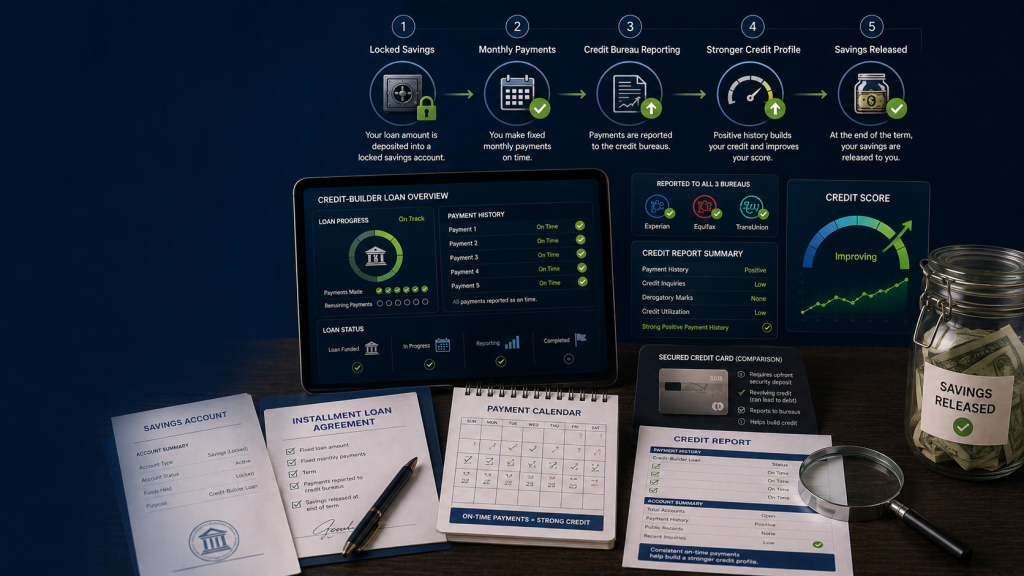
    Credit-builder loan explained and how it helps build credit

    Typical Terms and Costs

    Let’s get concrete about what you can expect to pay and what terms you’ll see in the market. These are typical ranges — actual offers vary by provider.

    Loan amounts

    • Small: $300–$500 — lowest monthly payments, good for tight budgets, builds less savings
    • Medium: $500–$1,000 — the most common range, balances payment affordability with meaningful savings at the end
    • Large: $1,000–$2,000 — higher monthly payments, more savings at the end, available from some providers

    Term lengths

    • 6 months — fast, lower total cost, fewer payment data points
    • 12 months — the standard, good balance of cost and history
    • 18–24 months — lower monthly payments, more payment history, higher total cost over the term

    Interest rates and fees

    Provider Type Typical APR or Fee Structure Total Cost on a $1,000 / 12-month Loan
    CDFI credit builder 5–10% APR or flat $10–$25 admin fee $25–$60
    Credit union 5–12% APR, sometimes no fees $30–$70
    Fintech (Self) $9 admin fee + $5–$10/month, or ~15% APR equivalent $70–$130
    Fintech (Credit Strong) Varies by plan; administrative fee + interest, ~15%+ APR equivalent $80–$150

    These are estimates — actual costs depend on the specific product, state, and term. The point is that the cost range across providers is meaningful: a low-cost CDFI loan might cost you $30 to build a year of credit history, while a premium fintech product might cost $130 for the same outcome. Both work; one is noticeably cheaper.

    Example payment schedules

    $500 loan, 12-month term, low-cost CDFI (no fee, 6% APR):

    • Monthly payment: ~$43
    • Total paid: ~$516
    • Amount you receive at end: ~$500
    • Net cost: ~$16

    $1,000 loan, 12-month term, fintech ($9 admin + $10/month):

    • Monthly payment: ~$92 ($83 principal + $9 monthly fee, plus initial $9 admin fee)
    • Total paid: ~$1,120
    • Amount you receive at end: ~$1,000
    • Net cost: ~$120

    $1,000 loan, 24-month term, credit union (8% APR):

    • Monthly payment: ~$45
    • Total paid: ~$1,083
    • Amount you receive at end: ~$1,000
    • Net cost: ~$83

    As you can see, the longer term lowers the monthly burden but increases the total cost slightly due to more interest accrual. The fintech option is meaningfully more expensive but offers convenience and app-based management.

    Step-by-Step: Using a Credit-Builder Loan

    If you’ve decided a credit-builder loan makes sense for you, here’s a clear walkthrough of how to use one effectively.

    Step 1: Check your current credit situation

    Before you apply, pull your credit reports from all three bureaus. You’re entitled to free reports at AnnualCreditReport.com. Review them for:

    • Errors or inaccurate negative marks — if there’s something wrong on your report, a credit-builder loan won’t fix it. Disputing errors first (or working with a professional credit repair firm) gives you a cleaner foundation to build on.
    • Existing accounts — know what’s already on your report so you can see how the credit-builder loan fits in.
    • Your current score (if you have one) — this gives you a baseline to measure progress against.

    If you find errors or significant negative marks, consider addressing those first or alongside the credit-builder loan.

    Step 2: Choose a provider that reports to all three bureaus

    Use the criteria in the . Confirm all-bureau reporting, compare costs, and pick a provider that fits your budget and preferences. If you have access to a local CDFI or credit union, start there — the cost savings are worth the extra step of joining.

    Step 3: Pick a loan amount and term you can afford

    Be honest with yourSelf about what monthly payment you can sustain for the full term. A smaller loan with a longer term and a $25–$40 monthly payment is a safer choice than a larger loan with a $90 payment that you’ll struggle to make in a bad month. The goal is 12–24 months of unbroken on-time payments — choose a payment level that makes that realistic.

    Step 4: Set up autopay before the first payment

    This is the single most important step after choosing the loan. Set up automatic payments from your primary bank account so that you never have to remember to make a payment manually. Verify the payment date works with your cash flow — if you get paid on the 15th, schedule the payment for the 16th or later, not the 10th.

    If your provider doesn’t offer autopay, set a recurring calendar reminder for at least five days before each due date, and make the payment manually as soon as you see the reminder.

    Step 5: Make every payment on time

    This is where the credit-building actually happens. Every on-time payment is a positive mark on your report. Every late payment is a negative mark that can undo months of progress. Treat the payment like rent or utilities — non-negotiable, paid before anything optional.

    If you see a rough month coming, contact the lender before the payment is due. Some providers offer forbearance or payment arrangements if you reach out proactively. They’re far less flexible after a payment is already late.

    Step 6: Monitor your credit along the way

    Check your credit score periodically (many banks and credit card issuers offer free score monitoring, and some credit-builder loan providers include it). You’re looking for:

    • Steady, gradual improvement over the loan term
    • The new installment account appearing on all three bureau reports
    • No unexpected drops that might indicate a reporting error or identity issue

    If the loan isn’t showing up on one of your bureau reports, contact the lender — it may be a reporting issue they can correct.

    Step 7: Receive your savings at the end

    When the loan term ends and you’ve paid in full, the lender releases the savings account balance to you. This is usually paid via ACH transfer to your bank account or by check. Take a moment to acknowledge what you’ve accomplished — you’ve built a year or more of positive credit history and you’ve saved a meaningful lump sum at the same time.

    Step 8: Decide what to do with the savings

    You have a choice here, and it matters for your long-term financial health:

    • Keep it as an emergency fund. If you don’t already have one, this is an excellent use. An emergency fund is the single best protection against the kind of financial setbacks that damage credit in the first place.
    • Use it as a secured credit card deposit. If you’ve been building credit with the loan and want to add a secured card for the utilization factor, your newly saved lump sum can serve as the deposit. This is a smart next step that covers more of the scoring factors.
    • Roll it into a new savings goal. If your emergency fund is already in place, keep the momentum going — move the money into a dedicated savings account for a specific goal.
    • Avoid spending it on non-essentials. The discipline you built during the loan term is a habit worth keeping. Don’t let the lump sum evaporate on a purchase that doesn’t serve your bigger financial picture.

    What Happens at the End of the Loan

    The end of a credit-builder loan is a moment worth understanding clearly, because it’s where the “forced savings” aspect pays off — literally.

    The payout

    When your final payment posts and the loan is paid in full, the lender releases the savings account balance to you. The amount you receive is the total of your principal payments — the money you paid in that went toward the loan amount, not toward interest or fees. For example:

    • On a $1,000 loan where you paid $1,080 total (with $80 in interest/fees), you receive $1,000.
    • On a $500 loan where you paid $530 total (with $30 in fees), you receive $500.

    The payout typically arrives within 7–14 days of the final payment, via ACH transfer or check, depending on the provider.

    What stays on your credit report

    The loan account doesn’t disappear from your credit report when it’s paid off. A paid installment loan remains on your report as a positive closed account for up to 10 years. During that time, it continues to contribute to your:

    • Payment history — the 12–24 months of on-time payments stay on your report as evidence of reliable repayment
    • Length of credit history — the account’s age continues to support your average age of accounts
    • Credit mix — the closed installment account still counts toward your mix of credit types

    This is a quiet but important benefit. The work you did during the loan term keeps paying off for years after the loan is gone.

    What to do next

    Once the loan is paid off, think about your next credit-building move:

    • If you don’t have a revolving credit account yet, consider opening a secured credit card (using part of your payout as the deposit, if needed). This starts building the utilization factor that the loan didn’t cover.
    • If you already have a credit card, keep its balance low and pay it in full each month. This maintains the utilization factor in your favor.
    • If your score has improved enough, you may now qualify for an unsecured credit card with better terms than a secured one. Check pre-qualification offers (which use soft inquiries) to see what’s available without adding a hard inquiry.
    • If you have older negative marks on your report, review whether any are due to age off soon or whether any are inaccurate and could be disputed.

    The credit-builder loan was a foundation. What you build on it next is where the bigger gains come from.

    Risks to Understand Before You Start

    A credit-builder loan is one of the safer credit-building tools available, but “safer” doesn’t mean “risk-free.” Here are the real risks to understand before you commit.

    Risk 1: Late payments damage your credit

    This is the biggest risk, and it bears repeating. If you miss a payment and the lender reports it as 30 days late to the bureaus, that negative mark stays on your credit report for up to seven years. The same mechanism that builds your credit when you pay on time can damage it when you don’t.

    A single 30-day late payment can drop a good credit score by 60–80 points. For someone building from scratch, it can mean going from a fledgling 650 back down to a 580 or lower — undoing months of careful work.

    Mitigation: Set up autopay. Choose a payment amount you can sustain even in a bad month. Contact the lender proactively if you see trouble coming.

    Risk 2: Fees can be higher than expected

    Some fintech credit-builder loans have fee structures that aren’t immediately obvious — monthly maintenance fees, administrative fees, early closure fees, payment processing fees for certain payment methods. Read the full fee schedule before you commit, not just the headline APR.

    Mitigation: Compare total cost across the full term, not just the monthly payment. Prefer CDFIs and credit unions where the fee structure is typically simpler and lower.

    Risk 3: The new account temporarily lowers your score

    When you open any new credit account, two things happen that can cause a small, temporary dip in your score:

    • A hard inquiry appears on your report (if the provider pulls credit — many don’t for credit-builder loans)
    • Your average age of accounts decreases because you’ve added a brand-new account

    This dip is usually small (5–15 points) and recovers within a few months as you build payment history. But if you’re applying for a mortgage or auto loan in the next 3–6 months, the timing could be inconvenient.

    Mitigation: If you have a major credit application coming up soon, either start the credit-builder loan after that application or talk to a credit professional about timing.

    Risk 4: The provider doesn’t report to all three bureaus

    We’ve covered this, but it’s a risk worth restating. If you complete a 12-month loan and discover at the end that one bureau never received the reports, you’ve built credit at two bureaus but not the third — and you can’t retroactively fix it.

    Mitigation: Confirm all-bureau reporting in writing before you sign up. If a provider won’t confirm it, choose a different provider.

    Risk 5: You need the money before the term ends

    Because the savings are locked until the loan is paid in full, you don’t have access to that money if an emergency hits mid-term. If you were counting on those funds being available, this can create a real problem.

    Mitigation: Don’t think of the credit-builder loan savings as an emergency fund during the term — it’s not accessible. Keep a separate small emergency fund (even $200–$500) in a regular savings account that you can reach if needed.

    Risk 6: Some providers have early closure penalties or restrictions

    If you need to close the loan early — because your situation changed, you’re moving, or you simply want out — some providers charge an early closure fee or have restrictions on how and when you can close. Read the terms before committing.

    Mitigation: Confirm the early closure policy before you sign up. Most reputable providers allow early payoff without penalty, but not all do.

    Common Mistakes to Avoid

    In our experience working with clients on credit building, a handful of mistakes come up repeatedly. Here are the ones to watch for.

    Mistake 1: Choosing a loan payment you can’t actually afford

    It’s tempting to pick a larger loan amount because you’ll get more savings at the end. But if the monthly payment is a stretch, you’re setting yourSelf up for a late payment that will cost you far more in credit damage than the extra savings are worth.

    Fix: Choose the smallest loan amount and longest term that still gives you meaningful payment history. A $500 loan at 24 months with a $22 monthly payment builds the same payment-history benefit as a $1,000 loan at 12 months with an $87 payment — but the smaller payment is far easier to sustain.

    Mistake 2: Not setting up autopay

    Manual payments rely on memory, and memory fails. One forgotten payment can undo months of progress.

    Fix: Set up autopay on day one. If your provider doesn’t offer autopay, set a recurring calendar alert for five days before each due date.

    Mistake 3: Not verifying all-three-bureau reporting

    We’ve seen clients complete an entire loan term only to find out the provider only reported to one bureau. They built credit at one bureau and have nothing to show at the other two.

    Fix: Before you sign up, find explicit confirmation (on the provider’s website, in their FAQ, or by calling and asking) that they report to Equifax, Experian, and TransUnion. If it’s not clear, choose a different provider.

    Mistake 4: Opening a credit-builder loan when your real problem is high utilization

    If your credit cards are maxed out, your utilization is suppressing your score by up to 30% of the total calculation. A credit-builder loan won’t touch that. You could complete a 12-month loan, pay on time every month, and see only a small score improvement because your utilization is still dragging you down.

    Fix: If high utilization is your main issue, prioritize paying down card balances first. A credit-builder loan can be a useful addition, but it’s not the primary fix for utilization.

    Mistake 5: Closing the loan early without understanding the impact

    Some people get impatient or need the money and close the loan a few months in. This gives you only a few months of payment history — far less impactful than a full 12–24 months — and may trigger early closure fees.

    Fix: Commit to the full term before you start. If you think you might need the money sooner, don’t lock it up in a credit-builder loan.

    Mistake 6: Not addressing errors or inaccurate negative marks first

    If your credit report has errors — accounts that aren’t yours, payments marked late that were actually on time, outdated information that should have aged off — a credit-builder loan builds positive history on top of a flawed foundation. The errors continue to hold your score down.

    Fix: Pull your reports and review them for accuracy before starting a credit-builder loan. Dispute any errors, or work with a professional credit repair firm that can help.

    Mistake 7: Treating the loan as your only credit-building tool

    A credit-builder loan is excellent for payment history, but it leaves utilization untouched. If you stop there, you’re leaving score points on the table.

    Fix: Plan to add a revolving credit account (secured card or unsecured card, depending on where your score is) at some point during or after the loan term. The combination covers more of the scoring factors and tends to produce better results than either tool alone.

    Mistake 8: Not having a plan for the savings when the loan ends

    When that lump sum lands in your account at the end of the term, it’s easy to spend it on something non-essential — and lose the savings habit you built over 12–24 months.

    Fix: Decide before the loan ends what the savings will go toward. An emergency fund, a secured card deposit, a specific financial goal — having a plan keeps the money working for you.

    Frequently Asked Questions

    1. Does a credit builder loan actually work?

    Yes — for people with no credit or thin credit, a credit-builder loan reliably builds a positive payment history on your credit report, which is the single most important factor in your credit score (35% of your FICO score). Research from the CFPB found that participants without existing debt saw average score gains of around 60 points, and most participants with no prior score became scoreable. The gains are largest for people starting from zero and more modest for people rebuilding with existing debt. The key condition: you must make every payment on time for the full term. For more detail, see our section on .

    2. How does a credit builder loan work if I don’t get the money upfront?

    That’s the unusual mechanic. The lender places the loan amount in a locked savings account in your name. You make monthly payments toward that amount, and the lender reports each on-time payment to the credit bureaus. When the loan is paid in full, the savings account unlocks and the money is released to you — minus any interest or fees. You’re essentially paying yourSelf while building a credit record, with the lender acting as the structured middleman who reports your payments. See for the full breakdown.

    3. What’s the difference between a credit builder loan and a secured credit card?

    A credit-builder loan is an installment loan — you make fixed monthly payments toward a locked savings account, and the lender reports those payments. It builds payment history and adds to your credit mix, but it doesn’t affect your credit utilization. A secured credit card is a revolving account — you put down a refundable deposit that becomes your credit limit, you use the card for purchases, and you pay it off each month. It builds payment history AND affects your utilization (keeping your balance low relative to your limit helps your score). The secured card gives you a usable credit line; the credit-builder loan doesn’t. See our for the full side-by-side.

    4. How much does a credit builder loan cost?

    The cost depends on the provider. A low-cost CDFI credit builder loan might cost you $15–$30 in fees and interest over a 12-month term. A fintech provider like Self or Credit Strong might cost $70–$150 over the same term. The monthly payment on a typical $500–$1,000 loan with a 12-month term ranges from about $25 to $90. See for specific examples.

    5. Can I get a credit builder loan with no credit check?

    Yes — most credit-builder loan providers do not require a credit check for approval, because the structure of the loan means the lender isn’t taking on credit risk (they hold the full amount in reserve). Approval is typically based on identity verification and your ability to make the monthly payments. This is one of the main reasons credit-builder loans are accessible to people who can’t qualify for other credit products.

    6. What happens if I miss a payment on a credit builder loan?

    A missed payment is the biggest risk of a credit-builder loan. If the lender reports it as 30 days late to the credit bureaus, that negative mark stays on your credit report for up to seven years and can cause a significant score drop — potentially undoing months of progress. Some providers have grace periods before reporting, and some may offer forbearance if you contact them proactively before the due date. Read the provider’s late payment policy before signing up, and set up autopay to eliminate the risk of forgetting. See our section on for more.

    7. How long does it take for a credit builder loan to improve my score?

    You can expect to see the loan appear on your credit report within 30–60 days of opening it, and you’ll start building payment history from your first on-time payment. Meaningful score improvement typically becomes visible after 3–6 months of on-time payments, with more substantial gains after 12 months. For people starting with no credit score, becoming scoreable usually takes about 6 months of reported payments (the minimum history most scoring models need to generate a score). The full benefit accrues over the entire loan term.

    8. What’s the best credit builder loan?

    There’s no single “best” credit-builder loan — the right choice depends on your priorities. If cost is your main concern, a CDFI credit builder loan from a community credit union or nonprofit lender is usually the most affordable option. If convenience and nationwide availability matter most, Self and Credit Strong are reputable fintech options with app-based management. The universal requirement, regardless of provider, is that they report to all three major credit bureaus. See our section on for the full criteria.

    Ready to Take the Next Step?

    A credit-builder loan is a solid, proven tool for establishing or rebuilding your credit — but it works best as part of a broader plan that also addresses any errors on your credit report, manages your credit utilization, and builds positive habits across all of your financial accounts.

    If you’re not sure where you stand right now, that’s the natural starting point. Before you open any new account — credit-builder loan, secured card, or anything else — it helps to know what’s actually on your credit report, what’s helping you, what’s holding you back, and what specific steps will move the needle for your situation.

    That’s exactly what we help with at credit-repair.com. We offer a free credit audit that reviews your reports from all three major bureaus, identifies any errors or inaccurate negative marks that may be unfairly dragging down your score, and gives you a clear, honest picture of where you stand and what your options are.

    We’re a San Diego-based, attorney-backed credit repair firm operating in full compliance with the Fair Credit Reporting Act (FCRA). We don’t make empty promises or sell quick fixes — we help you understand your credit, dispute what’s inaccurate, and build a plan that combines the right tools for your specific situation. Whether that includes a credit-builder loan, a secured card, professional help removing errors, or a combination of all three, we’ll give you a straight answer about what makes sense for you.

    Get your free credit audit at credit-repair.com →

    Your credit score is one of the most important numbers in your financial life. It affects your interest rates, your insurance premiums, your housing options, even your job prospects in some cases. Building it the right way — patiently, honestly, with the right tools and the right guidance — is one of the highest-return investments you can make. We’re here to help you do it.

    {/* Internal link placeholders to update when publishing:

    • Learn more about credit repair
    • Learn about credit monitoring
    • Learn about disputing credit report errors
    • Talk to a credit advisor
    • */}
  • Experian Boost Review: Can It Really Raise Your Score?

    Experian Boost Review: Can It Really Raise Your Score?

    See also: how to find and fix credit report errors across all three bureaus, compare FICO vs VantageScore to understand which models Boost affects, see what each score range means, and discover five free credit repair steps you can take on your own.

    You’ve seen the commercials. A friendly spokesperson promises that linking your utility and phone bills to your Experian account can “instantly” raise your credit score. No new credit cards. No hard inquiries. No cost. It sounds almost too good to be true — and like most things in credit, the reality is more complicated than the marketing.Experian Boost is a real, free feature offered by Experian, one of the three major credit reporting agencies in the United States. It can, in many cases, add points to a credit score within minutes. But the score it boosts is not the score most lenders use, and that distinction matters — a lot. If you’re applying for a mortgage, an auto loan, or a credit card, your “boosted” Experian score may be invisible to the lender reviewing your application.This review breaks down what Experian Boost actually does, how it works, what it counts, who benefits, who doesn’t, and whether it’s worth your time. We’ll be honest about the limitations, because we believe you deserve a clear picture before you hand over access to your bank account data. At , our job isn’t to sell you a quick fix — it’s to help you build credit that actually holds up when a lender pulls your report.

    What Is Experian Boost and How Does It Work?

    Experian Boost is a free opt-in feature launched by Experian in 2019. Its premise is simple: many people pay recurring monthly bills on time for years — utilities, phone service, streaming subscriptions — yet those on-time payments never appear on their credit reports and never help their credit scores. Experian Boost aims to change that by giving you credit for payments that traditionally aren’t reported to the credit bureaus.

    Here’s how the mechanics work:

    • You create a free Experian account. This gives you access to your Experian credit report and a VantageScore 3.0 credit score (more on that distinction shortly).
    • You connect your bank account(s). Experian uses a data aggregation service (originally powered by Finicity, now part of Mastercard) to scan your connected checking, savings, or money market accounts for qualifying transactions.
    • Experian identifies eligible payments. The service looks for payments to utility companies, telecom providers (phone, internet), streaming services, and — in a more recent expansion — certain rent payments.
    • You choose which payments to add. You have control over which accounts and which payment categories are included. Nothing gets added without your confirmation.
    • Experian recalculates your score. The eligible on-time payment history is fed into your Experian credit file, and your VantageScore 3.0 is recalculated — often within seconds or minutes.

    The entire process is designed to be frictionless. You link a bank account, confirm a few selections, and watch your score update. Experian reports that the average user sees an increase of around 13 points, though — and this is important — results vary widely and some users see no increase at all.

    The underlying logic

    The idea behind Experian Boost aligns with a broader trend in credit scoring: the recognition that traditional credit reports capture only a narrow slice of a person’s financial behavior. If you’ve never had a credit card, a car loan, or a mortgage, you might have a thin credit file — meaning there isn’t enough data for a scoring model to assess your reliability. Yet you might have paid your electric bill, cell phone bill, and Netflix subscription on time every month for a decade. Experian Boost argues that those payments demonstrate financial responsibility and should count.

    That’s a reasonable argument. The problem isn’t the logic — it’s the scope. Experian Boost only affects your Experian credit file and only the VantageScore model. And that’s where the conversation gets more nuanced.

    The Big Caveat: It Only Boosts Your Experian VantageScore

    This is the single most important thing to understand about Experian Boost, and we want to be completely upfront about it: Experian Boost only affects your Experian credit report and only your VantageScore — not your FICO score, not your Equifax or TransUnion reports, and not the scores most lenders actually use when making lending decisions.

    Let’s unpack what that means.

    VantageScore vs. FICO: The two scoring models

    There are two dominant credit scoring models in the United States:

    • FICO (created by the Fair Isaac Corporation) — the older, more widely adopted model. FICO scores are used in the overwhelming majority of lending decisions, particularly for mortgages, auto loans, and credit cards. There are multiple FICO versions (FICO 8, FICO 9, FICO 2, FICO 4, FICO 5, etc.), and different lenders use different versions.
    • VantageScore (created jointly by the three major credit bureaus — Equifax, Experian, and TransUnion) — a newer model designed as an alternative to FICO. VantageScore 3.0 and 4.0 are the current versions. VantageScore tends to be more forgiving of thin credit files and incorporates some alternative data, which is why Experian Boost works with it.

    Here’s the critical difference for this discussion: Experian Boost’s added payment history is only factored into your VantageScore, not your FICO score. FICO’s scoring models do not currently incorporate utility, phone, or streaming payment data added through Experian Boost. So if a lender pulls your FICO 8 score (the most common version), your Boost-eligible payments are invisible.

    Why this matters for mortgages

    If you’re considering Experian Boost because you’re planning to apply for a mortgage, you need to know this: mortgage lenders overwhelmingly use FICO scores — specifically FICO 2, FICO 4, and FICO 5 (the older “classic” FICO models tailored for mortgage lending), pulled from all three bureaus. These scores do not reflect Experian Boost data. When a mortgage lender pulls your credit, they will see:

    They typically use the middle score of the three (or the lower of the two if only two scores are available). None of these scores are affected by Experian Boost. So if you boosted your Experian VantageScore from 680 to 700, your mortgage lender won’t see that 700 — they’ll see your FICO scores, which remain unchanged.

    Why this matters for auto loans and credit cards

    Most auto lenders and credit card issuers also rely on FICO scores — typically FICO 8 or FICO Auto/Bankcard scores. While a small number of lenders use VantageScore (and would therefore see your boosted score), the majority do not. Some lenders that do use VantageScore include certain fintech lenders, some credit unions, and a growing (but still minority) number of card issuers.

    The bottom line on this caveat

    This doesn’t mean Experian Boost is useless. It means you need to calibrate your expectations. If you’re applying for credit with a lender that explicitly uses VantageScore and pulls from Experian, your Boost could help. If you’re applying with the vast majority of lenders — who use FICO — your Boost won’t be a factor.

    We’ll discuss who tends to benefit most in a later section. For now, the takeaway is: Experian Boost raises a real score, but it’s often not the score that matters most.

    How Much Can Experian Boost Actually Help?

    Experian’s own marketing states that the average user sees an increase of approximately 13 points on their Experian VantageScore 3.0. That’s a meaningful number for some people and a negligible one for others, depending on where you start and what you’re trying to accomplish.

    When the boost is small

    For many users — especially those who already have an established credit history with multiple accounts — the increase is modest, often in the range of 3 to 10 points. If your score is already in the 700s or higher, a few extra points rarely changes your lending outcomes. You’re already in prime territory, and a 7-point bump from 742 to 749 doesn’t move you across a meaningful threshold.

    When the boost is larger

    For users with thin credit files — people who have few or no traditional credit accounts — the boost can be more substantial. Experian has reported that some users see increases of 20 points or more. In rare cases, people with no scorable credit history at all (meaning they previously couldn’t generate a VantageScore) become “scoreable” for the first time after adding Boost-eligible payments. For someone who was previously invisible to the credit system, that’s genuinely significant.

    When the boost is zero

    It’s also entirely possible to see no increase at all. This happens when:

    • Your connected bank accounts don’t show qualifying payments (more on eligibility below).
    • Your existing credit history is already strong enough that adding a few utility payments doesn’t change the score.
    • Your payments are too recent or too infrequent to generate meaningful history.
    • The scoring model determines that your overall payment behavior is already well-represented by your existing accounts.

    Experian is transparent about this possibility, though it doesn’t lead with it in its marketing. The truth is that Boost is not guaranteed to help everyone, and for a significant percentage of users, the impact is either negligible or zero.

    A realistic range

    Based on user reports and Experian’s own disclosures, here’s a rough breakdown of what to expect:

    Starting Credit Situation Typical Boost Impact
    No score / unscorable thin file May become scoreable; potentially 20+ points
    Thin file, low score (500s–600s) 10–20 points possible
    Established file, mid score (600s–700s) 3–13 points
    Thick file, high score (700s+) 0–5 points, often none

    These are estimates, not promises. Your individual result depends on your unique credit profile and what payments Experian finds in your connected accounts.

    What Bills Does Experian Boost Count?

    One of the most common questions we hear is: “Does Experian Boost count my [specific bill]?” The answer depends on the category of the payment and whether Experian’s scanning system can identify it in your bank transactions. Let’s go through the eligible categories.

    Utility bills

    This is the core of what Experian Boost was built around. Eligible utilities include:

    • Electric payments
    • Gas payments
    • Water and sewer payments
    • Trash and recycling services

    If you pay these bills from a connected bank account and the payment can be identified as going to a utility provider, they’re generally eligible. Payments made through third-party services (like your bank’s bill pay system) may or may not be identified correctly — it depends on how the transaction appears in your bank data.

    Telecom bills

    Your phone and internet payments count:

    • Mobile phone bills (postpaid plans — prepaid plans may not always be identified)
    • Landline phone bills
    • Internet service bills
    • Cable TV bills (in some cases)

    Streaming services

    Experian added streaming service payments as an eligible category after launch. Qualifying services include:

    • Netflix
    • Hulu
    • Disney+
    • HBO Max / Max
    • Amazon Prime Video
    • Spotify
    • And several others

    The list of recognized streaming providers has expanded over time. If you pay for a streaming service through a bundled plan (like a phone carrier that includes Netflix), the transaction may not be separately identifiable and might not count.

    Rent payments

    More recently, Experian expanded Boost to include rent payments in some cases. This works through partnerships with rent reporting services and property management platforms. If your landlord or property manager uses a participating platform and your rent payments flow through your connected bank account in an identifiable way, those payments may be eligible.

    However, rent reporting through Boost is more limited than the utility/telecom/streaming categories. Not all landlords participate, and the identification of rent transactions can be inconsistent. If rent reporting is your primary goal, you may get better results through a dedicated rent-reporting service (more on that in the comparison section below).

    What does NOT count

    Several common payment types are not eligible for Experian Boost:

    • Insurance premiums (auto, health, life, renters, etc.)
    • Groceries and retail purchases
    • Subscription boxes (unless they fall under a recognized streaming category)
    • Gym memberships
    • Childcare or tuition payments
    • Tax payments
    • Medical bills
    • Loan payments to non-reporting lenders (e.g., some Buy-Now-Pay-Later services, private loans)
    • Cash payments or money transfers (Venmo, Zelle, Cash App to individuals)
    • Mortgage payments (your mortgage is already on your credit report as a tradeline — it doesn’t need Boost)

    A note on transaction identification

    Experian Boost’s ability to count a payment depends entirely on whether the transaction in your bank account can be automatically identified as a payment to an eligible provider. If your bank labels a transaction clearly (e.g., “PG&E PAYMENT” or “NETFLIX.COM”), it will likely be recognized. If the label is vague (e.g., “ACH DEBIT 8847291”), it may not be. This is a limitation of the data aggregation approach — Experian is reading your bank transactions, not receiving direct reports from the billers themselves.

    Who Benefits Most From Experian Boost?

    Experian Boost isn’t equally useful for everyone. Based on how the feature works and the population it was designed to serve, certain people stand to gain more than others.

    1. People with thin credit files

    If you have few or no traditional credit accounts — no credit cards, no loans, no mortgage — you likely have a thin credit file. This means there isn’t enough data in your credit report for scoring models to generate a reliable score, or the score you do get is low simply because there’s not enough positive history to offset any minor negative items.

    For this group, Experian Boost can be genuinely helpful. Adding a year of on-time utility and phone payments to your Experian file can provide the scoring model with additional positive payment history, which may push your VantageScore up meaningfully or make you scoreable for the first time.

    2. People with no credit score at all

    If you’ve never had a credit account, you may be credit invisible — meaning no credit score can be generated for you at all. This is common among young adults, recent immigrants, and people who have historically operated on a cash-only basis. Experian Boost can, in some cases, generate a VantageScore for someone who previously had none. That score, even if modest, can be a stepping stone to qualifying for your first credit card or a secured loan, which in turn builds the traditional credit history that matters most.

    3. People applying with VantageScore-using lenders

    If you know — or can find out — that the specific lender you’re applying with uses VantageScore and pulls from Experian, then Experian Boost directly benefits you. This is a smaller group of lenders, but it includes some online lenders, fintechs, and credit unions. If you’re in this category, Boost is working in your favor at the exact moment you need it.

    4. People rebuilding after a setback

    If you’re recovering from a financial setback — a period of missed payments, a collection, a bankruptcy — and you’re in the early stages of rebuilding, every positive data point helps. Experian Boost can add a layer of recent on-time payment history to your Experian file that complements your rebuilding efforts. It won’t erase the negative items, but it can help dilute their impact in the VantageScore model.

    5. People who want a quick, free confidence boost

    Let’s be honest about the psychological dimension. For some people, seeing their score go up — even a score that most lenders don’t use — is motivating. It feels like progress, and that feeling can sustain the habits (paying on time, monitoring credit) that lead to real, long-term improvement. If that’s you, there’s nothing wrong with using Boost as a motivational tool, as long as you understand its limitations.

    Who Won’t Benefit From Experian Boost?

    Just as important as knowing who benefits is knowing who doesn’t. If you fall into any of these categories, Experian Boost is unlikely to move the needle for you in any practically meaningful way.

    1. People applying for a mortgage

    As we covered earlier, mortgage lenders use FICO scores — specifically the older classic FICO models (FICO 2, 4, and 5) — not VantageScore. Your Experian Boost data does not appear in these scores. If you’re preparing to buy a home or refinance, Boost will not help you qualify or get a better rate. Your time is better spent on the factors that actually move your FICO scores: paying down balances, disputing errors, and ensuring your credit reports across all three bureaus are accurate.

    2. People with thick, established credit files

    If you have multiple credit cards, an auto loan, a mortgage, and years of on-time payment history, your credit file is already rich with positive data. Adding a few utility payments through Boost is like pouring a cup of water into a full bathtub — it doesn’t change the level. Your score is already well-supported by your existing tradelines, and the incremental data from Boost is statistically insignificant.

    3. People whose scores are already high

    If your VantageScore is already in the 740+ range, you’re in prime territory. A few extra points from Boost won’t change your lending outcomes — you already qualify for the best rates most lenders offer. The effort of connecting your bank accounts and granting data access isn’t worth the negligible (or zero) return.

    4. People who don’t pay eligible bills from connected accounts

    If you pay your utilities in cash, by money order, through a service that doesn’t create identifiable bank transactions, or if you split bills with a roommate who handles the actual payment, Experian Boost won’t find qualifying transactions in your bank account. The feature only works if the eligible payments flow through a connected account in a recognizable way.

    5. People who are uncomfortable sharing bank data

    This isn’t about whether Boost “works” — it’s about whether it’s right for you. Experian Boost requires you to grant access to your bank account transaction data through a third-party aggregation service. If you’re not comfortable with that level of data sharing — and many people aren’t — then Boost isn’t for you, regardless of its potential benefits. We discuss the data privacy considerations in the cons section below.

    Pros of Experian Boost

    Despite its limitations, Experian Boost has real advantages. Here’s what it does well:

    • It’s free. There’s no cost to use Experian Boost. You don’t need a paid subscription to Experian’s credit monitoring service to access it. You create a free Experian account, connect your bank, and opt in.
    • It’s fast. The connection and scoring process typically takes minutes. You can see your updated VantageScore the same day you set it up.
    • It only adds positive history. Experian Boost is designed to add only on-time payments to your credit file. It does not report late or missed utility payments. (Note: if you stop paying a utility and the account goes to collections, that collection can still appear on your credit report through normal reporting channels — Boost itself won’t add the negative item, but the underlying biller’s collection actions still can.)
    • It’s opt-in and controllable. You choose which bank accounts to connect and which payment categories to include. You can disconnect at any time, and the added history is removed when you opt out.
    • No hard inquiry. Using Experian Boost does not generate a hard inquiry on your credit report. Your score isn’t dinged for signing up.
    • It can help thin-file consumers. For people with limited credit history, it provides a way to build some positive payment data without taking on new debt.
    • It raises awareness about alternative credit data. Even if Boost itself is limited in scope, it has helped drive a broader conversation about incorporating utility and rent payments into credit scoring — a conversation that benefits consumers generally.

    Experian Boost review showing how the service affects credit scores

    Cons of Experian Boost

    The limitations are significant, and we want you to understand them fully before you decide whether to use the feature.

    1. Lender irrelevance for mortgages and most major lending

    This is the biggest drawback and bears repeating: the score Experian Boost raises (Experian VantageScore 3.0) is not the score used by most lenders, especially mortgage lenders. If you’re using Boost specifically to improve your chances at a mortgage, auto loan, or mainstream credit card approval, the impact will likely be zero at the moment of decision. You may feel good seeing a higher number in your Experian dashboard, but the lender’s underwriting system is looking at a different number entirely.

    2. Only Experian — not Equifax or TransUnion

    Experian Boost only affects your Experian credit file. Your Equifax and TransUnion reports are unchanged. Since many lenders pull credit reports from two or all three bureaus (and use the middle or lowest score), boosting only your Experian file often doesn’t change the score the lender actually uses. Even if a lender uses VantageScore, if they pull from TransUnion or Equifax, your Boost data won’t be there.

    3. Data privacy considerations

    To use Experian Boost, you must connect your bank account(s) through a third-party data aggregation service. This means:

    • A company you may not be familiar with (the aggregation provider) receives access to your bank transaction data.
    • Experian scans your transactions to identify eligible payments.
    • You’re granting ongoing access — the service continues to monitor for new eligible payments over time.

    Experian states that it uses bank-level encryption and that your data is used in accordance with its privacy policy. The aggregation provider is a regulated entity. But the reality is that you’re adding another party to the chain of entities with access to your financial transaction data, and you’re doing it for a benefit that may be marginal. For privacy-conscious consumers, that trade-off may not be worth it.

    We encourage you to read Experian’s privacy policy and the aggregation provider’s policy before connecting your accounts. Understand what data is accessed, how it’s stored, how long it’s retained, and whether it’s shared with any third parties. Informed consent matters.

    4. Only VantageScore, not FICO

    As discussed, FICO is the dominant scoring model. Boost does not affect any FICO score. This means the score you see increase in your Experian dashboard may create a false sense of progress if you’re tracking your credit improvement against the scores that lenders actually use.

    5. Potentially misleading score improvements

    There’s a subtle risk here: if you see your Experian VantageScore jump 15 points after enabling Boost, you might assume your credit has improved broadly. But if a lender pulls your FICO 8 score and it hasn’t moved, the “improvement” was illusory from the lender’s perspective. This can lead to misplaced confidence — applying for credit you don’t actually qualify for, or relaxing your credit-building efforts because you think you’ve made more progress than you have.

    6. Inconsistent transaction identification

    Because Boost relies on reading your bank transactions and pattern-matching them to known billers, the identification process isn’t perfect. Some eligible payments may not be recognized, especially if your bank’s transaction descriptions are vague or if you pay through intermediary services. You might expect a boost and get nothing, simply because the system couldn’t identify your payments.

    7. It doesn’t address the root causes of a low score

    If your credit score is low because of errors on your credit report, high credit utilization, collections, late payments, or other negative items, Experian Boost doesn’t fix any of those things. It adds a thin layer of positive data on top of existing problems. The underlying issues remain. This is the most important limitation from our perspective as a credit repair firm: Boost is a supplement, not a solution.

    Pros and Cons Summary

    Pros Cons
    Completely free Only boosts Experian VantageScore, not FICO
    Fast — results in minutes Not seen by most lenders (mortgages, auto, cards)
    No hard inquiry Only affects Experian, not Equifax or TransUnion
    Only adds positive payment history Requires sharing bank transaction data
    Controllable and opt-out anytime Transaction identification can be inconsistent
    Helpful for thin/no credit files May create false confidence about real progress
    Raises awareness of alternative credit data Doesn’t address root causes of a low score

    Experian Boost vs. Rent Reporting vs. Traditional Credit Building

    Experian Boost is one of several approaches to building or improving your credit. Understanding how it compares to alternatives helps you choose the right strategy — or combination of strategies — for your situation.

    Experian Boost

    • What it does: Adds utility, telecom, streaming, and some rent payments to your Experian file, boosting your VantageScore.
    • Cost: Free.
    • Score affected: Experian VantageScore 3.0 only.
    • Lender visibility: Limited — most lenders use FICO, not VantageScore.
    • Bureau coverage: Experian only.
    • Best for: Thin-file or no-score consumers looking for a quick, free way to generate some positive payment data.

    Rent Reporting Services

    Dedicated rent reporting services (such as Boom, RentTrack, Esusu, and others) report your rent payments directly to one or more of the three credit bureaus. Some report to all three; others report to only one or two.

    • What they do: Report your on-time rent payments as tradelines on your credit report, similar to how a loan appears.
    • Cost: Varies — some are free, some charge a monthly fee or a one-time setup fee. Some landlords cover the cost.
    • Score affected: Depends on the service and which bureaus they report to. Some report to FICO-scorable files (if they report as a traditional tradeline), which can be more impactful than Boost.
    • Lender visibility: Better than Boost if the service reports to all three bureaus and the data appears in FICO-scored files.
    • Best for: Renters who want their largest monthly payment to count toward their credit profile, especially those building credit for a future mortgage.

    The key advantage of rent reporting over Experian Boost is bureau coverage and scoring model impact. If a rent reporting service reports to all three bureaus and the data is incorporated into FICO-scoreable tradelines, it can actually move the scores lenders use — unlike Boost, which is VantageScore-only and Experian-only.

    Traditional Credit Building

    This is the bedrock approach, and it’s what we recommend to most of our clients at credit-repair.com. Traditional credit building involves:

    • Opening a secured credit card (if you can’t qualify for an unsecured card) and using it responsibly — small purchases, paid in full each month.
    • Becoming an authorized user on a trusted family member’s well-managed credit card account.
    • Taking out a credit-builder loan (offered by many credit unions and community banks), which holds the loan proceeds in a savings account while you make payments that are reported to all three bureaus.
    • Paying down existing credit card balances to lower your credit utilization ratio — often the fastest way to raise a FICO score.
    • Disputing and removing inaccurate negative items from your credit reports across all three bureaus — errors, outdated information, duplicate accounts, and items that should have fallen off.
    • What it does: Builds genuine credit history that appears on all three bureau reports and is scored by both FICO and VantageScore.
    • Cost: Varies — secured cards require a deposit (refundable), credit-builder loans involve small interest, and professional credit repair services have their own fee structures.
    • Score affected: Both FICO and VantageScore, across all three bureaus.
    • Lender visibility: Full — this is the credit history lenders actually see and use.
    • Best for: Everyone serious about building credit that matters. This is the foundation; Boost and rent reporting are supplements.

    Which should you use?

    There’s no rule saying you can only pick one. A smart credit-building strategy might include all three:

    • Start with traditional credit building — open a secured card or credit-builder loan, keep utilization low, and make every payment on time.
    • Add rent reporting if you’re a renter, to get your largest monthly payment working for you across all three bureaus.
    • Add Experian Boost as a free supplement, understanding that it only helps your Experian VantageScore.

    The important thing is to prioritize correctly. If you have limited time and resources, traditional credit building and credit report repair should come first. They address the scores lenders actually use and the root causes of credit problems. Boost is a nice-to-have, not a must-have.

    How to Use Experian Boost (If You Want To)

    If you’ve read through the pros and cons and decided Experian Boost is worth trying — maybe you have a thin file, or you’re curious to see if it helps your VantageScore — here’s how to set it up.

    Step 1: Create a free Experian account

    Go to and sign up for a free account. You do not need to subscribe to Experian’s paid credit monitoring service to use Boost. The free account gives you access to your Experian credit report and VantageScore, plus the Boost feature.

    Step 2: Navigate to Experian Boost

    Once logged in, look for the Experian Boost option in your dashboard. It’s typically prominently featured, since Experian promotes it as a key free benefit.

    Step 3: Connect your bank account

    You’ll be prompted to connect the bank account(s) where you pay your eligible bills. The connection is made through a secure data aggregation service. You’ll log in to your bank through the aggregator’s interface (not directly through Experian), grant permission for transaction data to be shared, and return to Experian.

    Before you do this: Take a moment to review Experian’s privacy policy and the aggregation provider’s policy. Make sure you understand what data is being accessed and how it’s used. If you’re not comfortable, don’t proceed — and that’s a perfectly valid decision.

    Step 4: Review identified payments

    Experian scans your connected account(s) for eligible payments and presents them to you. You’ll see a list of recognized utility, telecom, streaming, and (if applicable) rent payments. Review the list for accuracy.

    Step 5: Select which payments to add

    You choose which categories and which specific payments to include. You don’t have to add everything — if there’s a payment you’d rather not include for any reason, you can exclude it.

    Step 6: Confirm and see your new score

    Once you confirm your selections, Experian adds the eligible payment history to your Experian credit file and recalculates your VantageScore. You’ll see your updated score within seconds or minutes.

    Step 7: Monitor and manage

    After setup, Experian Boost continues to scan your connected accounts for new eligible payments over time, adding them as they occur. You can log in to your Experian account at any time to:

    • See your current boosted score.
    • Add or remove connected bank accounts.
    • Change which payment categories are included.
    • Disconnect entirely (which removes the Boost-added history from your file).

    A few practical tips

    • Connect the account where you actually pay bills. If you pay utilities from a checking account but keep savings in a different bank, connect the checking account.
    • Make sure your transactions are identifiable. If your bank’s transaction descriptions are clear (showing the biller’s name), Boost will work better. If they’re cryptic, recognition may suffer.
    • Don’t expect miracles. Check your score, note any change, and keep your expectations grounded. If you see a bump, great. If not, you haven’t lost anything but a few minutes.
    • Remember what you’re looking at. The score in your Experian dashboard is your Experian VantageScore — not your FICO score. Don’t assume a lender will see the same number.

    Should You Bother? Our Honest Verdict

    We’ve covered a lot of ground, so let’s bring it together into a clear, honest assessment.

    Experian Boost is a legitimate, free tool that can help certain people in certain situations. It is not a scam, and it is not useless. But it is also not the credit-building breakthrough its marketing sometimes implies. Here’s our balanced take:

    Use it if:

    • You have a thin credit file or no credit score, and you want to generate some positive payment data quickly and for free.
    • You’re curious about your VantageScore and want to see if your utility and streaming payments can nudge it up.
    • You’re applying with a specific lender you’ve confirmed uses VantageScore and pulls from Experian.
    • You’re comfortable connecting your bank account and sharing transaction data with a third-party aggregation service.
    • You understand that the score it raises isn’t the one most lenders use, and you’re okay with that.

    Skip it (or don’t prioritize it) if:

    • You’re applying for a mortgage — it won’t help, and your time is better spent on FICO-moving actions.
    • You have a thick, established credit file — the incremental benefit is negligible.
    • Your FICO scores are already strong — Boost won’t change your lending outcomes.
    • You’re uncomfortable sharing bank transaction data — the privacy trade-off isn’t worth a potentially zero benefit.
    • You’re looking for a substitute for real credit repair — Boost doesn’t fix errors, remove negative items, or address utilization. Those are the factors that actually move the scores lenders use.

    Our overall verdict

    Experian Boost is a low-risk, low-reward tool that’s worth trying if you fit the profile of someone it tends to help — but it should never be your primary credit-building strategy. Think of it as a complement to, not a replacement for, the fundamentals: accurate credit reports across all three bureaus, low credit utilization, a mix of account types, and a long history of on-time payments.

    If your credit score is holding you back from your goals — buying a home, financing a car, getting approved for a better credit card — the path to real improvement runs through your FICO scores and your reports at all three bureaus. That’s where our work at credit-repair.com focuses, and that’s where we’d encourage you to focus too.

    Common Myths About Experian Boost

    Let’s clear up some of the most common misconceptions we encounter.

    Myth 1: “Experian Boost raises your credit score with all lenders.”

    False. Experian Boost only raises your Experian VantageScore 3.0. It does not affect your FICO scores (any version), and it does not affect your Equifax or TransUnion reports. Most lenders — especially mortgage lenders — use FICO scores, not VantageScore. Your boosted score is real, but it’s not the score most lenders see.

    Myth 2: “Experian Boost can help you get a mortgage.”

    False, in practical terms. Mortgage lenders use classic FICO scores (FICO 2, 4, and 5) from all three bureaus. Experian Boost data does not flow into these scores. If you’re counting on Boost to help you qualify for a mortgage or get a better rate, you’ll be disappointed. Focus on paying down debt, disputing errors, and building genuine credit history instead.

    Myth 3: “Experian Boost is a scam.”

    False. Experian Boost is a legitimate, free feature offered by Experian. It does what it says it does — adds eligible payment history to your Experian file and recalculates your VantageScore. The issue isn’t deception; it’s that the score it affects has limited relevance to most lending decisions. There’s a difference between “it doesn’t do what the marketing implies” and “it’s a scam.” Boost is the former, not the latter.

    Myth 4: “Experian Boost can hurt your credit score.”

    Mostly false, with a caveat. Boost is designed to add only positive (on-time) payment history. It does not report late or missed utility payments. However, if you have an underlying utility account that goes to collections, that collection can be reported to the credit bureaus through normal channels — but that’s the collection agency reporting it, not Experian Boost. Boost itself doesn’t add negative data. Additionally, connecting your bank account and using Boost does not generate a hard inquiry, so there’s no score impact from the setup process.

    Myth 5: “If you disconnect, the boost is permanent.”

    False. If you disconnect your bank account or opt out of Experian Boost, the payment history added through Boost is removed from your Experian file. Your VantageScore will revert to what it was before Boost (or to whatever it would be based on your current credit file without the Boost data). The benefit is only present while Boost is active.

    Myth 6: “Experian Boost works the same as adding a tradeline.”

    False. A tradeline (like a credit card or loan) appears on your credit report as an account with a balance, limit, payment history, and status. It’s reported to the bureaus by the lender and scored by both FICO and VantageScore. Experian Boost, by contrast, adds payment history data to your Experian file without creating a traditional tradeline, and it’s only scored by VantageScore. The two are fundamentally different mechanisms with different levels of lender visibility.

    Myth 7: “Experian Boost counts all your bills.”

    False. Only specific categories are eligible: utilities (electric, gas, water, trash), telecom (phone, internet, cable), streaming services, and some rent payments. Insurance, groceries, gym memberships, subscriptions boxes, medical bills, tuition, taxes, and many other common payments do not count. Even within eligible categories, the payment must be identifiable in your bank transaction data.

    Frequently Asked Questions

    1. Does Experian Boost work for mortgage approvals?

    No, not in any practically meaningful way. Mortgage lenders use FICO scores (specifically FICO 2, FICO 4, and FICO 5) from all three credit bureaus. Experian Boost only affects your Experian VantageScore 3.0, which is not the score mortgage lenders use. If you’re preparing for a mortgage, focus on the factors that actually move your FICO scores: paying down credit card balances, disputing inaccurate items on your credit reports, and ensuring all your accounts are current. A across all three bureaus is a far better use of your time than Boost if a mortgage is your goal.

    2. Is Experian Boost really free?

    Yes. Experian Boost is a free feature available with a free Experian account. You don’t need to subscribe to Experian’s paid credit monitoring or identity theft protection services to use it. Experian offers those paid services alongside Boost, but Boost itself has no cost. Just be aware that Experian may market its paid products to you while you’re using the free feature.

    3. Can Experian Boost lower your credit score?

    No, not directly. Boost is designed to add only positive payment history. It doesn’t report late or missed payments on your utilities or streaming services. The setup process doesn’t generate a hard inquiry, so there’s no initial score dip. However, if an underlying utility account goes to collections, that collection can appear on your credit report through normal reporting — but that’s the collection agency’s action, not Boost’s. Also, if you disconnect from Boost, the added history is removed and your score may drop back to its pre-Boost level.

    4. How many points does Experian Boost add?

    It varies widely. Experian reports an average increase of about 13 points on the Experian VantageScore 3.0. But “average” obscures the range: some users see 20+ points (especially those with thin files), some see 3–10 points, and some see zero. Your result depends on your existing credit profile, how many eligible payments Experian finds, and how the VantageScore model weights the new data. There’s no guarantee of any specific increase.

    5. Does Experian Boost affect Equifax and TransUnion?

    No. Experian Boost only modifies your Experian credit file. Your Equifax and TransUnion reports are completely unaffected. Since many lenders pull reports from two or all three bureaus and use the middle or lowest score, boosting only Experian often doesn’t change the score a lender actually uses — even if that lender uses VantageScore.

    6. What bills count toward Experian Boost?

    Eligible categories include electric, gas, water, and trash utilities; mobile phone, landline, internet, and cable telecom services; streaming services like Netflix, Hulu, Disney+, HBO Max, and Spotify; and some rent payments (through participating platforms). Payments must be identifiable in your connected bank account transactions. Insurance, groceries, gym memberships, medical bills, tuition, taxes, and many other common payments do not count.

    7. Is it safe to connect my bank account to Experian Boost?

    It’s reasonably safe, but it does involve data sharing you should be aware of. Experian uses a third-party data aggregation service (the same type of technology used by budgeting apps like Mint or YNAB) to access your bank transaction data. The connection uses bank-level encryption, and the aggregation provider is a regulated entity. However, you are granting access to your transaction data to an additional party, and that access remains in place until you disconnect. We recommend reading Experian’s privacy policy and the aggregation provider’s policy before connecting, so you understand exactly what’s accessed, how it’s stored, and how it’s used. If you’re not comfortable with that level of data sharing, it’s perfectly fine to skip Boost.

    8. Should I use Experian Boost while also working with a credit repair company?

    You can, but keep your priorities straight. Experian Boost is a free, low-risk supplement that won’t interfere with credit repair efforts. It won’t conflict with disputes, doesn’t add hard inquiries, and doesn’t affect your FICO scores (which is where credit repair typically focuses). If you want to enable Boost for the possible VantageScore benefit while also pursuing professional credit repair, there’s no harm in doing both. Just remember that the real score gains — the ones that change your lending outcomes — come from the credit repair work (fixing errors, removing inaccurate negatives, optimizing utilization), not from Boost. Treat Boost as a bonus, not as the main event.

    The Bottom Line: Real Score Gains Come From Real Credit Repair

    Experian Boost has its place. For the right person — someone with a thin file, no score, or a specific VantageScore-using lender — it’s a free, quick, low-risk way to add a few points or become scoreable for the first time. We don’t discourage anyone in that situation from trying it.

    But we’d be doing you a disservice if we left it there without the full context. The credit score that matters most in your financial life — the one that determines whether you get the mortgage, the auto loan, the apartment, the better interest rate — is almost always a FICO score, and it reflects the data on all three of your credit reports, not just Experian’s. Experian Boost doesn’t touch that score or those reports. It operates in a parallel lane that most lenders don’t look at.

    Real, lasting credit improvement comes from:

    • Accurate credit reports. Studies have found that a significant percentage of credit reports contain errors — some minor, some serious enough to drag down a score by dozens of points. Disputing and removing inaccurate negative items across all three bureaus (Experian, Equifax, and TransUnion) is one of the most effective ways to raise the scores lenders actually use.
    • Lower credit utilization. If you’re carrying high balances on your credit cards relative to your limits, paying those down can produce rapid FICO score improvements — often more meaningful and more broadly visible than anything Experian Boost can do.
    • A history of on-time payments on real tradelines. Credit cards, installment loans, and other reported accounts form the backbone of your credit profile. Their payment history is scored by both FICO and VantageScore and appears at all three bureaus.
    • Time and patience. Negative items age off your report (most after seven years), and the older your positive history, the stronger your score. There are no shortcuts around the passage of time.
    • Professional guidance when you need it. If your credit reports have errors, collections, outdated items, or other negative marks you’re not sure how to address, working with a reputable, FCRA-compliant credit repair firm can help you navigate the dispute process effectively and make sure your rights under federal law are exercised fully.

    We can help

    At , we offer a free credit audit across all three major bureaus. We’ll review your Experian, Equifax, and TransUnion reports, identify inaccuracies and outdated items, and give you a clear picture of what’s actually affecting your FICO scores — the scores lenders use.

    Our approach is attorney-backed and fully FCRA-compliant. We don’t make empty promises or offer quick fixes. We dispute inaccuracies, negotiate with creditors, and build a customized repair plan tailored to your goals — whether that’s buying a home, financing a car, or simply getting your financial house in order. And because we believe credit repair should also be credit education, we equip you with the knowledge to keep your credit strong long after our work together is done.

    Experian Boost might give you a few points on a score most lenders don’t use. A real credit audit can find and fix the errors holding back the scores they do. If you’re serious about improving your credit — not just the number in one dashboard, but the numbers that actually open doors — we’d be honored to help.

    Get your free credit audit at credit-repair.com →

    Disclaimer: This article is for educational purposes and does not constitute legal or financial advice. Experian Boost is a product of Experian and is not affiliated with credit-repair.com. VantageScore is a registered trademark of VantageScore Solutions, LLC. FICO is a registered trademark of the Fair Isaac Corporation. Individual credit results vary based on your unique credit profile and the specific factors affecting your scores.

    Related reading: