
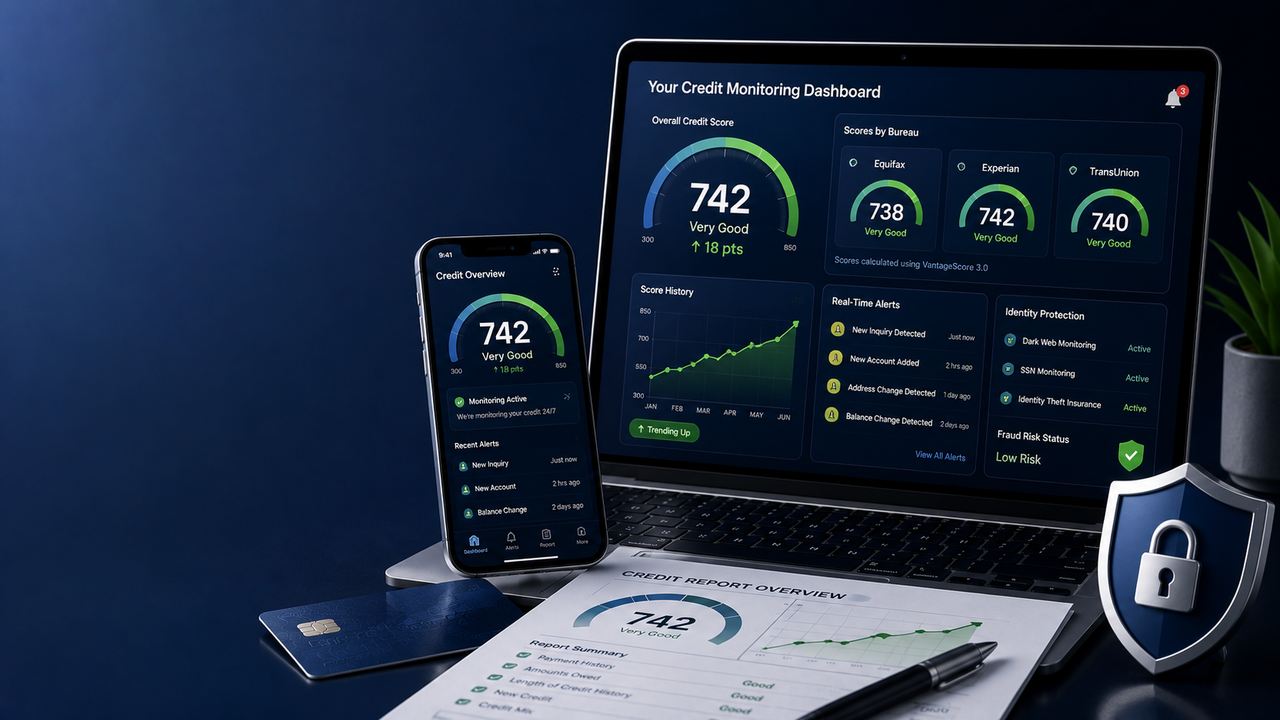
Credit monitoring services continuously track changes to an individual's credit report, offering crucial benefits like early fraud detection, progress tracking, and the ability to spot reporting errors. These services are essential because credit reports are dynamic documents, with accounts, balances, and inquiries constantly changing, making manual weekly checks impractical. While free options like Credit Karma and Experian provide basic alerts, paid services often add comprehensive 3-bureau coverage, identity theft insurance, and dark web monitoring for enhanced protection. Ultimately, credit monitoring helps maintain financial health by providing timely alerts to unauthorized activity or inaccuracies.
This guide breaks down what credit monitoring actually does, how free and paid services compare, why 3-bureau coverage matters more than most people realize, and how to choose a service (or combination of services) that fits your life and your goals. We will keep it honest: for many people, a well-built free setup is more than enough. For others — especially anyone actively repairing their credit or recovering from identity theft — a paid service earns its keep. We will help you tell the difference.
Whether you are just starting to pay attention to your credit or you are deep into a repair plan and want to track every point of progress, this is the framework you need.
What Is Credit Monitoring, Really?
Credit monitoring is the ongoing, automated tracking of your credit reports and credit scores across one or more of the three major credit bureaus — Equifax, Experian, and TransUnion. Instead of pulling your report manually once a year and hoping nothing changes in between, a monitoring service watches your file for you and tells you when something happens.
Think of it as a motion detector for your credit profile. The moment a new account opens, a balance jumps, an address changes, an inquiry hits, or a late payment gets reported, the service sends you an alert. Some services also track your credit score over time so you can see the trend — up, down, or flat — and connect those movements to real events in your financial life.
Here is the important distinction that gets lost in a lot of marketing copy: credit monitoring is not credit repair, and it is not identity theft prevention.
Monitoring does not stop someone from opening an account in your name. It tells you, quickly, that it happened. That early warning is valuable — incredibly valuable — but it is a detection tool, not a lock. (A credit freeze is the lock. We will come back to that.)
What monitoring does do well:
- Detects unauthorized activity early, often within 24 hours of it appearing on your report.
- Tracks your progress when you are actively building or repairing credit, so you can see whether your efforts are moving the needle.
- Surfaces reporting errors — accounts that are not yours, payments marked late that were actually on time, balances that are wrong — so you can dispute them before they do more damage.
- Keeps you informed about changes that are legitimate but still matter, like a credit card balance increase that drops your score, or a closed account that shortens your credit history.
In short, credit monitoring turns your credit report from something you check into something that checks in with you. That shift — from reactive to proactive — is the whole point.
Internal link placeholder: [What Is a Credit Report?] — a beginner explainer on what’s actually inside your three bureau reports.
Why Credit Monitoring Matters: Three Core Benefits
Let’s look more closely at the three reasons most people sign up for monitoring, and why each one matters for your financial life.
1. Early Fraud Detection
This is the headline benefit, and it deserves the attention. When a fraudster opens a credit card, takes out a loan, or applies for utilities in your name, that activity eventually lands on your credit report at one (or more) of the three bureaus. Without monitoring, you might not find out until months later — when a collection notice arrives, when you are denied credit, or when you pull your annual report and see accounts you do not recognize.
By then, the damage can be significant: multiple fraudulent accounts, tanked scores, collections, and hours of paperwork to unwind it all.
With monitoring, you can get an alert within a day of a new account or hard inquiry appearing on your report. That gives you a window to act fast — contact the creditor, place a fraud alert, freeze your credit, and file an identity theft report with the FTC at IdentityTheft.gov — before the fraud compounds.
The math is simple: the sooner you know, the less there is to clean up.
2. Tracking Your Progress
If you are working to build credit for the first time, or rebuild it after a setback, monitoring gives you something rare in the credit world: visible, measurable feedback. You pay down a credit card, and a week or two later your score ticks up. You add an authorized-user tradeline, and you watch the effect. You let a balance creep back up, and you see the dip.
This is not vanity. Tracking your score over time is how you learn which behaviors actually move your number — and which do not. It is how you confirm that a dispute you filed actually resulted in a negative mark being removed. It is how you stay motivated when the process feels slow, because credit repair is rarely a straight line.
A good monitoring service will show you a score history chart and, ideally, flag the events that correspond to each change. That context is what turns a number into insight.
3. Spotting Reporting Errors
Here is a fact that surprises a lot of people: a meaningful share of credit reports contain errors. The Federal Trade Commission has studied this repeatedly over the years, and the findings have been consistent — mistakes happen. Accounts get mixed up between consumers with similar names. Payments get misreported as late. Paid-off balances linger as “open.” Closed accounts stay listed as active. Collection accounts get re-aged to look newer than they are.
Some of these errors are minor. Some can cost you dozens of points, a better interest rate, or an approval altogether. Monitoring surfaces these discrepancies early, while they are still small problems — before you are sitting in a lender’s office wondering why your score is 40 points lower than you thought.
When you spot an error through monitoring, your next step is a dispute — with the bureau that is reporting it and, often, with the furnisher (the creditor or collector that sent the information). That is a process with its own rules under the Fair Credit Reporting Act (FCRA), and it is exactly the kind of work a credit repair firm can help you navigate.
Internal link placeholder: [How to Dispute Credit Report Errors Under the FCRA] — step-by-step dispute guide.
Free vs. Paid Credit Monitoring: The Real Difference
The credit monitoring market splits cleanly into two tiers: free and paid. Understanding what you get — and what you give up — at each tier is the foundation of choosing well.
What Free Monitoring Gives You
Free credit monitoring has gotten genuinely good. A decade ago, “free” mostly meant a gimmick — a trial that rolled into a monthly charge. Today, several major services offer legitimately free, ongoing monitoring with no credit card required. Here is what the best free options typically include:
- Monitoring of one bureau’s report (usually TransUnion or Experian, depending on the service) with alerts when key changes hit.
- A credit score, updated regularly — often weekly, sometimes daily. The score may be a VantageScore rather than a FICO score, and it may come from only one bureau.
- Basic identity monitoring — alerts if your email, phone number, or other personal info shows up in places it should not, like data breach dumps.
- Educational tools — simulators, tips, and recommendations tailored to your profile.
For a lot of people, that is enough. If your credit is stable, you do not have high fraud risk, and you just want to know if something unexpected happens, free monitoring does the job.
What Free Monitoring Usually Lacks
- Only one bureau is monitored. This is the big one. If a fraudulent account gets reported to Experian but your free service only watches TransUnion, you will not get an alert. We will dig into why this matters in the next section.
- No or limited identity theft insurance. If you are the victim of identity theft, a paid service might cover up to $1 million in expenses (legal fees, lost wages, stolen funds). Free services rarely offer this.
- No dedicated restoration help. Recovering from identity theft is paperwork-intensive and frustrating. Paid services often include a specialist who guides you through it. Free services point you to resources and leave you to do the walking.
- Score models and refresh frequency may be limited. You might see a VantageScore from one bureau updated weekly, rather than FICO scores from all three updated daily.
What Paid Monitoring Adds
Paid services — typically $15 to $40 per month depending on features and family coverage — layer on the things free services leave out:
- 3-bureau monitoring with alerts from all three bureaus, often with daily refreshes.
- Identity theft insurance, usually ranging from $500,000 to $1 million in coverage.
- Identity restoration assistance, including a dedicated case manager.
- Dark web monitoring that scans for your Social Security number, email, passport, and other sensitive data being traded or sold.
- Family or child monitoring plans that cover minors, who are frequent targets of identity theft because no one is checking their credit.
- More frequent score updates and, often, access to FICO scores from all three bureaus (the scores most lenders actually use).
The question is not whether paid services offer more — they clearly do. The question is whether you need the extra coverage. We will get to a framework for answering that a few sections down.
Single-Bureau vs. 3-Bureau Monitoring
This is the single most important technical distinction in credit monitoring, and it is the one most people get wrong when they sign up for a free service and assume they are covered.
What is the reality of three-bureau credit reporting?
The reality of three-bureau credit reporting is that your credit life is not managed by one company; instead, three independent bureaus—Equifax, Experian, and TransUnion—each maintain their own version of your credit report. Lenders and creditors choose which bureau(s) to report to, and they do not all report to all three, meaning your three reports are not identical. This implies that if your monitoring service watches only one bureau, you are seeing only a partial credit picture, leaving you vulnerable to fraud reported to unmonitored bureaus.
The result is that your three reports are not identical. A credit card account might appear on your Equifax and Experian reports but not your TransUnion report. A collection account might show up at only one bureau. A hard inquiry from a recent credit application might land at just one or two.
This means that if your monitoring service is watching only one bureau, you are seeing only a slice of your credit picture — typically about a third of it, give or take. A fraudster who opens an account that gets reported to a bureau you are not monitoring will fly completely under your radar. You will feel safe because you have monitoring, but you will not actually be covered.
Why 3-Bureau Monitoring Is Stronger
3-bureau credit monitoring watches all three of your reports simultaneously. When a new account, inquiry, address change, public record, or other key item appears on any of your three files, you get an alert. That is meaningfully different protection, and for anyone with elevated fraud risk, it is the floor we would recommend — not the ceiling.
Here is a way to think about it: single-bureau monitoring is like a security camera on your front door. It is better than nothing, and it might catch a problem. 3-bureau monitoring is like cameras on every entrance. You still are not invulnerable, but you are not blind to two-thirds of the possible entry points either.
Does Everyone Need 3-Bureau Monitoring?
No. And we want to be straight with you about that, because a lot of paid services will tell you otherwise.
If your credit is stable, your fraud risk is average, and you are using monitoring as a basic early-warning system, a free single-bureau service combined with a credit freeze at all three bureaus gives you solid protection for zero monthly cost. The freeze blocks new accounts from being opened in your name (the thing monitoring cannot do), and the single-bureau monitor gives you a reasonable heads-up if something changes on that one report.
Where 3-bureau monitoring clearly wins:
- You are at higher risk of identity theft — you have been in a data breach, your wallet or Social Security number was lost or stolen, or you have already been a victim.
- You are actively repairing your credit and you want to see disputes resolve across all three bureaus, not just one.
- You are about to make a major purchase (home, car) and you need a complete, accurate view of what every lender will see.
- You want peace of mind and the monthly cost is not a financial strain.
For everyone else, the free-plus-freeze approach is a genuinely smart, frugal setup. Do not let anyone — including us — talk you into a monthly bill you do not need.
Internal link placeholder: [Credit Freeze vs. Credit Lock: Which Protects You Better?] — comparison guide.
What a Good Credit Monitoring Service Includes
Whether you are comparing free options or weighing a paid service, here are the features that separate a useful monitoring product from a marketing wrapper. Not every service will have all of these, and that is fine — but you should know what you are getting and what you are not.
1. Real-Time (or Near Real-Time) Alerts
The value of monitoring drops sharply if you find out about a fraudulent account two weeks after it appears. A good service sends alerts within 24 hours of a change hitting your report — and ideally faster for high-severity events like new accounts or hard inquiries. Look for services that offer push notifications or email alerts, not just a dashboard you have to remember to check.
2. 3-Bureau Coverage
As we just covered, monitoring all three bureaus gives you a complete view instead of a partial one. For paid services, 3-bureau coverage should be table stakes. For free services, it is the main feature you are trading away.
3. Score Tracking Over Time
A single score snapshot is interesting. A score history is useful. You want to see the trend line — is your score trending up, down, or sideways — and ideally, annotations that show what events correspond to each change (a new account, a late payment, a dispute resolution). This is the feature that turns monitoring from a fraud detector into a progress tracker.
Pay attention to which score model the service provides. FICO scores are used by the vast majority of lenders. VantageScore is a competing model that is useful for tracking trends but may not match the number a lender pulls. Both have their place, but if you are preparing for a major application, FICO is the one that matters.
4. Report Refresh Frequency
How often does the service pull fresh data from the bureaus? Daily pulls are the gold standard. Weekly is solid for most people. Monthly is the bare minimum and, frankly, borderline for fraud detection. A service that refreshes your score daily but your full report only monthly is telling you about some changes quickly and others slowly — know which is which.
5. Dark Web and Identity Monitoring
Beyond your credit report, the best services scan the dark web, data breach databases, and public records for your personal information — your Social Security number, email addresses, phone numbers, passport number, driver’s license, and more. If your data shows up somewhere it should not, you get an alert. This is often the earliest signal that you have been compromised, sometimes before any credit fraud has occurred.
6. Identity Theft Insurance
If the worst happens, insurance helps cover the costs of recovery — legal fees, lost wages while you sort it out, fraudulent fund reimbursement, and sometimes the cost of re-filing taxes. Look for coverage of at least $500,000, and read the fine print on what is actually covered and what the deductibles are.
7. Restoration Help
This is the human feature that is easy to overlook until you need it. Identity restoration assistance means a dedicated specialist walks you through the recovery process: contacting creditors, placing fraud alerts, filing FTC reports, disputing fraudulent accounts, and handling the paperwork. After identity theft, this is the difference between a guided path and a maze.
8. Family and Child Coverage
Children are frequent identity theft targets because their credit files are clean and no one is checking them. A family plan that covers your children (and sometimes other household members) adds a layer of protection that individual plans miss. If you have kids, this is worth specifically looking for.
The Best Free Credit Monitoring Options in 2026
Let’s walk through the strongest free options and be clear about what each one does well — and where each one falls short. We are describing categories and tools rather than pushing you toward any specific paid upgrade, because for a lot of people the free tier is the right answer.
What does Credit Karma offer for free credit monitoring?
Credit Karma offers free credit scores and reports from TransUnion and Equifax, updated weekly, along with VantageScore 3.0 scores from both bureaus. It also provides credit monitoring alerts for key changes, a credit score simulator, and basic identity monitoring for breach databases. While widely used, it lacks Experian coverage, uses VantageScore instead of FICO, and does not include identity theft insurance or restoration help.
- Free credit scores and reports from TransUnion and Equifax, updated weekly.
- VantageScore 3.0 scores from both bureaus.
- Credit monitoring alerts when key changes hit your TransUnion or Equifax file.
- A credit score simulator that lets you model the impact of actions like paying down debt or opening a new card.
- Basic identity monitoring that alerts you if your info appears in breach databases.
What it does well: Two-bureau coverage (better than most free services), a clean interface, genuinely useful educational tools, and no credit card required.
Where it falls short: No Experian coverage. VantageScore rather than FICO. No identity theft insurance or restoration help. The interface is ad-supported, and Credit Karma makes money by recommending credit products — so take the “recommended for you” cards with a grain of salt.
Experian Free Membership
Experian offers a free tier that includes:
- Your Experian credit report and a FICO Score 8, updated periodically.
- Experian Boost, which lets you get credit for on-time utility, telecom, and streaming payments that normally would not count toward your score.
- Monitoring of your Experian file with alerts on key changes.
- Dark web scan of your email.
What it does well: Gives you a FICO score (the one lenders actually use), not a VantageScore. Experian Boost can genuinely help people with thin credit files. The dark web scan is a nice free addition.
Where it falls short: Only one bureau (Experian). The free tier is, predictably, a lead-in to Experian’s paid CreditWorks product. Limited score refresh frequency compared to the paid version.
What does the Discover Credit Scorecard offer?
Discover’s free offering is open to everyone — you do not need to be a Discover customer. It provides:
- A FICO Score 8 based on your Experian credit report.
- Score history so you can see the trend.
- Alerts when something on your Experian report changes.
What it does well: A clean, simple FICO score from Experian. No ads, no hard sell. Good for people who want a straightforward number and alerts without a dashboard full of credit card recommendations.
Where it falls short: Single bureau (Experian). Limited features compared to Credit Karma or Experian’s full free tier. Not a full monitoring solution on its own, but a good complement.
Bank and Credit Card Issuer FICO Scores
Many major banks and credit card issuers now include a free FICO score in their app or online dashboard — often updated monthly. Common examples include issuers that provide FICO Score 8 (or a bankcard-specific FICO variant) based on one bureau’s data.
What this does well: It is the score from the institution you already use, so you see the same number your lender sees when you log in. No separate app to manage.
Where it falls short: Monthly refresh is too slow for fraud detection. Single bureau. No monitoring alerts — just a score snapshot. Use this as a supplement, not your primary monitoring.
AnnualCreditReport.com — The Foundation
This is not a monitoring service, but it belongs in every credit-conscious person’s toolkit. AnnualCreditReport.com is the official, federally authorized site where you can get free copies of your full credit reports from all three bureaus.
Historically you were entitled to one free report from each bureau per year. In recent years, the bureaus have made weekly access available — meaning you can pull your full reports from all three bureaus, for free, far more often than annually. This is the place to get your actual full reports (not just summaries), which is what you need if you are disputing errors or want to see everything that is on file.
What it does well: The only authorized source for your full, free reports from all three bureaus. No scores, no fluff — just the raw reports.
Where it falls short: No monitoring, no alerts, no scores. You have to pull the reports yourself. But paired with a free monitoring service, it gives you the depth the monitoring service lacks.
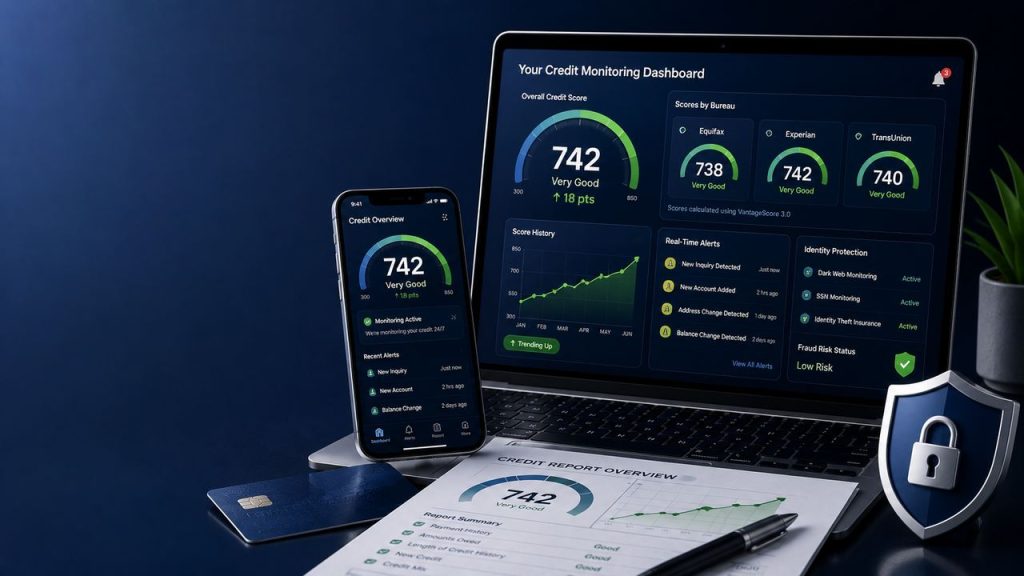
What is a strong free credit monitoring setup?
If you want genuinely good protection at zero monthly cost, here is a combination that works:
- Credit Karma for TransUnion + Equifax monitoring alerts and weekly scores.
- Experian’s free tier for Experian monitoring, a FICO score, and Experian Boost.
- AnnualCreditReport.com to pull your full reports from all three bureaus regularly — every few months, or anytime you are about to dispute something.
- A credit freeze at all three bureaus to block new-account fraud — the one thing monitoring cannot do.
That stack gives you alerts from all three bureaus, a mix of VantageScore and FICO, full report access, and a lock on new account openings — all for free. For many people, that is the right answer, and there is no shame in it.
What Paid Credit Monitoring Services Add
Now let’s talk about the paid tier honestly — what it adds, when it is worth it, and when it is overkill.
Paid credit monitoring typically runs $15 to $40 per month, with family plans on the higher end. The major paid services (across the industry) generally layer the following on top of what free services offer:
1. 3-Bureau Daily Pulls
Most paid services pull fresh data from all three bureaus daily, meaning you get the fastest possible alert when something changes on any of your three reports. For fraud detection, that speed matters — a fraudulent account caught on day one is far easier to unwind than one caught on day thirty.
2. Identity Theft Insurance
Paid services typically include $500,000 to $1 million in identity theft insurance, covering legal fees, lost wages, fraudulent fund reimbursement, and sometimes costs like re-filing taxes or notarizing affidavits. Check the specifics — coverage limits, deductibles, and exclusions vary — but the presence of insurance is a meaningful upgrade over free services.
3. Identity Restoration Help
This is, for many people, the single most valuable paid feature. If your identity is stolen, a restoration specialist takes on the heavy lifting: contacting creditors, placing fraud alerts, guiding you through the FTC identity theft report process, disputing fraudulent accounts, and handling the paperwork. After identity theft, this is the difference between a guided path and a maze.
4. Dark Web and Broader Identity Monitoring
Paid services go beyond credit reports. They scan dark web marketplaces, data breach databases, court records, change-of-address filings, and sex offender registries for misuse of your personal information. If your Social Security number, email, passport, or other sensitive data shows up somewhere it should not, you get an alert — often before any credit fraud has happened.
5. Family and Child Plans
Many paid services offer family coverage that includes children, a spouse, and sometimes other household members. Child identity theft is a real and growing problem — kids’ clean credit files are valuable targets, and the theft often goes undetected for years because no one thinks to check a child’s credit. A family plan with child monitoring closes that gap.
6. FICO Scores From All Three Bureaus
Free services typically give you VantageScore from one or two bureaus. Paid services often include FICO scores from all three bureaus, updated regularly — the actual scores most lenders use, from all three sources. If you are preparing for a mortgage or major application, this is the view you want.
7. Credit Lock Features
Some paid services bundle a credit lock — a quick, app-based way to lock and unlock your credit at one or more bureaus. A lock is similar to a freeze in effect (it blocks new account openings) but is faster to toggle and managed through the service’s app. Note: a lock is a voluntary, service-managed tool, while a freeze is a federally regulated right. Freezes are free by law; locks may be bundled with paid services. Both work. Use whichever fits your life.
How to Evaluate Any Credit Monitoring Service
Whether you are looking at a free service, a paid service, or trying to compare two side by side, here is a framework you can use to cut through the marketing and see what you are actually getting.
What features should you consider when evaluating credit monitoring services?
| Feature | Why It Matters | Free Tier | Paid Tier |
|---|---|---|---|
| Bureau coverage | Determines how much of your credit picture you can see. One bureau = partial; three = complete. | Usually 1–2 bureaus | All 3 bureaus |
| Refresh frequency | How fast you learn about changes. Daily is best; monthly is the floor. | Weekly to monthly | Daily |
| Alert types | New accounts, inquiries, address changes, public records, late payments, balance changes — the more, the better. | Key changes only | Comprehensive |
| Score model | FICO is what most lenders use; VantageScore is useful for trend tracking but may differ from lender pulls. | Often VantageScore | Usually FICO |
| Score history | Lets you see trends and connect events to score changes — critical for progress tracking. | Often included | Included |
| Dark web / identity monitoring | Early warning that your personal info is compromised, often before credit fraud occurs. | Basic or none | Comprehensive |
| Identity theft insurance | Covers recovery costs — legal fees, lost wages, stolen funds — if the worst happens. | Rarely included | $500K–$1M typical |
| Restoration help | A specialist who guides you through recovery from identity theft. Enormous peace of mind. | Not included | Included |
| Family / child coverage | Protects minors and household members, who are often overlooked targets. | Not included | Often available |
| Price | The bottom line. Know what you are paying and whether the features justify it for your situation. | $0 | $15–$40/mo |
Questions to Ask Before You Sign Up
Beyond the table, ask yourself:
- What am I actually trying to protect against? Fraud? Errors? Tracking repair progress? Your answer changes what matters.
- Is my fraud risk elevated? If yes, 3-bureau daily monitoring and insurance are worth more. If no, free plus a freeze is plenty.
- Am I about to apply for a major loan? If yes, you want FICO scores from all three bureaus and full reports, not just VantageScore from one.
- Do I have kids? If yes, look for family plans with child monitoring.
- Will I actually use the alerts? Monitoring only works if you read the alerts and act on them.
Do You Actually Need Paid Credit Monitoring?
This is where a lot of articles get vague. We are going to be direct, because that is what a trusted advisor should do.
Most People Are Fine With Free Monitoring Plus a Credit Freeze
If you are an average consumer — stable credit, no recent identity theft, no elevated fraud exposure, no major purchase on the immediate horizon — a free monitoring setup combined with a credit freeze at all three bureaus is more than enough.
The freeze does the heavy lifting on prevention (it blocks new accounts from being opened in your name), and the free monitoring gives you a reasonable early-warning system for changes on your report. You can always pull your full reports from AnnualCreditReport.com for depth when you need it.
This is not a compromise or a “starter” setup. It is a genuinely strong, financially smart protection plan that costs you nothing.
Paid Monitoring Makes Sense When
- You have been a victim of identity theft. After the first time, your risk of being targeted again is elevated. The insurance and restoration help alone justify the cost.
- Your personal data has been exposed in a major breach involving your Social Security number, and you want active 3-bureau daily monitoring while you assess the damage.
- You are actively repairing your credit and you want to see disputes resolve across all three bureaus in near real time, not just one.
- You are preparing for a major purchase (mortgage, auto loan) in the next 6–12 months and you need accurate FICO scores from all three bureaus, plus alerts on anything that could move your number.
- You have children and want to monitor their credit files for fraudulent activity.
- You run a business, have a public profile, or are otherwise a higher-value target for identity thieves.
- You simply value the peace of mind and can comfortably afford the monthly cost. That is a legitimate reason. Peace of mind has value.
Paid Monitoring Is Probably Overkill If
- Your credit is stable and you are not actively working on it.
- You have no recent fraud history and no elevated risk.
- A $20–$40 monthly bill would create financial pressure.
- You already have a freeze in place and check your reports periodically.
- You are signing up out of fear after seeing an ad, not because you have assessed your actual risk.
If any of those describe you, start with the free setup described earlier. You can always upgrade later if your situation changes. The free options are not a trap — they are genuinely useful, and for most people they are the right long-term answer.
How Credit Monitoring Fits Into a Credit Repair Plan
If you are working on repairing your credit — whether on your own or with help from a firm like ours — credit monitoring is not optional. It is how you know whether the work is working.
Here is how monitoring fits into each phase of a typical credit repair plan.
Phase 1: The Audit
Before any disputes are filed, you (or your credit repair team) need a complete picture of what is on all three of your reports. AnnualCreditReport.com gives you the full reports. A monitoring service — especially one with 3-bureau coverage — gives you the ongoing view as the plan unfolds.
At this stage, monitoring establishes your baseline: your starting scores at each bureau, the negative items that are dragging them down, and the positive items that are keeping them afloat. Everything from here forward is measured against that baseline.
Phase 2: Disputes and Interventions
Under the FCRA, you have the right to dispute any information on your credit report that is inaccurate, incomplete, or unverifiable. When you (or your credit repair firm) file a dispute, the bureau has typically 30 days to investigate and respond. If the disputed item cannot be verified, it must be removed or corrected.
Monitoring tells you the moment that removal or correction hits your report. You do not have to wonder whether the dispute worked. You see the score change, you see the item disappear, and you can confirm that all three bureaus updated — not just the one you disputed with. This matters because disputes do not always propagate across all three bureaus automatically. If an item is removed at TransUnion but still shows at Experian, monitoring is how you catch it.
Phase 3: Building and Rebuilding
Repair is only half the work. The other half is building positive credit history — new accounts, on-time payments, low utilization, responsible account aging. Monitoring tracks the impact of each of those moves in real time. You see a new tradeline report. You see your utilization drop as you pay down balances. You see your score climb as on-time payments accumulate.
This feedback loop is what keeps the rebuilding phase on track. Without it, you are making good decisions in the dark, hoping they add up. With it, you can see what is working and adjust what is not.
Phase 4: Long-Term Maintenance
Once your credit is where you want it, monitoring becomes your early-warning system. A surprise late payment, a fraudulent account, a reporting error — any of these can undo months of work. Monitoring catches them while they are still small, so you can address them before they become big.
This is also where a credit freeze becomes your long-term preventive tool. Freeze your credit at all three bureaus, keep monitoring in place, and you have a strong, low-cost defense that will catch problems fast while blocking most new-account fraud from happening in the first place.
Internal link placeholder: [The Credit Repair Process: Step-by-Step] — full walkthrough of a compliant, attorney-backed repair plan.
Common Credit Monitoring Mistakes to Avoid
Even with the right service in place, people make predictable mistakes that undercut the protection monitoring is supposed to provide. Here are the ones we see most often.
1. Confusing Monitoring With Prevention
Monitoring tells you something happened. It does not stop it from happening. If you want to actually block new-account fraud, you need a credit freeze — not a monitoring service, and not a “credit lock” that a paid service is trying to upsell you. The freeze is free by federal law at all three bureaus. Use it.
2. Ignoring the Alerts
A monitoring service only works if you read the alerts and act on them. If your inbox is full of unread monitoring emails, you have the illusion of protection, not the reality. Treat alerts the way you would treat a smoke alarm — read them immediately, and act if something looks wrong.
3. Relying on a Single-Bureau Service and Calling It Done
If your free service only monitors TransUnion, you are not monitoring your credit — you are monitoring one-third of it. Either stack free services to cover all three bureaus (as described above) or move to a paid 3-bureau service. Do not let “I have monitoring” lull you into false confidence.
4. Fixating on the Score Number Instead of the Report
Scores are useful, but the report is the source of truth. A score can drop for reasons that have nothing to do with fraud or error (a balance increase, a new inquiry, an account closure). The report tells you why. If you only look at the score and never pull the full report, you will miss the actual problems.
5. Paying for a Service You Do Not Need
A lot of people end up on a $25/month paid plan because they signed up during a moment of worry — after a data breach, after a news story about identity theft, after a friend’s horror story — and then never reassessed. If your situation has not changed and your risk is not elevated, the free setup is fine. Revisit your decision once a year.
6. Not Monitoring Children’s Credit
Children are prime identity theft targets because their credit files are clean and no one checks them. A child’s Social Security number can be used to open accounts for years before anyone notices — usually when the child turns 18 and applies for their first credit card or student loan and finds a wrecked credit history they did not create. If you have kids, look for a service with child monitoring or at minimum freeze their credit at all three bureaus (which is free).
7. Assuming One Service Covers Everything
No single service — free or paid — is a complete solution. The strongest setups combine monitoring (for alerts), a freeze (for prevention), and periodic full report pulls (for depth). Do not treat any one service as a complete defense. Layer your protection.
Frequently Asked Questions
Is free credit monitoring actually free, or is it a trial?
The services we described — Credit Karma, Experian’s free tier, Discover Scorecard — are genuinely free, ongoing services, not trials. You do not need a credit card to sign up, and you will not be charged after a period. They make money through advertising (showing you credit card and loan recommendations) or by upselling you to paid tiers. The free monitoring itself is real and ongoing.
How often should I check my credit report?
With monitoring in place, you do not need to pull your full reports constantly — the alerts will tell you when something changes. But it is wise to pull your full reports from all three bureaus via AnnualCreditReport.com at least a few times a year, and anytime you are about to dispute an item, apply for a major loan, or suspect fraud. The monitoring dashboard shows summaries and scores; the full report shows everything.
Does credit monitoring hurt my credit score?
No. Monitoring uses soft inquiries, which do not affect your credit score. Only hard inquiries — the kind a lender makes when you apply for credit — can lower your score, and only slightly and temporarily. Checking your own credit, through any service, never counts against you.
What is the difference between a credit freeze and a credit lock?
Both block new creditors from accessing your credit file, which effectively prevents new accounts from being opened in your name. A credit freeze is a free, federally protected right at all three bureaus. A credit lock is a voluntary, service-managed feature (often bundled with paid monitoring) that does essentially the same thing but through an app, with faster lock/unlock toggling. For most people, a freeze is the better choice because it is free and legally protected. A lock is fine if it comes with a service you are already paying for and you value the convenience.
Can credit monitoring prevent identity theft?
No — and any service that implies otherwise is being misleading. Monitoring detects identity theft early. It does not prevent it. To prevent new-account fraud, you need a credit freeze. To protect existing accounts, you need strong passwords, two-factor authentication, and vigilance against phishing. Monitoring is one layer in a broader defense, not the whole defense.
Should I pay for credit monitoring if I am already working with a credit repair firm?
It depends on your situation. If you are in an active repair plan, 3-bureau monitoring is genuinely useful for tracking dispute outcomes and score progress across all three bureaus. That said, a good credit repair firm should be pulling and reviewing your reports as part of the process, so you may not need a separate paid service if your firm provides that visibility. Talk to your firm about what they include. If they do not provide 3-bureau monitoring, a free stack (Credit Karma + Experian free) plus periodic full report pulls is a strong, zero-cost complement to your repair plan.
What should I do if I get an alert about an account I do not recognize?
Act immediately. First, do not assume it is fraud — sometimes a legitimate account shows up under an unfamiliar creditor name (a store card backed by a bank you do not recognize, for example). Look up the creditor and confirm whether it is yours. If it is not yours:
- Contact the creditor directly and tell them the account is fraudulent.
- Place a fraud alert at one of the three bureaus (it will propagate to the other two).
- Freeze your credit at all three bureaus if you have not already.
- File a report with the FTC at IdentityTheft.gov.
- Dispute the account with the credit bureau(s) reporting it.
- If you have identity theft insurance or restoration help through a monitoring service, call them — they will guide you through the process.
Speed matters. The faster you act, the less damage there is to undo.
Is it worth monitoring my child’s credit?
Yes. Child identity theft is a real and growing problem because children’s credit files are clean and no one is watching them. A child’s Social Security number can be used to open accounts for years before the theft is discovered — often not until the child applies for their first credit card, student loan, or apartment lease and finds a damaged credit history they did not create. You can freeze your child’s credit for free at all three bureaus (the process is a bit more involved than freezing an adult’s credit but worth it) and use a monitoring service with child coverage if you want ongoing alerts.
Next Steps: Take Control of Your Credit
Credit monitoring is one piece of a larger picture. If you want a clear, honest, attorney-backed review of your full credit profile across all three bureaus — including a breakdown of what is helping your score, what is hurting it, and what can be disputed under the FCRA — we can help.
At credit-repair.com, we offer a free credit audit that walks you through your reports, identifies errors and negative items that may be dragging your score down, and lays out a customized repair plan grounded in federal credit law. No quick-fix promises. No hidden fees. Just a clear path forward and a team that treats your financial future like their own.
Start your free credit audit at credit-repair.com →
Your credit score is not a verdict. It is a snapshot, and snapshots change. With the right monitoring, the right protections, and the right plan, you can watch it move in the direction you want — and know exactly what is moving it.