
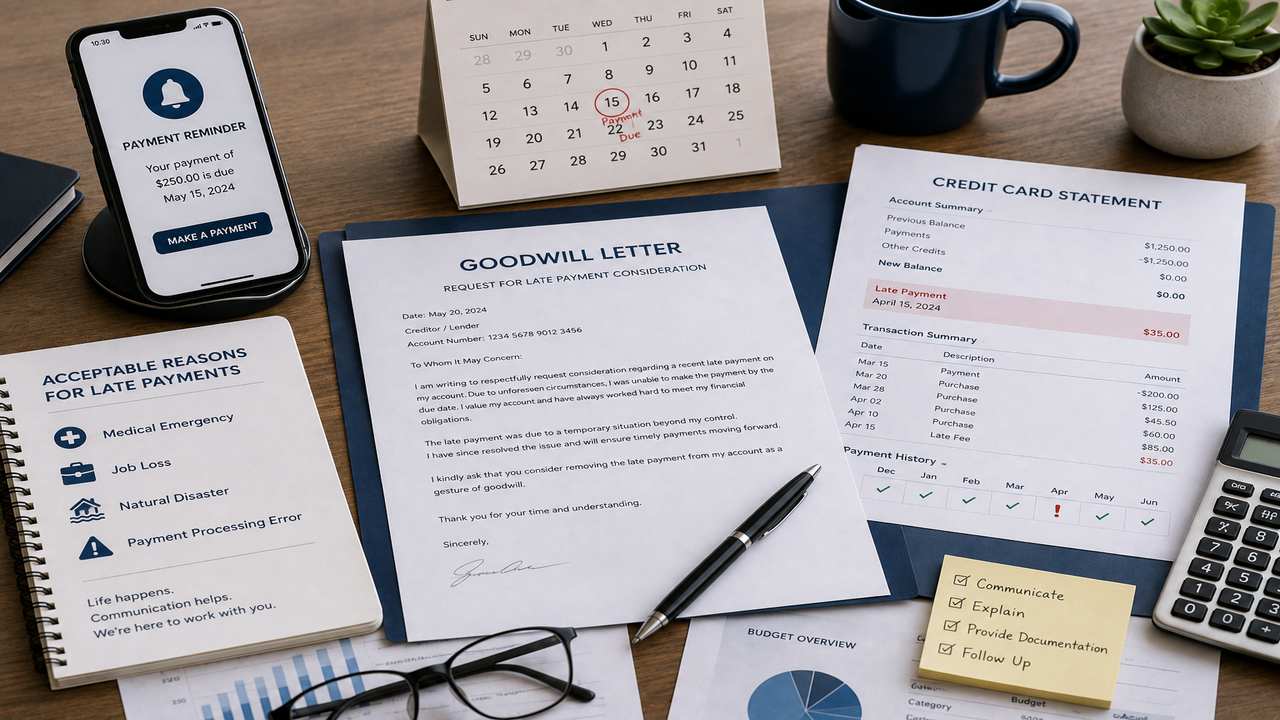
Creditors often show leniency for late payments caused by specific, well-documented circumstances, such as a documented medical emergency, natural disaster, job loss, or identity theft. These "acceptable reasons" are crucial because they can lead to a waived late fee, the removal of a negative late payment mark from a credit report, or a more understanding interaction with customer service representatives. In contrast, vague excuses like "I forgot" or unsubstantiated hardship claims are typically not accepted by lenders and credit bureaus, making documentation vital for any request for leniency.
This guide covers what actually counts as an acceptable, persuasive reason for a late payment, how to present it effectively, and the specific tools (goodwill letters, hardship programs, formal disputes) available depending on your situation.
Why are acceptable reasons for late payments important?
To be clear from the outset: creditors are never legally required to remove an accurate late payment mark just because you have a good explanation. Goodwill adjustments and hardship accommodations are discretionary, not guaranteed rights. That said, creditors do have real business incentives to retain good customers and avoid unnecessary disputes, and a well-presented, credible explanation meaningfully increases your odds of a favorable outcome compared to no explanation at all, or a poorly presented one.
Understanding which explanations tend to land well — and which ones don’t — helps you communicate more effectively when you do need to ask for consideration.
Reasons That Tend to Be Well-Received
A Documented Medical Emergency
Hospitalization, a serious injury, or a medical crisis affecting you or an immediate family member is one of the most consistently well-received explanations, particularly when it’s a one-time event on an account with an otherwise strong payment history. Creditors deal with this scenario often enough to have some institutional sympathy for it, and if you can provide documentation (a hospital discharge summary, for instance, though full medical details usually aren’t necessary — a brief confirmation of dates is often sufficient), it strengthens the request considerably.
A Natural Disaster or Declared Emergency
If you were affected by a hurricane, wildfire, flood, or another event covered by a federal or state disaster declaration, many creditors have specific, sometimes automatic, hardship accommodations for affected customers, including payment deferrals and late fee waivers, and in some cases these creditors proactively suppress credit bureau reporting for affected accounts during the crisis window. Check whether your creditor has a disaster relief program before assuming you need to negotiate this individually.
A Job Loss or Significant Income Disruption
Losing a job or experiencing a sudden, significant drop in income (such as being moved to reduced hours, or a business you own experiencing a temporary but serious downturn) is a commonly accepted hardship reason, especially if you can show it was resolved by the time you’re making the request — meaning you’re not simply explaining an ongoing inability to pay, but a specific past event that’s now behind you.
A Bank or Payment Processing Error
If a payment failed due to a documented error on the bank’s or creditor’s side — a processing glitch, an incorrectly declined transaction despite sufficient funds, a payment portal outage — this is one of the strongest possible explanations, since it isn’t really “your” late payment at all in a meaningful sense. Get whatever documentation you can (a bank statement showing the funds were available, a screenshot of an error message, a reference number from a customer service call made at the time) to support this kind of dispute.
A Death in the Family
The death of an immediate family member, particularly if you were managing their affairs or the event caused significant personal disruption, is generally treated with real sympathy by creditor representatives, most of whom have encountered this situation many times and have some latitude to extend grace in response to it.
Military Deployment or Active Duty Complications
Service members facing deployment-related payment disruptions have some additional legal protections under the Servicemembers Civil Relief Act (SCRA), which can include interest rate caps and other accommodations during active duty, separate from and in addition to any discretionary goodwill a creditor might extend.
An Identity Theft or Fraud Situation
If a late payment resulted from fraudulent activity on your account — an unauthorized user changing your payment information, or a fraudster intercepting statements — this isn’t really a “late payment reason” so much as a dispute of the underlying facts, and should be treated as a formal fraud dispute rather than a goodwill request, since you may have a right to have the item removed entirely rather than simply forgiven.
Reasons That Tend to Land Poorly
Is "I forgot" an acceptable reason for a late payment?
While completely human and extremely common, this explanation on its own doesn’t give a creditor much reason to extend discretionary leniency, since it doesn’t point to a specific, non-recurring circumstance. If forgetting was tied to something more specific — a house move that disrupted your mail, a period of genuine chaos in your life — including that context helps, but “I simply forgot” alone is a weak standalone explanation.
Is "I didn’t realize the bill was due" an acceptable reason for a late payment?
Similar to the above — this can work better if there’s a specific reason you didn’t realize (a billing address error, a paperless statement that went to an old email address you no longer check), but as a general statement it doesn’t carry much persuasive weight on its own.
Vague or unverifiable hardship claims.
A general statement like “I was going through a hard time” without any specifics is far less effective than a concrete, briefly stated circumstance, even if you don’t want to share extensive personal detail. A middle ground — specific enough to be credible, general enough to preserve privacy — tends to work best.
Blaming the creditor without documentation.
Claiming a payment failed due to their system when you don’t have any supporting evidence is unlikely to be taken seriously and can come across as an attempt to avoid responsibility rather than a genuine dispute.
A pattern of repeated “one-time” explanations.
If you’ve already used a goodwill request for a similar reason in the recent past, a second nearly identical request is far less likely to be granted, since it starts to look like a pattern rather than a genuine one-off circumstance.
How to Actually Request Leniency: The Goodwill Letter
A goodwill letter (sometimes called a goodwill adjustment request) is a written request asking a creditor to remove a late payment mark from your credit report, typically sent after you’ve already brought the account current. It works best under these conditions: the account has an otherwise strong payment history, the late payment was a genuine one-time event, and you can state your reason concisely and credibly.
A basic structure that works well:
What should be included in the opening of a goodwill letter?
Identify yourself and the account clearly, and state your request directly. “I’m writing to request a goodwill adjustment for a late payment reported on my account in [month/year].”
What context should you include in a goodwill letter?
Briefly explain what happened, in a sentence or two, without excessive detail. “This occurred during a period when I was hospitalized following [brief description], which disrupted my ability to manage bill payments during that specific window.”
How should you mention your payment track record in a goodwill letter?
Point to your broader history with them. “Prior to this incident, and in the time since, I’ve maintained an on-time payment record on this account for [X years/months].”
How do you state your specific request in a goodwill letter?
State clearly what you’re requesting. “I’m respectfully requesting that this late payment be removed from my credit report as a one-time goodwill exception.”
What should be included in the closing of a goodwill letter?
A polite, professional close, with your account information and contact details for follow-up.
Send this through whatever channel the creditor has designated for such requests — sometimes a written letter to a specific address, sometimes an online secure message through your account portal, sometimes through a phone call followed by a written confirmation. Persistence and a professional tone matter more than any specific magic wording.
What to Do If the Goodwill Request Is Denied
Not every goodwill request succeeds, and that’s a normal outcome, not a sign you did something wrong in how you asked. If denied, a few options remain:
- Try again after some additional time has passed, particularly if you continue building a clean payment record in the meantime, strengthening your case for a future request.
- Try a different contact channel or representative. Since these requests are discretionary, different representatives sometimes have different levels of authority or willingness to grant them, and a second attempt through a different channel occasionally succeeds where a first attempt didn’t.
- Focus on what you can control going forward. A single late payment’s impact on your score diminishes over time, particularly as it moves further into the past and gets outweighed by continued on-time payments. Building that ongoing track record is, in most cases, ultimately more impactful than any single goodwill request.
- Consider whether the item is genuinely disputable rather than simply requiring goodwill. If you believe the late payment was reported in error — wrong date, wrong amount, or shouldn’t be attributed to you at all — that’s a formal dispute under the FCRA, a different (and, when applicable, more powerful) process than a discretionary goodwill request.
Documenting Hardship the Right Way
If your situation involves an ongoing hardship rather than a single past event, many creditors offer formal hardship programs — temporary reduced payments, interest rate reductions, or forbearance — that are different from, and often more useful than, a goodwill request for a single already-reported late payment. These programs typically require you to proactively contact the creditor before missing additional payments, provide some documentation of your circumstances (which varies by creditor and program), and agree to specific terms for a defined period. Enrolling in a formal hardship program, when available, is generally a stronger and more reliable path than hoping for individual goodwill exceptions on a series of ongoing late payments.
A Note on Timing: Act Before, Not Just After
Every strategy discussed so far becomes meaningfully more effective when you reach out to your creditor before missing a payment, rather than only after the fact. A phone call in advance explaining a temporary hardship and asking about accommodation options is taken more seriously, and often produces better outcomes (a deferred due date, a waived fee, a formal hardship enrollment) than an after-the-fact request for forgiveness once the late payment has already been reported. If you know a payment issue is coming, treat that advance notice as your best opportunity to prevent the problem entirely, rather than saving your explanation for after the damage is done.
Frequently Asked Questions
Do I need to provide actual documentation, or is a written explanation enough?
It depends on the creditor and the specific circumstance. For less serious or lower-stakes requests, a credible written explanation alone is often sufficient. For more significant requests, or larger creditors with more formal processes, providing supporting documentation (even something as simple as a hospital admission date) strengthens your request considerably.
How many goodwill letters can I send for the same account?
There’s no fixed legal limit, but sending multiple requests for the same isolated incident rarely helps and can come across as excessive. If your first well-constructed request is denied, spacing out a follow-up by a meaningful amount of time, or waiting until you have additional positive history to point to, is a more effective approach than repeated immediate requests.
Does a “reasonable explanation” ever legally require a creditor to remove a late payment?
No, with one important exception: if the late payment was reported inaccurately in the first place (wrong date, wrong amount, fraud, or a documented creditor processing error), you have a legal right to dispute it under the FCRA, and if the creditor can’t verify its accuracy, it must be corrected or removed. A goodwill request, by contrast, is about accurate information the creditor chooses to forgive as a courtesy, and there’s no legal entitlement to that forgiveness.
Should I mention that I’m applying for a mortgage soon as part of my explanation?
This is generally not an effective inclusion, since it can come across as asking for a favor tied to your own upcoming benefit rather than a straightforward explanation of what happened, and creditors have heard this angle often enough that it doesn’t add persuasive weight.
What if the late payment happened years ago — is it still worth requesting a goodwill adjustment?
It’s still possible, though generally somewhat less likely to succeed the further removed it is from an active relationship-management conversation, since the creditor’s incentive to accommodate a currently active, valuable customer may feel less immediate for an old, resolved incident. That said, it doesn’t hurt to ask, particularly if the account is still open and you remain a customer in good standing.
A Complete Sample Goodwill Letter
Having a full template to adapt can make the process far less intimidating. Here’s a complete example you can modify for your own situation:
[Your Name]
[Your Address] [Date]

[Creditor Name] [Creditor Address, or note if sending via secure online message]
Re: Account Number [XXXX-XXXX-XXXX-XXXX]

Dear [Creditor Name] Customer Service,

I am writing to respectfully request a goodwill adjustment regarding a late payment reported on my account for [month/year]. I have been a customer with this account since [year], and prior to and following this single incident, I have maintained a consistent, on-time payment history.

The late payment occurred during [brief, specific circumstance — e.g., “a period when I was hospitalized due to a sudden medical emergency,” or “a natural disaster that significantly disrupted my household for several weeks”]. This was an isolated, non-recurring event, and I brought the account current as soon as I was able to address it.

I value my relationship with [Creditor Name] and would greatly appreciate your consideration in removing this late payment mark from my credit report as a one-time goodwill exception. I’m happy to provide any additional information that would be helpful in reviewing this request.

Thank you for your time and consideration.

Sincerely,
[Your Name] [Account Number] [Phone Number / Email]
Adjust the tone and specifics to match your actual situation and your natural voice — a letter that sounds authentically like you, rather than an overly formal template, tends to read more genuinely to the person reviewing it.
Goodwill Request vs. Dispute vs. Hardship Program: Choosing the Right Tool
These three tools solve different problems, and using the wrong one wastes time and can weaken your position. Here’s how to tell them apart:
- Use a goodwill request when the late payment was reported accurately, you don’t dispute that it happened, but you have a sympathetic, specific circumstance and a generally strong payment history, and you’re asking the creditor for a discretionary courtesy.
- Use a formal dispute when you believe the information itself is wrong — the date is incorrect, the payment was actually made on time and there’s a processing error, the account doesn’t belong to you, or it resulted from fraud. This is a legal right under the FCRA, not a request for a favor, and the creditor must investigate and correct verified inaccuracies.
- Use a hardship program enrollment when you’re facing an ongoing, current difficulty (not a single past event) and need structural help — reduced payments, a paused due date, a lower interest rate — for a defined period going forward, rather than forgiveness for something that’s already happened and been resolved.
Sometimes more than one applies simultaneously: for example, you might dispute an inaccurately dated late payment while also enrolling in a hardship program for genuinely ongoing difficulty affecting future payments. Being clear with yourself about which category your situation falls into helps you approach the right department and use the right language when you reach out.
How Creditors Internally Evaluate These Requests
Understanding roughly how a customer service representative or their internal system evaluates a goodwill request can help you present a stronger case. Most major creditors use some combination of the following factors, whether through a formal internal scoring system or a representative’s informal judgment:
Account tenure and overall payment history
A longtime customer with years of on-time payments carries far more weight than a newer account or one with a spottier history.
Total account value and relationship
Customers with higher balances, multiple products with the same institution, or a generally more valuable overall relationship sometimes receive more consideration, though this isn’t something you can control after the fact and isn’t guaranteed to matter at every institution.
How the request is framed
A concise, specific, professional request is easier for a representative to act on and justify internally than a vague or emotionally charged one, even when the underlying circumstance is equally sympathetic.
Whether it’s a genuinely isolated incident
Internal systems often flag whether an account has multiple late payments across its history, and a single isolated incident against an otherwise clean record is treated very differently than one in a string of several.
Frequently Asked Questions, Continued
Is it worth calling instead of writing a letter?
Both approaches have merit. A phone call allows for real-time conversation and can sometimes resolve things faster, but it’s harder to document precisely what was said. Many people find success with a hybrid approach: calling first to explain the situation and ask about the process, then following up in writing to formally document the request, which also gives the representative something concrete to escalate if they don’t have the authority to approve it themselves.
Can a goodwill letter backfire and draw more attention to the late payment?
This is very unlikely. The late payment is already visible to the creditor and on your credit report regardless of whether you request a goodwill adjustment — asking about it doesn’t create new negative information or draw attention that wasn’t already there.
Do all three credit bureaus need to be contacted separately if a goodwill request is approved?
No — when a creditor agrees to a goodwill removal, they typically update their reporting with all three bureaus they report to as part of their normal monthly reporting cycle, rather than requiring you to separately contact each bureau. It can take a billing cycle or two for the update to fully reflect across all your reports.
What if my hardship is ongoing rather than a single past event — should I still send a goodwill letter?
A goodwill letter is designed for a specific past incident, not an ongoing situation. If your hardship is continuing, focus on contacting the creditor about hardship program enrollment for your current and future payments first, and address any already-reported late payment through a goodwill request only once the immediate situation has stabilized.
How This Plays Out Differently Across Loan Types
How do goodwill requests apply to credit cards?
Credit cards tend to have the most accessible and flexible goodwill processes, since card issuers manage huge numbers of these requests routinely and often have dedicated customer retention teams with some discretion built into their role.
How do goodwill requests apply to mortgages?
Mortgages are more complex, since mortgage servicers often have less individual discretion than credit card issuers, and a late payment on a mortgage carries more weight in future underwriting (particularly for a future refinance or new home purchase). If you’re facing mortgage hardship, contacting your servicer proactively about a formal loss mitigation or forbearance program is generally more productive than a goodwill letter after the fact, and federally backed mortgages (FHA, VA, USDA, Fannie Mae, and Freddie Mac loans) have specific, more standardized hardship protections you may be entitled to.
How do goodwill requests apply to auto loans?
Auto loans vary significantly by lender — some, particularly captive finance arms of auto manufacturers, have structured hardship programs, while smaller or subprime auto lenders may have less flexibility and, in some cases, a lower threshold for pursuing repossession, making proactive communication especially important if you anticipate any payment difficulty.
How do goodwill requests apply to student loans?
Student loans (federal) have some of the most robust built-in hardship options of any loan type, including income-driven repayment plans, deferment, and forbearance, which are formal program enrollments rather than discretionary goodwill and are worth exploring first if you’re facing ongoing difficulty with federal student loan payments specifically. Private student loans function more like traditional personal loans, with hardship options varying by lender.
How do goodwill requests apply to personal loans and lines of credit?
Personal loans and lines of credit vary the most by individual lender, with online and fintech lenders sometimes having less flexible, more automated processes compared to traditional banks and credit unions, where a personal relationship or longer account history can matter more.
When a Late Payment Reason Also Signals a Bigger Financial Issue Worth Addressing
Sometimes the process of explaining a late payment reveals something worth addressing beyond the single incident itself. If you find yourself repeatedly constructing explanations for missed payments — even individually reasonable ones — it may be worth stepping back and looking at your overall budget, emergency savings, and bill payment system as a whole. A single unexpected expense causing a missed payment is a normal part of life; a pattern of near-misses or actual misses often points to a gap between income and obligations, insufficient emergency savings, or a bill-tracking system that isn’t working well for your specific life circumstances.
Addressing that underlying structural issue — whether through a formal budgeting approach, automating more of your bill payments, or building a small emergency fund specifically earmarked for bill continuity — tends to be far more valuable long-term than getting skilled at writing effective goodwill letters after the fact.
Frequently Asked Questions, Continued Further
Does a co-signer’s late payment reason matter for goodwill purposes on a jointly held account?
Yes — a goodwill request can reference the circumstances of either the primary borrower or a co-signer, since the late payment appears on both parties’ credit reports identically for a jointly held account. The explanation should focus on whatever circumstance actually caused the missed payment, regardless of which named party it happened to.
If my late payment reason involves my employer (like a delayed paycheck), is that considered acceptable?
This can be a reasonably persuasive explanation, particularly if it was a one-time, documented payroll issue rather than a chronic income timing problem. Providing a brief note or confirmation from your employer about the payroll delay, if available, can strengthen this type of request.
Can I request a goodwill adjustment before the late payment is even reported, if I know it’s coming?
It’s generally more effective to contact your creditor before a payment becomes 30 days late in the first place — at that point, you’re not asking for forgiveness of something already reported, but proactively seeking an accommodation (a short extension, a payment plan) that can prevent the negative reporting from happening at all, which is a stronger position to be in than any after-the-fact request.
What are the key takeaways for acceptable late payment reasons?
Not every late payment explanation carries the same weight, and understanding which reasons genuinely tend to move creditors — documented medical emergencies, natural disasters, job loss, processing errors, and similar concrete, one-time circumstances — helps you present your situation as effectively as possible. Reach out proactively when you can, keep your explanation concise and credible, get anything agreed to in writing, and remember that a goodwill adjustment is always a discretionary courtesy rather than a guaranteed right, which makes a well-prepared, professional request all the more valuable when you do need to ask for one.
Need Help Reviewing Your Credit?
If you’re dealing with a late payment or want to review your credit reports for inaccurate or negative information, you can request a credit audit or quote.