
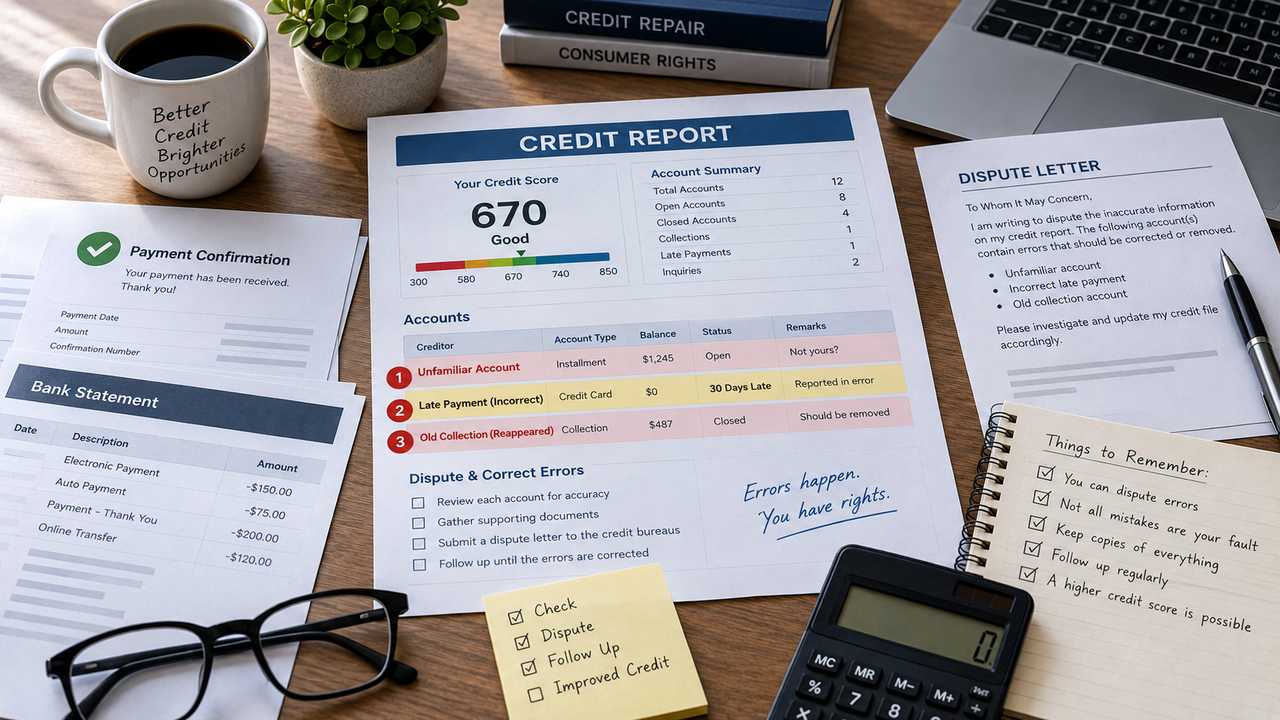
This isn’t about excusing genuine financial missteps — those happen too, and this article isn’t a way to dodge accountability for a payment you actually missed. It’s about the specific, well-documented category of credit report problems that occur through no fault of your own, so you can recognize them, understand why they happen, and know exactly what to do about each one.
Mistake One: A Data-Matching Error Puts Someone Else’s Account on Your File
Why This Happens
Credit bureaus process an enormous volume of data every single day, matching incoming account information to the correct consumer file using identifiers like your name, address, date of birth, and Social Security Number. With millions of files and billions of data points, mismatches happen — particularly for people with common names, for family members who share a name (a “John Smith Jr.” confused with “John Smith Sr.,” for instance), or for people whose Social Security Number was transposed by even a single digit somewhere in a creditor’s system.
This is a documented, well-understood category of credit reporting error, not a rare fluke. Studies examining credit report accuracy over the years have consistently found that a meaningful percentage of consumers have at least one error on at least one of their three credit reports, and mixed files — where information belonging to someone else ends up on your report — are one of the most common and consequential types.
How to Spot It
Look for anything that simply doesn’t match your own history: an account you never opened, an address you’ve never lived at, an employer you’ve never worked for, or a name variation you’ve never used. Sometimes the mismatch is obvious (a completely unfamiliar account with a large balance), and sometimes it’s subtler (an otherwise-plausible account that’s just slightly off in a detail like the opening date).
What to Do About It
Formally dispute it with whichever credit bureau is reporting the error, providing whatever documentation supports your position — proof of your actual address history, or simply a clear, factual statement that the account isn’t yours. Under the Fair Credit Reporting Act, the bureau is required to investigate, generally within 30 days, and correct or remove information that can’t be verified as accurately belonging to you.
If the mismatch seems to involve identity theft rather than a simple data error (multiple unfamiliar accounts, for instance, rather than one isolated item), it’s worth filing a report at IdentityTheft.gov as well, since this provides additional documentation and protection as you work through the correction process.
Mistake Two: A Payment You Made On Time Gets Reported Late
Why This Happens
This one is genuinely maddening because it can happen even when you did everything right. A few common, non-your-fault causes: your payment was processed by your bank or the creditor with an internal delay that pushed it past the due date on their end, even though you submitted it on time; a payment was misapplied to the wrong account (particularly common if you have multiple accounts with the same creditor, or a similar account number to another customer); or a system error at the creditor simply reported the wrong status entirely, something that happens more often than most people realize given how much of this process is automated with limited human review.
How to Spot It
Compare your own bank or payment records — statements showing exactly when a payment was sent and processed — against what your credit report shows for that specific account and date. If your bank statement shows a payment cleared before the due date, but your credit report shows a late payment for that same billing cycle, this is a genuine, documentable discrepancy worth challenging.
What to Do About It
Gather your proof first — bank statements, payment confirmation numbers, or screenshots showing the payment date. Contact the creditor directly, since they’re often able to correct their own reporting faster than going through a formal bureau dispute alone, though you can and should also file a formal dispute with the credit bureau reporting the error if the creditor doesn’t resolve it promptly.
This is one of the stronger, more straightforward disputes to win, precisely because you likely have concrete, dated proof rather than a more abstract disagreement.
Mistake Three: An Old, Paid Debt Resurfaces as a “New” Collection
Why This Happens
This is where the debt resale industry creates genuine confusion, even for people who did nothing wrong. When you pay off or settle a debt, that resolution needs to be accurately communicated back through the chain — from you, to the creditor or collector you paid, to the credit bureaus. If a debt was later sold to a different company before that resolution was properly recorded, or if a paid account gets confused with a similar unpaid one in a large resold portfolio, you can end up with what looks like a “new” collection account for a debt you already resolved, sometimes years earlier.
This isn’t a hypothetical edge case — it’s a well-documented pattern in the debt-buying industry, where accounts get bundled, resold, and sometimes resold again, with documentation occasionally failing to travel cleanly through each transfer. A debt you settled with Company A years ago can genuinely resurface through Company C, unaware of (or simply not having received records of) your prior resolution.
How to Spot It
If a collection account appears for a debt you’re confident you already paid or settled, check the original creditor’s name and approximate account details against your own records. If they match a debt you resolved, even years ago, this is worth challenging directly rather than assuming you must have missed something.
What to Do About It
Locate your proof of the original resolution — a settlement letter, a payment confirmation, or bank records showing the payment. Dispute the new entry directly with both the company currently reporting it and the credit bureau, providing this documentation.
It’s also worth requesting formal debt validation from whoever is currently attempting to collect, which legally requires them to pause collection activity and prove their claim before continuing — a request they often can’t fully satisfy once faced with your existing proof of resolution.
The Broader Pattern Behind All Three
What connects these three scenarios is that credit reporting, for all its importance in your financial life, is fundamentally a data-processing system with real, well-documented failure points — not a flawless record of your actual behavior.
Recognizing this distinction matters for two reasons. First, it protects you from unnecessarily internalizing shame or self-blame over something that wasn’t actually your doing. Second, and more practically, it points you toward the right response: not quietly accepting whatever your report says, but actively verifying it and disputing what doesn’t hold up.
Frequently Asked Questions
How often should I check my credit report specifically to catch these kinds of errors?
A full report review every three to four months is a reasonable general cadence for most people, striking a balance between catching problems in a timely way and not becoming excessively focused on frequent, minor fluctuations that don’t actually indicate an error.
Does disputing an error ever hurt my credit score?
No — filing a dispute itself has no negative effect on your score. If your dispute is successful and an inaccurate negative item is corrected or removed, your score can only improve or stay the same as a result, never worsen.
Can these kinds of errors happen on more than one of my three credit reports at once?
Yes, since some creditors report to all three bureaus, an error at the source can appear identically across all three — which is exactly why checking all three reports, not just one, matters for catching the full scope of any given issue.
Is there a cost to disputing an error?
No — filing a dispute with a credit bureau is free, and you’re never required to pay for this process, either directly to the bureau or through a third-party service, since it’s a right guaranteed under federal law.
How These Three Credit Report Mistakes Interact With the Recent Wave of Medical Debt Reforms
It’s worth briefly connecting this discussion to a genuinely positive, relevant development: medical debt reporting has changed meaningfully in recent years, with all three major bureaus now generally removing paid medical collections from credit reports entirely rather than simply marking them “paid,” and requiring a waiting period before an unpaid medical bill can even be reported in the first place.
This matters directly to mistake three specifically, since medical billing — with its layers of insurance processing, claim denials, and delayed billing — has historically been one of the most error-prone categories of debt to end up incorrectly in collections. If your resurfaced or disputed collection traces back to a medical bill, these newer, more consumer-favorable rules may work directly in your favor, sometimes making an otherwise complicated dispute considerably more straightforward.
A Broader Perspective on Why This Matters Beyond Just Your Score
It’s worth stepping back from the mechanics for a moment to name something important: credit report errors aren’t just an abstract inconvenience. An uncorrected error at the wrong moment — right before a mortgage application, an auto loan, or even certain job or apartment applications — can have real, costly consequences: a higher interest rate, a denied application, or lost time scrambling to correct something under pressure that could have been caught and fixed calmly months earlier.
This is precisely why proactive, periodic review matters more than reactive review only when something feels obviously wrong — many of the errors described in this article are subtle enough that they don’t announce themselves loudly; they simply sit quietly on your report until a lender happens to notice them at an inconvenient moment.
Frequently Asked Questions, Continued
If I successfully dispute one of these errors, will it definitely never come back?
In most cases, once a bureau removes information because the furnisher couldn’t verify it, they’re not permitted to simply re-report the same unverified information later without new substantiation — if it does reappear without new documentation, that’s grounds for a further dispute and potentially a complaint about the furnisher’s reporting practices.
Should I be more worried if I find one of these errors on my report, or is it truly common enough not to panic about?
It’s genuinely common enough that discovering one of these issues shouldn’t trigger panic — treat it as a solvable, well-understood administrative problem with a clear resolution path, rather than a sign that something is fundamentally wrong with your finances or your credit management.
Building a Personal Documentation Habit That Prevents These Problems From Becoming Bigger Issues
One of the most effective, low-effort defenses against all three Credit Report mistakes described in this article is simply developing a habit of holding onto financial documentation longer than might feel intuitively necessary.
Payment confirmations, settlement letters, and account closure notices are easy to discard once a matter feels resolved, but as this article has shown, resolved matters can resurface years later through no fault of your own. A simple digital folder — even just a dedicated email label or a folder of scanned documents — where you keep confirmation of every debt payoff, settlement, or dispute resolution gives you an immediate, ready answer if any of these situations ever arise again down the line, turning what could be a stressful scramble to reconstruct old records into a five-minute task of pulling up documentation you already have on hand.
What Creditors and Bureaus Are Doing to Reduce These Errors Industry-Wide
It’s worth noting that the credit reporting industry has faced real regulatory and public pressure over the years to improve accuracy, resulting in some genuine structural improvements: enhanced data-matching standards adopted by the major bureaus, more standardized reporting formats (like the Metro 2 format used industry-wide) intended to reduce inconsistent data submission from creditors, and increased scrutiny following high-profile regulatory settlements addressing credit reporting accuracy specifically.
These improvements have measurably reduced error rates over time, though they haven’t eliminated the underlying structural vulnerabilities described throughout this article — which is exactly why individual vigilance remains a necessary complement to industry-level improvements, not a redundant extra step.
Frequently Asked Questions, Continued Further
Is it worth paying for a credit monitoring service specifically to catch these kinds of errors faster than checking manually?
Paid monitoring services can provide faster alerts to new account openings or significant changes, which can help catch mistake one (a mixed file resulting in an unfamiliar new account) more quickly than periodic manual review alone — for Credit Report mistakes two and three specifically, which often involve existing accounts rather than new ones, a thorough periodic manual review of your full report remains valuable regardless of whether you also use a monitoring service.
Does it matter which of the three bureaus I check first if I only have time to check one?
Not particularly — since these errors can occur at any of the three bureaus depending on which creditors reported the problematic information to which bureau, there’s no single bureau inherently more likely to contain an error; checking all three periodically, even if staggered throughout the year, provides more complete protection than consistently favoring just one.
How Each of the Three Bureaus Handles Disputes Slightly Differently
While the Fair Credit Reporting Act sets the same baseline legal requirements for Equifax, Experian, and TransUnion, the practical experience of disputing an error with each bureau can differ in small but meaningful ways. Each bureau maintains its own online dispute portal, its own average processing timelines within the legally required 30-day window, and its own specific documentation upload requirements.
Because a single error can sometimes appear on only one or two of your three reports (since not every creditor reports to all three bureaus), it’s important to check all three individually rather than assuming a clean result from one bureau means the same is true across all of them. If you find the same error on multiple reports, you’ll generally need to file a separate dispute with each bureau reporting it — resolving it with one doesn’t automatically correct the others, since they maintain independent files.
The Role of the Original Creditor in Speeding Up Resolution
While you have the right to dispute directly with the credit bureaus, it’s often faster and more effective to also contact the original creditor or furnisher of the disputed information directly, particularly for Credit Report mistakes two and three described above.
This is because the bureau, upon receiving your dispute, generally forwards it to the furnisher (the creditor or collector who originally reported the item) for verification — meaning the furnisher is going to be involved in resolving your dispute either way.
Reaching out to them proactively, with your documentation in hand, sometimes resolves the issue in days rather than waiting the full 30-day bureau investigation window, since a furnisher who immediately recognizes their own error can update their records and notify the bureau directly, short-circuiting the longer formal process.
What Happens Behind the Scenes During a Bureau Investigation
Understanding the mechanics of what actually happens once you file a dispute can help set realistic expectations. The bureau doesn’t independently investigate your claim from scratch — instead, they package your dispute and supporting information and send it to the furnisher through a system called e-OSCAR (Electronic Online Solution for Complete and Accurate Reporting), which most major creditors and collectors use to respond to disputes.
The furnisher then has a limited window to investigate on their end and report back whether the information is accurate, should be updated, or should be deleted entirely.
While the process is designed to resolve errors efficiently, it also explains why detailed documentation matters so much: the clearer and more specific your evidence is when the dispute reaches the furnisher, the easier it is for them to identify the problem and correct it.
Why Paid and Resolved Debts Sometimes Get Swept Into Portfolio Sales
When a creditor sells a batch of accounts, they’re often selling hundreds or thousands of individual debts at once, bundled together based on general characteristics like age and balance range, not individually verified one by one before the sale.
If your specific account was actually already resolved at the time of a bulk sale — perhaps a payment posted right around the same time the portfolio was being finalized for transfer — it’s entirely possible for your resolved account to get swept into a batch sale anyway, simply because the seller’s records hadn’t yet caught up to reflect your payment before the sale was finalized.
The buyer, receiving what looks like a straightforward unpaid account, has no way of knowing it was actually already resolved unless and until you point this out with your own documentation.
The Bottom Line
Credit reports are important, but they are not infallible. An unfamiliar account may belong to someone else. A payment you made on time may have been reported incorrectly. A debt you resolved years ago may resurface through the complicated chain of debt resale.
The most important habit is to review your credit reports regularly, compare what you see against your own records, and avoid assuming that every piece of information on your report must automatically be correct.
If something doesn’t match your financial history, investigate it. Gather documentation. Contact the furnisher when appropriate. Use your rights under the Fair Credit Reporting Act to dispute information that is inaccurate, incomplete, or cannot be properly verified.
A credit report should reflect your actual financial history — not someone else’s account, a creditor’s processing error, or a debt that was already resolved.
Need Help Finding Credit Report Errors?
Reviewing three credit reports and identifying inaccurate accounts, incorrect late payments, or collections that should not be there can be complicated. A detailed review can help you understand what is accurate, what may be outdated, and what information may need to be disputed.
If you want help reviewing your credit reports and understanding your available options, request a credit audit or quote today.