
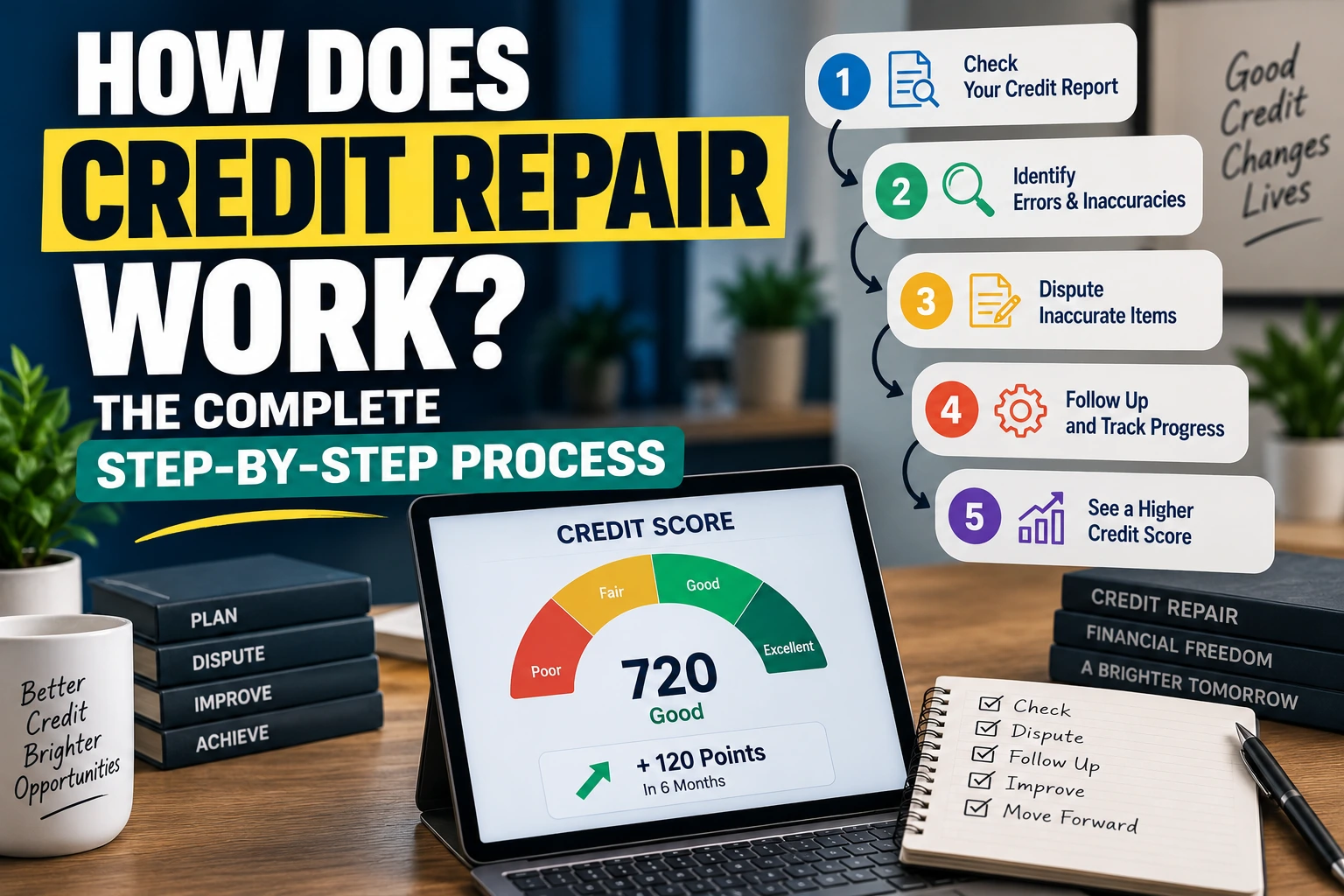
Credit repair works by identifying inaccurate, incomplete, or unverifiable items on your credit reports and formally disputing them with the credit bureaus, who must investigate within 30 to 45 days (Experian, 2026; Firstcard, 2026). If a disputed item can’t be verified as accurate, the bureau corrects or deletes it. If it’s confirmed accurate, it stays no company, paid or free, can remove a true negative mark early.
That’s the entire mechanism in one sentence, but the real process has more moving parts: gathering the right proof, writing a dispute that survives the bureaus’ automated review system, tracking multiple 30-day windows across three separate bureaus, and knowing what to do when a dispute comes back “verified” even though you’re sure it’s wrong.
This guide walks through every step, in order, whether you’re doing it yourself or evaluating what a paid service actually does on your behalf.
Key Takeaways
- Credit repair centers on formal disputes filed with Equifax, Experian, and TransUnion (Firstcard, 2026).
- Bureaus must investigate within 30 days, extendable to 45 in some cases (Experian, 2026).
- 2026 FCRA updates added a mandatory 10-day preliminary review for high-risk errors (Dispute Beast, 2026).
- Vague disputes often get reduced to a two-digit code inside the bureaus’ e-OSCAR system specificity and documentation matter (Stacking Capital, via CreditCareCo, 2026).
- Only inaccurate or unverifiable items can be removed; accurate negative marks stay for up to 7 years (Experian, 2026).
Step 1: Pull and Review All Three Credit Reports
The process starts with pulling your full credit reports from Equifax, Experian, and TransUnion and reviewing each one line by line (Firstcard, 2026). You’re looking for accounts you don’t recognize, duplicate listings, incorrect balances, and payment dates that don’t match your own records.
Get your reports free through AnnualCreditReport.com, and save a copy of each so you can track exactly what changes later (Firstcard, 2026). A low score is rarely caused by one bad month it’s usually the accumulation of old mistakes and unresolved negative items still dragging the report down (ExpressCreditBoost, 2026). Why start here instead of jumping straight to disputes? Because you can’t fix what you haven’t fully mapped out first.
If you’d rather handle the whole process without paying a company, this same review step is where a fix-your-own-credit playbook picks up in detail.
Step 2: Identify Specific, Disputable Errors
Not every negative item is fair game you’re specifically looking for information that’s inaccurate, outdated, unverifiable, or not yours (Firstcard, 2026). Common examples worth flagging include an account you don’t recognize, a duplicate collection for the same debt, a late-payment mark on an account you paid on time, or personal information that doesn’t belong to you.
Make notes in plain language next to each one “account not mine,” “balance wrong,” “paid but shown as unpaid” rather than vague objections (Firstcard, 2026). Vague disputes are the ones most likely to get lost. The credit bureaus’ e-OSCAR verification system strips context from long, detailed letters, often reducing them to a simple two-digit dispute code before forwarding them to the creditor (Stacking Capital, via CreditCareCo, 2026) so a sharply specific claim survives that compression better than a paragraph of general complaints.
Step 3: Gather Supporting Documentation
Every dispute needs proof attached, not just an assertion. That means bank statements showing an on-time payment, account closure letters, identity theft reports, or anything else that directly contradicts what’s being reported. According to dispute-letter best practices, an effective letter clearly identifies the account, explains specifically why it’s inaccurate, and includes the supporting documentation up front (Crediful, via CreditCareCo, 2026).
Skipping this step is one of the most common reasons a dispute comes back “verified” even when the consumer is right the furnisher simply confirms their own records because nothing was submitted to challenge them.
One specific tool worth knowing at this stage is the 609 dispute letter, which cites your right under FCRA Section 609 to request the bureau’s method of verification alongside your dispute documentation.
Step 4: File the Dispute With Each Bureau
You can file a dispute online, by mail, or by phone, and the process differs slightly across Equifax, Experian, and TransUnion (Experian, 2026). Because each bureau maintains its own version of your file, an error appearing on two reports needs two separate disputes filing with one bureau doesn’t automatically correct the others.
Under 2026 FCRA updates, high-risk errors now trigger a mandatory 10-day preliminary investigation in addition to the standard window, and bureaus must notify you if they need additional documentation before finishing their review (Dispute Beast, 2026). This is a meaningful shift: furnishers face stricter timelines, and slower or incomplete responses are no longer treated as acceptable under federal law.
[CITATION CAPSULE]: The standard credit-bureau investigation window is 30 days, extendable to 45 if you submit additional relevant information during that period a rule unchanged even after the 2026 FCRA updates tightened requirements elsewhere (Firstcard; Dispute Beast, 2026).
Step 5: The Bureau Investigates and Contacts the Furnisher
Once filed, the bureau forwards your dispute to whoever reported the information the bank, collector, or lender and asks them to verify their records (Experian, 2026). This is the step most consumers can’t see happening, and it’s also where the e-OSCAR compression problem shows up most: a detailed letter can get boiled down to a short code before the furnisher ever reads your full explanation (Stacking Capital, via CreditCareCo, 2026).
If the furnisher can’t verify the information as accurate, the bureau must correct or delete it. If they confirm it as accurate, it stays on your report, and you’ll be notified either way once the investigation closes (Experian, 2026).
Step 6: Escalate If the Dispute Comes Back “Verified” Incorrectly
If a dispute you’re confident is accurate still comes back verified, you’re not out of options. Escalation strategies include sending a follow-up dispute via certified mail with additional documentation, filing a complaint with the CFPB, or requesting the specific method the furnisher used to verify the record (Stacking Capital, via CreditCareCo, 2026). The CFPB has fined major bureaus for inadequate investigations in the past, and it continues to hold them accountable when consumers escalate formally.
For debts you owe but want off your report faster, a pay-for-delete letter asking a collector to remove the account entirely in exchange for payment is a separate tool from a standard dispute, and it works only in specific situations (CreditCareCo, 2026).
If the item in question is an accurate late payment rather than an error, a dispute won’t help that’s the situation goodwill letters are built for, asking a creditor to forgive a one-off late mark as a courtesy rather than contesting it as wrong.
Step 7: Address What’s Left With Credit-Building Habits
Once the disputable errors are resolved, whatever accurate negative information remains has to age off naturally, and the fastest path forward is standard credit-building: paying every bill on time, paying down balances, and avoiding unnecessary new credit applications (Experian, 2026). Most people see meaningful movement in their score within 45 to 90 days of starting the full process, with some early signs as soon as 30 days though the exact pace depends on how many negative items were on the report to begin with (Crowned Credit, 2026). For a fuller month-by-month picture, see how long credit repair actually takes.
If you’re weighing whether to handle these steps yourself or pay someone to manage them, how much credit repair costs breaks down both paths in detail.
FAQ
How long does it take for credit repair to work?
Most people see initial movement within 30 to 90 days, since bureaus must investigate disputes within 30 to 45 days (Crowned Credit; Experian, 2026). Full resolution across every disputed item can take several dispute cycles when errors appear on multiple bureaus or the case is more complex.
Can a credit repair company remove accurate negative items?
No. Credit repair whether done yourself or by a paid company can only dispute information that’s inaccurate, incomplete, or unverifiable. Accurate negative marks legally stay on your report for up to seven years regardless of who disputes them (Experian, 2026).
What happens after I file a dispute?
The bureau forwards your dispute to the company that reported the information and asks them to verify it. If they can’t confirm it’s accurate, the bureau corrects or deletes the item; if they confirm it, the item stays and you’re notified of the result (Experian, 2026).
Do the 2026 FCRA updates change how disputes are handled?
Yes. The 30-day standard window still applies, but high-risk errors now get a mandatory 10-day preliminary investigation, and bureaus must notify you if more documentation is needed, with stricter timelines imposed on furnishers as well (Dispute Beast, 2026).
What if my dispute comes back “verified” but I know it’s wrong?
You can escalate with a certified-mail follow-up including more documentation, request the furnisher’s verification method, or file a complaint with the CFPB, which has previously fined bureaus for inadequate investigations (Stacking Capital, via CreditCareCo, 2026).
The Bottom Line
Credit repair works through a defined legal process: pull your reports, flag specific errors with proof, file formal disputes with each bureau, and let the 30-to-45-day investigation window run its course. What changes between doing it yourself and paying a company is who manages that paperwork and follow-up not the underlying mechanism, and not what can legally be removed.