
Credit utilization is one of the most talked-about factors in credit scoring, and also one of the most commonly oversimplified — “keep it under 30%” is the advice everyone’s heard, but the actual relationship between utilization and your score is more precise than that single number suggests, and understanding the real curve can help you optimize more effectively than a rough rule of thumb.
What Utilization Actually Measures
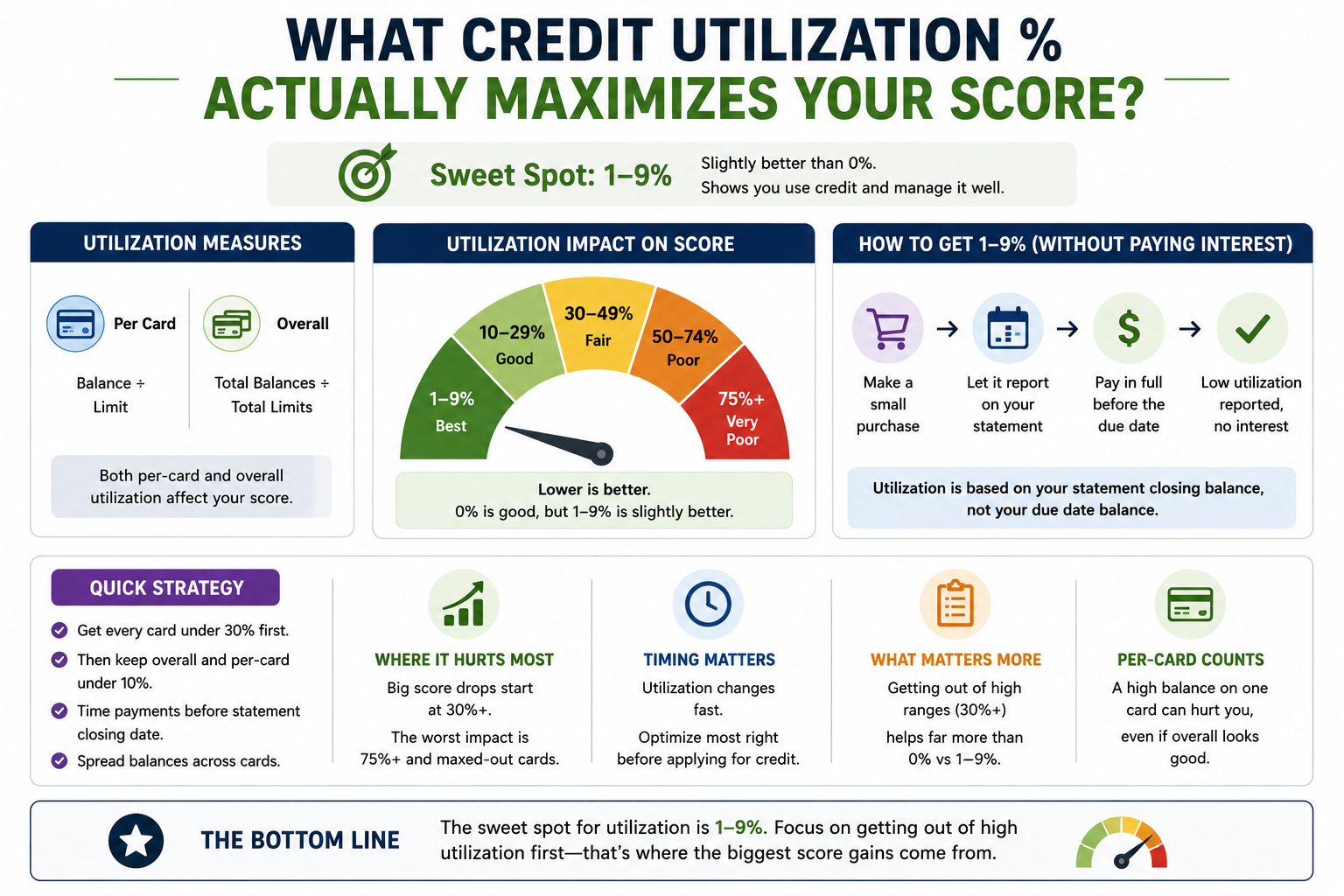
Credit utilization is the percentage of your available revolving credit currently in use, calculated both **per card** and as an **overall aggregate** across all your revolving accounts. Both the per-card and overall numbers matter to most scoring models, which is why a single maxed-out card can hurt you even if your other cards are at zero, even though your combined average might look reasonable.
Debunking “Under 30%” as the Optimal Target
The “under 30%” figure that’s become common financial advice is really more of a **danger threshold** than an actual optimization target — it’s the point above which utilization starts meaningfully hurting your score, not the point that maximizes it. In reality, scoring models generally continue rewarding lower utilization all the way down, well below 30%.
The Actual Sweet Spot: Low Single Digits, Not Zero
This is the part that surprises people: **0% utilization is not actually the optimal target for most scoring models** — a small amount of reported utilization, generally in the range of **1-9%**, tends to score slightly better than a reported $0 balance across the board.
Why does this happen? Scoring models are, in part, trying to assess how you actually manage revolving credit — and a small amount of reported, presumably-managed utilization slightly outperforms a complete absence of any utilization signal, in most model formulations. This doesn’t mean carrying a balance and paying interest — it means simply having a small amount show as your statement balance when it’s reported, even though you then pay it off in full and never carry interest.
How to Actually Achieve Low Single-Digit Utilization (Without Carrying a Balance)
This is a common point of confusion, so it’s worth being precise: you can have low utilization **reported** while still paying your balance in full every month and never paying interest, because of how billing cycles work:
– Your utilization is calculated based on the balance reported to the bureaus, which is typically your **statement closing balance**, not your balance at any other point in time.
– If you make a purchase, let a statement close with a small balance showing, and then pay that statement balance in full before the due date, you’ve achieved low reported utilization **and** paid zero interest — the two aren’t actually connected the way people often assume.
Practical approach: if you want to land in that 1-9% sweet spot rather than at 0%, simply let one small, predictable charge appear on your statement each cycle (a subscription, a recurring small purchase) rather than paying everything off before the statement even closes.
Does This Sweet-Spot Difference Actually Matter Much?
Honestly, the difference between 0% and 1-9% utilization is generally modest — a few points at most for most people. This is worth keeping in perspective: the much larger, more consequential distinction is between **low utilization (under roughly 10%) and high utilization (above 30%, and especially above 50-70%)**. Optimizing the last few points between 0% and single digits is a minor refinement, not where the real scoring impact lives.
The Bigger Picture: Where Utilization Really Hurts
The meaningful score damage happens at higher utilization ranges:
– **30-49%**: starts noticeably dragging on your score, though not dramatically for most profiles.
– **50-74%**: a more significant negative factor, clearly signaling heavier reliance on available credit.
– **75%+**: one of the more damaging utilization ranges, and **90%+ or maxed-out** cards are treated especially harshly, since this pattern strongly correlates with higher default risk in the data scoring models are built from.
If you’re currently in a high-utilization range, the actual priority isn’t chasing the theoretical 1-9% optimum — it’s making meaningful progress out of the high-damage ranges (50%+, and especially 75%+) down toward moderate levels first, since that’s where the largest score gains are actually available.
Per-Card vs. Overall: Which Matters More?
Both matter, but in slightly different ways:
– **Overall utilization** (total balances across all cards divided by total available credit) is generally the more heavily weighted factor in most models.
– **Per-card utilization** also matters somewhat independently — a single card at 95% utilization can hurt you even if your overall utilization across all cards averages out to something more moderate, since some models specifically flag any individual account showing very high utilization as its own risk signal.
Practical implication: if you’re managing multiple cards, it’s generally better to spread balances relatively evenly at moderate levels across cards than to max out one card while keeping others at zero, even if the aggregate percentage comes out similar either way.
Does Utilization Optimization Matter If You’re Not Applying for Credit Soon?
This is worth considering honestly: utilization is one of the more heavily weighted but also one of the more **volatile, fast-changing** scoring factors — unlike account age or payment history, which build slowly and steadily, utilization can swing significantly month to month based on your current balances. If you’re not planning to apply for credit in the near term, obsessive month-to-month utilization optimization matters less than the broader habit of generally keeping balances low relative to your limits. It becomes much more worth actively managing and timing precisely in the weeks before a planned major credit application (a mortgage, an auto loan), when you want your reported balances to reflect the most favorable possible snapshot.
A Practical Utilization Strategy
1. **If you’re currently above 30% on any card, prioritize paying that down first** — this is where the real score gains live.
2. **Once you’re consistently under 10% overall and per-card, don’t stress further optimization** unless you’re specifically preparing for a major credit application in the near term.
3. **If you are preparing for a major application**, consider timing a payment to land your statement balance in that 1-9% sweet spot (or even $0, if achieving the precise sweet-spot timing is impractical) rather than carrying a higher balance into the statement close.
4. **Spread balances relatively evenly across cards** if you’re carrying any balances at all, rather than concentrating them on one card while others sit at zero.
The Bottom Line
The often-repeated “under 30%” utilization guidance is really a danger-zone threshold, not an actual optimization target — most scoring models reward utilization all the way down into the low single digits, with a slight, modest edge for reported balances in the 1-9% range over a flat $0. That said, this fine-tuning matters far less than simply getting out of high-utilization ranges (30%+, and especially 50-75%+) in the first place, which is where the large majority of the available score improvement actually comes from. If you’re already comfortably under 10%, further optimization is a minor refinement worth pursuing mainly if you’re specifically preparing for a major credit application in the near term.