
If you’re dealing with a smaller medical bill and wondering whether it’s actually going to affect your credit, there’s genuinely good news here — but it’s worth understanding exactly why, and where the edges of this protection are, since the details matter more than the headline.
The Short Answer: No, Under Current Bureau Policy
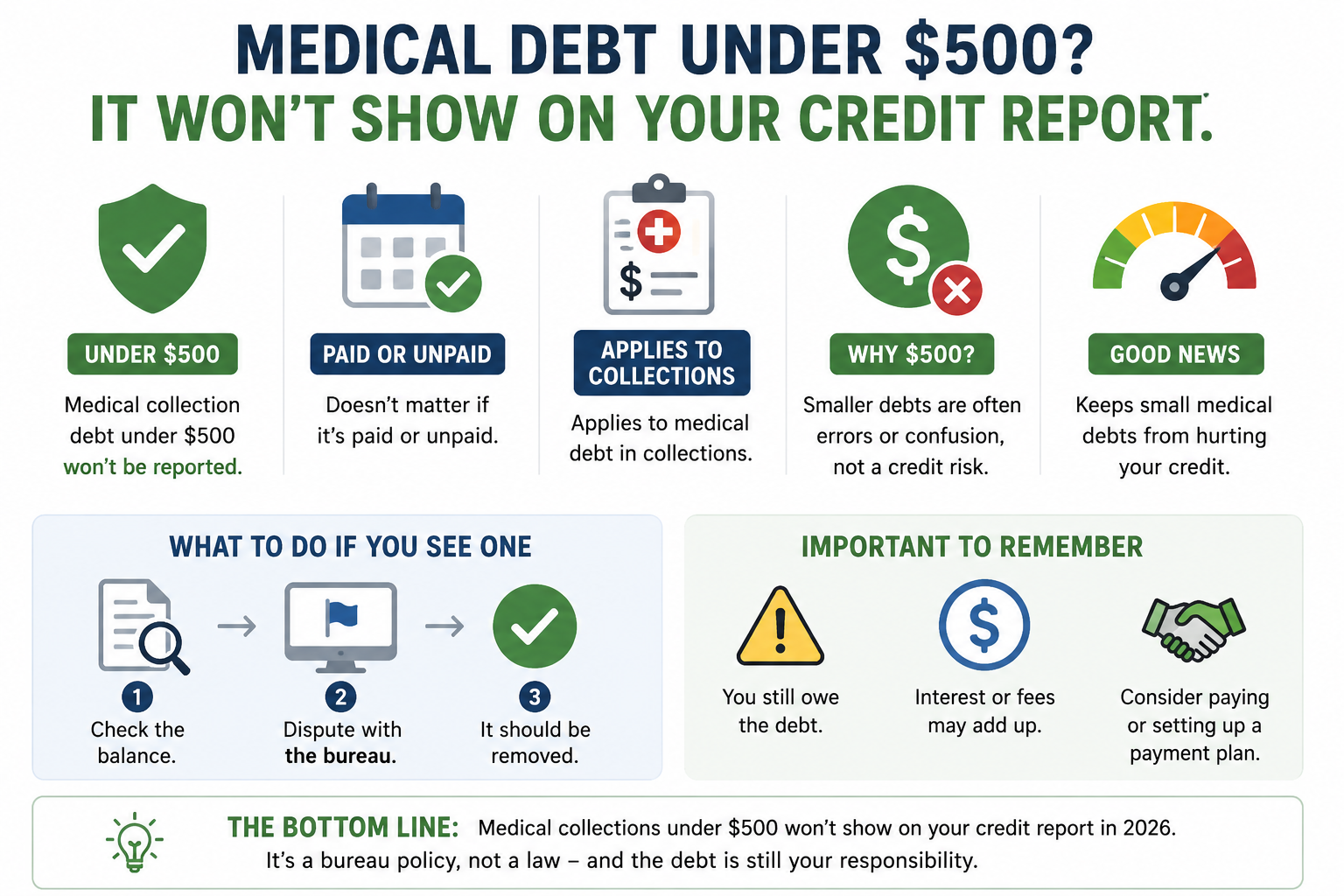
As of 2026, all three major credit bureaus — Equifax, Experian, and TransUnion — have voluntary policies in place that exclude medical collection debt under $500 from consumer credit reports entirely, regardless of whether the debt is paid or remains unpaid. This has been in effect since these policies were adopted in 2022-2023, and it remains in effect today, independent of the separate federal medical debt rule that was finalized by the CFPB and later vacated by a federal court (see our detailed guide on the 2026 medical debt rule changes for that broader context).
Why the $500 Threshold Specifically?
The bureaus set this threshold based on data showing that smaller medical debts are disproportionately likely to reflect billing errors, insurance processing issues, or genuine confusion rather than a consumer’s actual unwillingness or inability to pay — smaller bills are also more likely to simply get lost in the shuffle of post-treatment paperwork, insurance explanation-of-benefits confusion, and address changes, rather than representing a meaningful signal about someone’s overall creditworthiness. The $500 threshold was chosen as a level that captures a meaningful share of these smaller, often disputed or erroneous balances.
Does This Apply to All Medical Debt, or Just Collections?
This specifically applies to medical debt that has gone to **collections** — meaning it’s been referred from the original healthcare provider to a third-party collection agency (or, in some cases, reported directly by the provider as a delinquent account). It’s worth understanding this doesn’t mean you don’t owe the money if it’s under $500 — the debt itself remains valid and collectible, it’s simply excluded from credit report reporting under current bureau policy.
What If You See a Medical Collection Under $500 on Your Report Right Now?
If you’re actively looking at your credit report and see a medical collection under $500, this shouldn’t be there under current policy, and it’s directly disputable on that basis:
1. **Pull the specific account details**, confirming the exact reported balance.
2. **File a dispute directly with the bureau(s) showing the item**, citing that medical collections under $500 are excluded from reporting under current bureau policy.
3. **This tends to be one of the more straightforward, quickly-resolved disputes**, since it’s based on a clear, bureau-acknowledged policy rather than a contested factual question — the bureau’s own system should recognize and correct this once flagged.
What Counts Toward the $500 — the Original Bill or the Collection Balance?
This is worth checking carefully, since collection balances sometimes include added fees or interest beyond the original medical bill amount. If the reported balance on the collection account is under $500, it should be excluded under current policy — but if fees or interest have pushed a smaller original bill above the $500 threshold once it’s in collections, this is worth examining and potentially disputing separately, since fee and interest additions to medical debt are themselves sometimes subject to state-specific limitations or disputes on their own basis.
Does This Protection Apply Retroactively?
Generally, yes — if you have an old medical collection under $500 that was reported before these bureau policies took effect, it should have been removed once the bureaus implemented these changes, since the policy applies to what’s currently being reported, not just new debts going forward. If you have an old, small medical collection still showing, this is worth disputing on the same basis as a newly incurred one.
What About Multiple Small Medical Debts That Add Up to More Than $500 Combined?
The $500 threshold applies **per account/collection entry**, not as an aggregate across all your medical debts. This means if you have three separate medical collections of $300 each from different providers or dates of service, each one individually falls under the $500 threshold and should be excluded, even though they’d total $900 combined. This is worth understanding if you’re checking your report and doing your own math — don’t assume that having several small medical debts somehow pushes you over the threshold collectively; the exclusion is evaluated account by account.
Is This Protection Guaranteed to Continue?
It’s important to understand this is a **voluntary bureau policy**, not a federal or state law (in most states — some states have gone further and passed their own binding legal protections, which don’t depend on the bureaus’ continued voluntary cooperation). This means, in theory, the bureaus could modify or reverse this policy in the future, though there’s no current indication of that happening. If you live in a state with its own specific legal medical debt protections, those provide a more durable guarantee than the voluntary bureau policy alone, since state law protections don’t depend on the bureaus’ ongoing voluntary choice.
What Should You Actually Do About a Medical Bill Under $500, Even If It Won’t Hurt Your Credit?
Even though it likely won’t affect your credit report, this doesn’t mean it’s worth ignoring entirely:
– **The debt is still legally valid and collectible** — a collector can still pursue payment through other means (repeated contact, and in some cases, small claims court for the amount owed), even without credit reporting as leverage.
– **Interest or additional fees may continue accruing**, depending on the original agreement and your state’s rules on medical debt interest.
– **Resolving it (even a payment plan) is generally still worthwhile financially**, separate from the credit reporting question — an unresolved bill doesn’t just disappear because it’s not hurting your credit score.
The Bottom Line
Yes — under current, voluntary bureau policy in effect throughout 2026, medical collections under $500 should not appear on your credit report, whether paid or unpaid, and this applies per individual account rather than as a combined total across multiple smaller medical debts. If you see one on your report despite this policy, it’s a straightforward, well-grounded dispute. That said, this protection is a bureau policy choice, not a guaranteed federal law in most states, and it doesn’t erase your actual underlying financial obligation to pay the bill — it simply keeps it off your credit report under current industry practice.