
Medical debt credit reporting has been through a genuinely confusing few years of regulatory back-and-forth, and if you’ve seen conflicting headlines — “medical debt banned from credit reports” alongside “medical debt still affects your credit” — both have some truth to them, depending on exactly what’s being referenced. Here’s a clear, accurate picture of where things actually stand.
The Short Version: A Federal Ban Was Finalized, Then Struck Down
In January 2025, the Consumer Financial Protection Bureau finalized a sweeping rule that would have banned virtually all medical debt from consumer credit reports nationwide, and would have prohibited lenders from using medical debt information in underwriting decisions at all. The CFPB estimated this would have removed roughly $49 billion in medical debt from the credit files of approximately 15 million Americans.
That rule never actually took effect. In July 2025, a federal court vacated the rule, ruling that the CFPB had exceeded its statutory authority and that the rule conflicted with the Fair Credit Reporting Act. As of 2026, there is **no nationwide legal ban** on medical debt appearing on credit reports.
What’s Actually in Effect: The Bureaus’ Voluntary Changes
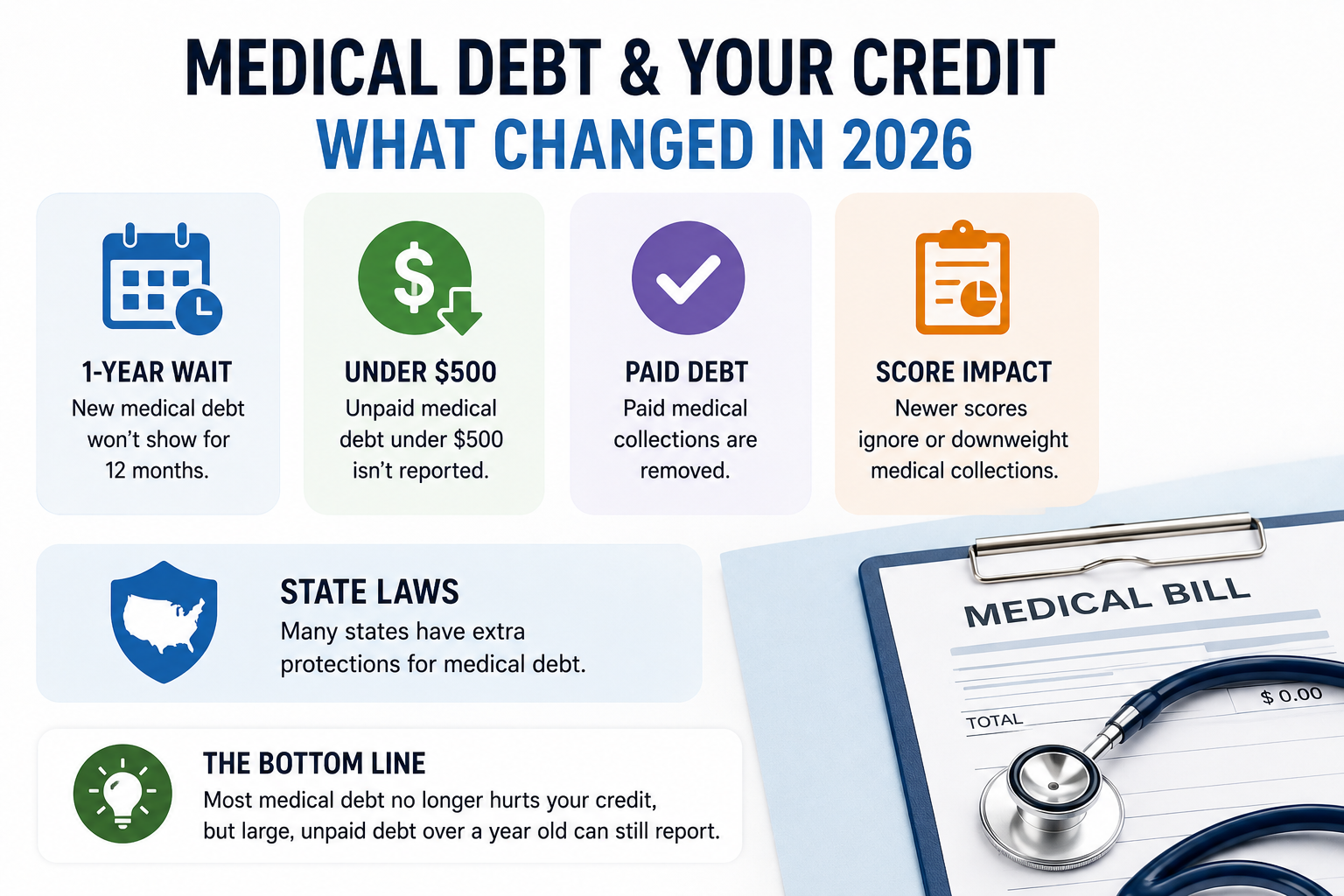
Separate from the now-vacated federal rule, the three major credit bureaus (Equifax, Experian, TransUnion) made their own voluntary policy changes starting in 2022-2023, and these remain in effect as of 2026, independent of the federal rule’s fate:
1. **Paid medical collections are removed from credit reports**, regardless of how large the original balance was or how long it took to pay.
2. **Unpaid medical collections under $500 are not reported**, and this threshold applies regardless of payment status.
3. **New medical debt has a 365-day waiting period** before it can be reported at all, giving patients a full year to resolve billing disputes, appeal insurance denials, or arrange payment plans before any credit reporting occurs.
It’s worth understanding these are **voluntary industry policies**, not legal requirements — the bureaus adopted them on their own and could, in theory, reverse them, though there’s no indication of that happening as of 2026.
What This Means Practically
– **If your medical debt is under $500**: it should not appear on your credit report at all, paid or unpaid, under current bureau policy.
– **If you’ve paid a medical collection of any size**: it should be removed from your report following payment, under current bureau policy.
– **If your medical debt is over $500, unpaid, and more than a year old**: it can still appear on your credit report and affect your score under current policy — this is the category still meaningfully at risk.
– **If your medical debt is brand new** (within the past year): it should not yet be reporting, regardless of amount or payment status, giving you time to resolve it before any credit impact.
Scoring Model Treatment: A Separate, Additional Layer of Protection
On top of what the bureaus report, some of the newer credit scoring models have gone further and specifically reduced or eliminated the weight given to medical collections even when they do appear on a report:
– **VantageScore 4.0** and **FICO Score 9 and 10** exclude or significantly reduce the weight of medical collections in their calculations, separate from whether the item is actually visible on your credit report.
– Older scoring models still in use by some lenders (particularly certain mortgage-specific FICO versions) don’t necessarily incorporate this same treatment, which means your practical exposure to medical debt’s scoring impact can depend on which specific score version a given lender uses.
State-Level Protections: A Patchwork on Top of the Federal Situation
With the federal rule vacated, state law has become a more significant factor in medical debt credit protections. A number of states have passed their own laws restricting or banning medical debt from appearing on credit reports for their residents, independent of what the bureaus voluntarily do nationally. If you live in one of these states, you may have stronger protections than the voluntary bureau policy alone provides — this is worth checking specifically for your state, since the list of states with such laws has been actively expanding and the details vary.
What to Do If You Have Medical Debt on Your Report Right Now
1. **Check the amount.** If it’s under $500, it shouldn’t be reporting under current bureau policy — if it is, that’s disputable on that basis alone.
2. **Check whether it’s paid.** If you’ve paid it and it’s still showing, dispute it, citing current bureau policy on paid medical collections.
3. **Check the age.** If it’s newer than 365 days from the date of service, it shouldn’t be reporting yet — also disputable.
4. **Check your state’s specific laws**, since you may have additional protections beyond the voluntary bureau policies.
5. **If none of the above apply and the debt is genuinely over $500, unpaid, and more than a year old**, treat it like any other collection account — verify it, consider negotiating, and understand it may currently be a legitimate, reportable item under current policy (see our detailed medical collections removal guide for a full walkthrough of that process).
Is This Situation Likely to Change Again?
Given the ongoing legal and regulatory activity around medical debt reporting — the vacated federal rule, active state legislation, and the bureaus’ own voluntary policies — this is an area that could continue to shift. If you’re dealing with medical debt on your credit report, it’s worth periodically checking for updates specific to your state and to the bureaus’ current policies, rather than assuming today’s rules are permanent.
The Bottom Line
The headline “medical debt banned from credit reports” refers to a federal rule that was finalized but then struck down in court and is not currently in effect. What actually protects most people with medical debt today is a combination of the three major bureaus’ voluntary policies (removing paid collections, removing debt under $500, and delaying reporting for a year) plus, in a growing number of states, additional legal protections specific to that state. The practical result is that a majority of medical debt that would have previously appeared on credit reports has been removed through these combined voluntary and state-level actions, even without the federal rule taking effect — but debt over $500, unpaid, and more than a year old remains a real, reportable risk under current policy.