
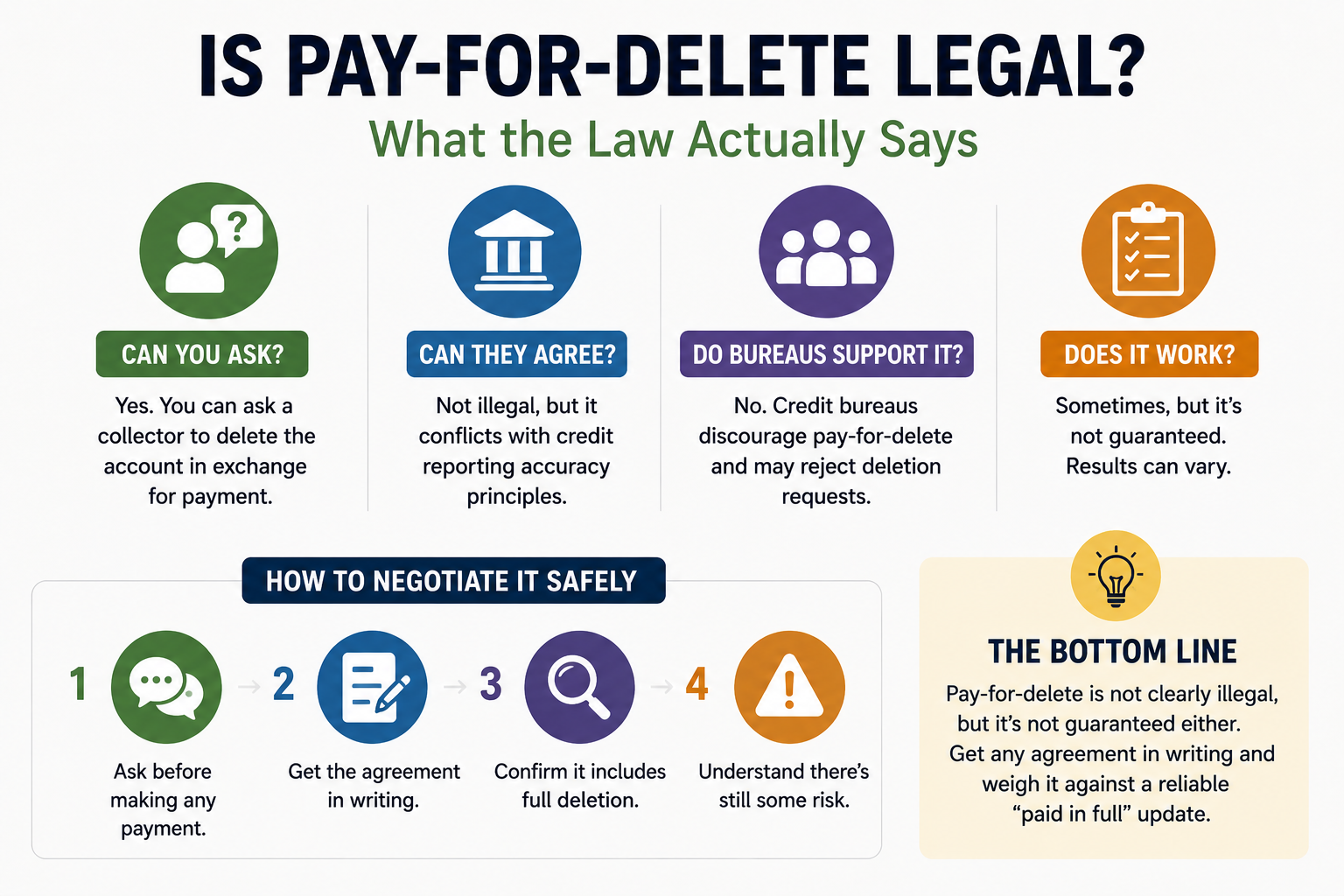
Pay-for-delete occupies a genuinely gray area that’s worth understanding precisely, because the honest answer isn’t a simple yes or no — it involves distinguishing between what’s legal for you to request, what collection agencies are legally allowed to agree to, and what credit bureaus think about the practice, which are three related but distinct questions.
What Pay-for-Delete Actually Is
Pay-for-delete is an informal arrangement where you agree to pay some or all of a debt (often a collection account) in exchange for the collector’s agreement to request that the account be deleted from your credit report entirely, rather than simply updated to show as “paid.” It’s not a formal legal process — it’s a negotiated agreement between you and the collector.
Is It Legal for You to Request?
Yes. There’s nothing illegal about you, as a consumer, asking a collector whether they’d be willing to delete an account in exchange for payment. This is simply a negotiation request, and collectors are free to agree or decline as they see fit.
Is It Legal for a Collector to Agree to It?
This is where it gets more nuanced. There’s no specific federal law that makes it illegal for a debt collector to agree to a pay-for-delete arrangement. However:
– **It arguably conflicts with the accuracy principles underlying credit reporting.** The Fair Credit Reporting Act is built around the idea that credit reports should reflect accurate information. A pay-for-delete arrangement, strictly speaking, involves removing accurate information (a debt you genuinely owed and are now paying) purely because of a private financial arrangement — not because the information was ever actually inaccurate.
– **Furnisher agreements with the credit bureaus themselves sometimes explicitly prohibit this.** Some furnisher contracts with the credit bureaus include clauses requiring furnishers to report accurately and consistently, which some interpret as conflicting with agreeing to selectively delete accurate information for certain consumers who negotiate it, while not doing so for others.
In practice, this means: **it’s not clearly illegal for a collector to agree to pay-for-delete, but it exists in tension with the broader accuracy framework of credit reporting**, which is part of why some collectors refuse to do it as a matter of policy, even though nothing explicitly criminalizes the practice.
Do the Credit Bureaus Support Pay-for-Delete?
No — and this matters practically, even though it doesn’t make the practice illegal. All three major credit bureaus have publicly stated they discourage or disapprove of pay-for-delete arrangements, viewing them as undermining the accuracy and consistency of credit reporting. Some bureau-furnisher agreements reportedly restrict furnishers from making these arrangements at all.
This creates a real practical problem: **even if a collector agrees to a pay-for-delete arrangement and submits a deletion request, the bureau is not obligated to honor it**, and increasingly, some bureaus have policies that resist or reject these specific deletion requests when they can identify them as pay-for-delete-motivated rather than accuracy-motivated.
So Does Pay-for-Delete Actually Work?
Sometimes, but it’s genuinely unreliable, for a few compounding reasons:
– Not all collectors are willing to agree to it in the first place.
– Of those willing to agree, their deletion request to the bureau isn’t guaranteed to be honored.
– Even if honored initially, there’s some risk (though less common) of the item being reinstated later if the bureau’s systems later flag the account.
This is why pay-for-delete should be understood as a **best-effort negotiation tactic, not a guaranteed outcome** — worth attempting, since it costs nothing to ask, but not something to rely on as a certainty when deciding whether to pay a debt.
How to Actually Negotiate It, Given These Realities
1. **Ask the collector directly, before making any payment**, whether they’re willing to agree to a pay-for-delete arrangement.
2. **Get their agreement in writing** — a verbal agreement from a collections representative is not enforceable, and without written confirmation, you have no recourse if they don’t follow through after you pay.
3. **Confirm the specific language** — you want them to agree to request full deletion, not just an update to “paid” status, and the agreement should specify this clearly.
4. **Understand you’re still taking some risk** — even with a written agreement, the bureau’s independent decision about whether to honor the deletion request is outside your and the collector’s control.
What Happens If They Agree, You Pay, and It’s Not Deleted?
If you have a written agreement and the collector fails to submit the deletion request as promised, that’s a breach of your specific agreement, and you have some recourse:
– **Contact the collector directly**, referencing your written agreement, and request they follow through.
– **If they refuse or ignore you, this may constitute a legitimate complaint** to the CFPB or your state Attorney General, since you have documented evidence of an agreement they didn’t honor.
– **If the collector did submit the request but the bureau simply didn’t honor it**, this is a different situation — the collector held up their end, but the bureau’s independent policies prevented the outcome. In this case, there’s generally no further recourse, since the bureau’s decision not to delete accurate information is within their discretion.
Is There a Better Alternative to Pursue Instead?
Given the reliability issues, it’s worth weighing pay-for-delete against simply negotiating a lower settlement amount without conditioning it on deletion, then separately pursuing a “paid in full” or favorable status update instead. This is a more reliable outcome — status updates are far more consistently honored than deletion requests — even though it leaves the account visible with a settled or paid status rather than removed entirely.
The Bottom Line
Pay-for-delete isn’t clearly illegal, but it exists in real tension with the credit bureaus’ own accuracy policies, and none of the three major bureaus are obligated to honor a collector’s deletion request, even when the collector agrees to submit one. This makes it worth attempting — since asking costs nothing — but not something to count on with certainty. Get any agreement in writing before paying, and consider whether negotiating a more reliably-honored outcome (a favorable status update rather than outright deletion) might better serve your actual goals if certainty matters more to you than the chance at full removal.