
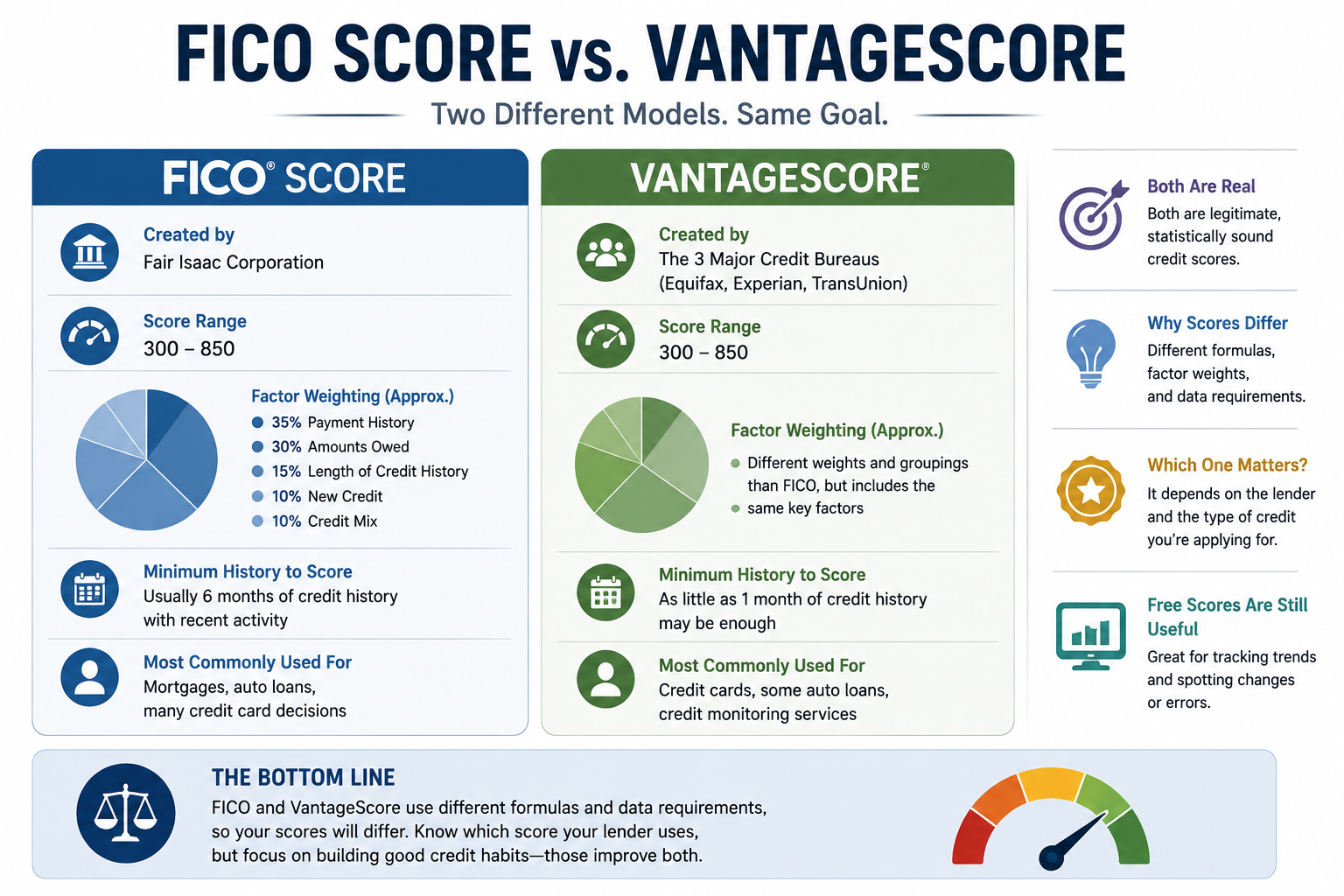
If you’ve checked your credit score through a few different apps or websites and seen noticeably different numbers, there’s a good chance you’re actually looking at two different scoring systems entirely — FICO and VantageScore — not just different data. Understanding the difference matters because it affects which number you should actually trust for a given purpose.
They’re Both Real, Legitimate Scores — Just Different Companies
FICO (Fair Isaac Corporation) has been the dominant credit scoring company for decades and remains the score most lenders — especially mortgage lenders — actually use in underwriting decisions. VantageScore was developed later, jointly by the three major credit bureaus (Equifax, Experian, TransUnion), partly as a competing model and partly to standardize scoring across the bureaus in a way FICO’s various versions didn’t always achieve.
Neither is “fake” or less legitimate than the other — they’re both statistically rigorous models built from real credit report data, but they weight factors somewhat differently and use different underlying formulas, which is why the same credit file can produce different scores under each system.
Score Range: Actually the Same
Both FICO and VantageScore use the same 300-850 range for their standard consumer-facing models, which is part of why the difference in actual numbers can be confusing — a 720 FICO and a 720 VantageScore aren’t necessarily reflecting the exact same underlying risk assessment, even though they’re expressed on the same scale.
How the Factor Weighting Differs
Both models consider similar broad categories — payment history, utilization, account age, credit mix, recent inquiries — but weight them somewhat differently:
**FICO’s general weighting approach:**
– Payment history: roughly 35%
– Amounts owed (utilization): roughly 30%
– Length of credit history: roughly 15%
– New credit (inquiries): roughly 10%
– Credit mix: roughly 10%
**VantageScore’s approach** is influenced by similar categories but groups and weights them somewhat differently, and — notably — has historically been able to generate a score with a shorter credit history than FICO typically requires, which matters for people just starting to build credit.
A Key Practical Difference: Minimum History Required
– **FICO** generally requires at least 6 months of credit history and at least one account reported within the past 6 months to generate a score.
– **VantageScore** (particularly newer versions) can sometimes generate a score with as little as 1 month of history and even from accounts with very limited activity, which is part of why VantageScore is sometimes considered more accessible for people with thinner credit files, including recent immigrants or young adults just starting out.
If you’re brand new to credit and checking a free monitoring app that shows a VantageScore, but a lender pulls a FICO score during an actual application, don’t be surprised if there’s a meaningful gap — the FICO score might not even be calculable yet if your file is thin enough, or it might be notably different once it is.
Which One Actually Matters for Getting Approved?
This is the practical question most people actually care about, and the honest answer is: **it depends on the lender and the type of credit you’re applying for.**
– **Mortgage lending** overwhelmingly still relies on specific older FICO versions (often FICO 2, 4, or 5, depending on the specific bureau), which is a notable quirk of the industry — many mortgage lenders use FICO score versions that are actually older than the versions most consumers see through free monitoring tools.
– **Credit card issuers** use a mix, with many using newer FICO versions (FICO 8, FICO 9) or VantageScore versions, depending on the specific issuer’s underwriting practices.
– **Auto lenders** often use industry-specific FICO Auto Score versions, which weight auto-loan-relevant factors (like past auto loan payment history) more heavily than a general-purpose score would.
There’s no single universal answer — the specific lender and product determine which score version actually gets pulled and used in the decision.
Why the Free Score You See Is Often Not What Actually Gets Used
Most free credit monitoring services (through banks, credit card issuers, or independent apps) display either a VantageScore or a specific FICO version (commonly FICO 8), largely because these are the versions most readily available for consumer-facing distribution agreements. This is genuinely useful for tracking general trends in your credit health over time, but it’s worth understanding it may not be the exact score version a specific lender pulls when you actually apply for something like a mortgage.
Does This Mean the Free Score You Check Is Useless?
Not at all — it’s still calculated from real credit report data and reflects genuine trends in your credit health. If your free score is going up, that generally (though not perfectly) correlates with your actual creditworthiness improving across most scoring models, even if the exact number a specific lender sees differs. The free score is most useful for:
– Tracking whether your overall credit health is trending in the right direction.
– Catching potential errors or sudden unexpected changes worth investigating.
– General financial literacy and awareness.
It’s less useful for:
– Predicting the exact number a mortgage underwriter will see.
– Precisely calibrating whether you’ll qualify for a specific credit product’s advertised minimum score requirement, since that requirement may reference a different score version than the one you’re checking.
How to Find Out Which Score a Specific Lender Uses
If you’re preparing for a major application (particularly a mortgage), it’s worth directly asking the lender which score version and bureau they’ll be using, since this varies by lender and loan type, and some lenders are willing to share this detail upfront, which can help you understand what to expect rather than relying solely on your free monitoring app’s number.
The Bottom Line
FICO and VantageScore are both legitimate, statistically robust scoring systems, but they weight credit factors somewhat differently and have different minimum history requirements, which is why you can see genuinely different numbers depending on which one you’re checking. For general trend-tracking and financial awareness, whichever free score you have access to is useful; for a specific, high-stakes application like a mortgage, it’s worth understanding that the actual score pulled may be a different version entirely, often an older FICO variant most consumers never see directly through free monitoring tools.