
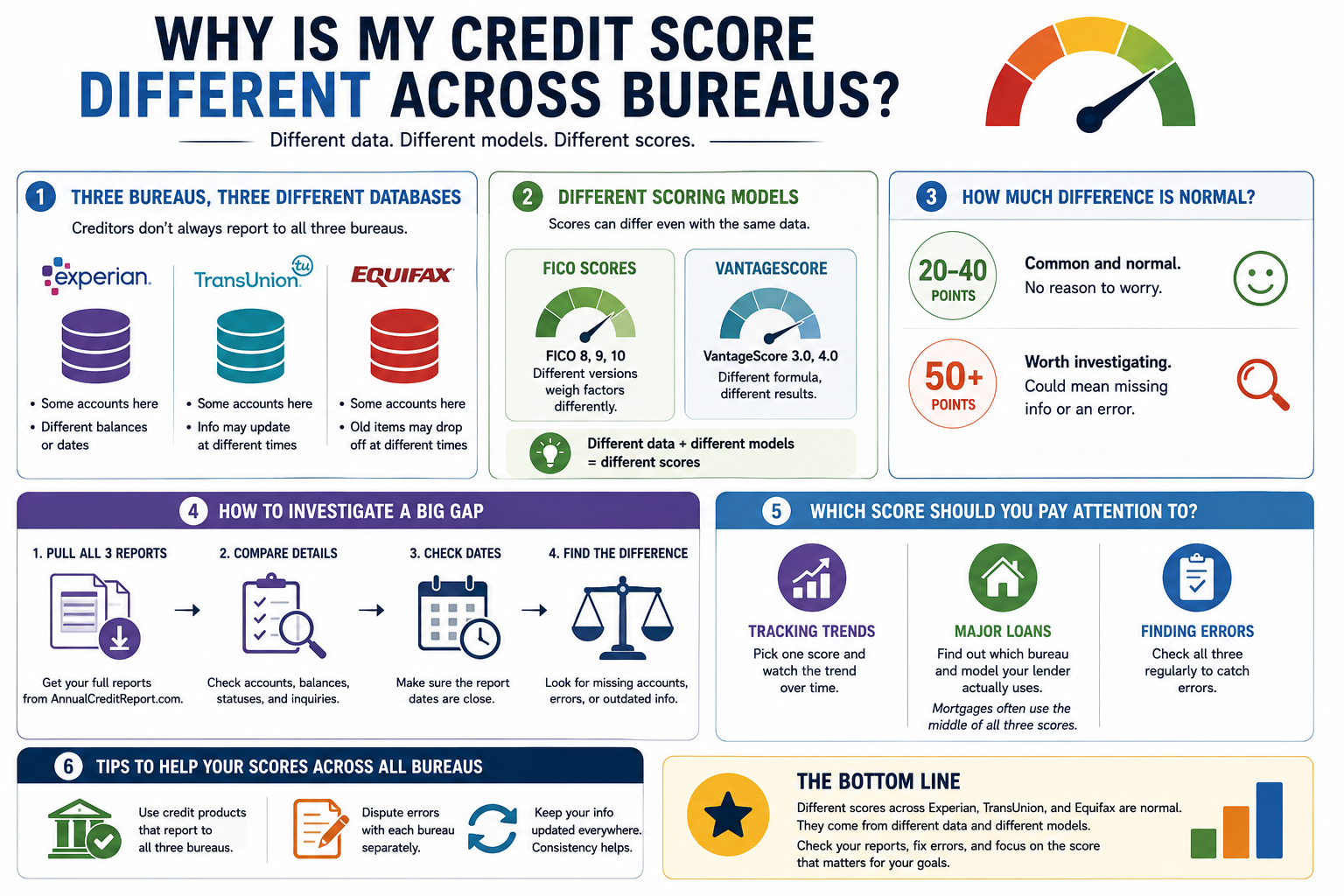
This is one of the most common sources of confusion in personal credit management — you check your score through two different apps or services, and the numbers don’t match, sometimes by a significant margin. This isn’t an error on anyone’s part; it’s actually an expected, structural feature of how the credit system works. Here’s why it happens and what it means practically.
The Three Bureaus Don’t Share a Single Database
Equifax, Experian, and TransUnion are three separate, independently operating companies, each maintaining its own database of your credit history. When a lender or creditor reports account information, they don’t necessarily report to all three bureaus — many report to two, and some smaller or regional creditors report to only one.
This means the underlying data each bureau has about you can genuinely differ:
– **A specific account might appear on your Experian report but not your TransUnion report**, if that creditor only reports to Experian.
– **The exact reporting date or balance snapshot might differ slightly** between bureaus, since creditors don’t always report to each bureau on the exact same schedule.
– **Older accounts or inquiries might have aged off one bureau’s report before another’s**, if there’s any variance in when each bureau processed the removal.
Since your score is calculated based on the specific data each bureau holds, different underlying data naturally produces different scores, even when using the exact same scoring formula.
Different Scoring Models Compound the Difference
On top of differing underlying data, the score you’re actually shown often comes from different scoring model versions depending on the app or service you’re using:
– **FICO has many versions** (FICO 8, FICO 9, FICO 10, industry-specific versions for auto and mortgage lending), and different services and lenders use different versions.
– **VantageScore also has multiple versions** (3.0, 4.0), which weight factors somewhat differently than FICO models and differently from each other.
– **A free credit monitoring app might show you a VantageScore**, while the mortgage lender you eventually apply with might pull a specific FICO version — these can differ by dozens of points even when calculated from the identical underlying data, simply because the formulas themselves weight factors differently.
This means the difference you’re seeing between your “Experian score” and your “TransUnion score” might actually be a combination of two separate factors: different underlying data between the bureaus, AND different scoring models used by whatever service is showing you each number.
How Much of a Difference Is Normal?
There’s no fixed “normal” range, but differences of **20-40 points** between bureaus are common and not a cause for concern on their own. Larger differences (50+ points) are worth investigating, since they may indicate:
– A significant account or negative item appearing on one bureau’s report but not another’s.
– An error specific to one bureau that isn’t reflected on the others.
– A meaningful gap in reporting timing (e.g., a recent payment reflected on one bureau but not yet processed by another).
How to Actually Investigate a Larger-Than-Expected Gap
1. **Pull your full report from all three bureaus** (free weekly at AnnualCreditReport.com), not just the summary score.
2. **Compare account by account**, checking specifically for:
– Accounts present on one report but missing from another.
– Different reported balances or utilization for the same account across bureaus.
– Different account statuses (one bureau showing “current,” another showing something else) for the same account.
3. **Check the report dates** — if one report is meaningfully older than another, some of the apparent difference may simply be timing, not an actual discrepancy.
Which Score Should You Actually Pay Attention To?
This depends entirely on what you’re using it for:
– **If you’re monitoring general trends** (is my score generally moving up or down over time), consistency matters more than which specific bureau or model you’re tracking — pick one and watch its trend, rather than comparing absolute numbers across different sources.
– **If you’re preparing for a specific major application** (mortgage, auto loan), it’s worth finding out which bureau and scoring model version your target lender actually uses, since that’s the number that matters for that specific decision — mortgage lenders, for instance, often pull all three bureaus and use the middle score of the three, a common industry practice.
– **If you’re trying to catch errors**, checking all three regularly matters more than focusing on one, since an error might exist on only one bureau’s file.
Does It Matter Which Bureau a Lender Pulls?
Yes, potentially significantly, if your accounts and history genuinely differ between bureaus. This is part of why it’s worth checking and correcting errors across all three, not just whichever one you happen to check most often — a lender pulling the one bureau where an error hasn’t yet been corrected will see the inaccurate, lower score, even if your other two bureau files are clean.
Should You Try to “Even Out” Your Scores Across Bureaus?
Not directly — there’s no legitimate mechanism to force your scores to match across bureaus, since the underlying cause (different data, different models) is structural, not something you manipulate directly. What you can and should do:
– **Ensure accounts you want reflected everywhere are actually reporting to all three bureaus** — if you’re using a specific credit-building product, confirm it reports to all three, not just one or two, precisely to avoid a scenario where your positive history only helps one of your three files.
– **Correct any errors on each bureau independently**, since a dispute filed with one bureau does not automatically correct the same error on the others — you generally need to dispute separately with each bureau where the error appears.
The Bottom Line
Different scores across Experian, TransUnion, and Equifax are expected and normal, driven by each bureau maintaining an independently reported, sometimes genuinely different set of underlying data, compounded further if you’re comparing scores calculated using different scoring model versions. Differences in the 20-40 point range are unremarkable; larger gaps are worth investigating by comparing your full reports account-by-account across all three bureaus, since a significant discrepancy often points to a real, correctable difference in what each bureau actually has on file for you.