
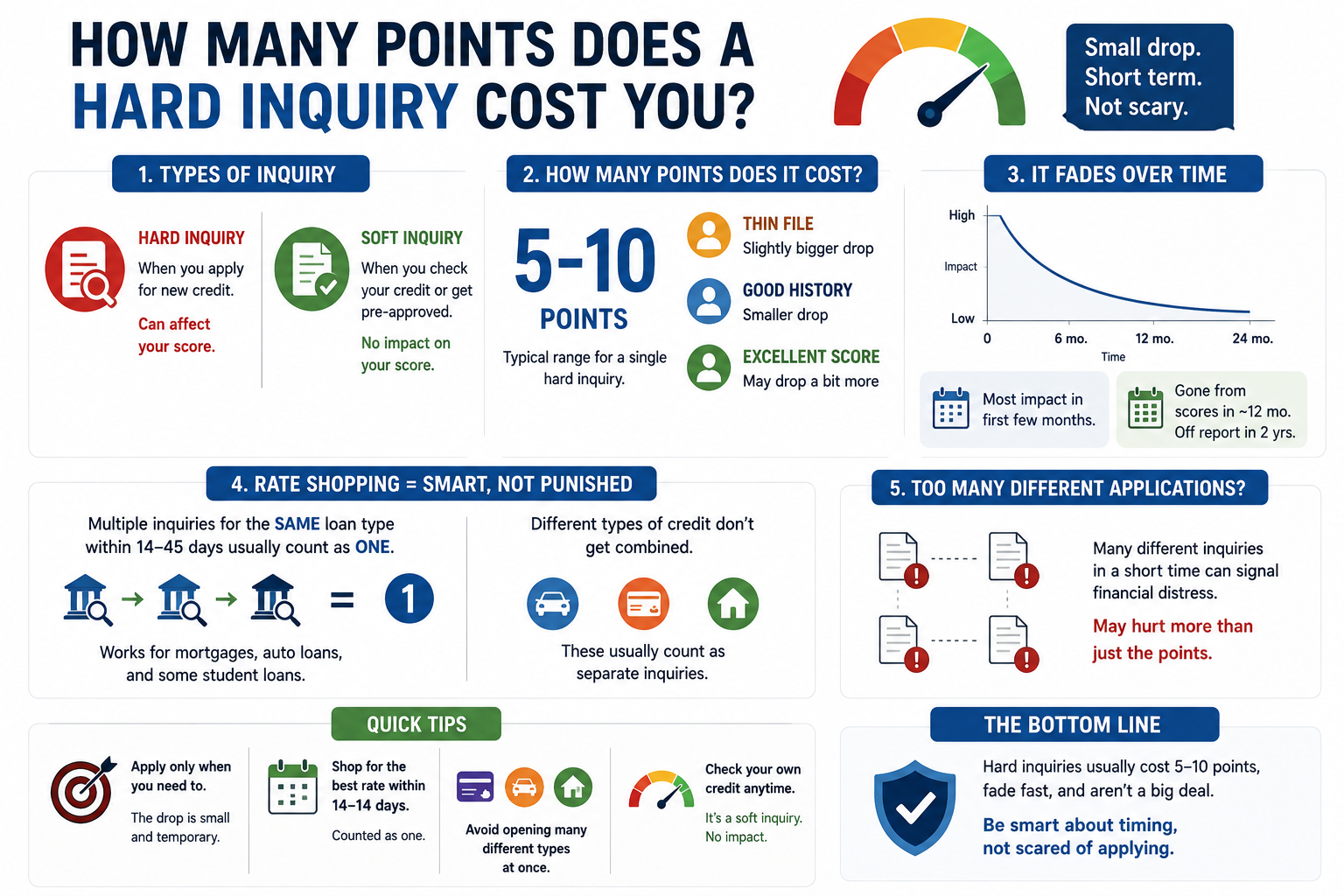
Hard inquiries get a reputation for being scarier than they actually are, largely because the exact number people fixate on — “how many points” — is more variable and generally smaller than most assume. Here’s a precise breakdown of what actually happens when a hard inquiry hits your report, and how to think about it realistically.
Hard Inquiry vs. Soft Inquiry: A Quick Distinction
Before getting into the point impact, it’s worth confirming which type of inquiry you’re dealing with, since only one of these matters for scoring:
– **Hard inquiries** occur when you apply for new credit and a lender checks your report as part of an actual lending decision — a credit card application, an auto loan, a mortgage application. These are the type that can affect your score.
– **Soft inquiries** occur when you check your own credit, when a company does a promotional/preliminary check without a full application, or during background checks unrelated to lending. These never affect your score, regardless of how many occur.
If you’re not sure which type you’re seeing on your report, it’s usually labeled directly, but generally: anything you didn’t specifically apply for as a credit product is a soft inquiry.
The Typical Point Range
For most people, a single hard inquiry results in a score decrease of **roughly 5-10 points**, though this varies based on your overall credit profile:
– **People with a thin credit file or a shorter credit history** tend to see a slightly larger relative impact, since a new inquiry represents a proportionally bigger change to a smaller data set.
– **People with an established, lengthy credit history and many existing accounts** tend to see a smaller relative impact, since one more inquiry is a smaller change relative to everything else already reflected in their file.
– **People with an already excellent score** sometimes see a slightly larger point drop than someone with an average score, simply because there’s more room to fall from a very high starting point, even though the underlying risk signal is the same.
Importantly: this is a general range, not a fixed universal number — no scoring model publishes an exact, guaranteed point deduction, and the actual impact is calculated as part of a complex overall model, not a simple flat subtraction.
Read More: How Much Does Credit Repair Cost
How Long Does a Hard Inquiry Affect Your Score?
This is arguably more important than the initial point drop:
– Hard inquiries remain on your credit report for **2 years**.
– However, their actual **scoring impact fades much faster** than that — most inquiries stop meaningfully affecting your score after about **12 months**, and the effect is typically strongest in the first few months, diminishing steadily after that.
This means a hard inquiry from 18 months ago is likely still visible on your report but probably has little to no remaining effect on your actual score, even though it hasn’t yet reached its full 2-year removal date.
Why Multiple Inquiries Don’t Always Multiply the Damage
This is one of the more useful, lesser-known nuances in credit scoring: most modern scoring models include **rate shopping windows**, which recognize that consumers shopping for the best rate on a single loan (particularly mortgages, auto loans, and sometimes student loans) shouldn’t be penalized as if they applied for many separate, unrelated lines of credit.
– Multiple inquiries for the **same type of loan within a defined window** (typically 14-45 days, depending on the specific scoring model) are often treated as a **single inquiry** for scoring purposes.
– This window is specifically designed to let you shop around for the best mortgage or auto loan rate without accumulating multiple separate inquiry penalties.
Important caveat: this deduplication generally applies to **similar loan types** (multiple mortgage applications, or multiple auto loan applications) shopped within the window — it typically does **not** apply to a mix of different credit types (a credit card application plus a mortgage application plus a personal loan application), which would generally still count as separate inquiries.
Do All Scoring Models Treat Inquiries the Same Way?
No, and this is worth understanding if you’re tracking a specific score:
– **FICO models** generally have more generous rate-shopping windows and clearer inquiry deduplication logic.
– **VantageScore models** also account for rate shopping, though the specific window and treatment can differ somewhat from FICO’s approach.
– **Industry-specific scores** (auto-enhanced, mortgage-specific versions) sometimes weight inquiries differently than the general-purpose base scores.
If you’re specifically preparing for a mortgage or auto loan application, it’s worth checking which score version the relevant lenders typically use, since the practical inquiry impact can vary.
Does Checking Your Own Credit Count as a Hard Inquiry?
No checking your own credit report or score, whether through a free service, your bank’s app, or AnnualCreditReport.com, is always a soft inquiry and has no effect on your score, regardless of how frequently you check. This is worth knowing because it removes any reason to avoid monitoring your own credit out of fear it will hurt your score — it won’t.
When Multiple Different-Type Inquiries in a Short Period Actually Matter More
Beyond the direct point impact, a cluster of hard inquiries across different credit types in a short window can itself be interpreted by some scoring models and manual underwriters as a signal of financial distress or a sudden need for credit sometimes referred to as “credit-seeking behavior.” This can compound the individual point impacts into a somewhat larger overall effect than the sum of the individual inquiries might suggest in isolation, particularly if it coincides with other risk signals on your file.
Practical Takeaways
• Don’t avoid a necessary credit application out of excessive fear of a hard inquiry the typical 5-10 point impact is real but modest, and it fades within about a year.
• Do consolidate rate-shopping into a tight window** (ideally within 14 days to be safe across different scoring models) when shopping for a mortgage or auto loan, to take advantage of deduplication treatment.
• Avoid applying for multiple different types of credit in a short period** if you’re actively trying to optimize your score for an upcoming major application, since this is where the cumulative effect (and the “credit-seeking” signal) is most likely to add up.
• Don’t worry about checking your own credit this never counts as a hard inquiry regardless of frequency.
The Bottom Line
A single hard inquiry typically costs somewhere in the range of 5-10 points, with the effect fading substantially within about a year and disappearing from your report entirely after two years — a real but generally modest and temporary impact, not something that should meaningfully deter a genuinely necessary credit application. The more important nuance is understanding rate-shopping deduplication windows if you’re comparing loan offers, and being mindful of clustering different types of credit applications together in a short period if you’re specifically trying to optimize your score ahead of a major application.