
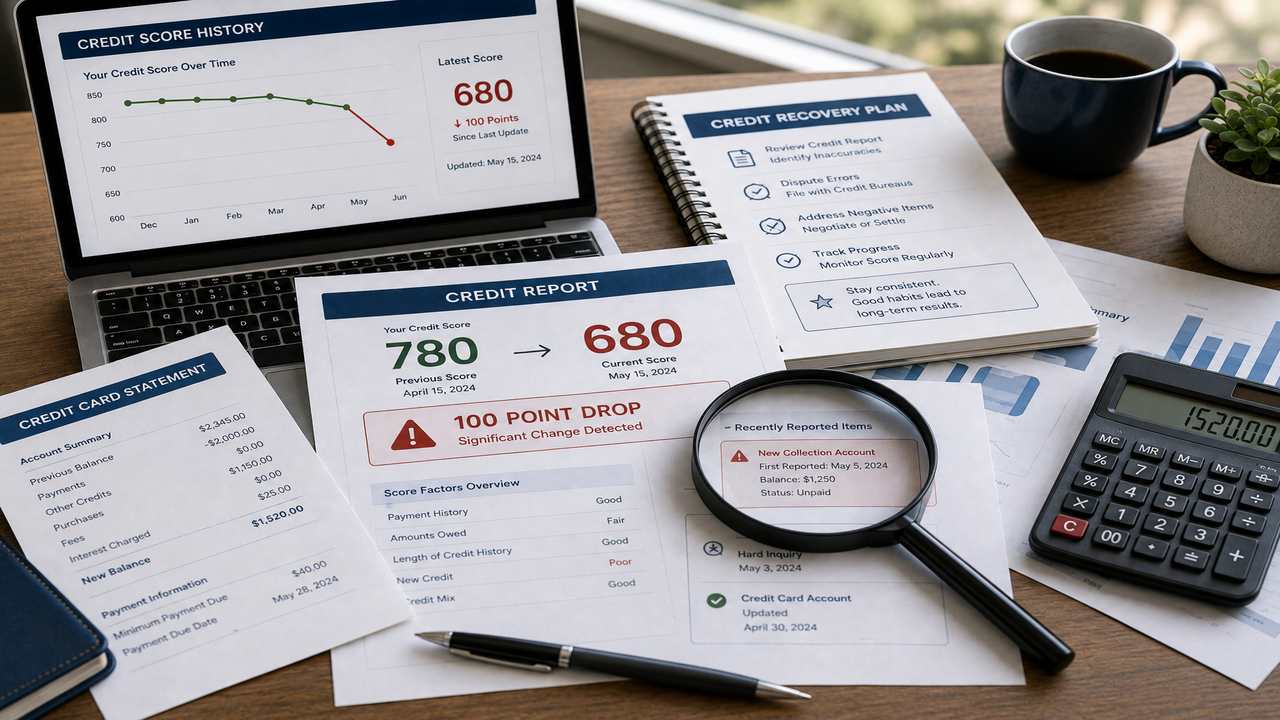
Watching your credit score fall by 100 points is alarming, and the phrase “for no reason” captures exactly how disorienting it feels — you didn’t miss a payment you know of, you haven’t applied for anything major, and yet the number has dropped dramatically. The reassuring news is that a drop this large is never truly random, even when the cause isn’t immediately obvious. Scoring models don’t move by triple digits without a specific, identifiable trigger. This guide walks through every plausible cause for a drop this significant, how to systematically identify which one applies to your situation, and exactly what to do once you know.
Why “No Reason” Almost Always Means “A Reason You Haven’t Found Yet”
A 100-point drop is a completely different category of event from the smaller 10-20 point fluctuations covered elsewhere, which are often routine and unremarkable. A change this large virtually always corresponds to one specific, identifiable, and usually serious event: a missed payment reaching the 30-day reporting threshold, a new collection or public record, a charge-off, a significant utilization spike (often from a specific large purchase or a credit limit reduction), a closed account materially affecting your file, or in some cases, identity theft or a reporting error. The task in front of you isn’t to wonder whether something happened — something did — but to identify exactly what, since your credit report itself will contain the answer.
Step One: Pull Your Full Credit Report Immediately
Don’t just check your score again — pull the full underlying report from all three bureaus at AnnualCreditReport.com. The score is a summary output; the report is the actual data driving it, and it’s the only place you’ll find the specific cause. Compare it carefully against what you remember from before the drop, looking specifically at the sections below.
The Most Likely Causes, Ranked by How Often They Explain a Drop This Large
1. A Missed Payment That Reached 30+ Days Past Due
This is the single most common cause of a drop in this range, particularly for someone with an otherwise strong credit history (counterintuitively, the stronger your existing credit, the more a single serious negative mark can move the needle, since the scoring model has less room to reassess a previously excellent record). Check every account for a payment status showing 30, 60, 90, or more days late. This can happen more easily than people expect — an autopay failure due to an expired card, a bank account closed and forgotten with a small automatic payment still linked to it, or a bill you didn’t realize existed (a medical bill sent to an old address, for instance).
2. A New Collection Account or Charge-Off
A previously unknown debt — a medical bill, a forgotten subscription, a utility final bill from a former address — reaching collections status can appear as a completely new negative item you had no prior awareness of. Similarly, if an existing account you knew was struggling finally crossed the charge-off threshold (typically 180 days of nonpayment for credit cards), this alone can produce a drop in this range, especially layered on top of the preceding months of late payment reports that led up to it.
3. A Significant, Sudden Utilization Spike
While routine utilization changes typically produce smaller score movements, a dramatic spike — maxing out a card, or having a credit limit sharply and unexpectedly reduced by your issuer (which can happen due to the issuer’s own internal risk reassessment, entirely independent of anything you did) — can produce a much larger impact than a routine month-to-month fluctuation, particularly if it affects your overall utilization ratio significantly or pushes a previously low-utilization card into a very high range.
4. A Public Record or Legal Judgment
A civil judgment, a tax lien (though federal tax liens are no longer included on standard credit reports as of a change implemented several years ago, some state and local liens or other judgments can still appear depending on your jurisdiction and specific circumstances), or in more serious cases, a bankruptcy filing, are all major public records that can trigger a drop of this magnitude or larger. If any legal action has been taken against you that you’re aware of — even one that felt minor or was resolved on your end — it’s worth confirming whether and how it appears on your credit report.
5. Identity Theft or Fraudulent Account Activity
If a fraudster opened a new account in your name, ran up significant charges, or defaulted on a fraudulent loan, this can appear on your report as new accounts, new hard inquiries, and eventually new negative payment history — all without any legitimate action on your part, making this one of the scenarios that most genuinely fits the description “for no reason,” since from your perspective, nothing you actually did caused it.
6. A Reporting Error
Sometimes a creditor’s system genuinely makes a mistake — reporting a payment as late when it was actually on time, misapplying a payment to the wrong account, or duplicating a negative item that should only appear once. These errors are less common than the causes above but do happen, and they’re worth ruling out if you’ve reviewed everything else and nothing seems to genuinely explain the drop.
7. An Authorized-User Account’s Serious Negative Event
If you’re an authorized user on someone else’s account, and that account experienced something serious on their end — a significant missed payment, a charge-off, a maxed-out balance — it flows into your credit file exactly as if it were your own account, and can easily be the kind of thing you’d have no direct awareness of, making it a genuinely plausible explanation for an otherwise mysterious drop.
8. Account Closure by the Issuer (Not You)
If a credit card issuer closed one of your accounts — due to their own internal risk assessment, extended inactivity, or a broader portfolio decision unrelated to your specific behavior — and it was a significant portion of your total available credit or one of your oldest accounts, the combined effect on your utilization ratio and average account age can be more substantial than a routine account closure you initiated yourself, especially if it happened without any advance notice you noticed.
A Systematic Diagnostic Process
Step 1: Note the exact date range.
Identify when your score was last known to be normal and when you first noticed the drop, to narrow your search to the specific reporting period involved.
Step 2: Review every account’s payment status.
Look specifically for any status other than “current” or “paid as agreed” across every single account, including ones you might not think of as active or important.
Step 3: Check for any new accounts you don’t recognize.
This includes both new credit accounts and new hard inquiries, which would indicate either your own forgotten application or, more concerning, unauthorized activity.
Step 4: Check for new public records or collections.
Look specifically for anything in these sections that wasn’t there before, even for a small dollar amount, since even modest new negative items can meaningfully affect a score, particularly layered onto an otherwise strong file.
Step 5: Review each account’s reported balance and limit.
Look for either a significant balance increase or, just as importantly, a limit decrease that wasn’t initiated by you.
Step 6: Check whether you’re an authorized user anywhere, and if so, contact the primary cardholder to ask whether anything changed on their end.
Step 7: Compare reports across all three bureaus.
Since not every creditor reports to every bureau, or reports at exactly the same time, comparing all three can sometimes reveal that an issue appears on one report but not the others, narrowing down exactly where the problem originated.
What to Do Once You’ve Found the Cause
If it’s a missed payment:
Bring the account current immediately if it isn’t already. Consider a goodwill adjustment request if this was a genuine one-time circumstance on an account with an otherwise strong history.
If it’s a new collection or charge-off:
Verify the debt is actually yours and accurate before paying anything, using your right to request debt validation. If accurate, decide on paying in full, negotiating a settlement, or, for very old or fraudulent debt, disputing it directly.
If it’s a utilization spike:
Pay down the balance as quickly as possible if it’s from your own spending. If it’s from an unexpected credit limit reduction, consider contacting the issuer to ask about reinstating your previous limit, and if declined, focus on paying down balances on other cards to help offset the overall utilization impact.
If it’s a public record or legal judgment:
Consult with a consumer law attorney if you believe the judgment is inaccurate, improperly obtained, or eligible to be vacated or resolved; if accurate and valid, understand your resolution options (payment, negotiated settlement, or, in bankruptcy cases, understanding your specific discharge and reporting timeline).
If it’s identity theft:
Place an immediate fraud alert or credit freeze with all three bureaus, file a report at IdentityTheft.gov (which generates an official FTC identity theft report you can use to dispute fraudulent accounts), and dispute every fraudulent item directly with the credit bureaus and creditors involved, providing your identity theft report as documentation.
If it’s a reporting error:
Gather your supporting documentation (payment confirmations, bank statements, prior correspondence) and file a formal dispute with whichever bureau shows the error, and separately contact the creditor directly to request they correct their reporting at the source.
If it’s an authorized-user account:
Consider whether remaining an authorized user on that account still serves your interests, and have a direct conversation with the primary cardholder about what happened and whether it’s likely to recur.
When It Might Genuinely Be Identity Theft: Red Flags to Watch For
Beyond the general process above, a few specific signs point more strongly toward fraud rather than an oversight or error on your own accounts: unfamiliar hard inquiries from lenders you’ve never applied with, an account opened with a different address than yours, a sudden change in your mailing address on file with a creditor that you didn’t make, being denied a legitimate application because of accounts you don’t recognize, or receiving collection notices for debts entirely unfamiliar to you. If any of these appear during your review, treat identity theft as the leading explanation and act with urgency — the sooner you freeze your credit and dispute fraudulent items, the less additional damage can accumulate while the issue remains unresolved.
How Long Recovery Takes From a 100-Point Drop
Recovery timelines vary enormously depending on the specific cause. A resolved reporting error can often be corrected within 30-45 days of a successful dispute, restoring your score close to its prior level relatively quickly once the inaccurate information is removed. A genuine missed payment or new collection, once resolved through payment, typically shows gradual improvement over several months to a year as the negative mark ages and is outweighed by continued positive payment history, though the specific item remains visible on your report for up to seven years even after being resolved. A charge-off or serious delinquency generally takes the longest to fully recover from, often requiring a year or more of consistent positive credit behavior to see substantial score improvement, even though the impact does lessen progressively over that time rather than remaining constant.
Preventing Future Large, Unexplained Drops
Set up account alerts with every creditor for payment due dates, balance thresholds, and any changes to your account terms or limits, so you’re notified in real time rather than discovering an issue weeks or months later during a routine score check.
Consider a credit freeze with all three bureaus if you’re not actively planning to apply for new credit, which prevents new fraudulent accounts from being opened in your name in the first place.
Review your full credit report, not just your score, on a regular schedule — quarterly is a reasonable cadence for most people — so that any new issue is caught closer to when it happens rather than accumulating for months before you notice a dramatic score change.
Keep contact information current with every creditor, since missed notices due to an old address or expired email are a common, preventable cause of payments or bills falling through the cracks unnoticed.
Frequently Asked Questions
Can a 100-point drop happen from a single missed payment alone?
Yes, particularly for someone with an otherwise excellent credit history and a relatively short list of negative marks — in these cases, a single serious late payment (especially 90+ days late, or a first-time charge-off) can produce an outsized impact precisely because the scoring model previously had very little negative information to weigh it against.
Is it possible for a drop this large to be completely unexplainable, even after a thorough review?
This is extremely rare. If you’ve genuinely reviewed your full report from all three bureaus and truly cannot find any specific new negative item, new inquiry, balance change, or closed account, it’s worth contacting the specific credit monitoring service showing you the drop directly, since in rare cases a monitoring service itself can display an inaccurate or delayed score due to its own technical issue, separate from your actual underlying credit report data.
How quickly should I act if I suspect identity theft caused this?
Immediately — the longer fraudulent accounts remain open and unaddressed, the more potential damage (additional fraudulent charges, further accounts opened, more significant score impact) can accumulate. Placing a fraud alert or freeze and filing your identity theft report should be your first actions upon strong suspicion, even before you’ve finished a full diagnostic review of every account.
Will my score ever fully return to where it was before a 100-point drop?
In most cases, yes, given enough time and consistent positive credit behavior afterward, particularly once the underlying negative item ages significantly or drops off your report entirely after seven years. The timeline varies considerably based on the specific cause and your overall credit management afterward, but a drop of this size is very rarely permanent if you address the underlying cause and continue building positive history.
Should I dispute everything on my report just in case something is wrong that I haven’t identified?
No — disputing accurate information doesn’t help and can create unnecessary complications. Focus your dispute efforts specifically on items you have genuine reason to believe are inaccurate, incomplete, or fraudulent, based on your careful review, rather than disputing broadly and indiscriminately.
A Real Example of How Multiple Small Issues Compound Into a Large Drop
Sometimes a 100-point drop isn’t one single dramatic event, but several moderate issues that happened close together and compounded. Consider this composite, illustrative scenario: a medical procedure results in a bill that’s misdirected to an old address and goes unpaid for months before being sent to collections (a new negative item, potentially a 40-60 point impact on its own for someone with a previously clean file). During the same general period, the financial strain of unexpected medical costs leads to a missed credit card payment that reaches 30 days late before being caught and resolved (another significant hit, particularly layered onto an already-strained month). And separately, the same card issuer, noticing the missed payment, proactively reduces the credit limit on that card as a risk-management measure, pushing utilization on that specific card up sharply even though the balance itself didn’t change (a further contributing factor).
Individually, any one of these might have produced a 20-40 point drop. Together, compounding within the same reporting period, they can easily combine into something in the 100-point range, which is why a “for no reason” drop this large often benefits from a careful, complete review rather than stopping the search after finding the first explanation — there may be more than one contributing factor, and understanding the full picture helps you address everything rather than just the most obvious piece.
How to Prioritize When You Find Multiple Issues at Once
If your review turns up more than one contributing factor, prioritize in roughly this order: first, anything indicating fraud or identity theft (since this requires the most urgent action to prevent further damage); second, anything that’s actively still delinquent or accruing further negative status (like a payment still currently past due, where every additional day makes the situation modestly worse); third, anything you can resolve quickly and completely (a small collection you can pay off in full immediately); and finally, anything that requires a longer-term approach (rebuilding utilization gradually, or waiting out an aging negative item). Tackling issues in this order ensures you stop any ongoing damage first, then address what you can control most immediately, before turning to the factors that simply require patience and continued good habits over time.
The Emotional Toll of a Large, Unexpected Drop — and Why It’s Worth Naming
It’s worth acknowledging directly: discovering a 100-point drop, especially one you can’t immediately explain, is genuinely stressful, and for many people it triggers a cascade of worry about mortgage applications, upcoming purchases, or a general sense that their financial life is less stable than they believed. This reaction is completely understandable, and it’s worth giving yourself permission to take the diagnostic process one step at a time rather than trying to solve everything in a single anxious evening. Most causes, once identified, come with a clear and manageable path forward — this isn’t a problem without solutions, even when it initially feels overwhelming. Approaching it as a solvable puzzle rather than a catastrophe tends to produce both better outcomes and considerably less stress along the way.
Frequently Asked Questions, Continued
Can a divorce or separation cause a 100-point drop?
Not directly through the credit scoring system itself — a divorce doesn’t automatically split or affect your credit file. However, the financial disruption sometimes associated with separating households (missed payments during a chaotic transition period, a joint account where an ex-partner stops paying their share, or removal from a joint account you’d relied on for a strong utilization ratio) can indirectly lead to exactly the kinds of events that do cause significant score drops.
If my score dropped 100 points, will every lender see the same reduced number?
Not necessarily the identical number, since different lenders may pull from different bureaus and use different scoring models, but if the underlying cause is a serious, accurately reported negative item, its impact would generally be reflected across whichever bureau received that information, even if the exact point value differs slightly between different scoring models.
Does a 100-point drop ever resolve itself without me taking any action?
Only in the specific case where the underlying cause was temporary or already resolving on its own (for example, a utilization spike from a large one-time purchase that you were already planning to pay off before your next statement closes) — for anything involving an actual delinquency, collection, or public record, meaningful recovery requires you to actively resolve the underlying issue rather than simply waiting.
Is it worth paying for a paid credit monitoring service after an event like this, rather than relying on free options?
Free monitoring (through your bank, card issuer, or services like Credit Karma) is generally sufficient for catching and understanding most score changes. A paid service with three-bureau monitoring and real-time alerts can offer faster notification and slightly more comprehensive coverage, which may be worth the cost specifically if you’ve just experienced a significant, concerning event like this and want the added reassurance of closer monitoring during your recovery period.
A Note on How This Differs From a Gradual Decline
It’s worth distinguishing a sudden 100-point drop from a gradual decline of the same magnitude spread across many months, since they usually point to different underlying stories and require somewhat different approaches. A sudden drop, as covered throughout this guide, typically traces to one or two specific, identifiable events within a single reporting period. A gradual decline of similar total magnitude — losing 8-10 points a month over the course of a year, for instance — more often reflects an ongoing pattern: slowly rising balances across several accounts, a series of small late payments accumulating over time, or a gradually worsening debt-to-income situation. If your situation looks more like the latter, the diagnostic process is less about finding a single smoking gun and more about honestly assessing your overall spending and payment patterns over the full period in question, since the “cause” in this case is more likely a trend than a single event.
Frequently Asked Questions, Continued Further
If I find the cause and fix it immediately, does my score jump back up right away?
Not usually instantly — most fixes take at least one full billing/reporting cycle (typically 30-45 days) to be reflected in an updated score, since your creditor needs to report the corrected or resolved status to the bureaus before it factors into a recalculated score. Some improvements, particularly a corrected error following a successful dispute, can show meaningful recovery relatively quickly once the correction is processed, while others, like recovering from a genuine charge-off, unfold more gradually over many months.
Could a 100-point drop be caused by something on my spouse’s credit report if we have joint finances?
Only if you have specific joint accounts together, or if you’re an authorized user on their individual accounts — otherwise, spouses maintain entirely separate credit files, and one spouse’s individual account activity (outside of shared or authorized-user accounts) has no direct effect on the other’s credit report or score.
Is it common for a drop this large to be permanent even after doing everything right?
No — while certain very serious items (a Chapter 7 bankruptcy, for example) do carry a longer-lasting impact than a single late payment, even these become progressively less impactful over time as they age and as you build new positive history, and all negative items eventually age off your report entirely, most within seven years, ensuring the impact is never truly permanent.
The Bottom Line
A 100-point credit score drop always has a specific, identifiable cause, even when it initially feels like it came from nowhere. The path forward is the same regardless of how alarming the number feels: pull your full credit report from all three bureaus, systematically review every account for missed payments, new negative items, utilization changes, and unfamiliar activity, and address whatever you find directly — through payment, dispute, a goodwill request, or fraud protection measures as appropriate. Once you understand the specific cause, a drop this size stops feeling mysterious and starts being simply another, more serious version of the same kind of credit management challenge that smaller fluctuations represent — solvable with the same combination of accurate information, direct action, and time.