
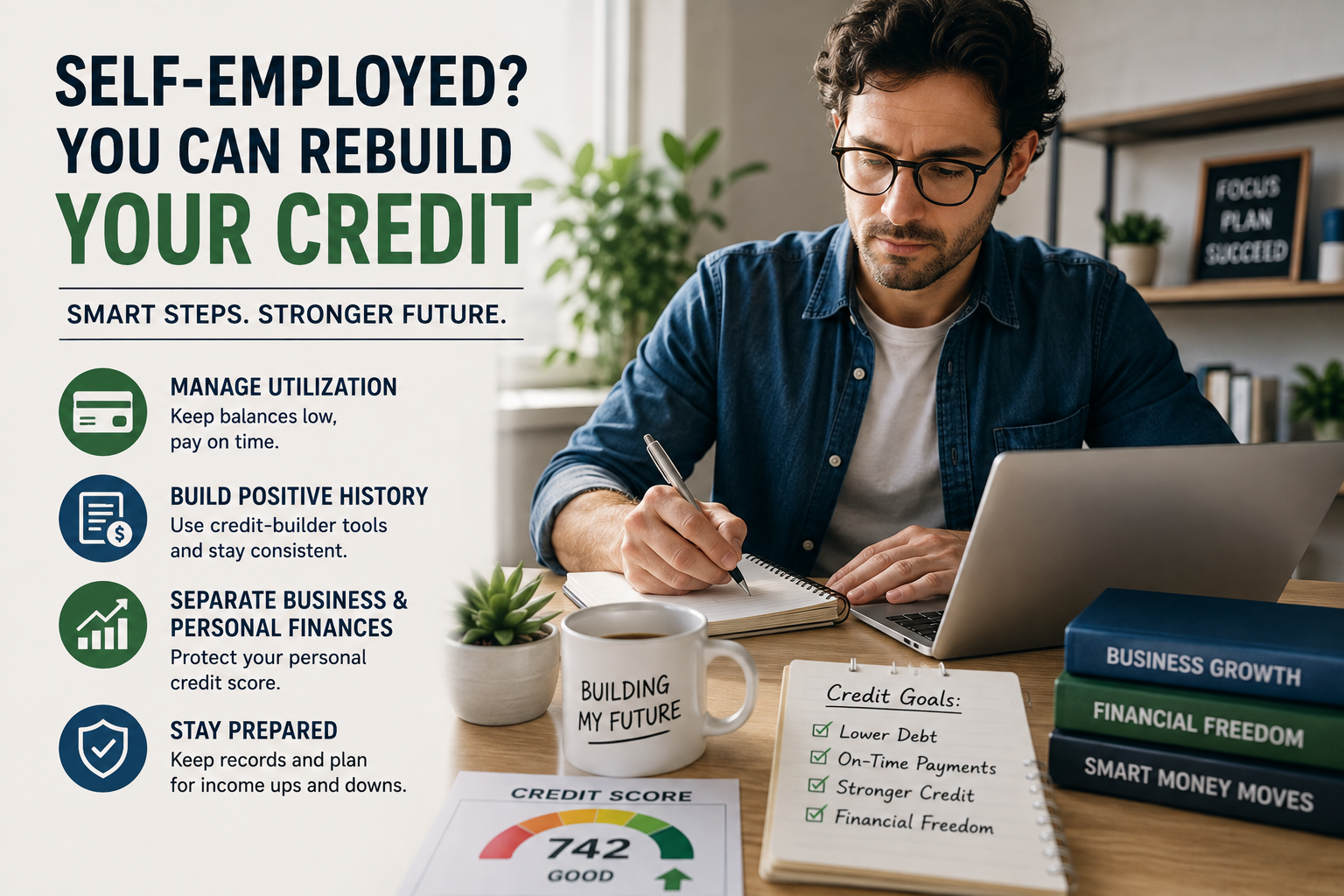
Being self-employed doesn’t directly affect your credit score — scoring models don’t know or care about your employment status — but it changes the practical landscape around credit in ways that matter a lot when you’re trying to rebuild, largely because of how lenders evaluate self-employed income during the approval process, and because of income volatility patterns that are more common in self-employment. Here’s how to navigate rebuilding with those realities in mind.
Your Credit Score Doesn’t Know You’re Self-Employed
This is worth stating clearly upfront: FICO and VantageScore calculations are based entirely on your credit report data — payment history, utilization, account age, credit mix, inquiries. Employment status isn’t a scoring factor. So the mechanics of rebuilding (paying down utilization, disputing errors, building positive history) work identically whether you’re self-employed or traditionally employed.
What’s different is the surrounding context: income verification for new credit approval, cash flow volatility that can affect your ability to make consistent payments, and sometimes limited access to employer-sponsored financial wellness resources.
The Real Challenge: Getting Approved for Rebuilding Tools
Ironically, the tools most commonly recommended for credit rebuilding — secured cards, credit-builder loans — are usually fairly accessible regardless of employment status, since secured cards are backed by your deposit rather than income, and credit-builder loans are specifically designed for people establishing or repairing credit. Where self-employment becomes a bigger obstacle is with **unsecured** credit products and loans that require income verification, since:
– Lenders often want two years of tax returns showing consistent self-employment income, which can be a barrier if your business is newer or your reported income (after deductions) looks lower than your actual cash flow.
– Income volatility, even if your average income is solid, can make automated underwriting systems more cautious than they’d be with a steady paycheck.
Step 1: Separate Business and Personal Credit Clearly
If you haven’t already, this is one of the most important structural steps:
– **Use a dedicated business credit card or line of credit** for business expenses, rather than running everything through personal cards. This keeps your personal utilization ratio clean and unaffected by business cash flow swings.
– **Consider establishing a business credit profile** (through an EIN and business credit bureaus like Dun & Bradstreet) separate from your
personal credit, especially if your business will need financing independent of your personal creditworthiness over time.
– **If you’re currently running business expenses through personal cards**, this is worth transitioning away from as soon as practical, since business expenses can create large, volatile balances that hurt your personal utilization ratio even when you’re managing the business finances responsibly.
Step 2: Prioritize Utilization Management Given Income Volatility
Since self-employment income often fluctuates month to month, utilization management deserves extra attention:
– **Pay down balances proactively during higher-income months** rather than letting them ride, since you can’t always predict a lower-income month around the corner.
– **Consider making multiple payments per month** rather than one lump sum at the due date, which can help keep reported balances lower even if your income timing is unpredictable — remember that balances typically report as of the statement closing date, so more frequent paydowns can result in a consistently lower reported balance.
– **Build a cash buffer specifically earmarked for credit payments** during lean months, separate from general business or personal savings, so a slow month doesn’t turn into a missed payment.
Step 3: Build a Track Record Lenders Can Actually Verify
If your goal includes eventually qualifying for larger unsecured credit or loans, start building documentation now:
– **Keep clean, consistent business financial records** — separate business bank accounts, organized bookkeeping, and consistent tax filing, even if your income varies. Lenders reviewing self-employed applicants weight consistency and documentation quality heavily, sometimes more than the specific income figure itself.
– **Consider working with an accountant on how income is reported.** Aggressive expense deductions minimize your tax bill but can also minimize your reported income in a way that hurts loan qualification later — this is a real tradeoff worth discussing proactively with a tax professional if you’re planning to seek financing in the near term.
– **Build 2 years of consistent self-employment history if possible** before applying for products that require it, since this is a common threshold for mortgage and some other loan underwriting.
Step 4: Use Bank Statement Loan Programs If Traditional Underwriting Is a Barrier
For self-employed individuals whose tax-return-reported income doesn’t reflect their actual cash flow well, some lenders offer “bank statement loan” programs (common in mortgage lending, increasingly available for other credit products too) that qualify borrowers based on bank deposit history rather than tax return net income. These typically carry somewhat higher rates or fees than conventional products, but can be a useful bridge while your credit and documented history continue building.
Step 5: Don’t Neglect the Basics Because of Business Focus
It’s common for self-employed individuals, especially in the early stages of a business, to deprioritize personal credit maintenance while focused on getting the business off the ground. A few things worth not letting slip:
– **Monitor your credit report regularly**, even when busy — errors and outdated items don’t fix themselves, and business stress is exactly when personal financial admin tends to get neglected.
– **Keep at least one or two personal credit accounts active and lightly used**, even if most of your daily spending routes through business accounts, so your personal credit history continues aging and reporting positively.
– **Address any negative marks from a rough patch (common in early business years) as soon as you have bandwidth**, rather than letting disputable errors sit unaddressed for years.
Retirement and Health Insurance Gaps: An Indirect Credit Factor
This is easy to overlook, but self-employed individuals without employer-sponsored health insurance sometimes face larger, less predictable medical expenses, which — as covered in our medical collections guide — is one of the more common sources of unexpected negative credit marks. If you’re self-employed, prioritizing some form of health coverage isn’t just a health decision; it’s meaningfully protective of your credit and overall financial stability too.
Realistic Timeline
– **0-6 months**: separate business/personal credit use, if not already done; establish proactive utilization management given income volatility.
– **6-12 months**: build documented, consistent history — both credit payment history and clean business financial records — that will support future loan applications.
– **1-2+ years**: sufficient self-employment history for most conventional underwriting requirements, combined with continued clean personal credit management, typically opens up the full range of credit products.
The Bottom Line
Self-employment doesn’t change how your credit score is calculated, but it changes the practical challenges around building and maintaining it — mainly through income verification friction with lenders and the discipline required to manage utilization through variable cash flow. The core rebuilding fundamentals (low utilization, on-time payments, clean dispute resolution) apply exactly the same way; the self-employed-specific work is mostly about separating business and personal finances cleanly and building the kind of documented, consistent record that lenders can actually verify when you’re ready to qualify for more than just rebuilding-tier credit products.