
What Is a Credit Score, Really?
Before we compare two scoring models, let’s make sure we’re on the same page about what a credit score actually is.
A credit score is a three-digit number (typically ranging from 300 to 850) that summarizes the information on your credit report. Think of it as a grade — a quick way for lenders to assess how likely you are to repay borrowed money based on your past behavior.
Here’s the key thing most people misunderstand: your credit score is not a single, universal number. It doesn’t live inside you like your blood type. Instead, it’s calculated on demand from the data on your credit report at one (or more) of the three major credit bureaus — Equifax, Experian, and TransUnion — using a specific scoring model.
This means several variables are always in play:
- Which bureau’s data is being used (Equifax, Experian, or TransUnion — and they don’t always have identical information)
- Which scoring model is being applied (FICO 8, FICO 9, FICO 10T, VantageScore 3.0, VantageScore 4.0, or one of many industry-specific variants)
- When the score is calculated (your report changes as creditors report new data, so a score pulled today may differ from one pulled next week)
Change any one of those variables and the number changes — even though your actual credit behavior hasn’t. That’s why you can have a dozen different “credit scores” floating around at the same time, all of them technically correct.
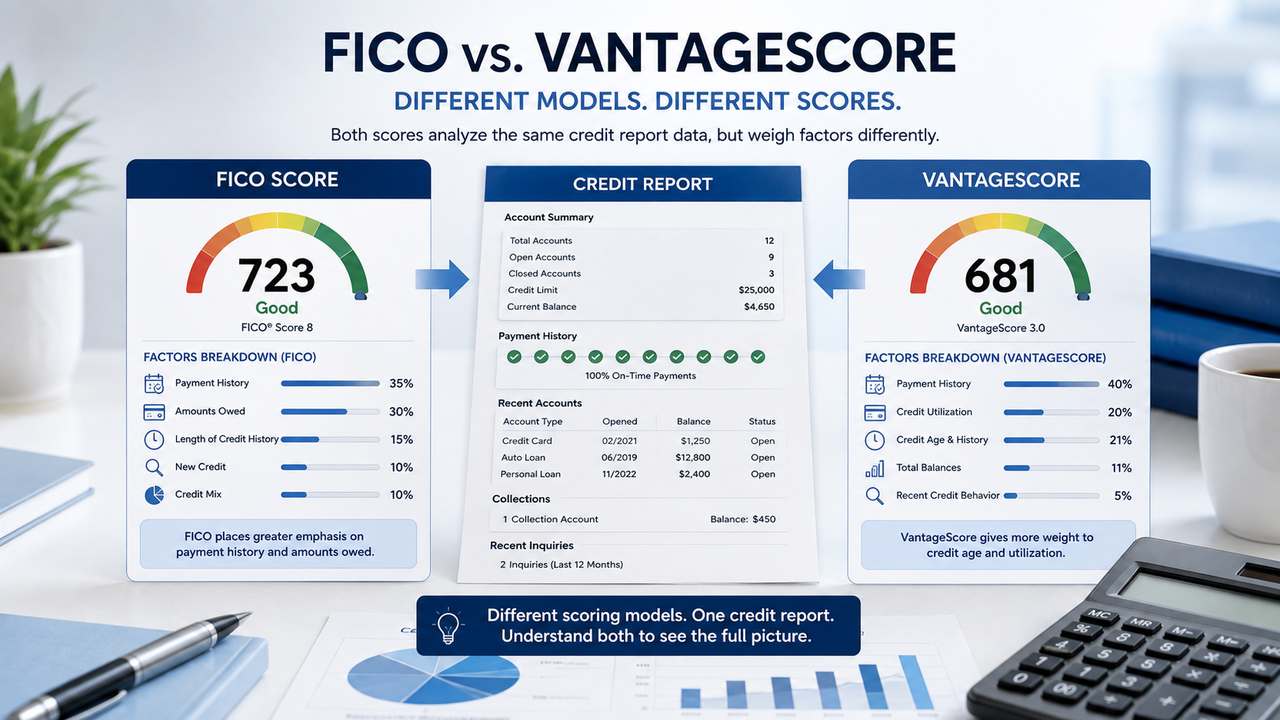
This is the foundation for everything that follows. When we talk about FICO vs. VantageScore, we’re talking about two different formulas applied to the same underlying raw material: your credit report.
FICO: The Score That Started It All
A Brief History of FICO
The Fair Isaac Corporation — now known simply as FICO — introduced the first general-purpose credit score in 1989. It was a revolutionary idea at the time: instead of a loan officer subjectively reviewing your file and making a judgment call, a statistical model would weigh your credit history and produce an objective number.
By the mid-1990s, Fannie Mae and Freddie Mac (the government-sponsored enterprises that buy most mortgages in the U.S.) began recommending FICO scores for mortgage lending. That endorsement cemented FICO’s dominance in the mortgage world — a position it still holds today.
FICO isn’t a single score, though. Over the decades, the company has released multiple versions of its scoring model, each designed to improve predictive accuracy as consumer credit behavior evolved. Lenders choose which version to use based on their needs, their industry, and sometimes on requirements set by regulators or investors.
This is why, when people say “my FICO score,” they’re really saying “my FICO score under a specific version of the model, pulled from a specific bureau, on a specific date.” It’s more precise than it sounds — and that precision matters.
FICO Score Versions: 8, 9, and 10T
FICO has released many versions over the years, but a few stand out as the most widely used today. Understanding the differences between them helps you see why your score might vary even between FICO pulls.
FICO 8 — Released in 2009, this is still the most widely used FICO model for general lending, including most credit card and auto loan decisions. FICO 8 introduced more nuanced treatment of late payments (a single late payment hurts less if your overall profile is otherwise strong) and placed greater emphasis on credit utilization — the percentage of your available credit you’re using. It also isolated authorized-user accounts to prevent piggybacking schemes from artificially inflating scores.
FICO 9 — Released in 2014, FICO 9 made several consumer-friendly changes. Most notably, it stopped counting paid collections in your score. Under FICO 8, a collection account — even one you’d paid off — could drag down your score for up to seven years. FICO 9 also reduced the impact of unpaid medical collections compared to other types of collections, recognizing that medical debt often results from circumstances beyond a consumer’s direct control.
Despite these improvements, adoption of FICO 9 among lenders has been slower than FICO 8.
FICO 10T — Released in 2020, this is FICO’s most significant update in years. The “T” stands for trended data. Instead of looking at a single snapshot of your balances and utilization, FICO 10T looks at your trajectory over the past 24 months. Have you been steadily paying down balances, or have you been creeping upward even while making minimum payments? That trend now influences your score.
FICO 10T also treats personal loans differently, recognizing that consumers who consolidate credit card debt into a personal loan and then rack up new card balances are higher risk. As of this writing, FICO 10T adoption is still limited — most lenders continue to use FICO 8 for general lending — but it’s worth understanding because it represents the direction scoring is heading.
Industry-Specific FICO Scores
FICO also produces specialized scores tailored to specific types of lending. These scores use the same underlying FICO framework but are calibrated to predict risk for a particular loan type.
FICO Bankcard Score — Optimized for credit card lending. This model places more weight on your history with revolving accounts (credit cards, store cards) and may produce a score that’s somewhat different from your general FICO score. If you’ve handled credit cards well but have a bumpy auto loan history, your Bankcard score might be higher than your general score.
FICO Auto Score — Optimized for auto lending. This model gives extra weight to your history with auto loans and installment loans. A past repossession will hurt this score more than it might hurt a general FICO score, while a clean auto loan history can give it a boost.
FICO Mortgage Scores — These are older FICO models (typically FICO 2, FICO 4, and FICO 5, pulled from Experian, TransUnion, and Equifax respectively) that Fannie Mae and Freddie Mac still require for mortgage lending. Yes, you read that right — the mortgage industry uses older FICO versions, not FICO 8 or 9. This is one of the biggest sources of confusion when people compare their “free” score to their mortgage pull.
Each of these industry-specific scores has its own range. Some use the standard 300–850 range, while others (like the Auto and Bankcard scores) extend to 900. That’s another reason your numbers can look different depending on the context.
The takeaway: FICO isn’t one score — it’s a family of scores, each calibrated for a specific purpose. The model your lender uses depends on what kind of credit you’re applying for.
VantageScore: The Challenger
How VantageScore Began
VantageScore was introduced in 2006 as a joint venture by the three major credit bureaus — Equifax, Experian, and TransUnion. The bureaus created VantageScore to compete with FICO, offering a model that the bureaus themselves owned and could license more flexibly.
From the beginning, VantageScore was designed with a few goals in mind:
- Consistency across bureaus: The same model formula is applied at all three bureaus, so scores should be more comparable across bureaus (though the underlying data still differs).
- Broader inclusion: VantageScore aimed to score more consumers, including those with thin credit files that FICO might not score at all.
- Innovation in scoring: VantageScore has been quicker to adopt new techniques, like trended data and machine learning.
VantageScore has gained significant traction over the years, particularly in the consumer-facing space. Many free credit score services — including Credit Karma — display VantageScore rather than FICO. That doesn’t make VantageScore “wrong” or “fake,” but it does explain a lot of the score discrepancies people experience.
VantageScore 3.0 and 4.0
Two versions of VantageScore matter most today:
VantageScore 3.0 — Released in 2013, this is the version most commonly displayed on free credit monitoring apps. It uses the familiar 300–850 range (earlier VantageScore versions used a different 501–990 scale, which caused no end of confusion). VantageScore 3.0 was designed to score more consumers, including those with limited credit history, by considering alternative data like rent and utility payments when available. It also ignores paid collections, similar to FICO 9.
VantageScore 4.0 — Released in 2017, VantageScore 4.0 was the first major scoring model to incorporate trended data — analyzing your balance and payment patterns over the prior 24 months rather than just a single snapshot. This means VantageScore 4.0 can tell the difference between someone who pays their balance in full each month and someone who carries a balance but makes minimum payments, even if both show the same utilization on a given day.
VantageScore 4.0 also uses machine learning to improve predictive accuracy, particularly for consumers with thin credit files or negative events in their history. It weighs recent credit behavior more heavily than older behavior, which can work in your favor if you’re actively rebuilding.
While VantageScore 4.0 is more advanced, VantageScore 3.0 remains more commonly displayed on consumer apps. Lender adoption of VantageScore, while growing, still trails FICO significantly — especially in mortgage lending.
FICO vs. VantageScore: Side-by-Side Comparison
Now let’s put the two models head to head. The table below highlights the most important differences between the dominant FICO and VantageScore versions in use today.
| Feature | FICO 8 | FICO 9 | FICO 10T | VantageScore 3.0 | VantageScore 4.0 |
|---|---|---|---|---|---|
| Score range | 300–850 | 300–850 | 300–850 | 300–850 | 300–850 |
| Minimum scoring criteria | Needs at least one account 6+ months old and at least one account reported to bureau in last 6 months | Same as FICO 8 | Same as FICO 8 with trended data available | Can score consumers with at least one account, no minimum age | Can score many thin-file consumers |
| Payment history weight | 35% | 35% | ~35% (weighting not publicly disclosed) | ~40% (extremely influential) | Extremely influential |
| Credit utilization weight | 30% | 30% | Significant, plus trended utilization | Highly influential (~23%) | Highly influential, plus trended data |
| Credit age / mix weight | 15% age, 10% mix | 15% age, 10% mix | Not fully disclosed | Moderately influential (~21% combined) | Moderately influential |
| New credit / inquiries weight | 10% | 10% | Not fully disclosed | Less influential (~11%) | Less influential |
| Paid collections | Counted | Ignored | Counted (if unpaid) | Ignored | Ignored |
| Unpaid medical collections | Counted | Reduced impact | Counted | Reduced impact | Reduced impact |
| Rent and utility payments | Generally not included unless reported | Generally not included | Not standard | Considered when reported | Considered when reported |
| Trended data (24-month history) | No | No | Yes | No | Yes |
| Hard inquiry window | 12 months (scored), 24 months (visible on report) | Same as FICO 8 | Same as FICO 8 | 12 months (scored), 24 months (visible) | 12 months (scored), 24 months (visible) |
| Rate shopping (multiple inquiries for same loan type) | Multiple auto or mortgage inquiries within ~14–45 days count as one | Same as FICO 8 | Same as FICO 8 | 14-day window | 14-day window |
| Machine learning | No | No | No | No | Yes (for certain sub-models) |
| Primary use | Credit cards, auto loans, personal loans | Limited adoption | Emerging | Consumer-facing free score apps | Some lenders, emerging |
A few things deserve emphasis:
The weighting differences are real but subtle. Both models agree that payment history is the single most important factor. Both agree utilization matters enormously. The percentage differences — 35% vs. “extremely influential” — sound dramatic, but in practice, the same behaviors that build a strong FICO score tend to build a strong VantageScore, and vice versa. The models diverge more in edge cases and in how they treat thin or damaged files.
Trended data is the biggest differentiator. FICO 10T and VantageScore 4.0 both look at your 24-month trajectory, which means your direction of travel matters — not just your current position. If you’ve been steadily reducing your balances, that positive trend can help you. If you’ve been gradually increasing your debt even while making on-time payments, that trend can work against you.
Treatment of collections has improved across both models. Paid collections are now ignored by FICO 9 and both VantageScore 3.0 and 4.0. Medical collections receive more lenient treatment across the board. This is a meaningful improvement for consumers rebuilding their credit.
Which Credit Score Do Lenders Actually Use?
This is the question that matters most, and the answer depends on the type of credit you’re seeking.
Mortgages: FICO Dominates
When you apply for a conventional mortgage — one that will be sold to Fannie Mae or Freddie Mac, which covers the vast majority of U.S. home loans — your lender is required to pull specific FICO scores: FICO Score 2 (Experian), FICO Score 4 (TransUnion), and FICO Score 5 (Equifax). These are older FICO models, not FICO 8 or 9 or 10T. The lender typically uses the middle of the three scores (or the lower of two if only two are available) as your qualifying score.
This is enormously important and widely misunderstood. If you’ve been tracking your FICO 8 score on a banking app and it shows 720, but your mortgage lender pulls FICO Score 2/4/5 and sees 695, that’s not an error — it’s a different model applied to the same data. The older mortgage FICO models can be less forgiving of certain items like collections and high utilization.
Auto Loans: FICO Auto Score or FICO 8
Most auto lenders use either FICO Auto Score (specialized for auto lending) or FICO 8. Some subprime and near-prime lenders use VantageScore. The variability here is higher than in mortgages.
If you’re shopping for an auto loan, track your FICO 8 score and be aware that your FICO Auto Score may be somewhat different (higher if you have strong auto-loan history, lower if you have a past repossession or auto loan delinquency).
Auto loan score targets: Many lenders approve with scores of 660+, but the best rates typically go to borrowers with 720+.
Credit Cards: FICO 8
The vast majority of credit card issuers use FICO 8 for approval decisions, and some use FICO Bankcard Score for credit line and account management. If you’re applying for a credit card, your FICO 8 score from the bureau the issuer typically pulls is what matters.
Credit card score targets: Approval thresholds vary widely by card. Premium rewards cards often want 700+ (sometimes 750+), while basic cards and secured cards are available to people rebuilding from the 500s upward.
Personal Loans: FICO 8 or VantageScore
Personal loan lenders split between FICO 8 and VantageScore, with online lenders and fintechs more likely to use VantageScore or proprietary models. If you’re applying with a traditional bank, FICO 8 is the safer bet to track.
Personal loan score targets: Most personal loan lenders want 600+, with better rates starting around 680+.
The practical framework: identify the type of credit you’re seeking, find out which scoring model that lender uses, and track that specific score. You can ask lenders directly which model and bureau they pull — they’re allowed to tell you, and reputable lenders will.
Why Your Credit Karma Score Differs From Your Lender Pull
This is one of the most common — and most frustrating — experiences for consumers. You check Credit Karma, see a solid 740, apply for a loan, and the lender tells you your score is 690. What happened?
There are several reasons, and understanding them removes the frustration:
Reason 1: Different scoring models
Credit Karma displays VantageScore 3.0. Most lenders use FICO 8 (or an older FICO model for mortgages). These are different formulas applied to the same credit report data. They can produce meaningfully different numbers — sometimes 20 to 50 points apart — even when the underlying data is identical. Neither score is “wrong”; they’re just measuring the same risk through different statistical lenses.
Reason 2: Different bureau data
Credit Karma shows scores from TransUnion and Equifax. Your lender might pull Experian. Not all creditors report to all three bureaus, so the data at each bureau can differ. A collection that appears on your TransUnion report but not your Experian report will affect your TransUnion-based score but not your Experian-based one.
Reason 3: Timing
Credit reports update as creditors report new information — typically once per billing cycle. A score calculated today might differ from one calculated two weeks ago because a new balance, payment, or account has been reported in the interim. Credit Karma’s score is calculated when you log in and refresh; your lender’s score is calculated at the moment they pull your credit. Any data reported in between will cause a difference.
Reason 4: Different scoring ranges
If you’re looking at a FICO Bankcard or FICO Auto score, those models use a range that goes up to 900, not 850. A “780” on one of those scores isn’t directly comparable to a “780” on a standard 300–850 scale. This is less common but worth knowing about.
Reason 5: Hard inquiries
When your lender pulls your credit, that inquiry is recorded. If you’ve been rate-shopping (say, applying with multiple auto lenders), those inquiries may temporarily affect your score. However, both FICO and VantageScore have rate-shopping windows (typically 14–45 days) during which multiple inquiries for the same type of loan count as a single inquiry for scoring purposes. This protects you while comparison-shopping.
The bottom line: don’t panic if your free app score doesn’t match your lender pull. It’s expected behavior, not a sign that something is wrong. What matters is that you understand which score your lender is likely to use and track that one when preparing for a major application.
How Each Model Handles Late Payments, Collections, and Utilization
The way FICO and VantageScore treat specific credit events is where their differences become most practical. Let’s break down the three areas that most affect consumers rebuilding their credit.
Late Payments
FICO’s approach: Payment history is the single largest factor in your FICO score (35%). A late payment — specifically one that’s 30+ days late — can cause a significant score drop, often 60 to 110 points depending on your starting score and credit profile. The higher your score, the bigger the drop, because a late payment is more “unusual” for someone with excellent credit.
FICO considers:
- How recent the late payment is (recent lates hurt more)
- How severe it is (30 days vs. 60 days vs. 90+ days — longer delinquencies hurt more)
- How frequent late payments are (a pattern of lates is worse than a one-time slip)
FICO 8 introduced slightly more nuanced treatment: a single late payment has less impact if the rest of your credit history is strong. But don’t underestimate the damage — even one 30-day late can linger on your report for up to seven years and affect your score for much of that time.
VantageScore’s approach: Payment history is weighted even more heavily in VantageScore (approximately 40% in VantageScore 3.0, described as “extremely influential” in 4.0). The practical impact of a late payment is similar to FICO — a significant drop — but VantageScore 4.0’s use of trended data means it can also see your payment pattern over time. If you have a long history of on-time payments with one recent slip, the trended data may contextualize that single late payment more favorably.
Both models treat late payments seriously. The best strategy is the same regardless of model: never miss a payment, and if you do, bring the account current as quickly as possible. A 30-day late is far less damaging than a 60- or 90-day late, so acting fast matters.
Collections
FICO 8: Both paid and unpaid collections affect your score. The impact depends on the collection’s age, amount, and type. Newer collections hurt more than older ones.
FICO 9: Paid collections are ignored. Unpaid collections still affect your score, but medical collections have reduced impact.
FICO 10T: Returns to counting paid collections (in most implementations), though the model considers trended data that may contextualize the event.
VantageScore 3.0 and 4.0: Both ignore paid collections. Medical collections receive more lenient treatment. VantageScore 4.0’s trended data can also see whether the collection is an isolated event or part of a broader pattern.
The practical takeaway: paying off a collection can help your score under FICO 9 and both VantageScore models, but may not help under FICO 8 or FICO 10T.
This doesn’t mean you shouldn’t pay — unpaid collections can still lead to lawsuits, wage garnishment, and continued credit damage. But it’s worth understanding that the score impact varies by model.
Also note: under the National Consumer Assistance Plan (an agreement among the three bureaus), the bureaus no longer report medical collections that are less than 180 days old, giving you time to resolve insurance and billing issues before they affect your credit. And as of 2023, the bureaus removed all paid medical collections from credit reports, regardless of age.
Credit Utilization
FICO’s approach: Utilization — the percentage of your available revolving credit that you’re using — accounts for 30% of your FICO score. It’s calculated both per-account and overall. The general guidance:
- Below 30% utilization is considered acceptable
- Below 10% is ideal for maximizing your score
- 0% (meaning you have balances but pay them in full) is excellent
FICO 8 looks at utilization as a snapshot: whatever balance is reported to the bureau on your statement closing date is what gets scored. If you pay your balance in full after the statement closes but before the due date, the statement balance may still show as your reported balance — meaning you can appear to have high utilization even though you pay in full every month. This is why many people who pay in full see their score dip when they make a large purchase.
VantageScore’s approach: Utilization is “highly influential” in VantageScore, weighted similarly to FICO. VantageScore 4.0, however, uses trended utilization data — it can see your utilization over the past 24 months. This means a single high-utilization month is less damaging if your long-term pattern shows low utilization. Conversely, a pattern of gradually increasing utilization can hurt you even if you’re currently under 30%.
The strategy that works for both models: keep your balances low throughout the month, not just at statement time. If you’re planning a major application, consider paying down balances mid-cycle (before the statement closing date) so the lowest possible balance gets reported. This is one of the fastest, most reliable ways to boost your score under any model.
Which Score Matters Most: Mortgages vs. Auto vs. Credit Cards
Since different lenders use different scores, the question “which score matters most?” really has three answers:
For Mortgages: Your FICO Mortgage Scores (2, 4, 5)
If you’re planning to buy a home or refinance, the scores that matter are the specific FICO models required by Fannie Mae and Freddie Mac: FICO Score 2 (Experian), FICO Score 4 (TransUnion), and FICO Score 5 (Equifax). Your lender will pull all three and typically use the middle score for qualification. If you’re applying jointly with a co-borrower, the lender uses the lower of the two middle scores.
These older FICO models can be less forgiving than FICO 8. They may weigh collections more heavily and don’t benefit from the consumer-friendly updates in FICO 9 (like ignoring paid collections). This means preparing for a mortgage requires extra diligence.
To check your FICO mortgage scores, your best option is myFICO.com, which offers plans that include the specific mortgage scores lenders use. Some credit unions and mortgage lenders also provide these scores to members or pre-qualified applicants.
Mortgage score targets: Most conventional loans require a minimum middle score of 620, though 680 or higher unlocks better rates. For the best rates, aim for 740+.
For Auto Loans: FICO Auto Score or FICO 8
Most auto lenders use either FICO Auto Score (specialized for auto lending) or FICO 8. Some subprime and near-prime lenders use VantageScore. The variability is higher here than in any other lending category.
If you’re shopping for an auto loan, track your FICO 8 score and be aware that your FICO Auto Score may be somewhat different (higher if you have strong auto-loan history, lower if you have a past repossession or auto loan delinquency).
Auto loan score targets: Many lenders approve with scores of 660+, but the best rates typically go to borrowers with 720+.
For Credit Cards: FICO 8
The vast majority of credit card issuers use FICO 8 for approval decisions, and some use FICO Bankcard Score for credit line and account management. If you’re applying for a credit card, your FICO 8 score from the bureau the issuer typically pulls is what matters.
Credit card score targets: Approval thresholds vary widely by card. Premium rewards cards often want 700+ (sometimes 750+), while basic cards and secured cards are available to people rebuilding from the 500s upward.
For Personal Loans: FICO 8 or VantageScore
Personal loan lenders split between FICO 8 and VantageScore, with online lenders and fintechs more likely to use VantageScore or proprietary models. If you’re applying with a traditional bank, FICO 8 is the safer bet to track.
Personal loan score targets: Most personal loan lenders want 600+, with better rates starting around 680+.
The practical framework: identify the type of credit you’re seeking, find out which scoring model that lender uses, and track that specific score. You can ask lenders directly which model and bureau they pull — they’re allowed to tell you, and reputable lenders will.
How to Check Both Your FICO and VantageScore
You don’t have to pay to see your scores, but you do need to know where to look for each type.
Checking Your VantageScore (Free, Widely Available)
- Credit Karma — Free VantageScore 3.0 from TransUnion and Equifax, updated weekly
- Credit Sesame — Free VantageScore from TransUnion
- Credit.com — Free VantageScore 3.0
- NerdWallet — Free VantageScore 3.0 from TransUnion
- Many bank and credit card apps — Some institutions now offer free VantageScore to customers
VantageScore is the easiest score to access for free. It’s excellent for general monitoring — catching unexpected changes, spotting errors, and tracking your overall progress. Just remember that it may not match the FICO scores your lenders use.
Checking Your FICO Score (Free Options Exist)
- Discover Credit Scorecard — Free FICO 8 score from Experian, available to anyone (not just Discover customers)
- Bank of America — Free FICO 8 for cardholders
- Chase — Free FICO 8 for cardholders (via Chase Journey)
- Citi — Free FICO 8 for cardholders (FICO Bankcard Score)
- Wells Fargo — Free FICO 9 for customers
- American Express — Free FICO 8 for cardholders
- myFICO.com — Paid service that provides the most comprehensive FICO scores, including the specific mortgage scores (FICO 2, 4, 5) and industry-specific scores (Auto, Bankcard). If you’re preparing for a mortgage, this is the gold standard.
Checking Your Credit Reports (Free, Required by Law)
Under the Fair Credit Reporting Act (FCRA), you’re entitled to a free copy of your credit report from each of the three bureaus every 12 months through AnnualCreditReport.com. Since the COVID-19 pandemic, the bureaus have made weekly access available — you can now pull your reports for free every week if you want to.
Your credit report is the raw data; your credit score is calculated from it. Reviewing your reports regularly is one of the most important things you can do, because errors on your report affect every score calculated from that report, regardless of model.
Look for:
- Accounts you don’t recognize (possible identity theft or reporting errors)
- Incorrect payment statuses (payments marked late that were actually on time)
- Outdated negative items (most negative information should fall off after 7 years; bankruptcies after 7–10 years)
- Duplicate accounts
- Incorrect balances or credit limits
If you find errors, you have the right to dispute them with the credit bureau(s) and the creditor that reported the information. The FCRA requires bureaus to investigate disputes within 30 days and correct or remove inaccurate information. This is a process we help clients navigate every day, and it’s one of the most effective ways to improve your credit profile across all scoring models.
Common Myths About Credit Scores
Misinformation about credit scores is everywhere. Let’s clear up some of the most persistent myths.
Myth 1: “Checking my own credit score hurts my credit.”
False. When you check your own credit score or pull your own credit report, it’s a soft inquiry.
Myth 2: “Carrying a credit card balance builds credit faster.”
False. Carrying a balance does not improve your credit score. Paying your balance in full each month is generally the financially healthier approach, and the scoring models do not reward you for paying interest.
Myth 3: “I only have one credit score.”
False. There are multiple credit scoring models and multiple credit bureaus. Different combinations can produce different scores, and there is no single “master” score that every lender uses.
Myth 4: “VantageScore is a fake credit score.”
False. VantageScore is a legitimate credit scoring model developed by the three major credit bureaus. It is simply different from FICO, and a lender may use one model rather than the other depending on the type of credit and the lender’s practices.
Myth 5: “My income determines my credit score.”
Your income is not part of your credit report and is not a factor in any credit scoring model. Lenders may consider your income separately when evaluating your debt-to-income ratio for a loan application, but the scoring models themselves only look at your credit history — not your earnings.
This means someone with a modest income and excellent credit habits can have a higher credit score than someone with a high income and poor credit habits. Credit scoring is about behavior, not wealth.
Myth 6: “Negative items fall off your report automatically after 7 years.”
Mostly true, but with caveats. Most negative information (late payments, collections, charge-offs) does fall off after 7 years. Chapter 7 bankruptcies remain for 10 years. Chapter 13 bankruptcies remain for 7 years. However, the item should fall off automatically — but that doesn’t always happen correctly. This is why reviewing your credit reports regularly is so important. If an item is still showing after its time limit, you have the right to dispute it and have it removed.
Myth 7: “Paying off a collection immediately removes it from my report.”
False. Paying off a collection updates the status to “paid,” but the collection can remain on your report for up to 7 years from the original delinquency date. As we discussed, FICO 9 and VantageScore 3.0/4.0 ignore paid collections for scoring purposes, but the item may still be visible on your report. Some collectors offer “pay-for-delete” agreements (you pay, they remove the collection from your report), but these are increasingly rare and not guaranteed.
Myth 8: “Credit repair companies can remove accurate negative information.”
False — and beware of anyone who promises this. Under the FCRA, accurate, verifiable, and timely negative information cannot be legally removed before its reporting time limit expires. What legitimate credit repair does is:
- Dispute inaccurate information and have it corrected or removed
- Ensure outdated items are removed on schedule
- Negotiate with creditors for goodwill removals of isolated negative items (not guaranteed)
- Help you build positive credit history to offset past negatives
Anyone who promises to “remove all negative items” or “boost your score 100 points guaranteed” is not being honest. Legitimate credit improvement is a process — one that works, but that requires time, consistency, and an accurate understanding of your rights under federal law.
Frequently Asked Questions
1. Which credit score is most important?
The one your lender uses for the type of credit you’re seeking. For mortgages, that’s the FICO mortgage scores (FICO 2, 4, 5). For credit cards and most general lending, it’s FICO 8. For general monitoring, VantageScore 3.0 (the free score on most apps) is useful for spotting changes and errors, even if it doesn’t match your lender’s pull exactly. If you’re not preparing for a specific application, tracking any reputable score consistently is more valuable than chasing the “right” one — what matters is the direction and trend.
2. Why do I have so many different credit scores?
Because each combination of scoring model (FICO 8, FICO 9, VantageScore 3.0, etc.) and credit bureau (Equifax, Experian, TransUnion) produces a different number. Your underlying credit behavior is the same, but each model weighs factors slightly differently, and each bureau may have slightly different data.
There’s no single “master” score — there are dozens of valid scores, each designed for a specific lending context.
3. Is VantageScore easier to get than FICO?
VantageScore can score more consumers than FICO, particularly those with thin credit files (limited credit history). VantageScore 3.0 and 4.0 were specifically designed to include consumers that older FICO models couldn’t score. If you’re new to credit or rebuilding, you may get a VantageScore before you get a FICO score. However, both models reward the same positive behaviors — on-time payments, low utilization, and a mix of account types over time.
4. How often should I check my credit score and report?
Check your score monthly (or weekly if you’re actively preparing for an application) to monitor for unexpected changes. Check your credit reports from all three bureaus at least once per year, or more frequently if you’re rebuilding or have had identity theft concerns. Since the bureaus now offer free weekly access through AnnualCreditReport.com, there’s no reason not to review them regularly. The key is consistency — regular monitoring catches problems early.
5. Does it hurt my score when a lender checks my credit?
A hard inquiry from a lender typically causes a small, temporary score drop (usually 1–5 points). However, both FICO and VantageScore include rate-shopping windows — typically 14 to 45 days, depending on the model — during which multiple inquiries for the same type of loan (mortgage, auto, student loan) count as a single inquiry for scoring purposes. This means you can shop around for the best rate without each inquiry compounding the impact. Hard inquiries stop affecting your score after 12 months and fall off your report after 24 months.
6. What credit score do I need to buy a house?
For a conventional mortgage (the most common type), the minimum middle FICO score is typically 620. However, higher scores unlock better terms:
- 620–679: You may qualify, but expect higher interest rates and potentially private mortgage insurance (PMI) requirements
- 680–739: Better rates and terms; this is the range where most conventional loans are approved
- 740+: The best available rates; above 740, additional points generally don’t improve your rate further
Government-backed loans have lower minimums: FHA loans can accept scores as low as 500 (with a 10% down payment) or 580 (with a 3.5% down payment). VA and USDA loans typically want 580+, though some lenders set their own higher minimums. Remember that these are FICO mortgage scores (the older 2/4/5 models), not FICO 8 or VantageScore.
7. Can I improve my credit score quickly, or does it take years?
Both — depending on what you’re optimizing for.
Take Control of Your Credit
Understanding the difference between FICO and VantageScore is more than an academic exercise — it’s the foundation for making informed decisions about your financial future. When you know which score matters for which goal, you can prepare strategically instead of guessing. When you understand how each model treats your credit behavior, you can focus your energy on the actions that actually move the needle.
Here’s what we want you to take away from this guide:
Your credit score is not a mystery. It’s a calculated number based on your credit report, and you have significant influence over it through your daily financial decisions. Pay on time, keep utilization low, maintain a mix of accounts, and let your credit age — those fundamentals work under every model.
Different scores serve different purposes. Track the one that matters for your next goal. For a mortgage, that’s your FICO mortgage scores. For credit cards, FICO 8. For general monitoring, VantageScore 3.0 is a useful (and free) barometer.
Your credit report is the foundation. Review it regularly, dispute errors promptly, and know your rights under the FCRA. Every score is calculated from your report — fix the report, and the scores follow.
Credit improvement is a process, not an event. There are no legitimate shortcuts, but there are proven strategies. The same behaviors that build a strong FICO score build a strong VantageScore. The work you do today compounds over time.
If you’re feeling overwhelmed by credit issues — collections you’re not sure how to address, errors you’ve spotted but don’t know how to dispute, or a score that’s not where you need it to be for an upcoming application — you don’t have to navigate it alone.
We offer a free credit audit at credit-repair.com. Our team will review your credit reports from all three bureaus, identify inaccuracies and negative items that may be affecting your scores, and walk you through a customized plan for improvement — all in full compliance with the FCRA, with attorney-backed oversight to ensure every step is ethical, accurate, and effective.
No pressure, no quick-fix promises — just an honest assessment of where your credit stands and a clear path forward. Because we believe you deserve to understand your credit, own your financial story, and have the tools to keep your credit strong for life.
Get your free credit audit at credit-repair.com →
Disclaimer: This article is for educational purposes only and does not constitute legal or financial advice. Credit score models and lending requirements change over time. For specific guidance about your credit situation, consult with a qualified professional or schedule a free credit audit with our team.
Last updated: August 2026