
If you’re working to build or rebuild your credit, one of the first decisions you’ll face is whether to apply for a secured credit card or an unsecured credit card. It’s a choice that affects your upfront costs, your approval odds, your monthly payments, and the speed at which your credit score climbs. And unfortunately, the marketing around both types is often confusing, vague, or designed to push you toward a product that may not serve your long-term goals.
That’s why we wrote this guide. We’re a San Diego-based, attorney-backed credit repair firm, and every day we help people across the country understand exactly how credit works — not in hype-driven snippets, but in plain, honest language. We believe that the more you understand about the tools in front of you, the better decisions you’ll make for your financial future. No quick fixes. No false promises. Just the facts, the trade-offs, and a clear path forward.
This article walks you through everything you need to know about secured and unsecured credit cards: what each one is, how they differ, who they’re designed for, how they affect your credit score, and how to move from one to the other when the time is right. By the end, you’ll have a confident answer to the question: which is right for you?
What Is a Secured Credit Card?
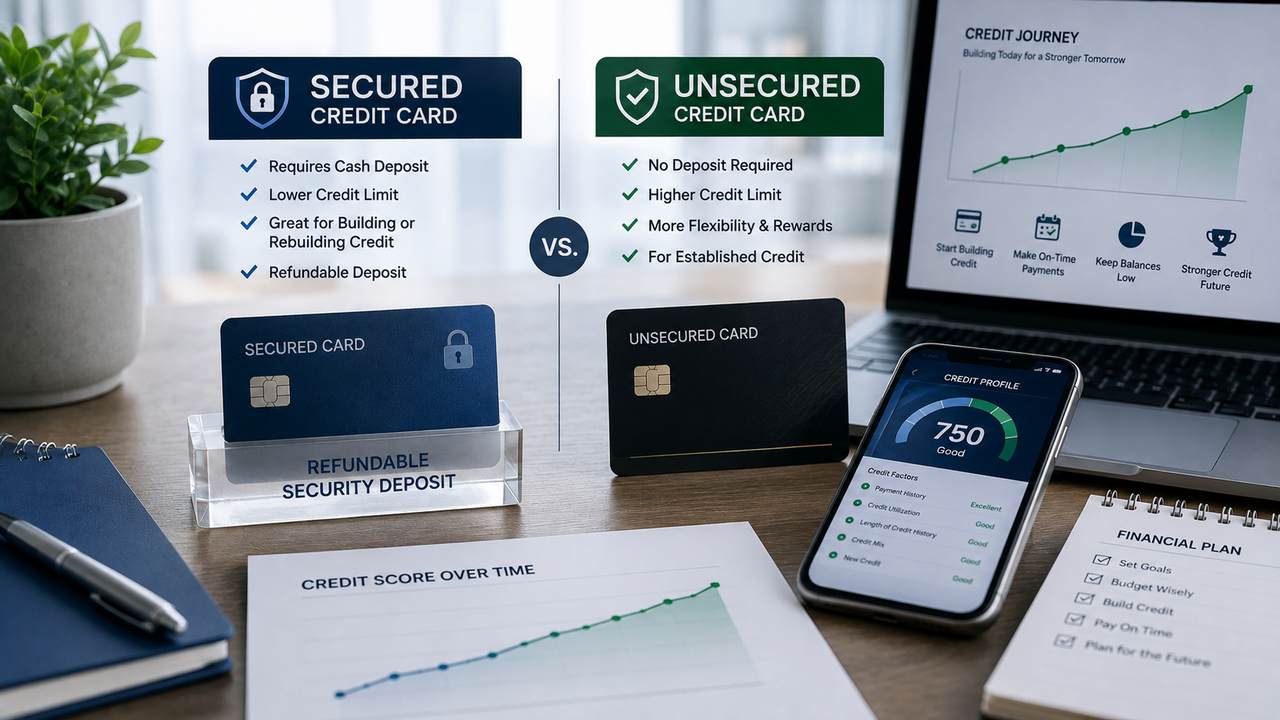
A secured credit card is a credit card that requires you to put down a refundable cash deposit before you’re approved. That deposit becomes your credit limit in most cases — so if you deposit $300, your card will typically have a $300 spending limit. If you deposit $500, your limit is usually $500.
The word “secured” refers to the fact that the card issuer is protected by your deposit. If you stop paying your bill, the lender can keep your deposit to cover the outstanding balance. This arrangement lowers the lender’s risk, which is why secured cards are available to people who might not qualify for other types of credit.
Here’s the most important thing to understand: a secured card is still a real credit card. It functions like any other credit card in day-to-day use:
- You make purchases with it at stores, online, and anywhere credit cards are accepted.
- You receive a monthly statement showing your balance, minimum payment, and due date.
- You’re expected to pay your bill on time each month.
- Your payment activity is reported to the three major credit bureaus — Equifax, Experian, and TransUnion.
That last point is the key. The purpose of a secured card isn’t really to give you a line of credit — it’s to give you a credit-building tool. Every on-time payment you make is reported to the bureaus and helps establish a positive payment history, which is the single most important factor in your credit score.
Your deposit is not a fee. It’s held in a separate account by the card issuer, usually interest-bearing (though the interest is minimal). As long as you manage the card responsibly — paying on time, keeping your balance low, and not defaulting — you’ll get that deposit back when you close the account or upgrade to an unsecured card with the same issuer.
Most secured cards require a minimum deposit between $200 and $300, and many allow you to deposit more to increase your credit limit. Some issuers let you add to your deposit over time, gradually raising your limit as your financial situation improves. A growing number of secured cards also offer a feature called a credit limit increase without an additional deposit after a period of on-time payments, which can be a helpful stepping stone.
One common point of confusion: a secured credit card is not the same as a prepaid debit card. With a prepaid card, you load money onto the card and spend it down — there’s no credit being extended, no monthly bill, and no reporting to the credit bureaus. A prepaid card does nothing for your credit score. A secured credit card, by contrast, involves a real line of credit that you borrow against and repay, and your activity is reported to the bureaus just like any other credit card.
If you’re starting from scratch no credit history at all or if you’re rebuilding after financial setbacks like missed payments, collections, or a bankruptcy, a secured card is often the most accessible and lowest-risk way to begin establishing positive credit.
What Is an Unsecured Credit Card?
An unsecured credit card is what most people picture when they hear the phrase “credit card.” It’s a traditional credit card that does not require a cash deposit. The card issuer extends you a line of credit based on your creditworthiness — your credit history, credit score, income, and overall financial profile — and trusts you to repay what you borrow.
The word “unsecured” means the lender has no collateral backing the loan. If you don’t pay, they can’t seize a specific asset the way a lender could repossess a car or foreclose on a house. Instead, they rely on the strength of your credit profile and their ability to pursue repayment through collections, charge-offs, or, in extreme cases, legal action. Because the lender is taking on more risk, they’re more selective about who qualifies.
An unsecured credit card works like this:
- You’re approved for a credit limit based on your credit profile and income — this could be anywhere from $500 to $25,000 or more.
- You make purchases up to your credit limit.
- Each month, you receive a statement and can choose to pay the full balance, a portion of it, or the minimum payment.
- If you carry a balance, you’re charged interest at the card’s APR (annual percentage rate).
- Your payment activity is reported to all three major credit bureaus.
Unsecured cards come in a wide range of tiers, from basic “starter” unsecured cards designed for people with fair credit to premium rewards cards aimed at those with excellent credit scores (typically 740 and above). The features, benefits, interest rates, and fees vary dramatically across these tiers:
- Entry-level unsecured cards may have low credit limits, higher APRs, and few or no rewards. Some carry annual fees.
- Mid-tier unsecured cards often offer modest cash back or points programs, moderate APRs, and perks like no foreign transaction fees.
- Premium unsecured cards may offer generous sign-up bonuses, travel benefits, airport lounge access, and premium purchase protections — but they typically require excellent credit and may charge higher annual fees.
Because an unsecured card doesn’t require a deposit, it’s more accessible from a cash-flow perspective — you don’t need to tie up hundreds of dollars upfront. But the approval bar is higher. Lenders want to see a track record of responsible credit use before they’ll extend an unsecured line.
The unsecured credit card is the goal for most people who are building or rebuilding credit. It represents a level of trust from the financial system, offers more flexibility and purchasing power, and typically comes with better terms than a secured card. But it’s not where everyone starts — and that’s okay. The journey from a secured card to an unsecured one is a normal, expected part of building strong credit.
Secured vs. Unsecured Credit Cards: The Key Differences
Now that you understand what each type of card is, let’s put them side by side. The table below summarizes the most important differences between secured and unsecured credit cards so you can compare them at a glance.
| Feature | Secured Credit Card | Unsecured Credit Card |
|---|---|---|
| Deposit required? | Yes — typically $200–$300 minimum, refundable | No deposit required |
| Credit limit | Usually equals your deposit (some issuers allow increases over time) | Set by the issuer based on creditworthiness; can range from $500 to $25,000+ |
| Approval requirements | Low — designed for bad or no credit; income verification may be required | Moderate to high — requires fair to excellent credit depending on the card |
| Risk to the lender | Low — deposit acts as collateral | Higher — no collateral backing the line of credit |
| Interest rates (APR) | Often higher than standard unsecured cards, though varies widely | Varies widely — from low-teens for excellent credit to high-20s for subprime unsecured cards |
| Annual fees | Common, usually $25–$50; some no-fee options exist | Varies — many no-annual-fee cards available; premium cards may charge $95–$500+ |
| Rewards and perks | Rare; a few secured cards offer modest cash back | Common — cash back, travel points, sign-up bonuses, purchase protections |
| Reports to credit bureaus? | Yes — all three major bureaus (confirm before applying) | Yes — all three major bureaus |
| Effect on credit score | Same as unsecured — bureaus don’t distinguish between secured and unsecured in scoring | Same as secured — payment history and utilization matter most |
| Path to upgrade | Many issuers allow graduation to unsecured after consistent on-time payments | N/A — already unsecured; may qualify for better terms as credit improves |
| Best for | Building or rebuilding credit from a low starting point | People with fair to excellent credit who want flexibility, rewards, and no deposit |
Let’s unpack a few of these differences in more detail, because the nuance matters.
Deposit and Cash Flow
The deposit is the most visible difference between the two card types. With a secured card, you need to have cash on hand to fund the deposit — usually $200 to $300 at minimum. That money is tied up for as long as you keep the card open. With an unsecured card, no deposit is required, so your cash stays available for other uses. For people living paycheck to paycheck, this is a meaningful distinction.
Approval Odds
Secured cards are designed for people who are building or rebuilding credit. Issuers are generally willing to approve applicants with thin credit files, past delinquencies, or even recent bankruptcies (though some require the bankruptcy to be discharged). Unsecured cards have stricter approval standards. Entry-level unsecured cards may accept applicants with fair credit (typically 580–669), but the best terms go to those with good or excellent credit.
Fees and APR
Secured cards often carry annual fees, though several reputable issuers now offer no-annual-fee secured cards. Their APRs tend to be on the higher side — often in the mid-20s — because the issuer is lending to higher-risk borrowers. However, if you pay your balance in full each month, the APR doesn’t matter; you won’t be charged interest.
Unsecured cards span a wider range. No-annual-fee options are plentiful for people with good credit, and APRs can be quite competitive. Premium cards may charge annual fees but offer benefits that can offset them if you use the card enough. Subprime unsecured cards — those marketed to people with bad credit — can carry exorbitant fees and APRs, which we’ll discuss in detail later.
Credit Limit and Purchasing Power
A secured card’s credit limit is constrained by your deposit. If you can only afford a $300 deposit, your limit is $300 — which limits both your purchasing power and your ability to keep your credit utilization low (more on that in the credit score section). An unsecured card’s limit is set by the issuer and can grow over time as you demonstrate responsible use, giving you more flexibility.
Rewards and Benefits
Most secured cards don’t offer rewards. A handful provide modest cash back on certain categories, but these are the exception. Unsecured cards, especially mid-tier and premium options, offer rewards programs that can return 1–5% of your spending in cash, points, or miles. For people who use credit cards for everyday spending and pay the balance in full, these rewards add real value.
The bottom line: a secured card is a stepping stone, not a destination. It’s a tool to help you build the credit profile you need to qualify for an unsecured card with better terms. An unsecured card is the destination — but it’s a destination that’s earned through consistent, responsible credit use over time.
Who Should Get a Secured Credit Card?
A secured credit card isn’t for everyone, but for certain situations, it’s the single best tool available for building or rebuilding credit. Here’s how to know if a secured card is the right choice for you.
You Have No Credit History
If you’re young, new to the country, or have simply never used credit before, you may have a “thin” credit file — meaning the credit bureaus don’t have enough information about you to generate a score. Lenders see thin files as risky because they have no evidence of how you handle credit. A secured card is one of the most reliable ways to build that history from nothing. Because the deposit reduces the lender’s risk, approval standards are low, and you can start establishing a payment record immediately.
You Have Bad Credit
If your credit score is below 580 — often referred to as the “poor” range — you may have difficulty qualifying for most unsecured cards. A secured card gives you a way to rebuild positive credit history while demonstrating to future lenders that you can manage a credit account responsibly. Every on-time payment is a data point that pushes your score in the right direction.
You’re Recovering From a Major Financial Setback
Bankruptcy, foreclosure, repossession, significant collections, or a period of missed payments can devastate your credit score. Recovering from these events takes time, and a secured card can be part of a deliberate rebuilding strategy. Many secured card issuers will approve applicants with a discharged bankruptcy, and some don’t even require a credit check — they use alternative data like income and banking history to make approval decisions.
You Want to Build Credit Without the Temptation of a Large Credit Line
Because a secured card’s limit equals your deposit, it naturally constrains your spending. For people who are working on financial discipline and don’t want the temptation of a large credit line, this can be a feature, not a bug. You can build a positive payment history with small, manageable purchases — a tank of gas, a recurring subscription, a grocery run — and pay them off each month.
You Want Guaranteed Approval (Almost)
While no credit card offers truly guaranteed approval, secured cards come close. The deposit eliminates most of the lender’s risk, so issuers are far more lenient. If you can fund the deposit and verify your identity and income, your odds of approval are very high — even with a rocky credit past.
What to Look For in a Secured Card
Not all secured cards are created equal. When choosing one, look for:
- Reports to all three bureaus. This is non-negotiable. If a card doesn’t report to Equifax, Experian, and TransUnion, it won’t help your credit. Confirm this before applying.
- Low or no annual fee. There are excellent secured cards with no annual fee. Avoid cards that charge high annual or monthly maintenance fees.
- A reasonable minimum deposit. $200 is standard. Avoid cards that require unusually high deposits for low limits.
- A path to graduation. Some issuers will review your account after 6–12 months of on-time payments and offer to upgrade you to an unsecured card, returning your deposit. This is a valuable feature.
- No application or processing fees. Reputable secured cards don’t charge these. If a card does, it’s a red flag.
A secured card is a means to an end. Use it consistently, pay on time every month, keep your balance low, and let it do its job: building the credit history you need to move on to better products.
Who Should Get an Unsecured Credit Card?
An unsecured credit card is the right choice when your credit profile is strong enough to qualify for one with reasonable terms. Here’s how to know if you’re ready.
You Have Fair Credit or Better
If your credit score is 580 or above — and especially if it’s 670 or above (the “good” range) — you’re likely a candidate for an unsecured card. Entry-level unsecured cards may accept scores in the 580–669 range, while better terms and rewards become available as your score climbs into the 700s.
You Don’t Want to Tie Up Cash in a Deposit
If you’d rather keep your cash available for emergencies, savings, or everyday expenses, an unsecured card’s no-deposit structure is a clear advantage. You get the credit-building benefits of a credit card without locking up $200–$500 in a refundable deposit.
You Want Rewards or Better Terms
If you use a credit card for regular spending and pay the balance in full each month, an unsecured rewards card can put money back in your pocket. Cash back, travel points, and sign-up bonuses have real value when you’re not paying interest. Unsecured cards also tend to offer lower APRs, better purchase protections, and perks like extended warranties and travel insurance.
You’ve Already Built a Positive Payment History
If you’ve had a secured card (or another credit account) for 6–12 months with consistent on-time payments, you may have built enough positive history to qualify for an unsecured card. This is the natural next step, and many secured card issuers will proactively offer to graduate you to an unsecured product.
You Need a Higher Credit Limit
If your secured card’s limit is too low to be practical — or too low to keep your credit utilization in a healthy range without obsessively micromanaging your balance — an unsecured card can provide a higher limit that gives you more breathing room. Higher limits, used responsibly, can actually help your credit score by lowering your utilization ratio.
You Have Stable Income and Manageable Debt
Lenders evaluate unsecured card applications based on both your credit score and your debt-to-income ratio. If you have a stable income and your existing debt obligations are manageable, you’re in a strong position to qualify for an unsecured card with good terms.
What to Look For in an Unsecured Card
When shopping for an unsecured card, consider:
- No annual fee unless the rewards or benefits clearly justify it.
- A competitive APR — though if you pay in full each month, this matters less.
- Rewards that match your spending — cash back on groceries and gas, travel points, or flat-rate cash back on everything.
- A sign-up bonus if you can meet the spending requirement naturally.
- No hidden fees — watch for late fees, foreign transaction fees, and over-limit fees.
- A grace period — at least 21 days from the statement closing date to the payment due date, during which you won’t be charged interest if you pay in full.
An unsecured card is a privilege you earn by building a track record. If you’re not quite there yet, that’s fine — a secured card will get you there faster than you might think.
Can You Get an Unsecured Card With Bad Credit?
This is one of the most common questions we hear, and the honest answer is: yes, but you need to be very careful.
There are unsecured cards marketed specifically to people with bad credit. They’re sometimes called “credit-building” or “credit-rebuilder” cards, and they don’t require a security deposit. On the surface, this sounds appealing — you get an unsecured card without tying up cash in a deposit. But the reality is that many of these cards come with terms that can make your financial situation worse, not better.
The Warning Signs of Predatory Unsecured Cards
Here’s what to watch out for when you encounter an unsecured card for bad credit:
Exorbitant fees
Some subprime unsecured cards charge an application fee, a processing fee, an annual fee, a monthly maintenance fee, and even a fee for requesting a credit limit increase. When you add it all up, you could pay $100–$200 or more in fees in the first year alone — before you’ve even made a purchase. Some cards charge fees that consume a significant portion of your credit limit before you ever use the card, leaving you with very little actual purchasing power.
Very high APRs
Subprime unsecured cards often carry APRs of 29.99% or higher. If you carry a balance, the interest charges can quickly spiral, making it harder to pay down the principal and increasing your overall debt load.
Low credit limits
These cards often start with very low limits — $300 to $500 — similar to what you’d get with a secured card, but without the security of a deposit. And because some of the fees are charged to the card immediately upon approval, your available credit can be dramatically less than the stated limit.
No grace period
Some predatory cards start charging interest from the day you make a purchase, with no grace period at all. This means even if you pay your balance in full each month, you’re still paying interest.
No path to better terms
Many of these cards don’t offer credit limit increases, rewards, or any upgrade path. You’re stuck with the same poor terms for as long as you hold the card.
The Honest Recommendation
If you have bad credit and you’re choosing between a predatory unsecured card and a reputable secured card, the secured card is almost always the better choice. Here’s why:
- A secured card from a reputable issuer typically has lower fees — many have no annual fee at all.
- Your deposit is refundable. Fees on a predatory unsecured card are gone forever.
- A secured card often has a path to graduation — after 6–12 months of on-time payments, you may be upgraded to an unsecured card with your deposit returned.
- The credit-building effect is the same. Both types report to the credit bureaus, and the bureaus don’t treat secured cards differently in scoring.
There are a small number of legitimate unsecured cards for people with fair credit — cards from reputable issuers with reasonable fees and transparent terms. These can be a good option if you’re on the border between bad and fair credit and you don’t want to put down a deposit. But read the fine print carefully. If a card’s fee structure seems designed to extract money from you rather than help you build credit, walk away.
A Note on “No Credit Check” Cards
Some unsecured cards advertise “no credit check” approval. These are often catalog cards or store-specific cards that can only be used at certain retailers and may not report to all three bureaus. They often charge membership fees and carry high interest rates. Read the terms very carefully before applying, and confirm that the card reports to all three major credit bureaus. If it doesn’t, it won’t help you build credit.
The bottom line: an unsecured card with bad credit is possible, but the terms are often designed to profit from your situation rather than help you improve it. A secured card from a reputable issuer is usually the safer, smarter, and cheaper path to the same destination.
How to Graduate From a Secured to an Unsecured Card
One of the most rewarding moments in a credit-building journey is the transition from a secured card to an unsecured one. This is often called “graduating,” and it represents tangible evidence that your credit profile has improved enough for a lender to trust you without a deposit.
Here’s how to make that transition happen as smoothly and quickly as possible.
Step 1: Use Your Secured Card Consistently
Don’t let your secured card sit idle. Make small, regular purchases — a subscription, a gas fill-up, a grocery run — so there’s activity on the account each month. Activity generates statements, and statements generate payment reports to the credit bureaus. A card that’s never used produces no positive payment history.
Step 2: Pay On Time, Every Time
This is the single most important thing you can do. Payment history accounts for 35% of your credit score — more than any other factor. A single missed payment can set your progress back significantly. Set up autopay for at least the minimum payment, and consider paying the full balance each month to avoid interest charges and keep your utilization low.
Step 3: Keep Your Balance Low
Aim to keep your balance below 10% of your credit limit, and never exceed 30%. If your secured card has a $300 limit, try to keep your statement balance under $30, and certainly under $90. Credit utilization accounts for 30% of your credit score, and lower is always better. If you need to make a larger purchase, consider paying it down before the statement closing date so the reported balance stays low.
Step 4: Wait 6 to 12 Months
Most issuers want to see at least 6–12 months of consistent on-time payments before they’ll consider upgrading you. Some issuers review accounts automatically; others require you to request a review. Check your card’s terms or contact customer service to find out the policy.
Step 5: Monitor Your Credit Score
Track your credit score over time using a free credit monitoring service. You should see steady improvement as your positive payment history accumulates. If your score has climbed into the fair or good range (620+), you’re likely a candidate for an unsecured card — either through an upgrade with your current issuer or by applying for a new unsecured card from a different issuer.
Step 6: Request an Upgrade or Apply for an Unsecured Card
When your score has improved and you have 6–12 months of on-time payments, you have two options:
Option A: Request an upgrade with your current issuer. Many secured card issuers will review your account and, if you’ve demonstrated responsible use, upgrade you to an unsecured card. This is the smoothest path because it doesn’t require a new credit application (which would result in a hard inquiry on your credit report). Your deposit is returned, your account history stays intact, and you continue building credit on the same account.
Option B: Apply for a new unsecured card. If your current issuer doesn’t offer an upgrade path, or if you want a card with better terms or rewards, you can apply for an unsecured card from a different issuer. This will result in a hard inquiry on your credit report, which may cause a small, temporary dip in your score, but the long-term benefit of a better card usually outweighs the short-term impact.
Step 7: Handle Your Secured Card Properly
If you upgrade with your current issuer, they’ll return your deposit and convert the account to unsecured — no need to close anything. If you apply for a new unsecured card and are approved, you’ll need to decide what to do with your secured card. We cover this decision in detail in the next section.
Graduating from a secured to an unsecured card is a milestone worth celebrating. It means your credit-building efforts are working, and the financial system is recognizing your progress. Keep the same habits that got you there — on-time payments, low balances, consistent activity — and your credit will continue to strengthen.
Should You Close a Secured Card After Graduating?
This is a more important question than most people realize, and the answer isn’t always what you’d expect. The short version: think carefully before closing a secured card, because it can affect your credit score in ways you might not anticipate.
Let’s break down why.
The Impact on Credit Utilization
Credit utilization — the percentage of your available credit that you’re using — accounts for 30% of your credit score. It’s calculated across all your credit card accounts, both individually and in aggregate. When you close a secured card, you lose that card’s credit limit, which reduces your total available credit.
Here’s an example. Suppose you have a secured card with a $500 limit and a new unsecured card with a $1,000 limit. Your total available credit is $1,500. If you typically carry a balance of $150 across both cards, your utilization is 10% — a healthy range.
Now suppose you close the secured card. Your total available credit drops to $1,000. That same $150 balance now represents 15% utilization — still okay, but higher than before. If your balance were $300, closing the secured card would push your utilization from 20% to 30% — a significant jump that could negatively affect your score.
If closing a secured card would push your utilization above 30%, it’s better to keep it open — at least until your new unsecured card’s limit is high enough to absorb the difference.
The Impact on Average Age of Accounts
The length of your credit history accounts for 15% of your credit score, and a key component is the average age of your accounts. Older accounts help your score because they demonstrate a longer track record of credit use.
When you close a credit card, the account remains on your credit report for up to 10 years and continues to contribute to your average age of accounts during that time. However, once it falls off your report, your average account age could decrease, which may cause a dip in your score.
If your secured card is one of your oldest accounts, closing it could eventually shorten your credit history. If it’s your only other account, the impact could be more noticeable.
When It Makes Sense to Close a Secured Card
There are situations where closing a secured card is the right call:
- The card charges an annual fee and you no longer use it. If you’ve graduated to an unsecured card and the secured card is sitting unused while charging you $35–$50 per year, the cost may not be worth the credit score benefit. Consider whether the fee is worth paying to keep the account open.
- Your utilization won’t be significantly affected. If your new unsecured card has a high enough limit that closing the secured card won’t push your utilization above 30%, the impact on your score will be minimal.
- You have other older accounts. If you have multiple credit accounts with long histories, closing one secured card won’t dramatically shorten your average account age.
- You want your deposit back and don’t qualify for an upgrade. If your issuer doesn’t offer an upgrade path and you need the deposit returned for other financial priorities, closing the card may be the practical choice.
When It Makes Sense to Keep a Secured Card Open
- The card has no annual fee. If it costs you nothing to keep open, there’s no financial downside, and the account continues to contribute to your credit history and available credit.
- Closing it would push your utilization too high. Keep it open until your other credit limits grow enough to absorb the difference.
- It’s one of your oldest accounts. Preserving long-standing accounts helps your average age of accounts over time.
- You can use it for a small recurring charge. Put a single small subscription on the card and set up autopay. This keeps the account active with minimal effort and cost.
A Practical Approach
If your secured card has no annual fee, the simplest strategy is to keep it open, use it occasionally for a small purchase, and let it continue contributing to your credit profile. If it has an annual fee, weigh the cost against the credit score benefit. In many cases, it’s worth paying a modest annual fee for a year or two until your other accounts have aged and your credit limits have grown — then close it when the impact will be minimal.
There’s no single right answer for everyone. The decision depends on your specific credit profile, your other accounts, your financial priorities, and the terms of your secured card. If you’re unsure, a credit professional can help you evaluate the trade-offs in the context of your overall credit strategy.
How Each Card Affects Your Credit Score
One of the most persistent myths about credit cards is that secured cards are somehow “lesser” or treated differently by the credit scoring system. This is not true. From a credit scoring perspective, secured and unsecured credit cards are identical. The major credit scoring models — FICO and VantageScore — do not distinguish between the two. They evaluate both based on the same factors:
Payment History (35%)
This is the most important factor in your credit score, regardless of which type of card you have. Every on-time payment is reported to the credit bureaus and contributes positively to your score. Every missed or late payment is reported and contributes negatively. A secured card and an unsecured card contribute to this factor in exactly the same way.
If you make on-time payments on a secured card for 12 months, the positive impact on your score is the same as it would be for 12 months of on-time payments on an unsecured card. The bureaus see payment activity — not the type of card behind it.
Credit Utilization (30%)
Your credit utilization ratio is the amount of credit you’re using divided by the amount you have available. If you have a $500 limit and a $50 balance, your utilization is 10%. Lower utilization is better for your score, and the scoring models look at both individual card utilization and your overall utilization across all cards.
Because secured cards typically have lower limits, it can be harder to keep utilization low. A $300 limit means a $90 balance already puts you at 30% — the upper end of the recommended range. With an unsecured card that has a $2,000 limit, the same $90 balance is only 4.5% utilization. This is one practical advantage of unsecured cards: higher limits make it easier to maintain low utilization without constantly micromanaging your balance.
That said, you can keep utilization low on a secured card by making small purchases and paying them down before the statement closes. The scoring impact is the same.
Length of Credit History (15%)
The age of your accounts matters. Older accounts help your score, and a longer average account age is better. Both secured and unsecured cards contribute to this factor equally. An account opened today — whether secured or unsecured — starts contributing to your credit history immediately and continues to age over time.
Credit Mix (10%)
The scoring models like to see a mix of different types of credit — revolving accounts (like credit cards) and installment accounts (like auto loans, mortgages, or personal loans). Having both secured and unsecured credit cards contributes to your credit mix in the same way, since both are revolving accounts. The scoring models don’t give extra points for having one type over the other.
New Credit and Inquiries (10%)
When you apply for any credit card — secured or unsecured — the lender performs a hard inquiry on your credit report, which can cause a small, temporary dip in your score (usually 1–5 points). Multiple hard inquiries in a short period can have a compounding effect, so it’s wise to space out applications. This applies equally to both types of cards.
The Bottom Line on Scoring
The credit scoring system doesn’t care whether your card is secured or unsecured. It cares whether you pay on time, keep your balances low, maintain a long and diverse credit history, and apply for new credit sparingly. Both types of cards give you the opportunity to build positive credit in all of these areas.
The practical difference is that secured cards typically have lower limits, which makes low utilization harder to maintain, and they may lack the rewards and benefits of unsecured cards. But from a pure credit-building standpoint, a secured card used responsibly is just as effective as an unsecured card used responsibly — and far more accessible if your credit is damaged or nonexistent.
Pros and Cons of Secured Credit Cards
Let’s summarize the advantages and disadvantages of secured credit cards so you can weigh them clearly.
Pros
- Accessible approval. Designed for people with bad or no credit. If you can fund the deposit, your approval odds are very high.
- Effective credit building. Reports to all three major bureaus, just like an unsecured card. On-time payments build positive credit history.
- Refundable deposit. Your money isn’t gone — it’s held in an account and returned when you close the card or upgrade.
- Controlled spending. The deposit-based limit naturally constrains your spending, which can help if you’re working on financial discipline.
- Path to graduation. Many issuers offer a clear upgrade path to an unsecured card after a period of responsible use.
- No risk of overspending beyond your means. You can’t spend more than your deposit (in most cases), which provides a built-in safety valve.
- Equal scoring treatment. The credit bureaus treat secured cards identically to unsecured cards in scoring.
Cons
- Requires upfront cash. You need $200–$300 (or more) to fund the deposit, which may be difficult if money is tight.
- Low credit limits. Your limit is tied to your deposit, which can make it harder to keep utilization low and limits purchasing power.
- Higher APRs. Interest rates are often in the mid-20s or higher, though this only matters if you carry a balance.
- Annual fees are common. While no-fee options exist, many secured cards charge $25–$50 per year.
- Few or no rewards. Most secured cards don’t offer cash back, points, or other rewards programs.
- Less flexibility. You can’t increase your limit without adding to your deposit (unless your issuer offers increases based on payment history).
Pros and Cons of Unsecured Credit Cards
Pros
- No deposit required. Your cash stays available for other uses — no need to tie up hundreds of dollars upfront.
- Higher credit limits. Limits are set by the issuer based on your creditworthiness and can grow over time, giving you more purchasing power and making low utilization easier to maintain.
- Rewards and benefits. Many unsecured cards offer cash back, travel points, sign-up bonuses, purchase protections, extended warranties, travel insurance, and other perks.
- Lower APRs (for qualified applicants). If you have good or excellent credit, you can qualify for APRs in the low-to-mid teens, and some cards offer 0% introductory APR periods.
- No-annual-fee options. Many excellent unsecured cards charge no annual fee, making them free to carry.
- Greater flexibility. Higher limits and better terms give you more room to manage your finances strategically.
Cons
- Harder to qualify. Requires fair to excellent credit. If your score is below 580, most reputable unsecured cards will be out of reach.
- Risk of overspending. Without the natural constraint of a deposit-based limit, it’s easier to charge more than you can afford to repay.
- Interest charges can compound. If you carry a balance, high APRs (especially on subprime unsecured cards) can lead to rapidly growing debt.
- Temptation of rewards. The prospect of earning cash back or points can encourage spending beyond your means if you’re not disciplined about paying the balance in full.
- Hard inquiry on application. Each application results in a hard inquiry, which can cause a small, temporary score dip.
- Predatory subprime options. Unsecured cards marketed to people with bad credit often carry exorbitant fees and terms that can worsen your financial situation.
Common Mistakes to Avoid
Whether you’re using a secured or an unsecured credit card, certain mistakes can undermine your credit-building efforts and cost you money. Here are the most common ones — and how to avoid them.
1. Missing Payments
A single missed payment can stay on your credit report for up to seven years and can cause a significant score drop, especially if your credit history is short. Set up autopay for at least the minimum payment on every credit card you hold. If you prefer to pay manually, set calendar reminders for at least a week before each due date.
2. Carrying High Balances
Even if you pay on time, carrying a high balance relative to your credit limit hurts your score. Aim to keep your statement balance below 10% of your limit, and never above 30%. If you need to make a large purchase, consider paying it down before the statement closes so the reported balance stays low.
3. Applying for Too Many Cards at Once
Each credit card application results in a hard inquiry on your credit report. Multiple inquiries in a short period can signal to lenders that you’re desperate for credit, which can lower your score and reduce your approval odds. Space out applications by at least 6 months when possible.
4. Choosing a Card Without Reading the Fine Print
Before applying for any credit card, read the terms and conditions carefully. Look for annual fees, monthly maintenance fees, application fees, processing fees, APR, grace period, and foreign transaction fees. If the fee structure seems designed to extract money rather than help you build credit, look elsewhere.
5. Confusing a Secured Card With a Prepaid Card
A prepaid debit card is not a credit card. It doesn’t report to the credit bureaus and doesn’t help you build credit. If your goal is to build or rebuild credit, make sure the card you’re applying for is specifically a credit card — secured or unsecured — and that it reports to all three major bureaus.
6. Closing Your Oldest Card Too Soon
Closing your oldest credit card can shorten your credit history and reduce your available credit, both of which can negatively affect your score. Think carefully before closing any older account, and consider keeping it open with a small recurring charge if it has no annual fee.
7. Not Using Your Card at All
A credit card that sits in a drawer doesn’t build credit. Issuers may close inactive accounts after a period of inactivity (typically 12–24 months), which can reduce your available credit and shorten your credit history. Make at least one small purchase each month to keep the account active.
8. Only Paying the Minimum
While paying the minimum keeps your account in good standing, it means you’re carrying a balance and paying interest. Over time, interest charges can make your purchases significantly more expensive and make it harder to pay down the principal. Aim to pay your balance in full each month. If you can’t, pay as much above the minimum as you can afford.
9. Ignoring Your Credit Report
Your credit report contains the information that determines your score. Errors on your report — accounts you don’t recognize, incorrect payment statuses, outdated information — can drag down your score unfairly. You’re entitled to a free copy of your credit report from each of the three major bureaus every 12 months through AnnualCreditReport.com. Review them regularly and dispute any inaccuracies.
10. Falling for “Guaranteed Approval” Schemes
No legitimate credit card offers guaranteed approval. Cards that make this claim often have hidden fees, don’t report to all three bureaus, or are catalog cards with limited utility. Stick with cards from reputable issuers — major banks and credit unions — and verify their terms before applying.
Avoiding these mistakes doesn’t require perfection. It requires awareness and consistent good habits. Pay on time, keep your balances low, read the terms, and monitor your credit. Do these things reliably, and your credit score will reflect your effort.
Frequently Asked Questions
1. Is a secured credit card better than an unsecured credit card?
Neither is inherently “better” — they serve different purposes at different stages of your credit journey. A secured card is the right choice when you’re building credit from scratch or rebuilding after financial setbacks, because it’s accessible and effective for establishing positive payment history. An unsecured card is the right choice when your credit is strong enough to qualify for one with good terms, because it offers higher limits, rewards, and no deposit requirement. The best card for you is the one that matches your current credit profile and financial goals.
2. How long does it take to graduate from a secured to an unsecured card?
Most issuers review secured card accounts for potential upgrades after 6–12 months of consistent on-time payments. Some may take longer — 12–18 months — depending on your starting credit profile and how quickly your score improves. You can speed up the process by paying on time every month, keeping your utilization low, and avoiding new credit applications during this period.
3. Do secured credit cards build credit the same as unsecured cards?
Yes. The credit bureaus and scoring models (FICO and VantageScore) do not distinguish between secured and unsecured cards. Both report payment activity, utilization, account age, and other factors in the same way. A secured card used responsibly builds credit just as effectively as an unsecured card used responsibly. The key is consistent on-time payments and low balances.
4. Can I get an unsecured card with no deposit and bad credit?
Yes, but you should proceed with caution. Unsecured cards for bad credit exist, but many come with high fees, high APRs, low limits, and no upgrade path. Some are outright predatory. Before applying, read the terms carefully, compare the total first-year fees to what you’d pay for a secured card, and confirm the card reports to all three major bureaus. In most cases, a secured card from a reputable issuer is the safer and cheaper option for building credit with bad credit.
5. What happens to my deposit when I upgrade from a secured to an unsecured card?
If your issuer upgrades your secured card to an unsecured card, your deposit is refunded — usually as a statement credit or a check. The account remains open with the same history, so there’s no impact on your credit age. If you close the secured card instead of upgrading, your deposit is also refunded after the final balance is paid.
6. Will closing a secured card hurt my credit score?
It can. Closing any credit card reduces your total available credit, which can increase your utilization ratio — and higher utilization can lower your score. Closing an older account can also eventually shorten your average account age, though the account remains on your credit report for up to 10 years after closing. If your secured card has no annual fee, consider keeping it open with a small recurring charge to preserve the credit limit and account age.
7. How many credit cards should I have to build credit?
There’s no magic number, but most credit experts recommend having 2–3 credit cards once your credit is established. This provides enough active accounts to build a strong payment history and gives you enough total credit limit to keep utilization low. However, more cards aren’t always better — each application results in a hard inquiry, and managing multiple cards requires discipline. Start with one card, build a solid payment history, and add cards gradually as your credit improves and your financial situation warrants.
8. What credit score do I need for an unsecured credit card?
It depends on the card. Entry-level unsecured cards may accept scores in the 580–669 range (fair credit). Cards with better terms, rewards, and no annual fees typically require scores of 670 or above (good credit). Premium rewards cards with the best perks usually require scores of 740 or above (excellent credit). If your score is below 580, a secured card is generally your best option for building the credit you need to eventually qualify for an unsecured card.
Take the Next Step Toward Stronger Credit
Choosing between a secured and an unsecured credit card is just one piece of a larger credit-building strategy. If you’re dealing with negative items on your credit report — late payments, collections, charge-offs, inaccuracies, or errors — having the right card can help you build positive history, but it won’t address the underlying issues holding your score down.
That’s where we come in. At credit-repair.com, we offer a comprehensive, attorney-backed approach to credit repair that goes beyond surface-level fixes. Our process includes:
- A thorough credit audit across all three major bureaus to identify errors, inaccuracies, and disputable negative items.
- Disputing inaccuracies under the Fair Credit Reporting Act (FCRA), with the support of experienced attorneys who ensure every step is ethical, accurate, and legally compliant.
- Negotiating with creditors to resolve outstanding debts and explore options for removing negative marks.
- A customized repair plan tailored to your specific credit profile, goals, and timeline.
- Ongoing education and support so you understand not just what we’re doing, but why — and how to maintain strong credit long after our work is done.
We operate with full transparency. No hidden fees. No misleading claims. No guarantees of specific outcomes, because no legitimate credit repair firm can honestly guarantee a particular score increase. What we can guarantee is that we’ll work diligently, ethically, and in full compliance with federal law to give your credit the best possible chance to improve.
Ready to see where you stand? Start with a free credit audit at credit-repair.com. We’ll review your credit reports from all three major bureaus, identify what’s helping and what’s hurting your score, and give you a clear, honest picture of your options — with no obligation.
Your credit journey doesn’t have to be a guessing game. With the right tools, the right information, and the right team in your corner, you can take control of your financial future — one step at a time.
This article is for educational purposes only and does not constitute legal or financial advice. Your individual credit situation is unique, and results vary based on your specific circumstances. Credit repair is a process that requires time, consistency, and compliance with applicable federal laws, including the Fair Credit Reporting Act (FCRA).