
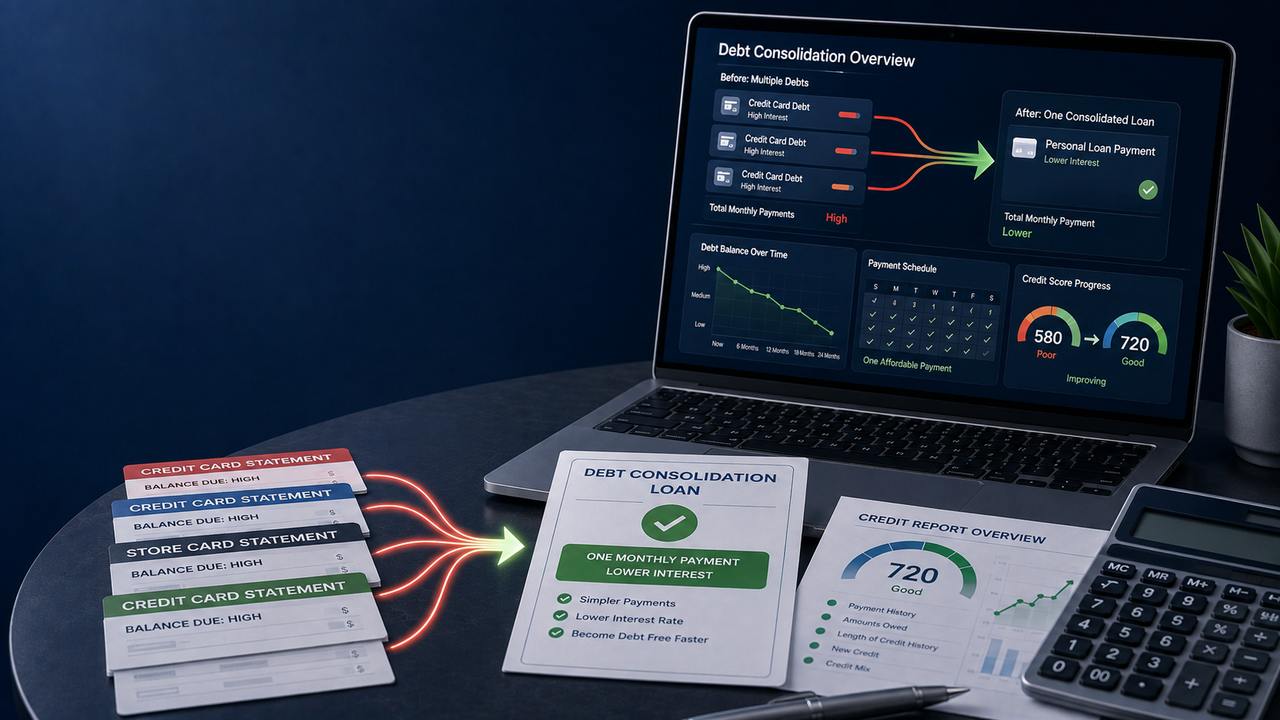
A debt consolidation loan sounds like a clean exit ramp: one loan, one monthly payment, one due date, ideally at a lower interest rate than what you’re paying now. And for some people, it genuinely is. But here’s the part most guides skip — when your credit is already bruised, consolidation can either be your way out or the thing that digs the hole deeper. The difference comes down to the rate you qualify for, the lender you choose, and whether you’ve fixed the spending pattern that got you here in the first place.
This guide is going to give you the full, unvarnished picture. No “guaranteed approval” nonsense. No pretending a 36% APR personal loan is a good deal because the monthly payment is lower. We’re going to walk through what a debt consolidation loan actually is, whether you can get one with bad credit, what it really costs, the traps to avoid, when it helps your credit, when it hurts, and what to do if you can’t qualify. We’ll also cover alternatives that may serve you better, and how improving your credit first can unlock dramatically better terms.
We’re credit-repair.com — a San Diego-based, FCRA-compliant, attorney-backed credit repair firm that helps people nationwide. We don’t sell loans and we don’t take kickbacks from lenders. Our job is to help you take control of your credit so you have real options. That’s the lens this guide is written through.
What a Debt Consolidation Loan Is and How It Works
Let’s start with the basics, because the term gets thrown around loosely and not everything called “consolidation” is actually a loan.
A debt consolidation loan is a new personal loan you take out to pay off multiple existing debts. Instead of owing money to four credit cards, a store card, and a medical provider, you owe one lump sum to one lender. You go from six payments on six dates to one payment on one date.
The goal — the honest goal — is twofold:
- Simplify your life. One payment, one due date, one creditor to deal with. This alone reduces missed payments, late fees, and the mental load of tracking everything.
- Lower your effective interest rate. If your credit cards are charging 24%, 27%, and 29% APR and you can get a personal loan at 12%, you’ve cut your interest cost meaningfully. More of each payment goes to principal, and you get out of debt faster — even with the same monthly outlay.
Here’s the mechanics. You apply for a personal loan (typically $1,000–$50,000, though some lenders go higher). The lender approves you for a loan amount, an APR (annual percentage rate), and a repayment term — usually 12 to 84 months. If approved, the lender either deposits the funds into your bank account (and you use them to pay off your creditors yourself) or, in some cases, pays your creditors directly. From that point on, you make one fixed monthly payment to the new lender until the loan is paid off.
Key terms to understand:
- APR (Annual Percentage Rate): This is the true cost of the loan per year, including interest and most fees. This is the number you compare — not the monthly payment, not the “interest rate.” We’ll come back to this because it’s where people get burned.
- Principal: The amount you actually borrowed.
- Term: How long you have to repay. Longer terms mean lower monthly payments but more total interest paid. Shorter terms mean higher payments but less total interest.
- Origination fee: A one-time fee some lenders charge to process the loan, usually 1%–8% of the loan amount, deducted from the loan proceeds. Not all lenders charge this.
- Prepayment penalty: A fee for paying the loan off early. You should never accept a loan with a prepayment penalty. Reputable lenders don’t charge them.
Consolidation vs. settlement vs. management — know the difference
These three get confused constantly, and the confusion can cost you:
- Debt consolidation = you take a new loan to pay off old debts in full. You still owe the same total amount, just to one lender, ideally at a lower rate. Your creditors are paid in full. Your credit is not damaged by the consolidation itself.
- Debt settlement = you (or a company) stop paying your creditors and try to negotiate a lump-sum payoff for less than you owe. This trashes your credit, can trigger lawsuits, and the “savings” are often eaten by settlement-company fees and tax liability on forgiven debt. We’ll cover this in the alternatives section.
- Debt management plan (DMP) = a nonprofit credit counseling agency negotiates lower rates and fees with your creditors, and you make one monthly payment to the agency, which distributes it. This is not a loan. We’ll cover this too — it’s often the best option for people with bad credit.
A debt consolidation loan is only the first one. If someone is offering to “settle” your debts for pennies on the dollar and calling it consolidation, walk away.
Can You Get a Debt Consolidation Loan With Bad Credit?
The honest answer: yes, but the terms get worse as your score drops, and below a certain point the options either dry up or become predatory.
“Bad credit” isn’t a precise term. In the lending world, it usually means a FICO score below 670, with “poor” being below 580. Here’s roughly how lenders see it:
| FICO Score Range | Label | What It Means for Consolidation |
|---|---|---|
| 720+ | Excellent / Very Good | You’ll qualify for the lowest advertised rates (often 6%–12% APR). Many options. |
| 680–719 | Good | Solid options, rates typically 10%–16%. You’re in good shape. |
| 640–679 | Fair | Fewer lenders, rates typically 14%–20%. You can still consolidate meaningfully if your existing card rates are 25%+. |
| 580–639 | Near-prime / subprime | Limited options, rates often 20%–30%+. Co-signer or secured loan may be needed. Consolidation may or may not save you money — you have to do the math. |
| Below 580 | Poor | Very few legitimate unsecured options. Rates from the few lenders who’ll approve you are often 30%–36% — the legal cap in many states. Predatory offers increase. Alternatives like a DMP are usually the better path. |
So can you get a loan with a 540 score? Possibly, from a subprime lender, at an APR that may not actually save you money. Can you get one with a 620? Yes, from several online lenders, but the rate may be 24% or higher — which means consolidation only makes sense if your current cards are even worse.
What “bad credit” actually tells a lender
Lenders don’t see “bad credit” as a moral judgment. They see it as a statistical prediction: borrowers with lower scores are more likely to default, so lenders charge higher rates to cover those expected losses. That’s it. It’s risk pricing.
This matters because it reframes the conversation. Your credit score isn’t a verdict on your character — it’s a number that reflects past payment behavior and current debt levels, and it can be improved. More on that at the end, because it’s the single biggest lever you have.
When bad credit plus consolidation makes sense
Consolidation with bad credit can still be worth it in specific situations:
- Your existing debts are at extremely high rates (store cards at 29%+, payday loans, etc.) and you can get a personal loan even 5–8 percentage points lower.
- You have a co-signer with strong credit who can help you qualify for a better rate.
- You have an asset (like a paid-off vehicle) you’re willing to use as collateral for a secured loan at a lower rate — and you’re confident you won’t lose it.
- You’re using the consolidation as part of a larger plan: you’ve stopped using the cards, you’ve built a budget, and you’re also working on repairing your credit so you can refinance into a better loan in 12–18 months.
When it doesn’t
- The only offers you’re getting are at 30%+ APR and your cards are already at 25%. The math doesn’t work.
- You haven’t changed the spending that created the debt. Consolidation without behavior change is a balance transfer, not a solution — and you’ll likely end up with the consolidation loan plus new card balances.
- You’re being offered a “secured” loan against your car or home and you’re already financially stretched. The risk of losing the asset is real.
What Credit Score Do You Need
There’s no single magic number because every lender sets its own thresholds, but here’s what the market actually looks like in practice.
For decent unsecured personal loan terms — APRs in the 10%–18% range — most lenders want to see a FICO score of around 640 or higher. This is the soft threshold where you move from “subprime” to “near-prime,” and the pool of willing lenders expands meaningfully.
Around 580 is where legitimate unsecured options start to become scarce. A handful of online lenders will approve borrowers in the 580–640 range, but the APRs are typically 20%–30%. Below 580, the legitimate unsecured personal loan market is thin, and this is exactly where predatory offers — payday loans, title loans, “guaranteed approval” scams — rush in to fill the gap.
For the best rates — single-digit to low-double-digit APR — you generally need 720+. That’s where credit unions and prime online lenders compete for your business with their lowest advertised rates.
The score isn’t the only thing
A common misconception is that the score alone determines approval. It doesn’t. Lenders also look at:
- Debt-to-income ratio (DTI): Your monthly debt payments divided by your gross monthly income. Most lenders want this under 36%–43%. We’ll dig into this in the next section.
- Income and employment: Steady, verifiable income matters. Some lenders have minimum income thresholds (often $12,000–$24,000/year).
- Payment history on your existing accounts: Recent late payments or collections signal risk.
- Credit utilization: How much of your available credit you’re using.
Types of Debt Consolidation Loans
Unsecured personal loans
These are the most common form of consolidation loan. You don’t put up collateral. The lender makes its decision based on your credit, income, DTI, and other underwriting factors. Because there’s no collateral to recover if you default, lenders charge higher rates to riskier borrowers.
Secured personal loans
These loans are backed by an asset — typically a vehicle, savings account, or other property. Because the lender has collateral, the rate may be lower than an unsecured loan. But the trade-off is significant: if you default, you can lose the asset.
A secured loan can make sense if you have strong equity in an asset, stable income, and a clear repayment plan. It is not a good choice if you’re already financially stretched.
Home equity loans and HELOCs
If you own a home with substantial equity, a home equity loan or HELOC may offer a lower interest rate than an unsecured personal loan. But you’re converting unsecured debt into debt secured by your home. If you default, you could face foreclosure.
Balance transfer credit cards
A balance transfer card can consolidate several credit card balances onto one card, often with a promotional 0% APR for a limited period. This can be powerful if you have enough credit to qualify and can pay the transferred balance before the promotional period expires.
But balance transfers typically charge a fee, and the standard APR after the promotional period can be high.
How to Qualify: The Real Requirements
Your credit score is only one part of the underwriting decision.
Debt-to-income ratio
Your DTI is calculated by dividing your monthly debt payments by your gross monthly income.
For example, if you earn $5,000 per month before taxes and have $1,800 in monthly debt payments, your DTI is 36%.
Most lenders prefer a DTI below 36%–43%, although some lenders will approve borrowers with higher ratios.
Income and employment
Lenders want to know that you have enough reliable income to make the new payment. Steady employment helps, although some lenders will accept other forms of verifiable income.
Payment history
Recent late payments, collections, charge-offs, and other negative marks can make approval more difficult and increase the rate you’re offered.
Credit utilization
High utilization can signal financial stress. If your cards are near their limits, a lender may view you as a higher-risk borrower even if your score is technically within its approval range.
The Real Cost Comparison: When Consolidation Costs More
This is where you need to slow down.
A lower monthly payment does not automatically mean a better loan.
Consider a $15,000 debt balance.
If your existing cards average 25% APR and you are paying aggressively, the interest cost is substantial. Now suppose you receive a consolidation loan at 22% APR over five years. The monthly payment may be lower than what you were paying before, but you could end up paying significantly more interest over the longer repayment period.
The only comparison that matters is the total cost of the debt.
What to compare
- APR
- Monthly payment
- Loan term
- Origination fee
- Prepayment penalty
- Total amount of payments
Never choose a consolidation loan solely because the monthly payment looks easier.
The break-even question
Ask yourself: “Will this new loan cost me less overall than keeping my existing debts?”
If the answer is no, consolidation may still simplify your payments, but it is not saving you money.
Predatory Traps to Avoid
3. Upfront-Fee Scams (Advance-Fee Loans)
A “lender” guarantees you a loan regardless of your credit — you just need to pay an upfront “processing fee,” “insurance premium,” or “collateral deposit” first. This is always a scam. Legitimate lenders deduct fees from the loan proceeds or roll them into the APR. They never ask you to wire money or pay a fee before you receive the loan.
The Federal Trade Commission has been clear on this: if a lender asks for money upfront before disbursing a loan, it’s a scam. Report them and walk away.
4. “Guaranteed Approval” Offers
There is no such thing as guaranteed approval for a legitimate personal loan. Every real lender evaluates risk. If an offer promises guaranteed approval — especially with bad credit — it’s either a scam, a payday loan in disguise, or a lead-generation site that will sell your information to dozens of other lenders (which then all pull your credit, damaging your score).
5. No-Credit-Check Loans
Legitimate lenders check credit. If a lender advertises “no credit check,” they’re either a payday/title lender charging predatory rates, or they’re not a lender at all. The absence of a credit check means the lender is pricing for maximum risk — and you’ll pay for it.
6. Debt Settlement Companies masquerading as consolidators
Some companies call themselves “debt consolidation” but are actually debt settlement companies. They’ll tell you to stop paying your creditors and deposit money into an account they control, while they “negotiate” with your creditors. This destroys your credit, can lead to lawsuits from your creditors, and the fees are often 20%–25% of your enrolled debt. Forgiven debt may be taxed as income.
How to tell the difference: A real consolidation loan pays your creditors in full. A debt settlement company tells you to stop paying them. If anyone tells you to stop paying your creditors, that’s settlement, not consolidation — and you should think very carefully before going down that road.
7. Balloon-Payment Loans
Some predatory loans have low “teaser” payments for the first several months, then a massive balloon payment at the end. If you can’t make the balloon payment, you’re forced to refinance (paying more fees) or default. Read the full payment schedule before signing.
How to protect yourself
- Verify the lender is legitimate. Check if they’re registered in your state (required for legitimate lenders). Search for the lender name + “complaints” or “reviews.” Look them up with the Better Business Bureau.
- Read the full loan agreement — APR, total of payments, payment schedule, fees, prepayment penalties. If something is unclear, ask. If they won’t explain it, leave.
- Never pay upfront fees.
- Never wire money to a lender.
- Don’t share your Social Security number or bank info until you’ve verified the lender.
When Consolidation Helps Your Credit
A debt consolidation loan can help your credit score in several ways — but only if you execute it properly.
1. Simplified payments reduce missed payments
Payment history is 35% of your FICO score — the single biggest factor. If consolidation turns six scattered due dates into one predictable payment and you never miss it, your payment history improves steadily. Over 6–12 months of on-time payments on the consolidation loan, you’ll see meaningful score improvement.
2. Lower credit utilization
Credit utilization is 30% of your FICO score.
When a consolidation loan pays off your revolving credit card balances, your utilization can fall substantially. That can help your score, particularly if you keep the old cards open and don’t immediately run them back up.
3. Better credit mix
Adding an installment loan to a profile that previously consisted mostly of revolving accounts can diversify your credit mix. This is a smaller scoring factor, but it can contribute positively over time.
When Consolidation Hurts Your Credit
1. The hard inquiry
Applying for a consolidation loan generally creates a hard inquiry. This can cause a small, temporary drop in your score.
2. The new account
A new installment loan lowers the average age of your accounts. Again, this is usually a temporary negative factor.
3. Closing old cards
If you close the credit cards that were paid off through consolidation, you may lose available credit and potentially increase your utilization ratio. Closing old accounts can also affect the average age of your credit accounts.
4. Running the cards back up
This is the biggest danger.
If you consolidate $15,000 of credit card debt and then immediately start using the cards again, you can end up with $15,000 of consolidation debt plus another $5,000, $10,000, or $15,000 in new card balances.
That is not consolidation solving the problem. That is consolidation increasing your total obligations.

Alternatives If You Can’t Qualify
Debt Management Plan (DMP)
A debt management plan through a nonprofit credit counseling agency can be one of the strongest alternatives for people with bad credit.
You don’t borrow new money. Instead, the counseling agency works with your creditors to reduce interest rates and fees, and you make one monthly payment to the agency.
Your credit score does not need to be high because you aren’t applying for a new loan.
Balance transfer
If your credit is strong enough to qualify, a 0% introductory balance-transfer credit card can give you a temporary window to pay down debt without interest.
The key is having a realistic plan to pay the balance before the promotional period expires.
Home equity
A home equity loan or HELOC may provide a lower rate, but it puts your home at risk if you cannot repay. This should be approached cautiously.
Credit repair first
If inaccurate, outdated, or unverifiable information is holding your score down, addressing those issues before applying for a consolidation loan may improve your borrowing options.
A higher score can mean a lower APR, better terms, and potentially thousands of dollars in interest savings.
How to Choose a Legitimate Lender
When comparing lenders, don’t focus only on the advertised rate. Look at the entire loan agreement.
- Compare APR, not just the interest rate.
- Check the origination fee.
- Confirm the repayment term.
- Look for prepayment penalties.
- Calculate the total amount you will repay.
- Verify the lender’s licensing and reputation.
- Never pay an upfront fee to receive a loan.
- Never provide sensitive financial information to a lender you have not verified.
If a lender refuses to explain the terms clearly, walk away.
Common Mistakes to Avoid
Mistake 1: Focusing only on the monthly payment
A lower payment can be attractive, but a longer term can dramatically increase the total amount of interest you pay.
Mistake 2: Ignoring APR
Always compare APR because it incorporates the interest rate and most loan fees.
Mistake 3: Applying everywhere
Multiple hard inquiries can lower your score. Compare lenders carefully before submitting multiple applications.
Mistake 4: Closing all your cards
Paying cards down does not necessarily mean you should close them. Keeping older accounts open can help preserve available credit and account age, assuming you can manage them responsibly.
Mistake 5: Using the cards again
Consolidation only works if you stop adding new debt.
Mistake 6: Taking a predatory loan because you feel desperate
A bad loan can make a difficult situation substantially worse. If the numbers do not work, consider a DMP, credit counseling, or improving your credit before borrowing.
Frequently Asked Questions
1. Is debt consolidation worth it with bad credit?
It can be, but only when the new loan has a meaningfully lower APR than your existing debts, the total cost is reasonable, and you can comfortably afford the new monthly payment.
It’s a bad idea when the only offers you’re getting are at rates that don’t beat your current debts, when the total cost is higher, or when you haven’t changed the behavior that got you into debt.
There’s no universal answer — it’s a math question and a behavior question. Run the numbers honestly.
2. Will a debt consolidation loan hurt my credit?
It can, temporarily. The hard inquiry drops your score a few points. Opening a new account lowers your average account age. But if you use the loan to pay off cards (lowering your utilization) and make every payment on time, the net effect over 6–12 months is usually positive. The damage happens when you close cards, miss payments, or run balances back up.
3. What credit score do I need for a debt consolidation loan?
For decent terms (APR under 18%), most lenders want 640+. You can get approved in the 580–640 range, but rates will be 20%–30%. Below 580, legitimate unsecured options are scarce and a DMP is usually the better path. For the best rates (single digits to low teens), you generally need 720+.
4. Can I get a debt consolidation loan with a 500 credit score?
Legitimate unsecured personal loans at 500 are extremely rare and, when available, at rates (30%–36%) that rarely make consolidation worthwhile. Your better options at that score are a DMP through a nonprofit credit counselor, a secured loan (if you have collateral and can afford it), or focusing on credit repair for 6–12 months to raise your score before applying.
5. What’s the difference between a debt consolidation loan and a debt management plan?
A consolidation loan is a new loan that pays off your existing debts in full — you owe one lender instead of many. A DMP is not a loan; a nonprofit counseling agency negotiates lower rates and fees with your creditors, and you make one monthly payment to the agency, which distributes it. DMPs don’t require good credit (you’re not borrowing), and the negotiated rates are often lower than what you’d get on a bad-credit consolidation loan.
6. Should I use my home equity to consolidate credit card debt?
It can offer the lowest rates, but you’re converting unsecured debt into debt secured by your home. If you default, you could lose your house. It makes sense for disciplined borrowers with stable income who are committed to not running up cards again. It’s risky for anyone else. Think very carefully and consider talking to a financial advisor before taking this step.
7. Can I consolidate debt without hurting my credit?
Any new loan will have a short-term impact (hard inquiry, new account). But if you pay off cards, keep them open, and make on-time payments on the new loan, your credit generally improves within 6–12 months. The way to avoid hurting your credit is to execute the consolidation properly — and to fix the underlying behavior.
8. How long does it take to pay off debt with consolidation?
It depends on your loan term (typically 12–84 months), your interest rate, and whether you make only the scheduled payment or pay extra. A 36-month loan at 14% will have you debt-free in 3 years. A 60-month loan at 22% will take 5 years and cost far more. Shorter terms cost less — choose the shortest term you can comfortably afford.
9. Should I use a debt settlement company?
Debt settlement is fundamentally different from consolidation. Settlement typically involves stopping payments and negotiating reduced payoffs, which can seriously damage your credit and may expose you to collection activity, lawsuits, fees, and potential tax consequences. It can be appropriate in certain hardship situations, but it should not be confused with consolidation.
A Smarter Path: Fix Your Credit First
Here’s the truth that gets buried in most debt consolidation articles: the best time to get a consolidation loan is when your credit is good enough to get a rate that actually saves you money.
If your score is 580 and the only loan you qualify for is 28% APR, consolidating your 25% credit card debt doesn’t solve anything. You’ve just rearranged the chairs. But if you can spend six to twelve months improving your credit — disputing inaccurate information, paying down balances, building a clean payment history — and move your score into the 640–680 range, suddenly you’re looking at 14%–18% offers instead of 28%. That difference can save you thousands of dollars.
And here’s the part people miss: you don’t have to wait years. Credit scores can move meaningfully in 6–12 months when you address the right factors. Lowering utilization, correcting errors, and establishing on-time payment history can produce substantial improvement.
That’s where we come in.
At credit-repair.com, we offer a free credit audit that looks across all three bureaus — Equifax, Experian, and TransUnion — to identify inaccurate, outdated, unverifiable, or potentially disputable information on your credit reports.
What we do is grounded in the Fair Credit Reporting Act and the legal right every consumer has to an accurate, verifiable credit report. We work alongside experienced attorneys, we operate in full compliance with federal credit laws, and we help you understand not just what’s on your report, but what to do about it.
Whether you’re consolidating, settling, rebuilding, or just trying to figure out where you stand, a free audit is a good place to start.
Get your free credit audit at credit-repair.com →
Related Reading
Disclaimer: This article is for educational purposes and does not constitute legal, tax, or financial advice. Debt settlement and debt consolidation have significant financial and credit implications. Always review loan terms carefully and consider consulting a qualified financial professional before making major financial decisions.