
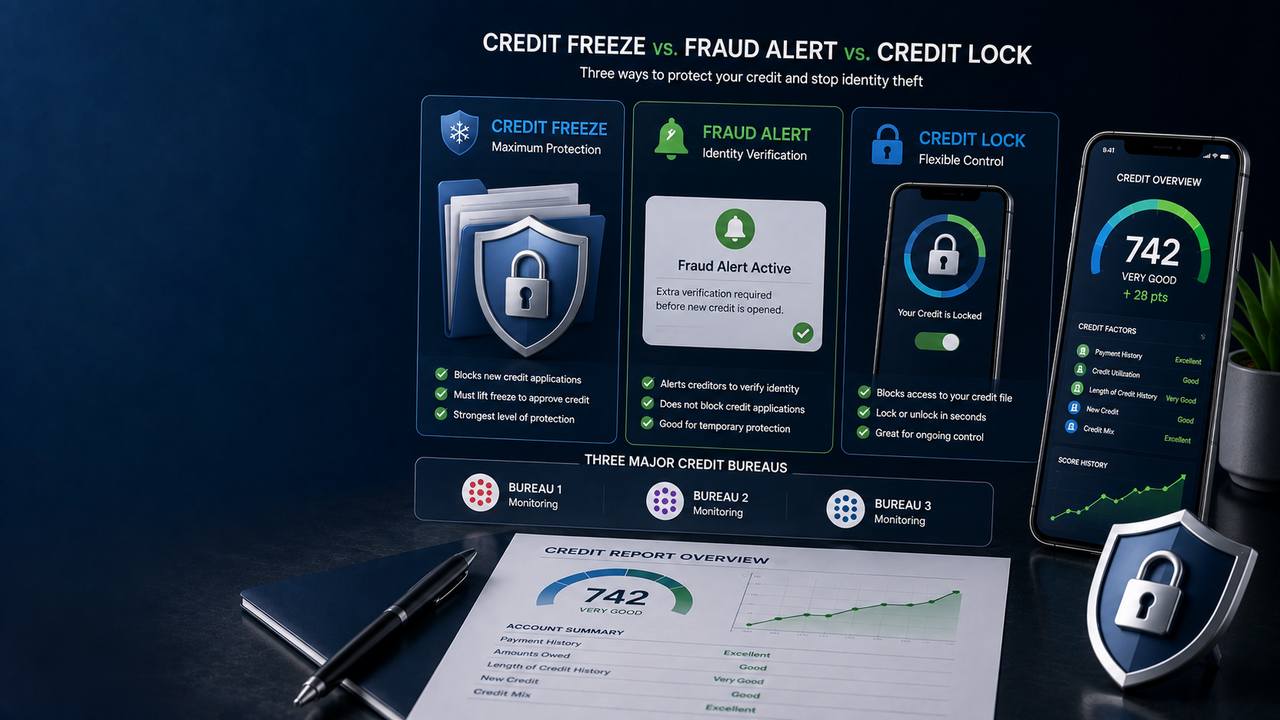
The answer almost always comes down to three tools — a credit freeze, a fraud alert, and a credit lock. They sound interchangeable. They are not. One is a federal right backed by law. One is a request that lenders verify your identity. One is a commercial product that behaves a lot like the first but without the legal scaffolding. Choosing the wrong one can leave a gap a thief walks right through, or slow you down the next time you genuinely need credit.
This guide breaks down each option in plain language, compares them side by side, and walks you through exactly how to place, lift, and combine them across all three bureaus — Equifax, Experian, and TransUnion. No quick-fix promises, no scare tactics. Just the clear, legally grounded information you need to protect your credit with confidence.
What Is a Credit Freeze?
A credit freeze — sometimes called a security freeze — is the strongest single tool available to lock down your credit file. When you place a freeze, the three major credit bureaus (Equifax, Experian, and TransUnion) restrict access to your credit report. Because almost every legitimate lender checks your report before approving new credit, a freeze effectively stops new accounts from being opened in your name.
Here’s the part most people misunderstand: a freeze does not close your existing accounts, and it does not prevent you from using the credit you already have. Your current credit cards, loans, and lines of credit keep working exactly as they did before. Your payment history keeps reporting. Your balances keep updating. The freeze only blocks new third parties from pulling your report for the purpose of opening new accounts.
It’s a Federal Right, Not a Favor
This is the single most important distinction between a freeze and the other two options. A credit freeze is guaranteed to you under federal law — specifically, the Fair Credit Reporting Act (FCRA), as strengthened by the Economic Growth, Regulatory Relief, and Consumer Protection Act of 2018. Before that law, bureaus could charge fees to freeze and thaw your file in some states. Today, placing, temporarily lifting, and permanently removing a freeze is free at all three bureaus, nationwide, regardless of where you live or whether you’ve been a victim of identity theft.
That legal grounding matters. A freeze isn’t a promotional product the bureau can reprice, deprecate, or bury in fine print. It’s a statutory right. If a bureau fails to comply, you have a legal remedy — and regulators who want to hear about it.
How a Freeze Actually Works
When you place a freeze, each bureau issues you a PIN (or, in some cases, a password or account-based credential) that you use to thaw — temporarily lift — the freeze later. Without that PIN, no one can lift the freeze on your file. That’s your control mechanism.
A few things to know about how the freeze behaves day to day:
- Existing creditors can still access your report. Companies you already do business with — your current bank, your existing card issuer, your mortgage servicer — retain access for account management, collections, and similar purposes permitted under the FCRA.
- Soft inquiries still go through. Prequalification checks, credit monitoring services you’ve enrolled in, and insurance underwriting inquiries that don’t involve new credit may still be visible. A freeze targets the hard inquiries that accompany new account applications.
- Government agencies can access your report in limited circumstances. This includes court orders, warrants, and certain benefit investigations.
- Your credit score keeps moving. A freeze does not pause your score. Payments, balances, new inquiries from existing creditors, and aging all continue to affect your score as normal.
Who Should Consider a Freeze?
A credit freeze is the right choice when you don’t expect to apply for new credit in the near future and you want maximum protection against new-account identity theft.
What Is a Fraud Alert?
A fraud alert is a lighter-touch form of identity-theft protection. Instead of blocking access to your credit report, it tells lenders to take extra steps to verify your identity before extending new credit.
A fraud alert does not prevent a lender from pulling your credit report. Instead, it creates an additional verification checkpoint intended to make it harder for an identity thief to successfully open an account in your name.
Types of Fraud Alerts
There are three types of fraud alerts, each tied to a specific situation:
1. Initial Fraud Alert — 1 Year
An initial fraud alert lasts for one year and is available to anyone who suspects — but may not yet be able to prove — that they are or are about to become a victim of identity theft. You don’t need a police report to place one. You can place it if your wallet was stolen, if you clicked a phishing link, if your information showed up in a breach notification, or simply if something feels off.
Under federal law, when you place an initial fraud alert with one bureau, that bureau is required to notify the other two. In practice, it’s still wise to confirm with all three that the alert is showing, but you should not need to place it three separate times.
Key features:
- Free to place
- Lasts one year (and can be renewed)
- Requires lenders to verify your identity before extending credit
- Does not block access to your credit report — lenders can still pull it; they just have to take extra steps
- You can still apply for credit; you’ll simply be asked to verify your identity
2. Extended Fraud Alert — 7 Years
An extended fraud alert lasts for seven years and is reserved for confirmed victims of identity theft. To place one, you must submit a copy of an identity theft report — typically a police report, a Federal Trade Commission (FTC) Identity Theft Report, or another report filed with a law enforcement agency — to each bureau.
The extended alert carries the same identity-verification requirement as the initial alert, plus an important additional benefit: it removes you from prescreened offers of credit and insurance for five years. That means fewer preapproval mailers in your mailbox — and fewer opportunities for someone to intercept one and respond in your name.
Key features:
- Free to place
- Requires an identity theft report (police report or FTC report)
- Lasts seven years
- Removes you from prescreened offer lists for five years
- Requires identity verification before new credit is extended
- Like the initial alert, placing it with one bureau triggers notification to the other two
3. Active-Duty Military Alert — 1 Year
An active-duty military alert is available to members of the U.S. armed forces on active duty. It functions like an initial fraud alert — requiring identity verification before new credit is extended — and also removes you from prescreened offer lists for two years. It lasts for one year and can be renewed for the duration of your deployment.
This alert exists because service members deployed away from home are frequent targets for identity theft. A fraud alert, combined with a freeze, is one of the strongest defensive postures a deployed service member can take.
The Limitation to Understand
A fraud alert is a speed bump, not a roadblock. It depends on the lender acting on it. Most do — the FCRA creates legal exposure for lenders who ignore alerts — but a fraud alert does not physically prevent a hard pull the way a freeze does. If you want a guarantee that no new account can be opened, a freeze is the stronger tool. A fraud alert is better suited to situations where you still want relatively frictionless access to new credit but want lenders to pause and check first.
For a step-by-step identity theft recovery roadmap, see [what to do if your identity is stolen].
What Is a Credit Lock?
A credit lock is where things get confusing for a lot of people, because from the outside it looks and feels almost identical to a credit freeze.
You lock your file; new lenders can’t see it; you unlock it when you need credit. The day-to-day experience is similar.
The difference is in what’s behind the lock.
Commercial Product, Not a Federal Right
A credit lock is a commercial product offered by each credit bureau — not a federal right. It is governed by the terms of service of the bureau’s lock program, not by the FCRA. That distinction matters in several practical ways:
Speed and Convenience
This is where locks shine. Because a lock is administered through the bureau’s app or website and tied to your account credentials, locking and unlocking can typically be done with a tap or a click — sometimes in seconds. There’s no PIN to manage, no scheduled thaw window, no calling. For people who open new accounts frequently or who want the ability to toggle protection on and off without friction, a lock is the most convenient option.
Some bureaus pair their lock products with mobile app features like instant push notifications when someone attempts to access your file. That real-time awareness can be valuable.
Cost and Terms
Here’s the catch. While credit freezes are free by law, credit locks operate under the bureau’s commercial terms. Depending on the bureau and the plan you choose:
- A lock may be free (some bureaus offer a basic free lock)
- A lock may be bundled into a paid monthly subscription that includes credit monitoring, identity theft insurance, and other features
- A lock may include advertising or marketing offers within the bureau’s app
- The bureau can change the terms of the lock program — pricing, features, availability — because it’s a product, not a statute
That last point is the core trade-off. A freeze is yours by right and can’t be repriced. A lock is a service the bureau provides under terms it controls. If you’re paying for a lock as part of a broader identity protection subscription, that can be perfectly reasonable — just go in understanding that you’re buying a product, not exercising a right.
Legal Recourse
Because a freeze is grounded in federal law, if a bureau mishandles your freeze, you have statutory remedies and a clear path to complain to the Consumer Financial Protection Bureau (CFPB). With a lock, your recourse is primarily the contract (the terms of service) you agreed to. That’s not necessarily worse — contracts are enforceable — but it’s a different and generally weaker posture than federal statute.
When a Lock Makes Sense
A credit lock is a good fit when:
- You want the convenience of app-based, instant lock/unlock
- You’re already paying for a bureau’s identity protection subscription that includes a lock
- You apply for credit often enough that PIN-based thawing feels like too much friction
- You’re comfortable with the bureau’s terms of service
It’s less ideal when:
- You want the strongest legal protection available
- You’re uncomfortable with a commercial product governing access to your credit file
- You don’t want to be exposed to potential pricing or feature changes
- You’re dealing with active, serious identity theft where you want every statutory protection on your side
Internal link placeholder: Compare bureau monitoring products side by side in [our credit monitoring guide].
Side-by-Side Comparison
The fastest way to understand the difference is to see them next to each other.
| Feature | Credit Freeze | Fraud Alert | Credit Lock |
|---|---|---|---|
| Legal basis | Federal law (FCRA) | Federal law (FCRA) | Bureau terms of service (contract) |
| Cost | Free by law | Free | Free tier at some bureaus; often part of paid subscription |
| Duration | Remains until you remove it | Initial: 1 year. Extended: 7 years. Active-duty: 1 year. All renewable. | Remains until you remove it |
| What it does to your report | Blocks access by new lenders | Allows access but requires identity verification | Blocks access by new lenders |
| Protection level | Strongest — physically prevents new hard pulls | Moderate — depends on lender action | Strong — similar to freeze, but governed by contract |
| Convenience when applying for credit | Requires thaw (PIN or account login) | Minimal friction — you verify identity with the lender | Fastest — tap to unlock in the app |
| Who can place it | Anyone | Initial: anyone. Extended: identity theft victims with a report. Active-duty: service members. | Anyone with a bureau account |
| Identity theft report required? | No | Only for the 7-year extended alert | No |
| Blocks prescreened offers? | No (though you can opt out separately at OptOutPrescreen.com) | Extended alert: yes, for 5 years. Active-duty: yes, for 2 years. | Depends on the bureau product |
| Cross-bureau placement | Must place separately with all three bureaus | Place with one; bureau notifies the other two | Must lock separately with all three bureaus |
| Recourse if mishandled | Statutory remedy + CFPB complaint | Statutory remedy + CFPB complaint | Contractual remedy under terms of service |
| Best for | Maximum protection when you’re not applying for credit soon | Recent ID theft or you’re applying for credit soon and want a verification check | Frequent credit applicants who want app-based convenience |
A few things stand out in that table:
- Freeze and lock both block access; a fraud alert does not. If your top priority is making sure no new account can be opened, the alert alone won’t get you there.
- A freeze is free forever; a lock’s terms can change. The cost difference may be small today, but the legal posture is fundamentally different.
- A fraud alert is the only one that places a verification requirement on lenders. That’s useful in a different way — it doesn’t block, but it does create a checkpoint a thief is likely to fail.
- Only the fraud alert auto-propagates across bureaus. A freeze or a lock requires action at all three.
Which Is Best for Your Situation?
There’s no single right answer — the best choice depends on what’s happening in your life and what you’re trying to protect against. Here are the most common scenarios and the tool that fits each.
You’re not applying for credit anytime soon — go with a freeze
If you already have the credit cards you need, your mortgage is in place, your car loan is set, and you’re not planning any new applications for the next six to twelve months, a credit freeze at all three bureaus is the strongest, simplest protection you can put in place. It’s free, it stays until you remove it, and it blocks new-account fraud at the source.
This is the baseline recommendation for most adults in the U.S. today, given how frequently consumer data is exposed in breaches. You don’t need to have been a victim to benefit — a freeze is preventive, not just reactive.
You’re applying for credit soon — use a fraud alert
If you’re about to shop for a mortgage, apply for an auto loan, or open a new rewards card in the coming weeks, a full freeze creates friction every time a lender needs to pull your report. A fraud alert is the better fit here. It tells lenders to verify your identity before extending credit, which adds a checkpoint for thieves without blocking your own applications. You’ll still get approved; you’ll just be asked to confirm who you are.
You can also place a fraud alert as a bridge — protection now, while you decide whether a longer-term freeze makes sense.
You’ve recently been a victim of identity theft — freeze + extended alert
If you’ve confirmed identity theft, don’t choose between the two. Use both:
- Place a freeze at all three bureaus to block any further new-account openings immediately.
- File an identity theft report with the FTC at IdentityTheft.gov and/or your local police department.
- Place an extended fraud alert (7-year) at one bureau using your identity theft report — it will propagate to the other two.
- Request removal from prescreened offer lists at OptOutPrescreen.com (the extended alert does this for five years, but you can do it independently too).
This combination gives you the strongest available posture: a freeze that physically blocks new pulls, plus an alert that creates a verification requirement for any thaw you authorize, plus reduced exposure to intercepted preapproval mail.
You want maximum convenience and don’t mind a commercial product — consider a lock
If you apply for credit frequently — you churn credit card bonuses, you’re a real estate investor running multiple financings, you’re shopping several lenders for a big loan — and PIN-based thawing feels like too much friction, a credit lock at all three bureaus may fit your life better. You get app-based instant toggle without a PIN, and you can unlock for a specific lender in seconds.
Just understand the trade: you’re trading statutory protection for convenience. If you’re already paying for one of the bureau’s identity protection subscriptions, the lock may be included, which makes the cost question moot. If you’re not, weigh whether the convenience is worth the terms-of-service posture.
You’re deploying or on active military duty — active-duty alert + freeze
Service members on active duty get a dedicated tool — the active-duty military alert — that lasts one year, requires lender identity verification, and removes you from prescreened lists for two years. Pair it with a freeze for the strongest protection while you’re deployed and less able to monitor your accounts in real time.
You’re protecting a minor child — freeze
Children are increasingly targeted by identity thieves because their credit files are clean and rarely monitored. Under federal law, you can place a freeze on a child’s credit file at all three bureaus if one exists (and if one doesn’t, you can request that the bureau create one for the purpose of freezing it). This is one of the most effective preventive steps a parent can take. The process requires documentation proving your authority to act on the child’s behalf — birth certificate, your ID, a utility bill — but it’s straightforward and free.
You’re caring for an older adult — freeze
Older adults are another frequent target. If you’re helping a parent or older relative manage their finances and they don’t plan to apply for new credit, a freeze at all three bureaus is the cleanest protection. Be sure to store the PINs securely and document the process so that you (or they) can thaw when needed.
How to Place Each One With Each Bureau
You’ll work with the three major credit bureaus — Equifax, Experian, and TransUnion — for all three tools. The general steps are similar; the specifics differ slightly by bureau. In every case, have your personal information ready: full name, address, date of birth, Social Security number, and a government-issued ID.
Placing a Credit Freeze
You can place a freeze online, by phone, or by mail with each bureau. Online is fastest. You’ll need to place it separately with each of the three.
Equifax
- Online: Visit Equifax’s security freeze page and follow the prompts to create or log into your myEquifax account and place the freeze.
- Phone: Call Equifax’s dedicated freeze line.
- Mail: Send a written request with your identifying information and copies of supporting documents to Equifax’s freeze mailing address.
- Equifax typically does not require a PIN for online freeze management — you manage it through your account credentials.
Experian
- Online: Visit Experian’s freeze center, create or log into your account, and place the freeze.
- Phone: Call Experian’s freeze line.
- Mail: Send a written request with your personal information and ID documents.
- Experian issues a PIN that you’ll use to thaw by phone or mail. Online thawing may use your account credentials instead.
TransUnion
- Online: Visit TransUnion’s freeze page, create or log into your account, and place the freeze.
- Phone: Use TransUnion’s automated freeze line or speak with a representative.
- Mail: Send a written request with identification to TransUnion’s freeze address.
- TransUnion issues a PIN for phone and mail thawing. Online management uses your account credentials.
General steps (online):
- Go to the bureau’s freeze page.
- Create an account or log in (you may need to answer identity-verification questions based on your credit history).
- Follow the prompts to “Place a freeze” or “Add a freeze.”
- Save your PIN and/or account credentials in a secure, encrypted location — a password manager is ideal. You will need these to thaw.
- Repeat at all three bureaus. A freeze at one bureau does not freeze your file at the others.
By mail, include:
- Your full name, current address, date of birth, and Social Security number
- Any previous addresses from the past several years
- A copy of a government-issued ID (driver’s license, state ID, or passport)
- A copy of a utility bill, bank statement, or insurance statement showing your name and address
- For a child or a protected person, the documents proving your authority to act on their behalf
Mail-based freezes take longer (typically a few business days after receipt) but are a good option if you prefer not to manage the freeze online or if you’re placing one on behalf of someone else.
Placing a Fraud Alert
A fraud alert is simpler because placing it with one bureau triggers notification to the other two. You only need to contact one.
For an initial 1-year alert:
- Visit any one bureau’s fraud alert page (Equifax, Experian, or TransUnion) and follow the prompts.
- You’ll provide your information and confirm your contact details (phone number, email) — these are what lenders will use to verify your identity.
- The bureau you contact is required to forward the alert to the other two.
For a 7-year extended alert:
- You must submit an identity theft report — a report filed with the FTC at IdentityTheft.gov and/or a police report — to each bureau.
- Contact each bureau and follow its process for submitting the report and placing the extended alert. Because this is tied to documented identity theft, the bureaus want to see the report before placing the longer alert.
- The extended alert also removes you from prescreened offer lists for five years.
For an active-duty military alert:
- Contact any one bureau and verify your active-duty status.
- The alert lasts one year and can be renewed. It also removes you from prescreened offer lists for two years.
Placing a Credit Lock
A credit lock is managed through each bureau’s app or website account. Because it’s a product, you’ll typically need to:
- Create an account with the bureau (if you don’t already have one).
- Enroll in the bureau’s lock product — confirm whether you’re using the free tier or a paid subscription tier that includes monitoring and other features.
- Lock your file through the app or dashboard.
- Repeat at all three bureaus. Like a freeze, a lock at one bureau does not lock your file at the others.
Be sure to read the terms of service before enrolling, particularly around any arbitration clauses, data-use permissions, and whether the free tier can be converted to a paid tier automatically.
How to Thaw or Temporarily Lift a Freeze
When you’re ready to apply for credit, you’ll need to temporarily lift the freeze at the bureau or bureaus the lender will pull from.
You can request:
- A temporary lift for a specific time period, after which the freeze automatically goes back into effect.
- A specific lift for a specific lender, allowing only that lender to access your report.
- A permanent removal of the freeze, although this is not recommended unless you have a specific reason.
When you’re applying for credit, ask the lender which bureau it pulls from. Most lenders pull from one bureau (some pull from two or all three). If you know which one, you can thaw only that bureau and leave the other two frozen — keeping your protection tighter during the application window.
If the lender won’t tell you, thaw all three for a short, defined window — say, three to five business days — and let them re-freeze automatically. Don’t leave a thaw open-ended.
Does Freezing or Locking Hurt Your Credit Score?
No. This is one of the most persistent myths, and it’s worth putting to rest clearly.
A credit freeze (or lock) does not affect your credit score in any way. It does not:
- Lower your score
- Pause your score’s movement
- Remove your accounts from your report
- Stop your payment history from reporting
- Count as a negative item on your report
Your score continues to be calculated based on the same factors it always has — payment history, amounts owed, length of credit history, credit mix, and new credit. A freeze simply controls who can see the report your score is based on. It doesn’t change the contents of the report or the score itself.
What a freeze does prevent is new hard inquiries from lenders you haven’t authorized. Since hard inquiries can have a small negative impact on your score, a freeze actually removes one pathway by which your score could be dinged — a fraudulent application. In that indirect sense, a freeze can help protect your score from identity-theft-driven damage.
The one scenario where a freeze creates score-related friction is if you forget to thaw before applying for credit and the lender can’t pull your report. In that case, the application simply can’t be processed — it doesn’t result in a denial that hurts your score, but it does result in a delay. The solution is straightforward: thaw before you apply.
Can You Still Be Approved for Credit While Frozen?
Yes — but you have to thaw first.
While your file is frozen, a lender that tries to pull your report for a new application will receive a message indicating the file is frozen and inaccessible. The application cannot proceed. The lender will typically contact you (if it has your contact information) to let you know a thaw is needed, or you’ll see a message in the application portal.
To be approved:
- Find out which bureau(s) the lender pulls from (ask the lender, or check your past reports to see which bureau your existing accounts report to).
- Thaw your file at that bureau — a temporary lift for a specific creditor or a short date range.
- Re-apply or have the lender re-pull your report.
- Once the application is processed, let the freeze automatically re-engage (if you used a scheduled lift) or manually re-freeze.
If you’re rate-shopping — say, for a mortgage — you can thaw for a window of a couple of weeks. The credit scoring models treat multiple mortgage inquiries within a short period (typically 14–45 days, depending on the model) as a single inquiry, so rate-shopping within that window won’t ding your score beyond the initial inquiry.
The bottom line: a freeze is not a permanent wall. It’s a gate you control. When you want credit, you open the gate; when you’re done, you close it.
Using a Freeze and a Fraud Alert Together
Yes — you can, and in some situations you should. A freeze and a fraud alert serve different purposes and don’t conflict with each other.
- The freeze blocks new lenders from pulling your report.
- The fraud alert requires lenders to verify your identity before extending credit (on the occasions when you’ve thawed and a pull is happening).
Together, they create layered protection: the freeze stops unauthorized pulls entirely, and the alert adds a verification checkpoint whenever you intentionally open the gate for your own application. If you’ve been a victim of identity theft, this layering is worth the small extra effort.
A credit lock and a fraud alert can also coexist, with the same layering logic.
What you generally don’t need: a freeze and a lock at the same bureau on the same file. They do essentially the same thing at the access-control level. Pick one per bureau. If you want statutory protection, choose the freeze. If you want app-based convenience and are comfortable with the terms, choose the lock.
Common Myths to Stop Believing
A surprising amount of bad advice circulates about freezes, alerts, and locks. Let’s clear up the ones we hear most often.
Myth 1: “A freeze hurts your credit score.”
False. A freeze has zero direct impact on your score. Your score keeps moving based on your payment behavior, balances, and account aging — exactly as it did before. The freeze only controls who can see your report.
Myth 2: “If you freeze your credit, you can’t use your existing cards.”
False. A freeze blocks new third-party access. Your existing creditors retain access for account management, and you can use your current cards, lines of credit, and loans exactly as before.
Myth 3: “A fraud alert is just as strong as a freeze.”
Not quite. A fraud alert adds a verification requirement, but it does not block access to your report. A lender could still pull your report — they’re just supposed to verify your identity first. A freeze physically prevents the pull. If you want guaranteed blocking, choose a freeze.
Myth 4: “Locks and freezes are the same thing legally.”
No. A freeze is a federal right under the FCRA. A lock is a commercial product governed by the bureau’s terms of service. The day-to-day experience is similar, but the legal posture and your recourse if something goes wrong are different.
Myth 5: “You only need to freeze at one bureau.”
False. Equifax, Experian, and TransUnion are separate companies. A freeze at one does not propagate to the others. You must place a freeze at all three to fully protect your file. (A fraud alert, by contrast, does propagate — but a freeze does not.)
Myth 6: “Freezing your credit costs money.”
False. Since the 2018 federal law, placing, temporarily lifting, and permanently removing a freeze is free at all three bureaus nationwide.
Myth 7: “Once you freeze, you can never get credit again.”
False. You thaw the freeze — temporarily and for free — whenever you need to apply. Many people schedule a thaw in under a minute through a bureau’s app or website.
Myth 8: “A lock is always free.”
Not necessarily. Some bureaus offer a free basic lock, but many lock products are bundled into paid subscriptions. Read the terms before enrolling.
Myth 9: “Credit monitoring replaces a freeze.”
No. Credit monitoring alerts you after something happens on your report. A freeze prevents the thing from happening in the first place. Monitoring is reactive; a freeze is preventive. They’re complementary, not substitutes.
Myth 10: “If you’ve never been a victim, you don’t need a freeze.”
You don’t have to freeze, but given the frequency of data breaches and the low cost (free) and low effort of freezing, many people who have never been victims choose to freeze as a preventive measure. A freeze doesn’t require you to have been harmed first.
Frequently Asked Questions
1. Is a credit freeze or a fraud alert better?
It depends on your situation. A freeze is stronger — it blocks new lenders from accessing your report entirely. A fraud alert is lighter — it allows access but requires lenders to verify your identity first. If you’re not applying for credit soon and want maximum protection, a freeze is better. If you’re actively applying for credit and just want an identity checkpoint, a fraud alert is the more convenient fit. For confirmed identity theft victims, use both.
2. How long does a credit freeze last?
A freeze remains in place until you remove it. There is no expiration. You can leave it frozen for years if you want, thawing only when you need to apply for credit.
3. Does placing a fraud alert cost anything?
No. Fraud alerts — initial (1-year), extended (7-year), and active-duty military (1-year) — are all free under federal law.
4. Can I have a freeze and a lock at the same time?
Technically possible at different bureaus, but redundant at the same bureau. Since a freeze and a lock serve the same access-control function, pick one per bureau. Mixing across bureaus (freeze at Equifax, lock at Experian, freeze at TransUnion) is unusual but workable. Most people choose one approach and apply it consistently at all three.
5. What happens if I lose my freeze PIN?
Each bureau has a process to recover or reset a lost PIN. You’ll need to verify your identity — typically with your personal information and supporting documents. It adds friction, which is by design: the PIN is a security control, so resetting it has to be deliberate. Store your PIN in a password manager or a secure physical location to avoid this.
6. Will a freeze stop someone from using my existing credit card?
No. A freeze only prevents new account openings. It does not prevent someone from using a card you already have if they’ve obtained the number. Protect existing accounts separately — strong, unique passwords, two-factor authentication on financial accounts, and regular statement review.
7. Can I place a freeze on my child’s credit?
Yes. Under federal law, parents or legal guardians can place a freeze on a minor child’s credit file at all three bureaus. If the child doesn’t have a credit file (which is typical), the bureau can create one for the purpose of freezing it. You’ll need to provide documentation proving your identity, the child’s identity, and your authority to act on the child’s behalf.
8. Should I freeze my credit if I’ve never been a victim of identity theft?
For many people, yes. A freeze is free, doesn’t affect your score, and provides the strongest available protection against new-account identity theft. You don’t need to have been a victim to benefit — prevention is the whole point. If you’re not applying for credit soon, the downside is minimal (the occasional thaw), and the upside is substantial peace of mind.
Take the Next Step Toward Stronger Credit
A credit freeze, a fraud alert, and a credit lock are all powerful tools — but they’re just one piece of a larger picture. Strong credit is built and protected through consistent habits: on-time payments, careful management of balances, regular review of your reports from all three bureaus, and a clear plan for addressing anything inaccurate, outdated, or fraudulent that shows up on your file.
If you’re dealing with the aftermath of identity theft, wrestling with errors on your report, or simply not sure where your credit stands, that’s where we come in. At credit-repair.com, we offer a free credit audit across all three major bureaus — Equifax, Experian, and TransUnion — to help you see exactly what’s on your report and identify anything that shouldn’t be there. Our process is FCRA-compliant and attorney-backed, which means every step we take is grounded in federal law and reviewed by experienced legal professionals.
We don’t make empty promises or sell quick fixes. What we do is walk beside you, step by step, to dispute inaccuracies, negotiate with creditors, remove unverifiable negative marks, and build a customized repair plan that fits your goals — so your credit is not just repaired, but stronger for the long term.
Ready to see where you stand? Visit credit-repair.com to request your free credit audit today. It’s the first step toward a credit file you can trust — and a financial future you control.