Take action: if you have too many hard inquiries, learn how to remove hard inquiries from your report; see how a credit limit increase request can trigger a hard pull and how to avoid it; understand what score range you’re aiming for; and if you’re house-hunting, read our guide on credit repair before applying for a mortgage.
What Is a Credit Inquiry?
A credit inquiry is simply a record of someone looking at your credit report. That’s it at its core. Every time a party — whether it’s you, a lender, a landlord, or an employer — requests a copy of your credit file from one of the three major bureaus (Equifax, Experian, or TransUnion), an entry gets logged on that report noting who looked, when, and why.
Credit bureaus track inquiries for a few important reasons. First, inquiries are a historical record of who has been evaluating your credit and when. That matters for transparency — you have a right to know who’s been poking around your financial life. Second, and more relevant to your score, inquiries are a signal. A sudden cluster of applications can suggest someone is scrambling for credit, which historically correlates with higher risk of default. Lenders want to see that pattern before they extend more credit themselves.
But here’s where most of the confusion lives: not every inquiry is treated the same. The credit bureaus split inquiries into two categories — hard and soft — and the two categories have completely different rules, visibility, and scoring impact. Understanding that split is the whole ballgame.
The distinction comes down to two questions: Did you give permission for this check as part of an application for new credit? And does this check show up on the version of your report that lenders see? If the answer to both is yes, it’s almost certainly a hard inquiry. If not, it’s soft. Let’s look at each in detail.
Hard Inquiries: The Basics
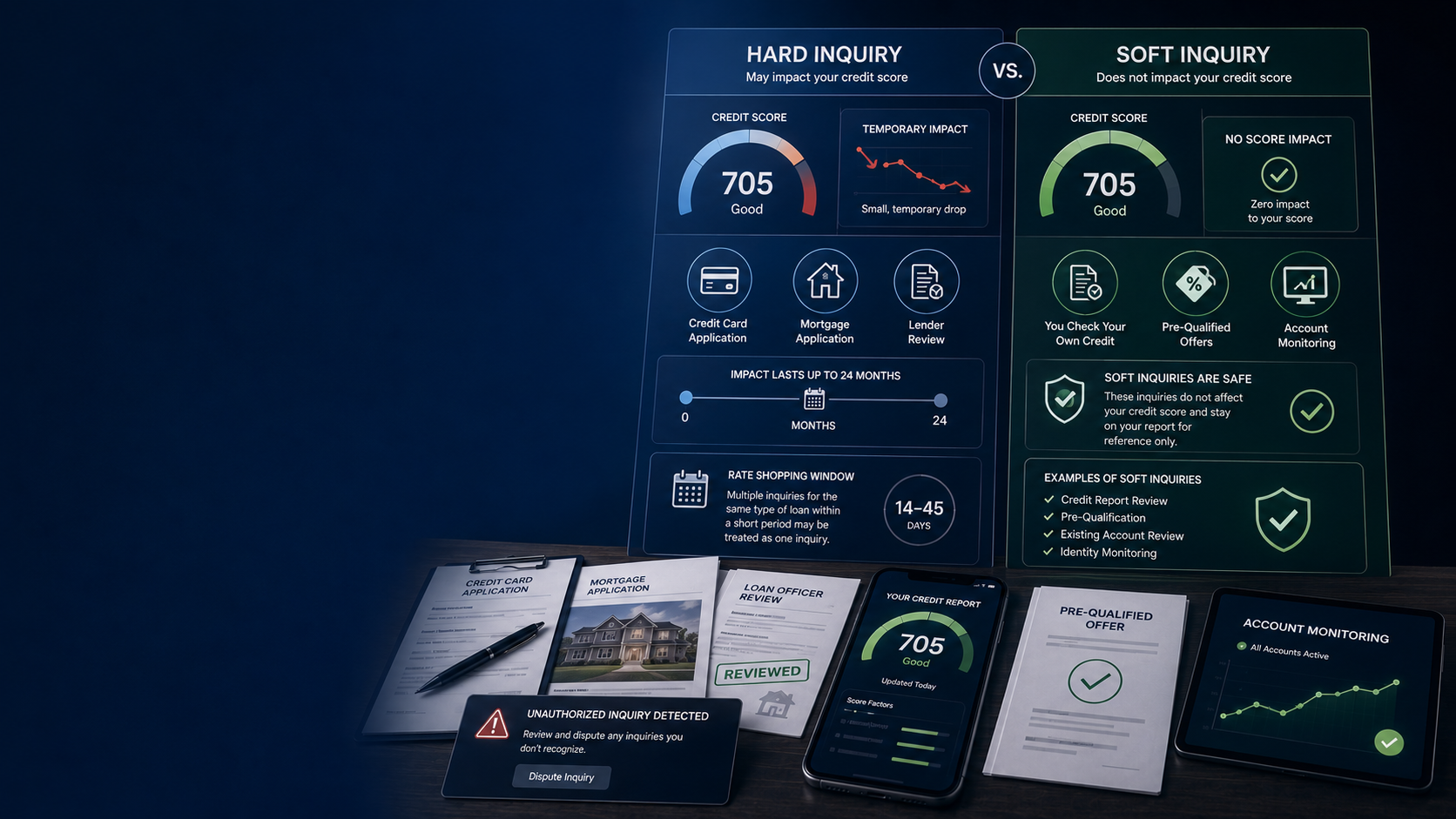
A hard inquiry (also called a hard pull) is a credit check that happens when you apply for new credit — a credit card, a mortgage, an auto loan, a personal loan, a student loan refinance, and sometimes things like a new cell phone contract or an apartment rental application. The defining feature is that you initiated it by applying for something, and you gave the lender explicit permission to review your credit as part of that application.
Here’s what you need to know about hard inquiries:
They require your permission
A lender cannot perform a hard pull on your credit without your authorization. When you apply for a credit card online and click “Submit,” buried in the terms you’re agreeing to is language granting the issuer permission to access your credit report. Same with a mortgage application — you sign a form authorizing the lender to pull your credit. If a hard inquiry appears on your report and you never applied for anything, that’s a problem worth disputing (more on that later).
They show up on your report for two years
A hard inquiry stays on your credit report for 24 months from the date it was made. That means anyone who pulls your report during that window — including you and any prospective lender — can see that inquiry listed, along with the name of the company that made it and the date.
They only affect your score for 12 months
This is the part most people get wrong. While the inquiry is visible on your report for two years, it only factors into your credit score for the first 12 months. After one year, the inquiry stops affecting your FICO and VantageScore numbers — even though it’s still printed on the report. After 24 months, it falls off entirely.
Typical point impact: small
A single hard inquiry typically lowers your credit score by 1 to 5 points. That’s it. For most people, the drop is barely noticeable and recovers within a few months of on-time payments. We’ll dig into the specifics — and debunk the “each inquiry costs 10 points” myth — in its own section below.
Who can see them
Hard inquiries appear on the version of your credit report that lenders see when you apply for new credit. They do not appear on the version used for marketing pre-screened offers (more on that when we get to soft inquiries). You can also see them on your own consumer disclosure.
Why they affect your score at all
The logic is straightforward: research shows that people who have recently applied for multiple new credit accounts are statistically more likely to fall behind on payments than people who haven’t. A hard inquiry is the credit system’s way of noting “this person just asked someone for credit.” One inquiry is barely a blip. A stack of them in a short window is a different story — and we’ll cover that in the red-flag section.
The key takeaway: A hard inquiry is the cost of applying for credit. It’s small, it’s temporary, and for the vast majority of people, it’s nothing to worry about.
Soft Inquiries: The Basics
A soft inquiry (or soft pull) is a credit check that happens without you applying for new credit. The check still gets logged, but it doesn’t carry the scoring implications of a hard pull — and critically, it doesn’t show up on the version of your report that lenders see.
Soft inquiries happen more often than most people realize. Here’s what you should know:
They do not affect your credit score
This is the big one. A soft inquiry has zero impact on your credit score. Not a point, not a fraction of a point. Zero. You can check your own credit every single day and your score will not move because of it. This is why the myth “checking your credit hurts your score” is so damaging — it discourages people from doing exactly the thing they should be doing.
Only you can see them
Soft inquiries appear only on the version of your credit report that you see — your consumer disclosure. They do not appear on the report a lender sees when you apply for credit. So a lender reviewing your application has no idea how many times you’ve checked your own credit, how many pre-approval offers you’ve been screened for, or whether your existing creditors have been monitoring your account.
Common examples of soft inquiries
- Checking your own credit — through AnnualCreditReport.com, your bank’s free credit monitoring, Credit Karma, Experian’s free app, or any similar service.
- Pre-approval and pre-qualified offers — when a credit card company or lender screens your credit to decide whether to send you a promotional offer in the mail.
- Existing creditor account reviews — your current credit card issuer or lender periodically checking in on your credit to see how you’re managing your overall debt load. This is routine and called “account review.”
- Employer background checks — when a prospective employer checks your credit as part of a hiring decision (this requires your written permission under the FCRA, but it’s still a soft pull and doesn’t affect your score).
- Insurance underwriting — when an insurer checks your credit to set your premium.
- Utility and telecommunications checks — sometimes these are soft, sometimes hard (we’ll explain in the triggers section).
Why they exist at all
Soft inquiries serve two purposes. One, they let you monitor your own credit without penalty — which is good for consumers and encouraged by the FCRA. Two, they let lenders and other businesses screen large pools of consumers for marketing offers without dinging everyone’s credit. If every pre-screened mailing list check were a hard pull, no one’s credit would survive a single month of junk mail.
The key takeaway: Soft inquiries are invisible to lenders and harmless to your score. They’re the credit system’s way of saying “this one is just for information, not for a decision about new credit.”
Hard vs. Soft Inquiries: The Comparison Table
Here’s a side-by-side breakdown on every dimension that matters. Bookmark this — it answers about 90% of the questions people have about inquiries.
| Dimension | Hard Inquiry | Soft Inquiry |
|---|---|---|
| What triggers it | You apply for new credit (card, mortgage, auto loan, personal loan, etc.) | You check your own credit; a lender screens you for a pre-qualified offer; an existing creditor reviews your account; an employer runs a background check |
| Requires your permission? | Yes — always tied to a credit application you initiated | No (with the exception of employer checks, which require written permission under the FCRA) |
| Affects your credit score? | Yes — typically 1–5 points per inquiry | No — zero impact, ever |
| How long it stays on your report | 24 months | Varies (often 12–24 months on your consumer disclosure, but irrelevant to scoring) |
| How long it factors into your score | 12 months | Never |
| Visible to lenders? | Yes — appears on the report lenders see when you apply for credit | No — appears only on the consumer version of your report that you see |
| Visible to you? | Yes — you can see it on your own report | Yes — you can see it on your own report |
| Can you dispute it? | Yes — if it was unauthorized or inaccurate | Generally no need (no score impact), but you can dispute factual errors |
| Example | You apply for a Chase Sapphire card; Chase pulls your credit | You log into Credit Karma to check your score; Credit Karma does a soft pull |
| Effect on rate shopping | Multiple inquiries for the same loan type within the rate-shopping window count as one | N/A — soft pulls don’t affect scoring |
| Cost to you | Small and temporary | None |
That table is the single most useful thing to internalize. If you only remember one thing, remember this: if you didn’t apply for credit, it’s almost certainly a soft pull, and it can’t hurt your score.
Common Hard Inquiry Triggers
Hard inquiries are triggered specifically when you apply for new credit or, in some cases, when you sign up for a service where the provider checks your credit to assess risk. Here’s the full list of common triggers:
1. Credit card applications
Every time you apply for a new credit card — whether it’s a rewards card, a balance transfer card, a secured card, or a store card at the checkout counter — the issuer does a hard pull on at least one bureau (sometimes two, occasionally all three). This is the most common hard inquiry trigger, by far.
2. Mortgage applications
When you apply for a home loan, the lender pulls your credit from all three bureaus. That’s three inquiries right there — but as we’ll explain in the rate-shopping section, they’re typically treated as a single inquiry for scoring purposes if you’re shopping for a mortgage within a window.
3. Auto loan applications
Whether you’re financing through the dealership or applying directly with a bank or credit union, an auto loan application triggers a hard pull. Dealers may shop your application to multiple lenders, which can result in multiple inquiries — again, the rate-shopping window is designed to protect you here.
4. Personal loan applications
Personal loans from banks, credit unions, or online lenders (SoFi, Upstart, LendingClub, Marcus, etc.) all require a hard pull as part of the application. Some lenders offer a pre-qualification step that uses a soft pull first — we’ll cover that distinction in the pre-qualified vs. pre-approved section.
5. Student loan refinancing
Refinancing federal or private student loans through companies like SoFi, Earnest, or Laurel Road involves a hard credit pull at the formal application stage.
6. Requesting a credit limit increase
This one catches people off guard. Some credit card issuers do a hard pull when you request a credit limit increase, while others use a soft pull. The policy varies by issuer and sometimes by card product. If you’re going to request a limit increase, it’s worth checking the issuer’s policy first — or asking the rep directly whether it will be a hard or soft pull before you proceed.
7. New utility or cell phone contracts (sometimes)
Here’s where it gets nuanced. Some utility companies (electric, gas, water) and cell phone providers do a hard credit check when you open a new account; others use a soft check or no check at all. It depends on the provider and the state. If you’re asked for your Social Security number on a utility application, there’s a decent chance a credit check is coming — ask whether it will be hard or soft.
8. Apartment rental applications (sometimes)
Many landlords and property management companies run credit checks as part of a rental application. Some use a hard pull; some use a soft pull. The trend in recent years has been toward soft pulls or specialized tenant-screening reports that don’t ding your score, but hard pulls still happen. Read the application language carefully.
9. Opening a bank account (sometimes)
Some banks and credit unions do a hard pull (often through ChexSystems or one of the bureaus) when you open a checking account, especially if you’re requesting overdraft protection. Many use a soft pull or no pull. Again — ask first.
The common thread: if the check is tied to you asking someone to extend you credit, credit-like risk, or a financial relationship where they’re evaluating whether to trust you with their money or service, it’s likely a hard pull. When in doubt, ask the company directly: “Will this credit check be a hard or soft pull?” It’s a fair question, and most companies will tell you.
Common Soft Inquiry Triggers
Soft inquiries happen quietly, often without you realizing it. Here’s where they come from:
1. Checking your own credit
This is the most important one to understand. Any time you check your own credit — through AnnualCreditReport.com, your bank’s free credit score feature, Credit Karma, Experian Boost, myFICO, or any similar service — it’s a soft pull. It does not affect your score. You can do it daily if you want. (You won’t, but you could.)
2. Credit Karma and similar monitoring services
Services like Credit Karma, Credit Sesame, Experian’s free monitoring, and your bank’s built-in credit score feature all use soft pulls. The bureaus know you’re checking your own credit, and they treat it accordingly — no score impact, no lender visibility.
3. Pre-qualified and pre-approval screenings
When a credit card company or lender sends you a “You’re pre-qualified!” offer in the mail, they got your name by screening your credit with a soft pull. This is called a “pre-screen” under the Fair Credit Reporting Act, and it doesn’t touch your score. Same for online pre-qualification tools — you put in some basic info, the lender does a soft pull to see if you’d likely qualify, and they show you offers. None of that costs you points.
4. Account monitoring by existing creditors
If you already have a credit card with, say, Capital One, Capital One will periodically check your credit — not because you applied for anything, but to monitor the overall health of your credit profile. They want to know if you’ve taken on a bunch of new debt elsewhere, which might affect your ability to pay them. This is called an account review inquiry, and it’s always a soft pull.
5. Insurance underwriting
When an auto or homeowners insurance company checks your credit to set your premium (in states where this is allowed), it’s typically a soft pull. Insurance credit checks don’t behave like lender credit checks.
6. Employer background checks
When a prospective employer runs a credit check as part of a hiring decision — common in financial services, government, and positions involving fiduciary responsibility — it’s a soft pull. It requires your written permission under the FCRA, but it doesn’t affect your score. And no, the employer doesn’t see your score — they see a modified version of your credit report.
7. Soft pulls by debt collectors (in some cases)
Some debt collectors use soft pulls to locate consumers or monitor their financial situation. This is regulated and doesn’t affect your score.
The big-picture takeaway: soft inquiries are the credit system’s background noise. They’re everywhere, they’re harmless, and they exist to let you and certain businesses stay informed without penalizing you.
The Rate-Shopping Window Explained
This is one of the most important — and most misunderstood — features of how credit scoring handles inquiries. If you’re shopping for a mortgage, auto loan, or student loan refinance, pay close attention.
The problem the rate-shopping window solves
Without any protection, shopping for the best mortgage rate would be financially punishing. Lender A pulls your credit. Lender B pulls your credit. Lender C pulls your credit. The dealer shops your auto application to five different banks. Suddenly you have six or seven hard inquiries on your report, and your score tanks — even though you only ever intended to take out one loan.
That’s clearly unfair, and the credit scoring models recognize it. The solution is the rate-shopping window.
How it works
When you apply for the same type of loan — a mortgage, an auto loan, or a student loan — from multiple lenders within a specific time window, the FICO and VantageScore models treat those inquiries as a single inquiry for scoring purposes. The logic is that you’re rate-shopping, not actually trying to open seven separate mortgages.
Here are the specifics:
- FICO’s window: 14 to 45 days, depending on which version of the FICO model is being used. Older FICO models use a 14-day window. Newer FICO models (FICO 8, FICO 9, FICO 10) use a 45-day window. To be safe, do your rate shopping within 14 days — that way you’re covered regardless of which FICO version the lender uses.
- VantageScore’s window: 14 days. VantageScore 3.0 and 4.0 both use a 14-day window across all loan types.
- Which loan types qualify: Mortgages, auto loans, and student loans. Credit cards and personal loans are NOT covered. Each credit card application is its own inquiry, period.
- Same loan type only: The window applies when you’re shopping for one specific type of loan. If you apply for a mortgage and an auto loan in the same week, those are two separate inquiries — they don’t get bundled together.
What this means in practice
If you’re buying a car and you want to compare rates from three banks, a credit union, and the dealership’s financing arm, do it within a 14-day window. All those auto loan inquiries will count as one inquiry for scoring purposes. You’ll still see each individual inquiry listed on your credit report (they don’t disappear from view), but the scoring math treats them as one.
Same with a mortgage — get your quotes from multiple lenders within 14 days, and the scoring impact is the same as if you’d only applied to one.
Important caveats
- The inquiries still show up on your report individually. A lender who manually reviews your report will see that you applied to five auto lenders. But the scoring models, which most lenders rely on for automated decisions, treat them as one.
- Some older FICO models don’t recognize the 45-day window and stick with 14 days. Stick to 14 days when possible.
- The rate-shopping window does NOT apply to credit cards. Apply for five credit cards in a week and you’ll have five separate hard inquiries on your report, each one counting toward your score.
- The window applies to the same type of loan. Mixing auto and mortgage applications in the same window doesn’t bundle them.
The smart move
If you know you’re going to be shopping for a mortgage or auto loan, do your research first — identify 3–5 lenders you want to compare — and then submit all the applications within a focused 14-day period. That maximizes the rate-shopping protection and minimizes the scoring impact. Spreading applications out over a month or two defeats the purpose.
How Many Points Does a Hard Inquiry Really Cost?
This is the question we hear more than any other. And the answer, in most cases, is reassuringly small.
The typical range: 1 to 5 points
For most people, a single hard inquiry lowers your credit score by 1 to 5 points. The exact number depends on your overall credit profile — someone with a long, flawless credit history may see no measurable change at all, while someone with a thin or weaker file may see a slightly larger dip. But the range is narrow, and it’s almost always on the lower end.
Why the impact is so small
Inquiries make up only about 10% of your FICO score. The much bigger factors are payment history (35%), amounts owed / credit utilization (30%), and length of credit history (15%). A single inquiry is a small fraction of a small fraction of your score. It’s not nothing, but it’s nowhere near the catastrophe many people imagine.
The recovery timeline
Here’s the good news: your score typically recovers from a single hard inquiry within about 6 to 12 months, assuming you continue making on-time payments and don’t take on significant new debt. After 12 months, the inquiry stops affecting your score entirely, even though it remains visible on your report for the full 24 months.
Busting the “10 points per inquiry” myth
You’ll sometimes see people online claiming that each hard inquiry costs 10 points (or more), and that a few applications can wreck your score. That’s not how it works. The scoring models don’t deduct a fixed number of points per inquiry — they evaluate the pattern of inquiries as part of a broader risk assessment. One or two inquiries on an otherwise healthy profile are a rounding error. The models get concerned when the pattern signals distress (see the next section).
When the impact can be larger
There are a few situations where a hard inquiry can cost more than the typical 1–5 points:
- You have a thin credit file. If you have only one or two accounts and a short history, a new inquiry represents a larger proportional change to your profile, and the scoring impact can be more noticeable.
- You already have several recent inquiries. The marginal impact of each additional inquiry can grow as the pattern starts to look riskier.
- You’re right on a scoring threshold. If you’re sitting at, say, 679 (top of the “Fair” range) and a hard inquiry drops you to 674, that 5-point swing can feel bigger because you’ve crossed a category boundary — even though the underlying score change is small.
The bottom line
For the vast majority of people, a single hard inquiry is a minor, temporary dip — not a financial emergency. Don’t avoid applying for a credit card you genuinely want or need because you’re worried about a 3-point drop. Apply strategically, understand the trade-off, and focus on the bigger factors that actually move your score: paying on time and keeping utilization low.
When Hard Inquiries Become a Red Flag
So far we’ve established that individual hard inquiries are no big deal. But there’s a point where the pattern of inquiries starts telling a story that lenders don’t like.
What the scoring models are looking for
Credit scoring models don’t just count inquiries — they look for patterns that statistically correlate with elevated risk of default. The pattern that worries them most is multiple inquiries in a short period of time. When someone applies for six credit cards in two months, the models interpret that as potential financial distress — someone scrambling for credit because they’re running low on cash, or someone about to take on a pile of new debt all at once.
How many is “too many”?
There’s no hard, published threshold, because the models consider your overall profile, not just the inquiry count. But as a general guideline:
- 1–2 inquiries in the past 12 months: Completely normal. Not a concern.
- 3–5 inquiries in the past 12 months: Starting to look active. May raise an eyebrow with some lenders, especially for new credit card applications, but usually not a dealbreaker if the rest of your profile is strong.
- 6+ inquiries in the past 12 months: This is where lenders get genuinely nervous. It suggests you’re either in financial distress or aggressively seeking new credit, both of which elevate risk.
- Multiple inquiries across different loan types in a short window: This can look worse than multiple inquiries for the same loan type (which, as we discussed, are bundled by the rate-shopping window).
The “credit-seeking” signal
Lenders have their own internal risk models on top of the standard FICO/VantageScore. Some banks will decline a new credit card application based on “too many recent inquiries” even if your score is still in the 700s. This is sometimes called the “velocity” rule — they don’t like seeing a high rate of new credit applications, regardless of the absolute score.
What to do if you already have several inquiries
If you’ve accumulated more inquiries than you’d like:
- Stop applying for new credit for a while. The 12-month scoring window is your friend. Each inquiry that crosses the one-year mark stops affecting your score.
- Focus on the bigger factors. On-time payments and low utilization matter far more than inquiries. A strong payment history will carry you through a period of elevated inquiry activity.
- Let time pass. Inquiries age out. In 12 months, they’re scoring-neutral. In 24 months, they’re gone entirely.
- Check your reports for unauthorized inquiries. Sometimes inquiries appear that you didn’t initiate. We’ll cover how to handle that next.
Can You Remove Hard Inquiries?
This is a question that gets asked constantly, and the honest answer is: only if the inquiry is unauthorized, inaccurate, or the result of identity theft. You cannot have a legitimate hard inquiry removed early just because you don’t like it being on your report.
When removal is possible
A hard inquiry can be disputed and removed from your credit report if any of the following are true:
- You never authorized it. If an inquiry appears from a company you never applied to, it may be the result of identity theft or an error by the lender.
- It’s a duplicate. Sometimes the same inquiry gets recorded twice due to a processing error. The duplicate can be removed.
- It’s older than 24 months. Inquiries should fall off automatically after two years, but if one lingers, you can dispute it.
- The lender’s name or the date is wrong. Factual errors in the inquiry listing can be corrected or removed.
When removal is NOT possible
If you applied for a credit card, got approved or denied, and a hard inquiry was logged — that inquiry is legitimate and it stays on your report for the full 24 months (12 months for scoring purposes). You cannot pay to have it removed, and no credit repair company can legitimately remove it early. Anyone who promises to remove a legitimate hard inquiry for a fee is either scamming you or planning to dispute it fraudulently (which can backfire).
How to dispute an unauthorized hard inquiry
If you spot a hard inquiry on your report that you didn’t authorize, here’s the process:
- Pull all three credit reports. Go to AnnualCreditReport.com — you’re entitled to a free copy of each bureau’s report every week under current federal rules. Review all three, because an inquiry may appear on one bureau’s report but not the others.
- Identify the unauthorized inquiry. Note the lender name, the date, and which bureau(s) it appears on.
- File a dispute with the bureau. Each bureau (Equifax, Experian, TransUnion) has an online dispute process. You can also dispute by mail or phone. State clearly that you did not authorize the inquiry and that you’re requesting its removal.
- File a dispute with the lender. Contact the company that made the inquiry directly. They are required under the FCRA to investigate. If they can’t produce proof that you authorized the pull, they must request that the bureau remove it.
- Consider a fraud alert or credit freeze. If the unauthorized inquiry is part of a pattern of identity theft — multiple inquiries you didn’t initiate, accounts you didn’t open — place a fraud alert with one of the bureaus (it will notify the other two), or place a credit freeze on all three reports to prevent new hard pulls.
- File an identity theft report. If identity theft is involved, file a report with the FTC at IdentityTheft.gov and with your local police department. This creates a paper trail that supports your disputes.
- Follow up. Bureaus typically have 30 days to investigate disputes. If the inquiry isn’t removed and you have evidence it was unauthorized, you can escalate — including filing a complaint with the Consumer Financial Protection Bureau (CFPB).
What a reputable credit repair firm does
This is where our work comes in. A legitimate, FCRA-compliant credit repair firm — and we count ourselves in that category — will:
- Pull all three bureau reports and identify every unauthorized, duplicate, or factually incorrect inquiry.
- File formal disputes with each bureau and follow up persistently.
- Work directly with the furnishing lender when necessary.
- Help you place fraud alerts or freezes if identity theft is involved.
- Never promise to remove legitimate inquiries, and never charge upfront fees for work not yet done.
If you’re seeing inquiries on your reports that you don’t recognize, that’s exactly the kind of thing a is designed to surface.
Pre-Qualified vs. Pre-Approved: What’s the Real Difference?
These two terms get thrown around almost interchangeably in credit card mailers and online lending offers, but there’s a meaningful distinction — and it ties directly back to the hard vs. soft inquiry distinction.
“Pre-Qualified” — a soft pull, a preliminary screen
When you see “You’re pre-qualified for this card” in your mail or in an online lender’s tool, it means the lender has done a soft pull on your credit (or purchased a pre-screened mailing list from a bureau using soft-pull criteria) and determined that you meet some basic initial eligibility requirements. This is a light screen — they’ve looked at broad factors and decided you’re in the ballpark.
Crucially, a pre-qualified offer does NOT guarantee approval. When you actually submit the application, the lender will do a hard pull and review your full credit profile. You can still be denied at that stage.
Pre-qualification tools — like the ones on Capital One’s, Discover’s, or American Express’s websites — typically use a soft pull to show you offers you’d likely qualify for. Using them costs you nothing in score points. It’s a smart first step before formally applying.
“Pre-Approved” — a stronger soft-pull screen, still not a guarantee
“Pre-approved” sounds more definitive, and it usually does represent a stronger initial screen than pre-qualified — the lender has done a more detailed soft-pull review and determined you meet more of their underwriting criteria. Some lenders use the term “pre-approved” to signal a higher likelihood of final approval.
But — and this is important — “pre-approved” is still not a guarantee. The formal application still triggers a hard pull, and the lender can still decline you based on the full review. The language used in these offers is carefully hedged for legal reasons; the firm offer of credit you receive in a pre-screened mailing is conditional on your credit profile not having materially changed since the screening.
What this means for you
- Use pre-qualification and pre-approval tools before formally applying. They’re free, they’re soft pulls, and they give you a real sense of your approval odds before you take the hard-inquiry hit.
- Don’t treat either as a guarantee. You can still be denied after a formal application. The only way to know for sure is to submit the application and let the lender do the hard pull.
- A pre-qualified or pre-approved offer in the mail does not affect your score. The screening was a soft pull. Throwing the offer away or acting on it later doesn’t change that.
- Responding to the offer by formally applying does trigger a hard pull. The pre-screen was soft; the application is hard. That’s the trade-off.
A note on “firm offers of credit”
Under the FCRA, when a lender uses a bureau’s pre-screening service to send you a pre-approved offer, they’re making what’s called a firm offer of credit. If you respond to the offer and your credit hasn’t materially changed, they’re generally obligated to extend the credit — though there are exceptions. This is a consumer protection built into the law. If you’re ever denied after responding to a firm offer, you have the right to ask why and to request the specific reasons.
How to Minimize Inquiries When Shopping for a Loan
If you’re planning to apply for a mortgage, auto loan, or personal loan, here’s how to keep your inquiry impact as small as possible:
1. Use pre-qualification tools first
Many lenders — especially for credit cards, personal loans, and auto loans — offer pre-qualification tools on their websites that use a soft pull. Use them. They’ll tell you whether you’re likely to qualify before you commit to a formal application. This lets you skip lenders who would probably deny you, saving the hard inquiries for lenders where your odds are real.
2. Cluster your rate shopping in a 14-day window
For mortgages, auto loans, and student loan refinancing, the rate-shopping window treats multiple inquiries for the same loan type as one — but only within the window. Do your homework first (identify your target lenders, gather your documents), then submit applications within a tight 14-day period to maximize the protection. Don’t spread them across two months.
3. Don’t apply for credit cards while shopping for a loan
A common mistake: someone is mortgage shopping and, in the middle of it, applies for a new rewards credit card or finances new furniture for the house they’re about to buy. That’s a separate hard inquiry outside the rate-shopping window for the mortgage, and worse, the new credit account changes your utilization and credit age — which can spook a mortgage underwriter. While a major loan is in underwriting, freeze your new credit applications entirely.
4. Ask before you apply
If you’re not sure whether a credit check will be hard or soft, ask. “Will opening this account trigger a hard or soft credit pull?” is a reasonable question that any reputable company should answer before you commit. This is especially relevant for utilities, cell phone contracts, bank accounts, and rental applications.
5. Space out credit card applications
Credit card inquiries don’t get bundled by the rate-shopping window, so each one counts. If you’re building a portfolio of cards (for rewards, for example), space applications out — generally at least 6 months between credit card applications is a sensible rule of thumb for most people, and many “chase” enthusiasts follow stricter guidelines.
6. Be cautious with “apply now” buttons
Online marketplaces — credit card comparison sites, lending marketplaces, rate-comparison tools — sometimes pass your information to multiple lenders, each of which may do a hard pull. Read the language carefully. Reputable comparison tools will tell you whether clicking through results in a hard or soft pull, and they’ll use soft pulls for the initial comparison stage.
7. Monitor your reports
Pull your reports from all three bureaus regularly (you can do this for free every week at AnnualCreditReport.com). Verify that every hard inquiry on there is one you authorized. If something looks wrong, dispute it immediately.
Do Inquiries Matter If You’re Rebuilding Credit?
If you’re working to rebuild a damaged credit profile, your relationship to inquiries is a little different. Here’s how to think about it.
Inquiries still matter — but less than you might think
The scoring models don’t treat someone rebuilding credit dramatically differently than someone with a strong profile when it comes to inquiries. A single hard inquiry still costs roughly 1–5 points, and it still stops affecting your score after 12 months. What changes is context — your score is already lower, so a 5-point drop represents a larger proportion of your available scoring headroom, and it can feel more significant.
The bigger factors are still bigger
If you’re rebuilding, the factors that move your score the most are still payment history (35% of FICO) and credit utilization (30%). A single missed payment costs you vastly more than a dozen hard inquiries. A maxed-out credit card costs you more than every hard inquiry on your report combined. If you’re choosing where to focus your energy, focus on on-time payments and paying down balances — not on avoiding every possible inquiry.
But be strategic about new applications
When you’re rebuilding, you should be more cautious about applying for new credit — not because of the inquiry itself, but because of what the application represents. Each new application is a chance to be denied (which doesn’t directly hurt your score, but wastes the inquiry), and each new credit account you open changes your credit age and utilization calculations. Be intentional. Apply only for credit you have a realistic chance of being approved for and a clear plan to manage well.
Tools for rebuilding credit
If you’re rebuilding, your best tools are:
- A secured credit card — a card backed by a refundable deposit, designed for people rebuilding credit. Use it for small purchases, pay it in full each month, and let the on-time payment history build your score.
- A credit-builder loan — offered by many credit unions and some online lenders, these hold the loan proceeds in a savings account while you make payments, building payment history without the risk of running up debt.
- Authorized user status — being added as an authorized user on a trusted family member’s long-standing, well-managed credit card can import their positive payment history onto your report.
- Consistent on-time payments — every single month, on every single account. This is the single most powerful thing you can do.
Don’t let inquiry anxiety stop you from building
One mistake we see sometimes: people who are rebuilding become so afraid of hard inquiries that they never apply for the credit-building tools they need. A secured card requires a hard pull. A credit-builder loan may require a hard pull. If you refuse every hard pull, you also refuse every opportunity to build the payment history that will actually help you. The smart play is to apply for the right tools strategically — one or two well-chosen applications — and then focus on the behavior that actually builds the score.
How a credit repair firm fits in
If you’re rebuilding and you have negative marks on your reports — late payments, collections, charge-offs, inaccuracies — a reputable credit repair firm can help you address those underlying issues, which will have a far larger impact on your score than worrying about inquiries. The inquiry question is small potatoes next to the question of “is everything on my report accurate and verifiable?”
Common Myths About Credit Inquiries — Busted
There’s a lot of bad information out there about credit inquiries. Let’s take down the most common myths one by one.
Myth 1: “Checking your own credit hurts your score.”
False. Checking your own credit is always a soft pull, and soft pulls have zero impact on your score. You can check your credit every day and your score won’t move because of it. In fact, regularly monitoring your credit is one of the smartest financial habits you can develop — it helps you catch errors, fraud, and unauthorized inquiries early. Please, check your own credit. Often.
Myth 2: “Each hard inquiry costs you 10 points.”
False. There is no fixed per-inquiry point deduction. A single hard inquiry typically costs 1–5 points, and the exact impact depends on your overall credit profile. The scoring models evaluate the pattern of inquiries, not a per-inquiry tariff. Ten points per inquiry is a myth that vastly overstates the reality.
Myth 3: “All inquiries stay on your report for 7 years.”
False. Hard inquiries stay on your report for 24 months and affect your score for only 12 months. Negative account information (late payments, collections, charge-offs) can stay for 7 years — and that’s probably where this myth comes from. But inquiries are a different category with a much shorter lifespan.
Myth 4: “Credit Karma lowers your score.”
False. Credit Karma uses soft pulls to show you your score and report. It cannot lower your score. What can confuse people is that Credit Karma shows VantageScore 3.0 scores, which may differ from the FICO scores a lender uses — so the number you see on Credit Karma might not match what a mortgage lender pulls. But that’s a scoring model difference, not a score impact from checking.
Myth 5: “Pre-qualified offers hurt your credit.”
False. The pre-screening that generates pre-qualified offers is a soft pull. Receiving a stack of pre-qualified credit card offers in the mail does not affect your score at all. Only when you formally apply does a hard pull occur.
Myth 6: “A credit repair company can remove any hard inquiry.”
False — and anyone who promises this is either scamming you or planning to file fraudulent disputes. Only unauthorized, inaccurate, or duplicate inquiries can be removed. A legitimate hard inquiry that resulted from an application you submitted stays on your report for the full 24 months. No legitimate credit repair firm will promise to remove it.
Myth 7: “Rate shopping always hurts your score.”
False. The rate-shopping window is specifically designed to protect you when shopping for a mortgage, auto loan, or student loan. If you cluster your applications within a 14-day window, the inquiries count as one for scoring purposes. Shop confidently for the best rate — that’s the smart financial move.
Myth 8: “Inquiries are the biggest factor in your credit score.”
False. Inquiries make up about 10% of your FICO score. Payment history (35%) and credit utilization (30%) dwarf inquiries in importance. If you want to improve your score, focus on paying on time and keeping your credit card balances low relative to your limits. Obsessing over inquiries while missing payments is putting your energy in exactly the wrong place.
Myth 9: “You should avoid all hard inquiries.”
False. Applying for credit is a normal, healthy part of building a credit profile. Without hard inquiries, you’d never open new accounts, and your credit file would stay thin. The goal isn’t to avoid inquiries entirely — it’s to apply strategically, only when you have a real need and a reasonable chance of approval.
Myth 10: “Soft inquiries show up to lenders and make you look desperate for credit.”
False. Soft inquiries appear only on the consumer version of your report — the one you see. Lenders do not see them. A lender reviewing your credit application has no idea how many times you’ve checked your own credit, how many pre-qualified offers you’ve been screened for, or whether your existing creditors have been reviewing your account. Those are all invisible to them.
Frequently Asked Questions
1. How long does a hard inquiry stay on my credit report?
A hard inquiry stays on your credit report for 24 months from the date it was made. However, it only factors into your credit score for the first 12 months. After one year, the inquiry stops affecting your score; after two years, it falls off your report entirely.
2. Does checking my own credit lower my score?
No. Checking your own credit is always a soft pull, and soft pulls have zero impact on your credit score. You can check your credit as often as you like — through AnnualCreditReport.com, Credit Karma, your bank’s credit monitoring, or any similar service — without affecting your score.
3. How many points does a hard inquiry cost?
A single hard inquiry typically lowers your credit score by 1 to 5 points. The exact impact depends on your overall credit profile. The drop is usually small and temporary, with most scores recovering within 6 to 12 months as long as you keep making on-time payments.
4. If I apply for five auto loans in two weeks, does that hurt my score five times?
No. Thanks to the rate-shopping window, multiple inquiries for the same type of loan (auto, mortgage, or student loan) within a 14-day period are treated as a single inquiry for scoring purposes. The individual inquiries will still appear on your report, but the scoring math counts them as one. Note: this protection does NOT apply to credit cards — each credit card application is its own inquiry.
5. Can I remove a hard inquiry from my credit report?
Only if the inquiry is unauthorized, inaccurate, a duplicate, or older than 24 months. If you didn’t apply for credit with the company listed, you can dispute the inquiry with the credit bureau and the lender. Legitimate inquiries — ones that resulted from applications you actually submitted — cannot be removed early and will remain on your report for the full 24 months.
6. What’s the difference between pre-qualified and pre-approved?
Both are based on a soft pull and neither affects your credit score. “Pre-qualified” generally means the lender did a basic screen and you appear to meet initial criteria. “Pre-approved” typically means a more thorough screen and a stronger likelihood of approval. Neither is a guarantee. When you formally apply, the lender does a hard pull, and you can still be denied.
7. Will requesting a credit limit increase hurt my score?
It depends on the issuer. Some credit card companies do a hard pull when you request a limit increase; others use a soft pull. Before requesting an increase, ask the issuer’s customer service whether it will be a hard or soft inquiry. If it’s a hard pull and you’re worried about the small score impact, you can decline to proceed.
8. What should I do if I see a hard inquiry I don’t recognize?
Dispute it. Pull all three credit reports from AnnualCreditReport.com, identify the unauthorized inquiry, and file a dispute with the bureau(s) showing it. Also contact the company that made the inquiry directly — under the FCRA, they must investigate and provide proof you authorized the pull. If you suspect identity theft (multiple unauthorized inquiries, accounts you didn’t open), place a fraud alert with one bureau, consider a credit freeze, and file a report with the FTC at IdentityTheft.gov.
Take Control of Your Credit Inquiries
Here’s what we’ve covered, distilled to its essence:
- Hard inquiries happen when you apply for new credit. They cost about 1–5 points, stay on your report for 24 months, and affect your score for only 12 months. They’re a small, temporary cost of doing business with the credit system.
- Soft inquiries happen when you check your own credit, when lenders screen you for pre-qualified offers, when existing creditors monitor your account, or when an employer runs a background check. They have zero impact on your score and they’re invisible to lenders.
- The rate-shopping window protects you when you’re shopping for a mortgage, auto loan, or student loan — cluster your applications within 14 days and they count as one inquiry.
- Unauthorized inquiries can be disputed and removed, but legitimate ones cannot. Anyone who promises to remove a legitimate hard inquiry for a fee is not being honest with you.
- The biggest factors in your score are payment history and credit utilization, not inquiries. Focus your energy there.
- Checking your own credit is one of the smartest financial habits you can build. It does not hurt your score. Do it regularly.
If you’re seeing inquiries on your credit reports that you don’t recognize — or if you just want a clear-eyed look at everything that’s currently on your three bureau reports — that’s exactly what our is for. As part of the audit, we’ll review all three bureau reports, flag any unauthorized or suspicious inquiries, identify any inaccurate negative marks, and walk you through a customized plan to address what we find.
We’re a San Diego-based, FCRA-compliant, attorney-backed credit repair firm serving clients nationwide. We don’t make empty promises or sell quick fixes. We believe in transparency, legal compliance, and measurable progress — and we equip you with the knowledge to keep your credit strong long after the work is done.
Ready to see where you stand? today.
Leave a Reply