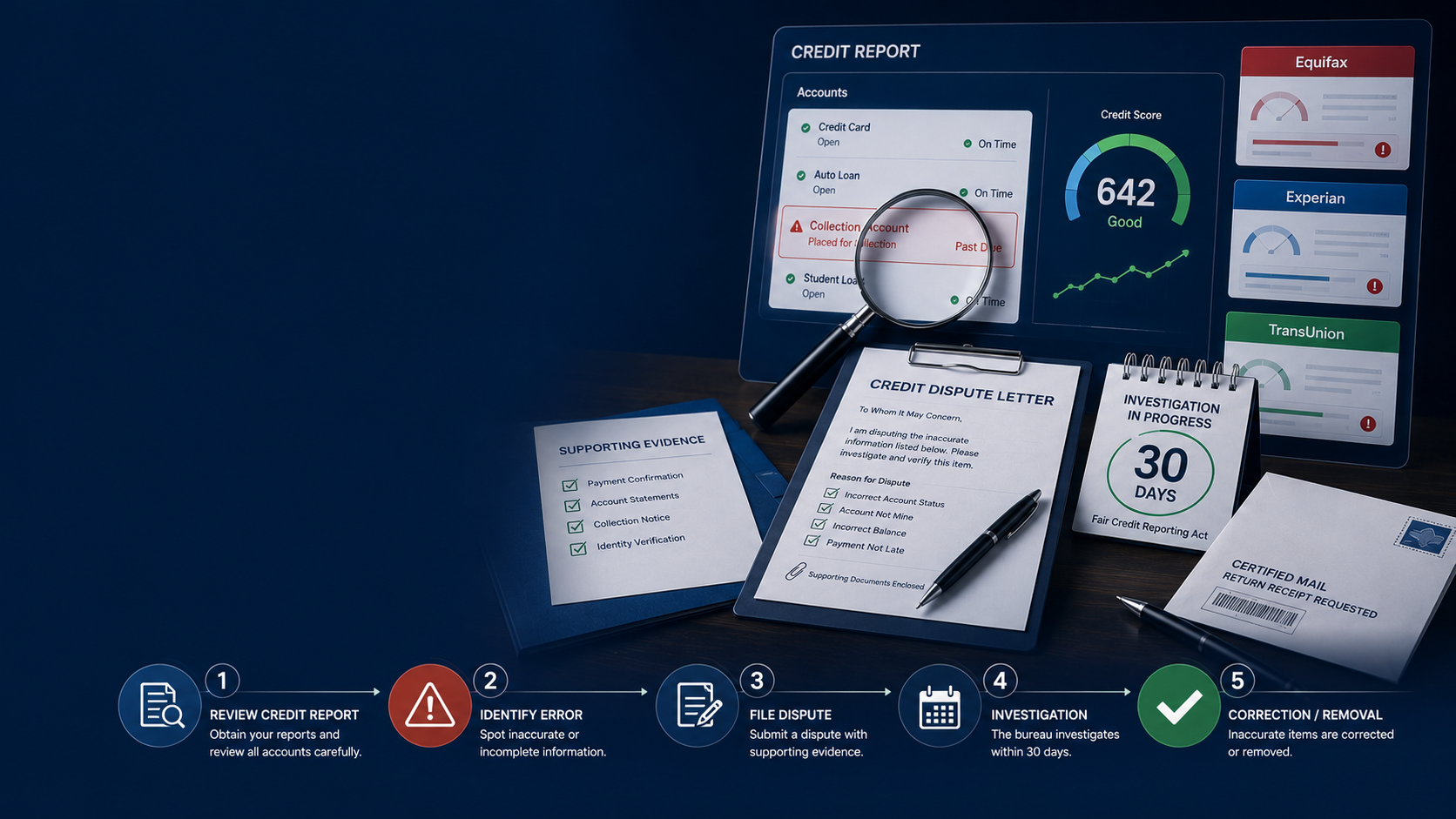
What a Credit Dispute Is — and Your Legal Right to File One
A credit dispute is a formal request you make to a credit reporting bureau (Equifax, Experian, or TransUnion) asking them to investigate and correct or remove information on your credit report that you believe is incorrect. When you file a dispute, the bureau is legally required to review the item, contact the company that reported it (the “furnisher”), and determine whether the information can be proven accurate. If it can’t, the bureau must remove or correct it.
This isn’t a favor the bureaus are doing for you. It’s a legal obligation under the Fair Credit Reporting Act (FCRA), a federal law originally passed in 1970 and updated several times since. The FCRA gives you, the consumer, a specific set of rights when it comes to the information credit bureaus collect and sell about you. These rights include:
- The right to see your credit report. You’re entitled to one free report from each bureau every 12 months at AnnualCreditReport.com — and since the pandemic, the three bureaus have made free weekly reports available indefinitely.
- The right to dispute inaccurate information. Under FCRA Section 611, you can dispute any item you believe is incorrect, incomplete, or unverifiable, and the bureau must investigate — usually within 30 days.
- The right to have inaccurate information removed. If an item cannot be verified, the bureau must delete it from your report, usually within 30 days of completing the investigation.
- The right to know who looked at your report. Anyone who pulls your credit report must have a “permissible purpose” under the FCRA, and you’re entitled to a record of who has accessed it.
- The right to seek damages. If a bureau or furnisher willfully violates the FCRA, you can sue them in federal court for actual damages, statutory damages, and in some cases punitive damages and attorney’s fees.
The key thing to understand is that the FCRA puts the burden of proof on the bureaus and the furnishers — not on you. You don’t have to prove the item is wrong. You only have to assert that you believe it’s wrong and state why. The bureau then has to go back to the furnisher and get proof that the information is accurate. If they can’t get that proof, or if they don’t respond within the legal timeframe, the item comes off.
This is a powerful right, and it’s one of the few places in the consumer financial system where the law is genuinely on your side. But it only works if you use it correctly.
Valid Reasons to Dispute an Item on Your Credit Report
Not every dispute is a valid dispute. The FCRA gives you the right to challenge information that is inaccurate, incomplete, unverifiable, or outdated — and there’s a specific category for information that simply isn’t yours. Let’s break down each of these.
1. Inaccurate information. This is the most common reason to file a credit dispute. Inaccurate means the information on your report doesn’t match what actually happened. Examples include:
- A payment reported as late when you paid on time (and have the bank statements to prove it).
- An account balance that’s wrong — say, a credit card showing $4,200 owed when you’ve paid it down to $800.
- A loan amount or original credit limit that’s incorrect.
- A payment history that shows missed payments in months you paid in full.
- An account status reported as “charged off” when you’ve since settled it or paid it in full.
2. Incomplete information. Sometimes an account is reported with missing context that makes it look worse than it is. Examples include:
- A settled account that doesn’t show as “settled” — it still looks like an open collection.
- A paid-off account still showing a balance.
- A credit card that doesn’t report its credit limit, which can make your utilization look artificially high.
- An account that was transferred or sold but only shows the original creditor’s entry as delinquent, without showing the transfer.
3. Unverifiable information. This is one of the most powerful grounds for a dispute, and it’s often misunderstood. “Unverifiable” means the bureau, when they investigate, cannot get the furnisher to confirm that the information is accurate. This can happen for several reasons:
- The original creditor has gone out of business or no longer has records of the account.
- The furnisher doesn’t respond to the bureau’s investigation request within the required timeframe.
- The furnisher’s records are incomplete or contradictory.
- A collection agency can’t produce documentation proving they own the debt or that you owe it.
You don’t have to know in advance that an item is unverifiable. You dispute it, the bureau investigates, and if the furnisher can’t back it up, the item gets removed. This is why it’s worth disputing older collection accounts — the documentation trail often doesn’t survive.
4. Outdated information. The FCRA sets strict time limits on how long negative information can stay on your report. Most negative items — late payments, collections, charge-offs, foreclosures, and settled accounts — must be removed after seven years. A Chapter 7 bankruptcy can stay for ten years. If an item has passed its reporting time limit and is still showing up, you have a clear right to have it removed.
A common outdated-information issue: a collection account that was sold and re-aged by a new collection agency, resetting the clock on the reporting period. That’s illegal. The seven-year clock starts from the original delinquency date with the original creditor — not from when a new collector bought the debt.
5. Not yours (identity theft or mixed file). Sometimes information shows up on your report that has nothing to do with you. This can happen because of identity theft (someone opened accounts in your name) or because of a “mixed file” — where the bureau has merged your credit file with someone else’s, often someone with a similar name or Social Security number. Mixed files are shockingly common, especially among family members with similar names (Jr. vs. Sr., for example).
If an account isn’t yours, dispute it immediately. For identity theft cases, you should also file a report with the Federal Trade Commission at IdentityTheft.gov and place a fraud alert or credit freeze with the bureaus.
What You Can’t Dispute Away (and Why Honesty Matters)
Here’s the part some credit repair companies won’t tell you, and it’s important: you cannot legally dispute accurate negative information that you legitimately owe. If you missed a payment, defaulted on a loan, or ran up a credit card and didn’t pay it, that negative mark has a right to be on your report for up to seven years — and no dispute letter, no matter how cleverly worded, is going to change that.
Filing a dispute on an item you know is accurate is not just ineffective — it can actively work against you. Here’s why:
- The bureau can flag your dispute as “frivolous.” Under FCRA Section 611, a bureau can refuse to investigate a dispute if they reasonably determine it’s frivolous or irrelevant. If you dispute every negative item on your report at once, with no specific reason, they’re likely to dismiss the whole batch — and that dismissal can make it harder to get legitimate disputes taken seriously later.
- You’re training the furnisher to verify. Every time you dispute an accurate item, the furnisher gets pinged and confirms it. Now they’ve got their records pulled and organized. When you (or a credit repair company) dispute it again later, they’ve already done the homework — they verify faster the second time.
- You may create a paper trail that hurts you. If you dispute something in writing and state “this is not my account” when it clearly is, that statement can come back to bite you in a lawsuit, a loan application, or any future proceeding where your credibility matters.
So what can you do about accurate negative items you legitimately owe? A few honest paths:
- Wait it out. Most negative items fall off after seven years. The impact on your score also fades over time — a late payment from five years ago hurts far less than one from last month.
- Negotiate a pay-for-delete or goodwill deletion. Some creditors will remove a negative mark if you pay the debt (or settle it). Others will consider a “goodwill” removal if you’ve since rebuilt a positive payment history with them. This isn’t a dispute — it’s a negotiation. We do this for clients regularly.
- Pay it and let time work. A paid collection is still a collection on your report, but many scoring models (including FICO 9 and VantageScore) treat paid collections more favorably than unpaid ones. And “paid in full” looks better to a manual reviewer than “unpaid.”
- Rebuild with positive history. The single most powerful thing you can do for your credit score is to build new, positive payment history. A secured credit card, a credit-builder loan, or becoming an authorized user on a responsible family member’s card can start moving your score in the right direction even while old negatives are still on the report.
The honest truth is that credit repair isn’t magic. It’s a legal process that works when there are actual errors on your report — and there very often are. But it’s not a tool for erasing legitimate debts, and anyone who tells you otherwise is either lying or putting you at legal risk.
How to Prepare Before You File a Dispute
Before you file a single dispute, do the preparation work. Skipping this step is one of the biggest reasons disputes get rejected. Here’s what you need to do.
Step 1: Pull current reports from all three bureaus.
Go to AnnualCreditReport.com — the only federally authorized source for free credit reports. You can pull all three bureau reports at once, or stagger them throughout the year. Since the bureaus made free weekly reports available, you can also check back regularly at no cost.
Pull all three. Equifax, Experian, and TransUnion are separate companies with separate databases. An error on your Equifax report may not appear on your Experian report at all — and vice versa. Disputing with Equifax does nothing to fix an error on your TransUnion report. You need to see all three to know what you’re dealing with.
Save copies as PDFs. Print hard copies if you can. You want a snapshot of your report as it exists right now, because the bureaus update reports constantly and you may need to prove what was showing on a specific date.
Step 2: Go through each report line by line.
This is tedious, but it’s the most important part of the process. For each report, check:
- Personal information — name, current and previous addresses, Social Security number, date of birth, employer. Mixed files often show up here first. If you see an address you’ve never lived at or an employer you’ve never worked for, that’s a red flag.
- Account list — every account, including creditor name, account number (often partially masked), account type, date opened, credit limit or original loan amount, current balance, payment status, and payment history.
- Public records — bankruptcies, civil judgments, tax liens. (Note: most tax liens and civil judgments were removed from credit reports following a 2017 settlement, but bankruptcies still appear.)
- Inquiries — both hard inquiries (which affect your score) and soft inquiries (which don’t). If you see a hard inquiry from a company you never applied with, that’s either a mixed file or identity theft.
Step 3: Identify every error and categorize it.
For each error you find, write down:
- Which bureau it appears on (it may be on one, two, or all three).
- The account name and account number.
- What specifically is wrong (e.g., “shows 30 days late in March 2024, but payment was made on March 12, 2024 — see attached bank statement”).
- What category of error it is: inaccurate, incomplete, unverifiable, outdated, or not mine.
- What evidence you have to support the dispute.
Step 4: Gather your evidence.
This is where disputes succeed or fail. The more documentation you can provide, the harder it is for the bureau to dismiss your dispute. Useful evidence includes:
- Bank or credit card statements showing payments were made on time.
- Settlement letters or paid-in-full letters from creditors.
- Billing statements showing the correct balance.
- Identity theft reports from IdentityTheft.gov (for “not mine” disputes).
- Police reports (for identity theft cases).
- Previous correspondence with the creditor or collection agency.
- Court documents showing a debt was discharged in bankruptcy.
Make copies of everything. Never send originals. If you’re mailing your dispute, keep a copy of every document you send, plus the dispute letter itself, plus the certified mail receipt (more on that below).
Step 5: Decide which items to dispute first.
If you have multiple errors, prioritize. Start with the most damaging and most clearly wrong items — a collection that isn’t yours, a bankruptcy that’s past the ten-year mark, a charge-off that was actually settled. These are the disputes most likely to succeed and the ones that will move your score the most.
Don’t file a dozen disputes at once unless they’re all clearly valid. Filing too many at once increases the chance the bureau flags the batch as frivolous. Pace yourself — three to five well-documented disputes at a time is a reasonable approach.
How to File a Dispute With Each Bureau
Each of the three credit bureaus has its own dispute process. You can file online, by mail, or by phone. We’ll cover all three methods for each bureau, plus what to include regardless of which method you use.
No matter which bureau you’re disputing with, every dispute should include:
- Your full name, current address, and any previous addresses relevant to the account.
- Your Social Security number and date of birth (the bureaus use these to locate your file).
- A clear identification of each item you’re disputing — creditor name, account number, and the specific information you believe is wrong.
- The specific reason for each dispute — why you believe the information is inaccurate, incomplete, unverifiable, outdated, or not yours.
- Any supporting documentation (copies, never originals).
- A clear statement of what you want the bureau to do: “I am requesting that this item be removed” or “I am requesting that this information be corrected to reflect…”
Equifax Dispute
Equifax offers three ways to file a dispute.
Online: Go to the Equifax dispute portal (equifax.com/personal/credit-report-services/credit-dispute). You’ll need to create an account or log in, then follow the prompts to select the item(s) you’re disputing and provide your reasons. You can upload supporting documents directly through the portal.
By mail: Send your dispute letter and supporting documents to:
Equifax Information Services LLC P.O. Box 740256 Atlanta, GA 30374-0256
Include a copy of your Equifax credit report with the disputed items circled or highlighted, your dispute letter, and copies of supporting documentation. Send it via certified mail with return receipt so you have proof of delivery and the date it was received.
By phone: Call Equifax’s dispute line at 1-866-640-2273. Have your credit report handy — the customer service rep will need the report number. Phone disputes are faster but harder to document, and you lose the paper trail. We recommend following up a phone dispute with a written letter for the record.
Equifax typically completes investigations within 30 days and will send you the results in writing, including an updated copy of your credit report if changes were made.
Experian Dispute
Experian’s dispute process is similar.
Online: Go to the Experian Dispute Center (experian.com/disputes). You’ll need to have your Experian credit report — either the one you pulled from AnnualCreditReport.com or a current one from Experian’s site. Enter the report number, select the items you want to dispute, provide your reasons, and upload supporting documents.
Experian’s online portal is generally well-designed and lets you track the status of your dispute through your account. You’ll get updates as the investigation progresses.
By mail: Send to:
Experian P.O. Box 9701 Allen, TX 75013
Include the same materials as for Equifax — a copy of your Experian report with disputed items marked, your dispute letter, and supporting documentation. Certified mail with return receipt.
By phone: Call 1-866-200-5764. Have your Experian report number ready. As with Equifax, a phone dispute is quick but harder to document — follow up in writing if you can.
Experian is often the fastest of the three to complete investigations, frequently finishing within 20–25 days, though they have the full 30.
TransUnion Dispute
TransUnion’s process mirrors the others.
Online: Go to the TransUnion dispute portal (transunion.com/credit-disputes/dispute-your-credit). You can create a free account or use your existing TransUnion account to file and track your dispute. Upload supporting documents directly through the portal.
By mail: Send to:
TransUnion LLC Consumer Dispute Center P.O. Box 1000 Chester, PA 19022
Same package: copy of your TransUnion report with disputed items marked, dispute letter, supporting docs, certified mail with return receipt.
By phone: Call 1-800-916-8800. Have your TransUnion report number available.
TransUnion generally completes investigations within the full 30-day window and sends results by mail.
A note on dispute timing across all three bureaus: The 30-day clock starts when the bureau receives your dispute, not when you mail it. If you mail on the 1st and they receive it on the 5th, the 30 days runs from the 5th. This matters if you’re tracking deadlines — always use certified mail so you have proof of the receipt date.
Disputing With the Furnisher vs. the Bureau
Most people only dispute with the credit bureaus. But the FCRA also gives you the right to dispute directly with the furnisher — the original creditor or collection agency that reported the information to the bureau. This is under FCRA Section 623, and it’s a separate, independent right from your right to dispute with the bureau.
When to dispute with the bureau: Almost always. This is your primary path. The bureau has the legal obligation to investigate and remove unverifiable information, and they’re the ones who actually control what shows on your report.
When to dispute with the furnisher directly:
- When you have strong documentation that the furnisher’s reporting is wrong and you want them to correct it at the source.
- When a bureau investigation “verified” the item but you know it’s wrong — a furnisher dispute creates a separate record and a separate legal obligation.
- When you’re dealing with a collection agency that may not have the documentation to back up the debt.
- When you want to build a paper trail for a potential FCRA lawsuit — direct furnisher disputes create their own set of legal obligations and potential liability for the furnisher.
Why doing both can help: When you dispute with the bureau, the bureau contacts the furnisher and asks them to verify. If you’ve also sent a separate dispute letter to the furnisher directly, the furnisher now has two obligations: respond to the bureau’s investigation request AND respond to your direct dispute. If they fail on either front, you have grounds for removal — and potentially for legal action.
To dispute directly with a furnisher, send a letter to the creditor or collection agency at the address listed on your credit report (or their correspondence address, if different). State clearly that you are disputing the accuracy of information they reported to the credit bureaus, identify the specific account and the specific information you believe is wrong, and include copies of any supporting documentation. Under FCRA Section 623, they are required to investigate, review the information, and report the results to you — and if they find the information is inaccurate, they must notify all the bureaus they reported to so the information can be corrected.
Keep in mind: the furnisher dispute process has its own rules and timelines, and it’s slightly different from the bureau process. The furnisher must complete their investigation within roughly the same 30-day window. If you’re dealing with a stubborn furnisher, this is where having an attorney-backed credit repair firm can make a real difference — a letter from a law firm tends to get taken more seriously than a letter from a consumer. Get a free credit audit.
What to Include in a Dispute Letter — Full Sample Template
A good dispute letter is clear, specific, and well-documented. It doesn’t need to be long or use legal-sounding language — in fact, plain language is better. The bureaus’ dispute processing systems are largely automated, and clear, specific information gets processed faster than dense legal prose.
Here’s a template you can adapt. Replace the bracketed information with your details.
[Your Full Name]
[Your Current Address]
[Your Phone Number]
[Your Email]
[Your Date of Birth]
[Your Social Security Number: XXX-XX-XXXX]

[Date]

[Credit Bureau Name — Equifax, Experian, or TransUnion]
[Bureau Dispute Mailing Address]

RE: Dispute of Inaccurate Information on My Credit Report
Report Number: [Your report number, if available]

To Whom It May Concern:

I am writing to dispute the following information that appears on my credit report. I believe this information is inaccurate and should be investigated and corrected or removed.

1. Item #1
   - Creditor: [Creditor Name]
   - Account Number: [Account Number or partial number as shown on report]
   - Disputed Information: [Describe what is wrong — e.g., "Account shows a 30-day late payment in March 2024"]
   - Reason for Dispute: [State why it's wrong — e.g., "Payment was made on time on March 12, 2024. I have attached a copy of my bank statement showing the payment."]
   - Requested Action: [e.g., "Remove the late payment notation" or "Delete this account entirely"]

2. Item #2
   - Creditor: [Creditor Name]
   - Account Number: [Account Number]
   - Disputed Information: [Describe]
   - Reason for Dispute: [Explain]
   - Requested Action: [What you want]

[Repeat for each disputed item.]

I have attached the following supporting documentation:
- [List each document — e.g., "Copy of bank statement dated March 2024," "Copy of settlement letter from XYZ Collections dated January 2024," etc.]

Please investigate these disputed items in accordance with the Fair Credit Reporting Act, 15 U.S.C. § 1681i. If the information cannot be verified, please remove it from my credit report. Please send me the results of your investigation in writing, along with an updated copy of my credit report reflecting any changes.

Thank you for your prompt attention to this matter.

Sincerely,

[Your Signature]
[Your Printed Name]

Enclosures: [List number of enclosures]
A few notes on using this template:
- Be specific. “This account is wrong” doesn’t work. “This account shows a balance of $4,200 but was settled in full for $2,100 on January 15, 2024 — see attached settlement letter” does work.
- Keep copies of everything you send. Keep the certified mail receipt and the return receipt when it comes back.
- Don’t use this template to dispute items you know are accurate. Remember the frivolous-dispute rule — honesty matters here.
- You can use the same letter format for all three bureaus; just change the mailing address and report number.
- If you’re disputing identity theft, include a copy of your FTC Identity Theft Report and a police report. The FCRA gives identity theft victims additional rights, including blocking information from their report.
Online Disputes vs. Mail Disputes — Pros and Cons
You can file a credit dispute online or by mail (or by phone, but phone is the least documented option). Each method has trade-offs.
Online disputes — pros:
- Fast. You can file in 15–20 minutes from your computer.
- Free and available 24/7 through each bureau’s dispute portal.
- You can upload supporting documents directly.
- You can track the status of your dispute through your account.
- The bureaus’ systems are set up to process online disputes efficiently — they often move through the pipeline faster.
Online disputes — cons:
- The online forms may limit how much detail you can include or the types of documents you can upload.
- You may inadvertently agree to the bureau’s terms of service, which in some cases include arbitration clauses that limit your right to sue. Read the fine print.
- You don’t have the same physical paper trail you get with certified mail.
- It’s harder to document exactly what you submitted and when.
Mail disputes — pros:
- You have a complete paper trail: a copy of your letter, copies of all supporting documents, the certified mail receipt proving you sent it, and the return receipt proving they received it.
- You can include as much detail and as many documents as you want — no character limits or upload restrictions.
- You avoid any online terms-of-service agreements and their arbitration clauses.
- Certified mail with return receipt is legally compelling evidence if you ever need to prove the bureau received your dispute and failed to act on it.
Mail disputes — cons:
- Slower — you have to print, assemble, and mail the package, then wait for delivery.
- Costs a few dollars for certified mail and return receipt.
- You can’t track the investigation status online (though you’ll get results by mail).
Our recommendation: For most disputes, mail with certified mail return receipt is the stronger option. The paper trail matters — especially if you end up needing to escalate to a CFPB complaint or a lawsuit. The bureaus are more careful when they know you have documented proof of every step. But for simple, clear-cut disputes (a misspelled name, an old address, a single clearly wrong late payment), the online portals are perfectly fine and faster.
If you use online disputes, take screenshots of every page of the submission process, save PDFs of any confirmation emails, and keep a log of what you disputed and when. That’s your paper trail.
The 30-Day FCRA Investigation Rule Explained
The FCRA gives the credit bureaus 30 days to complete an investigation after receiving your dispute. This is the single most important deadline in the dispute process, and it’s worth understanding in detail.
What the bureau must do within 30 days:
- Review your dispute and all the information you provided.
- Contact the furnisher (the creditor or collection agency that reported the information) and ask them to verify the accuracy of the disputed information.
- Review the furnisher’s response and any evidence they provide.
- Make a determination — is the information accurate, inaccurate, or unverifiable?
- Notify you of the results in writing, usually within 5 days of completing the investigation.
- Update your credit report if changes are required — removing deleted items, correcting updated information, etc.
The 45-day extension: There’s an important exception to the 30-day rule. If you send additional information related to your dispute after you’ve already filed it, the bureau gets an extra 15 days — bringing the total to 45 days. This is meant to give them time to review the new information.
Be careful with this. Some credit repair companies deliberately send additional information mid-investigation to trigger the 45-day extension, thinking more time helps. It usually doesn’t — it just delays the outcome. Only send additional information if it genuinely strengthens your dispute.
What counts as “receiving” the dispute: The 30-day clock starts when the bureau receives your dispute, not when you mail it. This is why certified mail matters — it gives you proof of the receipt date. If you file online, the receipt date is usually the same day you submit.
When the clock doesn’t start: If your dispute is missing required information (like your identity, the specific item you’re disputing, or the reason for your dispute), the bureau can request more information from you — and the 30-day clock doesn’t start until they have what they need. This is another reason to be thorough and specific in your initial dispute.
What happens if they miss the deadline: If a bureau fails to complete the investigation within 30 days (or 45, if extended), they must delete the disputed item from your report. This is a hard rule. In practice, bureaus rarely miss the deadline — but if they do, you have a clear right to removal, and documented proof (certified mail receipt, screenshots of your online submission) makes enforcement straightforward.
A note on frivolous disputes: The 30-day rule only applies to disputes the bureau considers legitimate. If they determine your dispute is frivolous — because you didn’t provide enough information, you’re disputing the same item repeatedly without new information, or you’re disputing everything on your report without specific reasons — they can refuse to investigate. They must notify you within 5 days of that determination and explain why. If you get a “frivolous” rejection, read the reason carefully, fix the deficiency, and refile with better documentation.
What Happens During an Investigation
When you file a dispute, here’s what goes on behind the scenes.
1. Your dispute is logged and routed. The bureau enters your dispute into their system, assigns it a tracking number, and routes it to their dispute processing team. For online disputes, this happens almost instantly. For mailed disputes, it happens when the letter is received and opened.
2. The bureau contacts the furnisher. Through an electronic system called e-OSCAR (Online Solution for Complete and Accurate Reporting), the bureau sends the furnisher a brief summary of your dispute — usually just a two-digit ” dispute code” and minimal context. This is a known weakness in the system: the furnisher often doesn’t see your actual dispute letter or supporting documents, just a compressed summary. This is one reason items that are clearly wrong sometimes get “verified” — the furnisher is responding to a generic code, not your specific evidence.
3. The furnisher investigates. The furnisher is supposed to review their records, check whether the information they reported is accurate, and respond to the bureau. They can confirm, correct, or delete the information. In practice, many furnishers simply confirm what they originally reported without a thorough review — which is why furnisher disputes (see above) and documentation matter.
4. The bureau makes a determination. Based on the furnisher’s response, the bureau decides whether to:
- Delete the item (if the furnisher can’t verify it or agrees it’s wrong).
- Update the item (if the furnisher provides corrected information).
- Leave it as is (if the furnisher confirms the information is accurate).
5. You’re notified of the results. The bureau sends you the results in writing, usually within 5 days of completing the investigation. If items were deleted or updated, you’ll receive an updated copy of your credit report.
The whole process is designed to take 30 days, and it usually does. The weakness in the system is step 2 — the e-OSCAR summarization often strips out the nuance of your dispute, and the furnisher’s “investigation” can be cursory. This is why strong documentation and, in stubborn cases, direct furnisher disputes and escalation matter.
Possible Outcomes: Deleted, Updated, Verified, Remains
When the investigation is complete, you’ll get a results letter. Here are the possible outcomes for each disputed item.
Deleted. The item is removed from your credit report entirely. This is the best outcome. It happens when the furnisher can’t verify the information, doesn’t respond within the timeframe, or agrees the information is wrong. A deleted item stops affecting your score immediately and is removed from all future reports.
Updated. The information is corrected but the account remains on your report. For example, a late payment that was reported as 60 days late might be corrected to 30 days late, or a balance might be updated to reflect a payment you made. This can still help your score, depending on the nature of the update.
Verified / Remains. The furnisher confirmed the information is accurate, and the item stays on your report as-is. This is the outcome no one wants, but it’s common — and it’s not the end of the road. If you still believe the item is wrong, you have escalation options (next section).
Reinserted. Rarely, an item that was deleted can reappear on your report later if the furnisher subsequently certifies that the information is accurate. The FCRA requires the bureau to notify you within 5 days if an item is reinserted. If this happens, you have a right to dispute again, and the reinsertion itself can be challenged.
For items that are verified and remain, you can also request that the bureau include a brief statement of your dispute on your credit report — a “consumer statement” that future creditors will see when they pull your report. This doesn’t change your score, but it gives context to anyone reviewing your file manually.
What to Do if an Item Is “Verified” but Still Wrong
Sometimes a bureau investigation comes back “verified” but you know — and can prove — the information is wrong. The furnisher confirmed it, but they’re wrong (or lying, or relying on incomplete records). This is frustrating, but it’s not the end of the line. Here’s the escalation path.
Step 1: Request a reinvestigation. You have the right to request that the bureau reinvestigate, especially if you have new information or evidence that wasn’t considered in the first investigation. Send a new dispute letter with the additional evidence and a clear explanation of why the original verification was incorrect. Don’t just refile the same dispute — that’s likely to be flagged as frivolous. Add something new.
Step 2: Dispute directly with the furnisher. As we covered earlier, FCRA Section 623 gives you the right to dispute directly with the furnisher. This creates a separate legal obligation. If the furnisher can’t substantiate the information, they must notify the bureaus to correct or remove it. A direct furnisher dispute also creates a record that can support a later legal claim.
Step 3: File a complaint with the Consumer Financial Protection Bureau (CFPB). The CFPB is the federal agency that enforces the FCRA. You can file a complaint at consumerfinance.gov. The CFPB will forward your complaint to the bureau or furnisher and require them to respond, usually within 60 days. CFPB complaints get attention — they’re public, they’re tracked, and companies don’t want a pattern of complaints on their record. In many cases, filing a CFPB complaint prompts a more careful review and can result in items being removed.
Step 4: Consult an attorney. If the item is clearly wrong, you’ve disputed it properly, and the bureau and furnisher still won’t fix it, you may have a case under the FCRA. The FCRA allows you to sue for:
- Actual damages — money you’ve lost because of the error (higher interest rates, denied credit, denied housing, etc.).
- Statutory damages — a set amount per violation, up to $1,000 per violation.
- Punitive damages — in cases of willful violations.
- Attorney’s fees and costs — the FCRA requires defendants to pay your attorney’s fees if you win, which means many FCRA attorneys take cases on contingency.
This is one of the biggest advantages of working with an attorney-backed credit repair firm. If your case warrants legal action, you already have a lawyer in your corner who knows your file. Get a free credit audit.
How Disputes Affect Your Credit Score
One of the most common questions about credit disputes is whether filing one will affect your score. The short answer is: not directly, and usually not negatively.
Filing a dispute does not affect your credit score. The act of disputing an item is not a scoring factor in any FICO or VantageScore model. Your score won’t drop because you filed a dispute.
What can affect your score is the outcome. If an item is deleted, your score may go up — sometimes significantly, especially if the deleted item was a serious negative like a collection or charge-off. If an item is updated (say, a balance is corrected downward or a late payment is removed), your score may go up modestly. If the item remains, your score doesn’t change.
The “soft pull” question. When you pull your own credit report — whether from AnnualCreditReport.com, a bureau’s website, or a credit monitoring service — it’s a soft inquiry (or “soft pull”). Soft inquiries do not affect your credit score. You can pull your own report as often as you like with no impact. Only hard inquiries — made when a lender pulls your credit to evaluate an application — affect your score, and even then the impact is usually small (typically 1–5 points) and temporary.
The dispute comment. While an item is under dispute, it may show a “Account in Dispute” comment on your credit report. Some older scoring models temporarily excluded disputed items from certain calculations while the dispute was pending — which could cause a small, temporary score fluctuation. Under current FICO and VantageScore models, this is less common, but it’s worth knowing about. The comment is removed once the investigation is complete.
Indirect effects. If you’re applying for a mortgage or other major loan while a dispute is pending, the lender may ask you to resolve the dispute before proceeding — some mortgage underwriters won’t approve a loan with open disputes on the file. This is a practical consideration, not a scoring one, but it’s worth timing your disputes around major credit applications if possible.
In short: file disputes when you have real errors. Don’t worry about the dispute itself hurting your score — it won’t. Focus on the outcome.
Common Mistakes That Get Disputes Rejected
After walking through this process with thousands of credit reports, here are the mistakes we see most often — and how to avoid them.
1. Disputing everything at once with no specific reasons. This is the number one way to get flagged as frivolous. If you send a dispute that says “everything on my report is wrong, please remove it all,” the bureau will reject it. Always be specific: identify each item, state what’s wrong, and explain why.
2. Not providing enough detail. “This isn’t my account” with no further explanation is weak. “This account is not mine. I have never had an account with [Creditor]. I have attached a copy of my FTC Identity Theft Report and a police report documenting the identity theft” is strong. The more detail and documentation, the better.
3. Not keeping a paper trail. If you file by mail and don’t use certified mail, you have no proof the bureau received your dispute. If they claim they never got it — and this happens — you have no recourse. Always use certified mail with return receipt for mailed disputes.
4. Disputing accurate items. As we covered earlier, this trains the furnisher to verify and can get future legitimate disputes flagged as frivolous. Only dispute items you genuinely believe are wrong.
5. Giving up after one “verified” result. A first dispute coming back “verified” is not the end. You can reinvestigate with new evidence, dispute with the furnisher directly, file a CFPB complaint, or consult an attorney. Many items that survive a first dispute come off after a second, better-documented attempt.
6. Using a generic dispute letter with no customization. There are plenty of “credit dispute letter templates” online that promise magic results. They don’t work. A good dispute letter is specific to your situation, identifies your specific items, and includes your specific evidence. Copy-paste letters get poor results.
7. Not pulling all three bureau reports. If you only dispute with Equifax because that’s the report you happened to pull, you’re missing errors on your Experian and TransUnion reports. Always check all three.
8. Missing the 30-day follow-up. If the bureau’s 30-day window has passed and you haven’t heard back, follow up. They may have missed the deadline, which gives you grounds for removal. But if you don’t follow up, the item just sits there.
9. Believing a “dispute” removes the underlying debt. A credit dispute challenges whether information should appear on your credit report. It does not erase the underlying debt. If you owe the money, you still owe it — even if the item is removed from your report because the furnisher couldn’t verify it. A creditor can still pursue collection, file a lawsuit, or resell the debt.
The “Dispute Everything” Scam — A Warning
If you’ve spent any time researching credit repair online, you’ve probably seen ads or social media posts promising to “remove all negative items from your credit report in 30 days” or “boost your score 100 points guaranteed.” These are almost always scams, and some of them can get you in legal trouble.
Here’s how the “dispute everything” scam typically works:
A company (or an individual on TikTok, YouTube, or Instagram) tells you to dispute every single negative item on your credit report — regardless of whether it’s accurate — using the theory that if the furnisher doesn’t respond within 30 days, the item has to be removed. They sell you a packet of dispute letters or a “credit sweep” service, take your money, and fire off disputes on everything.
Why this is a bad idea:
- It’s often illegal. If you knowingly dispute accurate information, you may be making false statements to the credit bureaus — which can be a violation of federal law. Some credit repair companies have been shut down and prosecuted for this exact practice.
- It gets flagged as frivolous. The bureaus have seen this playbook a thousand times. A batch dispute of every negative item, with no specific reasons, is nearly always rejected as frivolous — and now you’ve made it harder to get legitimate disputes taken seriously.
- It trains furnishers to verify. Every time a furnisher responds to a bogus dispute, they’re organizing their records. The next time the item is disputed — even for a legitimate reason — they verify it faster.
- It wastes your time and money. Even if a few items get removed because a furnisher didn’t respond, they often get re-reported later when the furnisher updates their records. The removal is temporary, and you’ve paid for the privilege.
- It can expose you to legal liability. If you sign a dispute letter stating “this is not my account” when it is, you’ve made a false statement in writing. That can come back to haunt you in a lawsuit, a loan application, or any proceeding where your credibility matters.
The Credit Repair Organizations Act (CROA) is a federal law that regulates credit repair companies. Among other things, it prohibits credit repair companies from:
- Charging upfront fees before they perform any services.
- Making false or misleading claims about what they can do.
- Advising you to make false statements to the credit bureaus.
- Altering your identity to create a new credit file.
If a credit repair company is doing any of these things, walk away. Legitimate credit repair firms — like ours — operate within the FCRA and CROA, only dispute items with valid grounds, and never promise guaranteed results or charge upfront fees for work not yet done.
The honest version of credit repair is less sexy than “remove everything in 30 days” but it actually works: identify real errors, document them thoroughly, file specific disputes, follow up, and escalate when the system fails. It’s not magic, but it’s effective, legal, and lasting.
Frequently Asked Questions
How long does a credit dispute take?
Under the FCRA, credit bureaus must complete their investigation within 30 days of receiving your dispute. If you send additional information during the investigation, they get an extra 15 days (45 days total). You’ll typically receive the results in writing within 5 days of the investigation being completed. In practice, many investigations finish in 20–25 days, but you should plan for the full 30.
Will filing a dispute hurt my credit score?
No. Filing a dispute does not directly affect your credit score. Only the outcome matters — if a negative item is deleted or corrected, your score may go up. If the item remains, your score is unchanged. Pulling your own credit report (to check for errors) is a soft inquiry and also doesn’t affect your score.
Can I dispute a debt I actually owe?
You have the right to dispute any information you believe is inaccurate, incomplete, unverifiable, or outdated. If you legitimately owe a debt but the information being reported about it is wrong (wrong balance, wrong date, wrong status), you can dispute the inaccurate details. But you cannot use the dispute process to remove accurate information about a debt you legitimately owe — and trying to do so can get your disputes flagged as frivolous and expose you to legal risk.
Do I need to hire a credit repair company?
No. You have the right to file disputes yourself for free. The FCRA gives you the tools, and this guide walks you through the process. That said, a legitimate, attorney-backed credit repair firm can help when disputes get complicated, when furnishers push back, or when you need to escalate to a CFPB complaint or lawsuit. If you choose to work with a firm, make sure they’re CROA-compliant, don’t charge upfront fees for unperformed services, and only dispute items with valid grounds. Get a free credit audit.
What if the bureau says my dispute is frivolous?
The bureau must notify you in writing within 5 days if they determine your dispute is frivolous, and they must explain why. Common reasons: not enough information, no specific reason for the dispute, or you’re disputing the same item repeatedly without new information. Read the reason, fix the deficiency, and refile with better documentation and more specific details. If the bureau continues to reject valid disputes, you can file a CFPB complaint or consult an attorney.
Can I dispute an item that’s older than seven years?
Yes — and you should. Most negative information must be removed from your credit report after seven years (bankruptcies after ten). If an item is still showing after its reporting period has expired, dispute it as outdated. The bureau must remove it. Check the “date of first delinquency” or “original delinquency date” on the account — that’s when the seven-year clock starts, not the date a collection agency bought the debt.
What’s the difference between a credit freeze and a fraud alert?
A credit freeze locks your credit report so no new creditor can access it (and therefore no new accounts can be opened in your name) until you unfreeze it. It’s free under federal law and is the strongest protection against identity theft. A fraud alert is a note on your report asking creditors to take extra steps to verify your identity before opening new accounts. It lasts for one year (or seven years for an extended fraud alert if you’ve filed an identity theft report). A freeze is stronger; an alert is more convenient if you’re actively applying for credit.
Can I dispute an item that’s already been “verified” once?
Yes. You can request a reinvestigation, especially if you have new evidence or information that wasn’t considered in the first investigation. You can also dispute directly with the furnisher under FCRA Section 623, file a CFPB complaint, or consult an attorney. A first “verified” result is not final — many items come off after a better-documented second dispute or an escalation.
Ready to Get Your Credit Back on Track?
Filing a credit dispute is one of the most powerful tools you have for protecting your financial reputation. The FCRA gives you the right, the process is something you can do yourself, and the outcomes — when the disputes are valid and well-documented — can meaningfully improve your credit score and your financial options.
That said, we know the process can feel overwhelming, especially when you’re dealing with multiple errors across three bureaus, stubborn furnishers, or the aftermath of identity theft. You don’t have to do it alone.
At credit-repair.com, we offer a free credit audit across all three bureaus — Equifax, Experian, and TransUnion. We’ll pull your reports, identify every error, and walk you through exactly what can be disputed and how. If you decide to work with us, our attorney-backed team handles the disputes, the furnisher negotiations, and any escalations — including CFPB complaints and legal action when warranted.
We don’t make empty promises or guarantee results we can’t deliver. We operate in full compliance with the FCRA and the Credit Repair Organizations Act, we only dispute items with valid grounds, and we charge no hidden fees. What we do is give you a clear, honest picture of your credit, a plan to fix what’s wrong, and a team of attorneys and credit experts in your corner from start to finish.
— Get your free 3-bureau credit audit today. Get a free credit audit.
Your credit report shouldn’t be telling a story that isn’t true. Let’s fix it — the right way, the legal way, the way that lasts.
Leave a Reply